

Crypto enthusiast and creator @alturax and Elite Miner @redstone_defi
Teresina, Brasil
Joined May 2014
- Tweets8.4K
- Following1.2K
- Followers566
- Likes10.5K





Aos poucos estamos ganhando as recompensas nessa nova temporada do @0xSunflowerLand
#SunfloweLandWeekly
#SunfloweLandFarm

33
There are still 39 days left until the end of this season of @0xSunflowerLand, and I'm still on the hunt for the pet.
Let's see if I can get the points I need. The best part is that new features are being added to the game every day, which has me really excited.
#SunflowerLandWeekly
#SunflowerLandFarm

2
44
With 50 days left in this season, the goal is to try to get the pet.
Let's see if I can do it and also snag some NFTs from this season of @0xSunflowerLand
#SunflowerLandWeekly
#SunflowerLandFarm

2
6
202
Participating in DeFi today can be far more demanding than it looks. Instead of simply depositing and letting your capital grow, most users end up making dozens of decisions constantly: which protocol offers the best yield right now, which chain to use, when to rebalance, how to manage risk, and what to do when incentives shift. As the ecosystem grows, so does the complexity. The result is friction, wasted time, and the feeling that you need to become a full-time portfolio manager just to keep your capital productive. Most people don't want to operate nonstop. They want the results.
This complexity isn't accidental. DeFi offers real opportunities, but accessing them usually involves multiple protocols, several blockchains, active management, and constant decision-making. To capture real yield, users end up becoming their own execution layer: monitoring opportunities, moving capital, tracking risks, and adjusting everything manually. That model works for those with time, technical knowledge, and patience but it leaves most people exhausted or underperforming.
This is where infrastructure starts to matter. Instead of placing all complexity on the user, a well-built infrastructure layer can absorb most of that work. It handles automated execution, coordinates capital intelligently, performs quantitative allocation, and manages strategies in a structured way. The user still decides where to allocate but the infrastructure takes over the repetitive and complex operations. It's the shift from a manual model to an efficient one.
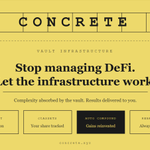
Concrete Vaults are a direct example of this approach. When you deposit into a vault, you receive ctAssets representing your share in the system. From that point, the infrastructure takes over: automated compounding, onchain strategy execution, and continuous capital coordination through structured vault systems. You no longer need to jump between protocols or time your rebalances. The vault handles capital deployment professionally, giving you access to multiple opportunities without the operational burden.
The benefits are straightforward. Capital works far more efficiently, operational effort drops significantly, strategy execution becomes more consistent, and users access risk-adjusted yield without needing to be experts. This opens the door to genuine institutional participation in DeFi, where capital can be scaled reliably. Instead of watching screens all day, you rely on infrastructure that works for you around the clock.
The future of DeFi isn't about giving users more tools and more decisions. It's about building infrastructure that does the heavy lifting and delivers a genuinely simple experience. Vaults are becoming the default interface for anyone who wants to participate in the ecosystem intelligently. One-click DeFi doesn't mean ignoring market complexity. It means that complexity is absorbed by the infrastructure leaving users focused on what actually matters: allocating capital and capturing results.
Explore Concrete Vaults at concrete.xyz/
@ConcreteXYZ

3
82
Mais um capítulo concluído!
Esse é meu segundo capitulo participando e realmente foi bom acompanhar a evolução da @redstone_defi durante esse período, e de fato é um projeto que tem entregado muito para a web3.
E como todo projeto excelente, a comunidade não fica pra trás é de longe a melhor que já participei, desde as call e o workshops incríveis que acontece.
Ser Miner pra mim significa fazer parte da construção de uma infraestrutura séria pro DeFi e não é só farmar, é acompanhar de perto o desenvolvimento de produtos como Bolt, Settle, Live e todas as integrações que estão tornando RWAs e pagamentos onchain algo real.
Tá sendo uma jornada bem interessante e ainda tem muito pela frente 🔥🔥♦️♦️♦️

4
10
138
Muito bom ver o crescimento da comunidade do @0xSunflowerLand e aqui aos poucos vou adquirindo m ais Nfts e melhorando minha fazenda.
#SunflowerLandWeekly
#SunflowerLandFarm

1
22
DeFi is beginning to develop a more mature understanding of risk, and for years, much of the market operated by focusing solely on collateralization and APY. Now, solutions like Credora are starting to introduce quantitative models, ratings, and more sophisticated analyses into the ecosystem.
This completely changes the way capital can be allocated in the long term.
@redstone_defi
1
23
RWAs are completely transforming the landscape of DeFi, shifting the market away from a reliance solely on native crypto assets and toward the incorporation of securities, tokenized funds, and instruments more closely aligned with the traditional financial system.
But this requires a new level of infrastructure where data must be more reliable, transparent, and consistent, and it is in this context that @redstone_defi has positioned itself as one of the most important pieces in connecting the real world to the on-chain ecosystem.
1
24
Oracles have always delivered data on prices. Redstone has just started delivering data on what people believe.
@redstone_defi

1
2
27
Kalshi is not a betting exchange; it's the world's largest regulated prediction markets platform, the only one authorized by the CFTC in the United States to operate financial markets on future events. When someone trades on Kalshi, they are putting real capital into a position on what will happen in the world.
In addition to being the leading CFTC-regulated prediction exchange, Kalshi is a real-time index of human conviction a continuously updated layer of data on culture, sports, politics, and markets.
And now this data arrives on-chain via Redstone.

1
20
For a long time, latency was treated merely as a technical detail within DeFi, but as the market evolves, it becomes clear that delay also poses a financial risk.
Just a few seconds can be enough to cause incorrect liquidations, poor executions, and distortions during periods of high volatility, which is exactly why solutions like Bolt from @redstone_defi are gaining traction by delivering real-time data.
22
@0xSunflowerLand está a cada dia melhor, e sem contar que o mercado de NFTs é realmente muito bom!
#SunflowerLandWeekly
#SunflowerLandFarm

2
4
33
The market has begun to realize that oracles are no longer just auxiliary tools in DeFi; today, they are evolving into a full-fledged financial infrastructure. @redstone_defi is a clear example of this, combining price feeds, real-time data, OEV capture via Atom, and risk intelligence through Credora.
The result is a layer that is far better equipped to support complex protocols and institutional markets.
2
33
The integration of @redstone_defi into Stellar underscores how blockchains focused on payments and RWAs are beginning to require more robust data infrastructure. As these networks grow, the reliability of data feeds becomes essential to ensuring security in financial applications that are more closely aligned with the real world.
This demonstrates how the data layer is becoming indispensable for the next phase of the market.
1
4
48
The evolution of Credora by RedStone shows that DeFi is beginning to refine its approach to risk assessment. For a long time, the market operated by focusing almost exclusively on collateralization and APY, but now quantitative credit models and ratings are gaining traction, bringing the ecosystem closer to the standards already used in the traditional financial market.
This is @redstone_defi
3
35
RedStone Bolt’s growth underscores a key trend in which speed has become an essential component of security in DeFi. In fast-moving markets, even a few seconds of delay can lead to significant distortions. The concept of sub-second data is no longer just about performance; it has become a way to reduce operational risk within protocols.
@redstone_defi truly understands how DeFi actually works.
5
37
The release of the Tokenization & RWA Standards Report 2026 underscores a trend that has become increasingly clear: the RWA market is entering a more mature phase. The sector no longer revolves solely around tokenization itself, but rather around standards, risk management, and reliable infrastructure.
As real-world assets enter the blockchain, the need for consistent data and models closer to institutional standards also grows, and @redstone_defi is evolving significantly every day to further facilitate access.
1
4
45
The expansion of RedStone Live signals a major shift in the market: DeFi is moving beyond crypto data alone, and its infrastructure is now beginning to include real-time equities, commodities, forex, and global indices. This brings on-chain data even closer to the traditional financial market and paves the way for much more sophisticated applications within Web3.
Ultimately, the future of DeFi seems increasingly connected to markets that never stop, and @redstone_defi is constantly improving the user experience and protocols.
1
8
57
There is a Turkish central bank paying ~40% interest per year. And now anyone with a stablecoin can access that.
It's not a scam, it's not liquidity mining, it's sovereign monetary policy, and Brix has transformed that into a programmable on-chain product.
The idea is simple on paper: tokenize exposure to the Turkish lira's carry trade and distribute the yield to stablecoin holders. The ambition was to give any stablecoin holder access to the type of yield (~40% APY) typically reserved for institutional desks, generated by sovereign monetary policy, not by fleeting liquidity mining rewards.
The problem that arose in the implementation was not simple.
@redstone_defi

1
3
41
The timing paradox
The central tension is that foreign exchange markets operate on fixed schedules, while blockchains operate continuously. This fundamental mismatch created three existential threats to the Brix protocol: pricing gaps, NAV economic drift, and composability failure.
In practical terms, any oracle that relied exclusively on institutional FX data would run out of valid data for much of each week, weekends, holidays, and the wee hours of the morning. And blockchain doesn't stop; a protocol without a valid price on Sunday at 3 AM is not a functional protocol.

1
24
The concept of OEV is becoming increasingly relevant in DeFi; in many protocols, bots capture value during liquidations without the protocol itself receiving anything in return. With Atom, @redstone_defi changes this dynamic by transforming liquidations into an auction system, allowing part of that value to flow back to the protocol. This creates a much more sustainable economic alignment for the ecosystem.
1
24
A major shift is underway at @redstone_defi it is evolving from a mere price feed provider into a comprehensive data and intelligence stack for DeFi. Today, the ecosystem combines real-time pricing, OEV capture via Atom, and risk intelligence via Credora.
This solves a long-standing industry problem where data, settlements, and risk analysis operated separately the result is a system that is more efficient, faster, and better prepared for institutional markets.
1
18