

2x Founder | Chief Builder @TheBuildersC | Lifelong Learner
Joined February 2021
- Tweets2.1K
- Following1.4K
- Followers2.4K
- Likes2.4K







This was inevitable, frankly.
A good ( and probably a more profitable) BU to have for pronto, or any Qservice startup.
@varunkhaitan - do take note.

🚨Scoop: Pronto founder Anjali Sardana has set up a new venture in the US
Provision Labs will operate in the physical AI space - and will focus on collecting data to train, test AI systems designed to perform real-world tasks using robots and other machines
@ETtech
How tiny ants take down a giant 3000x their size... and the massive business lesson behind it 🐜📉
Ants use an asymmetric market anchoring strategy—instead of fighting head-on, they bite the tail, anchor the ground, and freeze their giant predator. In business and startups, you don't need to crush the whole competitor; you just need to choke their critical pipeline and force them to waste 100% of their energy on defense.
Pure grip and leverage > Pure scale.
Share this with a founder or builder who needs to see this! 🚀
#BusinessStrategy #StartupLife #MarketingTips #AsymmetricStrategy #FoundersMindset #TheBuildersClub #ReelsIndia #BusinessLesson
When Crocs launched, the world labeled their product as "ugly." Instead of retreating, the founders transformed that very criticism into a powerful multi-billion-dollar marketing strategy.
Initially, the fashion industry mocked Crocs for being clunky, perforated, and visually unconventional.
The consensus was clear: they were unattractive. Most brands would have panicked, redesigned the product, or even shut down.
Crocs, however, took a different approach. They embraced the negativity, marketing themselves with a bold message: "Yes, we look ugly. But we are the most comfortable thing you will ever put on your feet."
They tapped into a fundamental aspect of human psychology: people either loved or hated Crocs, but no one ignored them.
By refusing to conform, they attracted hundreds of millions of dollars in free media attention.
Every late-night talk show joke, meme, and critique became free publicity. Today, Crocs are not just quirky footwear; they are a $4 billion global fashion staple, worn by everyone from everyday workers to top celebrities.
As founders and marketers, we can learn a significant lesson from their journey: being polarizing is far more impactful than being boring.
Trying to please everyone often results in a forgettable product. However, having the courage to let some people dislike you can lead to a passionate following. In a crowded market, being authentically yourself is the ultimate growth hack.

Can India build its own OpenAI?
Or are we completely misjudging how AI value will actually be created by Enterprises?
When you sit down with someone reverse-engineering AI for enterprise e-commerce and B2B growth, you don't just talk about hype—you talk about real unit economics, enterprise trust, and customer friction.
I recently had the pleasure of sitting down with @aniket_dtc , Co-Founder at @LimeChatAI, for an insightful and deeply candid conversation on The Builders Club Podcast.
Here are 3 big takeaways from our conversation:
Enterprise Sales is Still Human First: You aren't selling software to a corporate entity; you are selling to a real person. When you have zero brand name, zero traction, and no logos, trust is your only currency.
The Reality of AI in India: Building foundational models vs. scaling operational Enterprise AI are two completely different games. Why Indian startups need to focus on context, workflows, and solving actual customer friction rather than just chasing model size.
Starting from Zero in 2026: What young founders get wrong about B2B sales cycles, managing talent, and why most early-stage AI services struggle to scale past the initial baseline.
Whether you're a founder trying to close your first 10 enterprise clients, an investor watching the Indian AI ecosystem, or an executive trying to navigate B2B sales—this episode is packed with zero-fluff, actionable playbooks.
Full episode out now on Youtube!
Part 1: youtu.be/tgZexW4a9LQ
Part 2: youtu.be/gakC1UguXK0
Follow The Builders Club for more raw founder breakdowns, strategic insights, and ecosystem playbooks.
Global automotive dominance built on smart internal engineering. 🚀
When Ajit Rai saw an opportunity while working with OEMs like Hero and Bajaj, he didn't rely on expensive, high-capital automated machines from abroad. Instead, Suprajit Engineering fabricated low-cost, modular assembly machines optimized specifically for Indian labor dexterity and flow dynamics.
The result?
📉 Installation and overhead costs dropped to a fraction of global competitors.
✅ OEM-grade, zero-defect cables produced at 1/10th the price.
🌍 Scaled from one Bangalore unit to the world's largest two-wheeler cable manufacturer, supplying Asia, Europe, and America.
A masterclass in operational efficiency, cost reduction, and scaling. Have you heard the Suprajit Engineering story before? Let us know below! 👇
#SuprajitEngineering #IndianManufacturing #BusinessStrategy #OperationalEfficiency #MakeInIndia #AutomotiveIndustry #BusinessCaseStudy #ScalingBusiness #ManufacturingInIndia #TheBuildersClub

How one Indian company is saving farmers LAKHS on battery replacements!
Replacing heavy chemical battery packs for traditional solar pumps can completely wipe out a small farmer's savings.
Enter Shakti Pumps from Pithampur. They built a direct solar drive system that completely eliminates battery chemical storage.
Here is how it works:
* The DC current from solar panels goes straight into custom-engineered variable frequency drivers.
* The system modulates water speed according to changes in sunlight.
* The pumps are tuned to keep running even in extreme low radiance, so they don't shut down when it gets cloudy.
Thanks to this proprietary technology, Shakti Pumps is now a global leader in solar-powered water pumping solutions and maintains high margins while supporting government green initiatives.
Save this reel to share this incredible Indian innovation! 🇮🇳👇
#TheBuildersClub #ShaktiPumps #SolarPower #AgriTech #IndianFarmers #BusinessCaseStudy #Innovation #SustainableFarming #CleanEnergy #Pithampur
Sohail Khan retweeted

Rahul Chaturvedi is joining the CMO Round Table 2026 coming thursday.
Rahul heads the Middle East and Africa business at Perfios.
📅 Thursday, 29 October 2026
⏰ 7 – 8:30 PM IST
📍 Virtual
👉 Register now: thebuildersclub.me/gtm-round…

To all investors in my feed:
You got money.
Others money.
That is not a sign of having brains.
You just got a good network and a long sword hanging over your head.
Instinct is the shittiest AI app ever.
This bugger forgets its own tasks and i have to remind him.
Then again after 2 days, it forgets.
Probably their VM might be going to sleep,but then where is the VC money going to?
What VC (money) gets you. 😊

we are @LightspeedIndia. We move mountains for our portfolio companies!
and then sometimes also just find a way of telling them how thankful we are of being a part of their journey.
congratulations @acharyaamrit and @srinathramki and @zetwerk team!

How a small town in Gujarat is beating European pump giants at their own game! 🤯🔥
Western pumps are built for clean European water. But Indian groundwater? It has high salinity, heavy rust-causing minerals, and fine sand that destroys imported pumps in months.
Instead of copy-pasting expensive foreign technology, local artisans in Rajkot built a hyper-specialized cluster supply chain:
1️⃣ Local factories casting custom rust-resistant stainless steel alloys.
2️⃣ Re-engineered pump diffusers that flush out sand instead of trapping it.
3️⃣ Distributed micro-manufacturing where every shop masters one specific component.
The result? 40% cheaper, ultra-durable pumps built for Indian conditions—now exporting to 40+ countries! 🇮🇳💪
What other Indian manufacturing hidden gems should we cover next? Let us know in the comments! 👇
#MadeInIndia #VocalForLocal #BusinessGrowth #StartupIndia #IndianEngineering #Manufacturing #BusinessInsights #EntrepreneursOfIndia
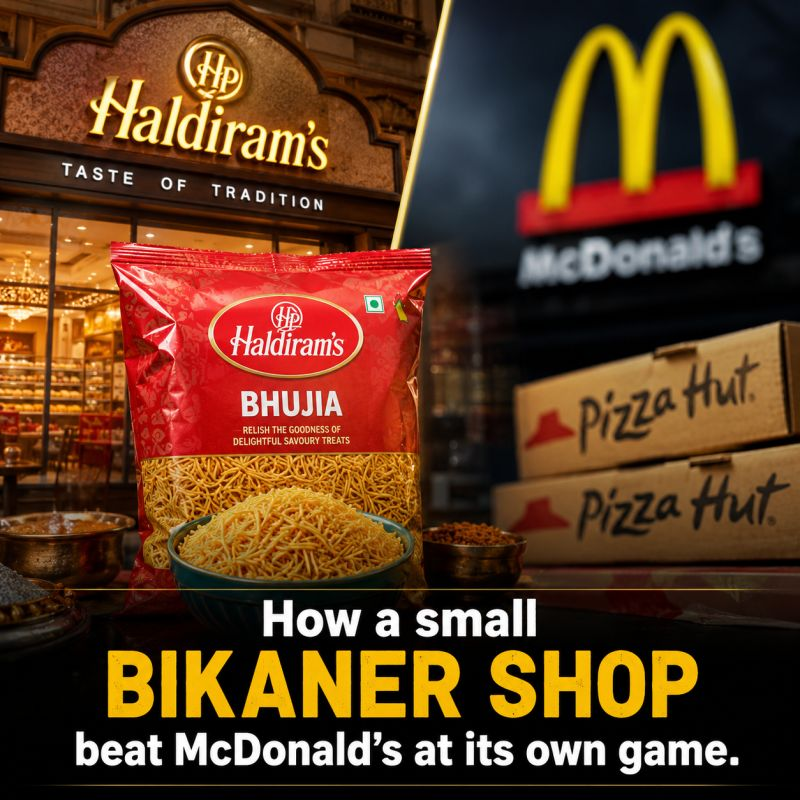
How a tiny sweet shop in Bikaner completely outmaneuvered McDonald’s and Domino's to build India's largest food network.
When global fast-food giants entered India with billions of dollars, they believed burgers and pizzas would redefine the Indian palate.
Instead, a homegrown brand selling bhujia and namkeen silently beat them at their own game. I am talking about Haldiram's.
Long before they became a household name, Haldiram's started as a single, small shop in Bikaner.
The founders noticed a fundamental problem that was holding back traditional Indian snacks: the shelf life was incredibly short, and the quality was never standardized.
While most local sweet shops accepted this as the cost of doing business, Haldiram’s decided to innovate.
They became early adopters of vacuum packaging—a move that allowed their sweets and namkeens to stay perfectly fresh for months.
With the shelf-life problem solved, they obsessively focused on consistent branding and aggressive distribution.
While Western brands were busy selling burgers, Haldiram's standardized the Indian taste bud. Today, their distribution spans across the globe, and their annual revenue eclipses many Western fast-food chains operating in India.
The biggest takeaway here? You don't need to reinvent the wheel or copy Western trends to build a massive business.
If you can take a deeply rooted traditional product, elevate it with modern packaging, strict hygiene, and consistent quality, you can build a brand that is absolutely unshakeable.
What traditional Indian product do you think is ripe for this kind of disruption next?
Actor by day, Python coder by night? 🤯💻
Most people see him on the big screen, but Ben Affleck actually understands neural networks, GPUs, and complex VFX models.
Instead of resting on his acting career, he approached the R&D labs at OpenAI and Google to understand the future of the video production ecosystem. Going in as a tech researcher rather than a Hollywood celebrity, he built an AI startup utilizing machine learning to fix post-production continuity errors.
The final move? He developed the technology, filed the patents, and sold the company to Netflix for a massive $600 million.
Creator mind or business genius? Drop your thoughts below! 👇
#BenAffleck #ArtificialIntelligence #TechStartup #OpenAI #Netflix #MachineLearning #BusinessStrategy #Founders #TechFounders #TheBuildersClub #CreatorEconomy
Indian traffic is a whole different beast. While European horns give up after a few weeks of constant honking, dust, and monsoons, Coimbatore’s Roots Industries re-engineered the game. From water-sealed acoustic chambers to handling 20x continuous honking cycles without circuit failure—this is peak Indian engineering. Today, giants like BMW and Harley-Davidson import these horns!
Tell us in the comments what other brilliant Indian inventions you want to see covered next. 👇
Don't forget to save this reel and follow for more insane stories from our Indian Jugaad series! 🚀
#IndianJugaad #RootsIndustries #CarMod #AutomotiveEngineering #MadeInIndia #Inventions #BusinessCaseStudy #ReelsIndia #AutoEnthusiast`
An Indian brand has successfully tackled a significant markup issue by shutting down four parallel product categories, ultimately building a multi-billion dollar business by addressing a broken supply chain.
While many attribute high retail prices to greedy brand marketing, Peyush Bansal identified a flawed middleman network and chose to automate it.
When Lenskart launched, it wasn't merely an eyewear retailer.
The team initially established separate verticals like Watchkart, Bagskart, and Jewelskart, targeting categories where retail prices were inflated up to 10 times higher than actual manufacturing costs.
The main issue? Multiple layers of distributors, wholesalers, and retail middlemen, each taking a markup that forced consumers to pay premium prices for basic goods.
Through various experiments, data revealed a breakout opportunity in the eyewear market, which exhibited the deepest inefficiencies and highest consumer demand.
Consequently, Lenskart made a decisive move to shut down all other "kart" brands and concentrate solely on eyewear.
However, thriving in a competitive market required more than just an e-commerce platform.
To disrupt the ecosystem effectively, Lenskart bypassed the traditional supply chain by establishing Asia's largest automated lens manufacturing facility in Delhi-NCR.
By automating production and eliminating middlemen, they halved operational costs and redirected those savings to consumers, providing high-quality eyewear at significantly lower prices.
Today, Lenskart holds over 50% of the organized Indian eyewear market share.
The key takeaway is that true market disruption arises from creating a structural advantage in the supply chain that competitors cannot replicate.

Heavy tractors were failing 80% of Indian farmers. Here is how one startup fixed it. 💡👇
Most agricultural machinery is built for massive Western farms, which completely ignores the reality of India: over 80% of our farmers operate on less than 2 acres. Heavy diesel tractors are simply too expensive and hard to maintain for micro-farming.
Enter Kamal Kisan. They turned this massive constraint into a brilliant business opportunity using 3 steps of genius "jugaad":
Zero Fuel: Stripped out diesel engines in favor of lightweight, mechanical push-systems.
Modular Micro-sizing: Scaled down transplanters and weeders to fit 1-acre dimensions, light enough for a single farmer to operate easily.
Massive Time Savings: Tools that reduce 10 days of grueling manual labor into just 1 to 2 hours, slashing labor costs by 70-80%.
It is a perfect example of building frugal, sustainable tools for the actual end-user, rather than forcing corporate machinery onto a micro-market.
#BusinessStrategy #StartupStory #AgriTechIndia #KamalKisan #IndianFounders #GrowthMindset #TheBuildersClub #JugaadInnovation #BusinessReels #FounderJourney