

ゴルゴ13の要素をハンドルネームに(0.13%)。SLG『ビビアミ』一時休止(2021,06,21~、22,04,07~)の後再開。テーマは『きまぐれオレンジ☆ロード』、天体、宇宙科学、風光明媚な場所、写真、宮澤賢治作品、アニメ(ジブリなど)。背景は科博地球館展示の小惑星探査機『はやぶさ』1/1模型。※DMは非対応。
Joined February 2020
- Tweets46.8K
- Following941
- Followers447
- Likes499K








辺境を往く一兵卒 retweeted
UNITS TELL YOU STUFF
With all of this kerfuffle about one light-day distance, I’m seeing a lot of people ask “how can a time be a distance?” But then turn around and say “the restaurant is only five minutes from here.” Same idea. The speed of travel is _implied_. In the restaurant example, it might be walking or driving, and in the Voyager’s case, the implied speed is the speed of light, c.
Remember that units _tell_ you something about the answer, and you can actually "do math" on units. Often the formulas you need are hidden in the units!
For example, if I asked how far you would have gone after traveling 1 million years at 1 km/s, you know your answer has to be in units of distance (…right?).
Looking at what you are given, you have distance/time, or [km/s] and time, in [y]. The only way to get [distance] out of [distance/time] and [time] is to multiply the two together so that the [time]/[time] cancels out: [distance*time/time] = [distance].
So, using what we have learned above:
1 [My] * 1 [km/s] = 1E6 [y] * piE7 [s/y] * 1 [km/s]
Gathering all the numbers and units:
= piE7 * 1E6 * 1 [km*s*y/y/s]
= piE13 [km]
The 1 yr equals piE7 seconds thing? A trick I picked up at Caltech. Close enough for most calculations.
Some concepts about units are a little more complex. For example, I was well along in my career when I realized that °C and C° (or °F and F°) are different things. The difference is like date vs. days: a date is a fixed place in time, but a number of days is an _interval_. It makes sense to say “meet me _on_ September 7th,” but no sense to say “meet me September 7 _from_ now.” Conversely, it makes sense to say “meet me 7 days from now,” but no sense to say “meet me on day 7” because the immediate response to that would be “…from when?” Similarly, we can write “it is 2°C outside today,” meaning it is cold, but if we wrote “it is 2C° cooler outside,” we wouldn’t really know whether it was cold or not.
American Football has a system which has some of this folded into it, since the position on the field is an absolute, but the 10-yards for a first down can occur anywhere on that field (except within 10 yards of the end lines in which case it’s a touchdown rather than a first down…). Football uses the units ‘yards’ and ‘yard-line’ to distinguish when speaking of the absolute position vs the interval: “…the Rams are starting their drive down the field. It’s first down and ten yards to go at the Rams’ 10 yard-line,” is understandable, while “It’s first down and ten yard-line at the Rams’ 10 yard” would make no sense.
So now _you_ can see that
32°F-32F°=0°F, but
32°F-32°F=0°F, is bullsH!7,
(You’ll start seeing this kind of nonsense everywhere, especially in pharmacy and medicine, which are some of the most inconsistent users of units, not to mention American aviation info, which has a nightmare of mixed units that depend on context, no less).
Pedants will comment here that non-dimensionalizing is also possible, and my response to that is that conversion between _any_ units are possible if you have the correct combination of fundamental constants. For example, I could report the distance to the Voyagers in Kelvins. Not very useful, but quite possible (and correct).
Someone please add the video of people being asked how far they go if they travel one hour at 60 mph.
辺境を往く一兵卒 retweeted

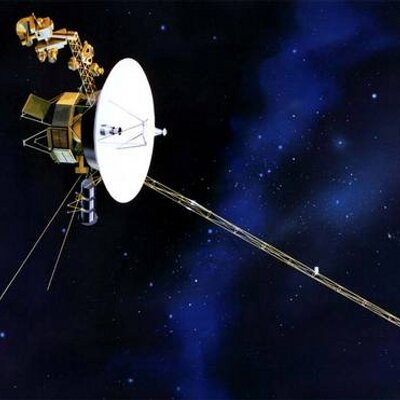
Let's talk about Voyager 1 and 2!
Join us Nov. 19 for a status update on the twin probes and a discussion of their unique mission. Plus, we'll have a Q&A session and a sneak peek at the upcoming NASA+ Voyager documentary. go.nasa.gov/4k942pz

ALT An artist's concept of the Voyager spacecraft, with its long antenna pointing down and to the right in the direction of Earth. Earth isn't visible in the image, but Voyager is among the stars. In the background, there is also a long, deep blue ribbon of gas and dust stretching from the bottom of the image to the top.
辺境を往く一兵卒 retweeted
So you’ve probably seen a lot of posts and articles about Voyager 1 reaching the one light-day milestone on November 18, 2026. What are the _next_ milestones for the Voyager probes?
While Earth and even Jupiter fade into the background and become less relevant for the Voyagers, the Sun is still the dominant gravitational force, and will remain so for hundreds of years. On February 4 next year, Voyager 1 will reach the one light-day distance _from the Sun._ Why is this date different? Because of the position of Earth in its orbit around the Sun. Earth was a little farther away (orbiting around the ‘backside’ as seen from Voyager 1) and so the distance to Earth was a little greater in November.
For this next milestone, you will notice that the order is reversed (Sun first, Earth second), and now you can figure out why that is! On August 11, 2028 Voyager 2 will be 150 times as far from the Sun as the Earth, or 150 Astronomical Units (AU). It will be 150 AU from the Earth five weeks later on September 18, 2028.
The milestone after that? On January 6 2029, the two Voyagers will be 20 BILLION miles apart. I have milestones tagged out to 2100 (the current limit to the HORIZONS system for the Voyagers), but that’s for another post…
#Voyager1 #OneLightDay
辺境を往く一兵卒 retweeted

Next week, for the first time in human history, a human-made object will reach a distance of one light-day from Earth.
We're inviting the world to celebrate Voyager 1's major milestone with us. science.nasa.gov/mission/voy…


辺境を往く一兵卒 retweeted

⚠️明日11月10日(火)より3日間全館休業⚠️
いつも道の駅富士川楽座をご利用いただきまして誠にありがとうございます。
富士川楽座はメンテナンスのため、明日11月10日(火)〜11月12日(木)の期間、全館休業とさせていただきます。
皆さまにはご迷惑をおかけいたしますが、ご理解の程お願い申し上げます。
≪全館休業期間≫
2026年11月10日(火)〜12日(木)

辺境を往く一兵卒 retweeted

猪は青だけは見える
ということを知った父の畑の猪対策は、まず防獣テープとブルーシートを周りに巡らし、鋭い刃を固定した棒をサツマイモの株の真ん中に置いておく
地面を掘る猪の鼻に刃が刺さり、そのうちこの青いのはやべぇと学習するらしい
隣は猪の跡だらけなのにうちのは無傷だった
お見事✨


辺境を往く一兵卒 retweeted

From @NASA The U.S. Space Force confirmed that NASA's Neil Gehrels Swift Observatory spacecraft re-entered Earth's atmosphere at 7:39 a.m. EST Wednesday over the North Sumatra region of Indonesia, at approximately 3.4 degrees north latitude and 98.6 degrees east longitude. NASA expected most of the spacecraft to burn up as it traveled through the atmosphere, but some components may have survived re-entry.
For information about the mission, visit:science.nasa.gov/blogs/swift

辺境を往く一兵卒 retweeted

どっちかというと昨今のペットへの「虹の橋を渡る」という表現が出典を考えると間違っていると思うんだ
元の詩では、亡くなったペットは虹の橋を「渡らずに」橋のたもとで飼い主が来るのを待っているから、飼い主が虹の橋を渡る時にはたもとで再会して一緒に渡れるよ、と言っているわけで


辺境を往く一兵卒 retweeted

火星衛星探査機( #MMX )の初期クリティカル運用フェーズが終了しました。
初期クリティカル運用フェーズ:
ロケットから探査機が分離した後、太陽電池パドル展開、三軸姿勢確立、ミドルゲインアンテナ(MGA)保持解放など、探査機の一連の健全性を確立するまでの期間。
#MMXGOODLUCK
#フォボ旅

[プレスリリース]
火星衛星探査機(MMX)の初期クリティカル運用フェーズ終了
#JAXA
jaxa.jp/press/2026/10/202610…

辺境を往く一兵卒 retweeted

【不審メールにご注意ください】
日本年金機構を装い、年金関連の審査に必要な補足情報の提出のために、専用アプリをインストールするよう誘導するメールが発生していますので、ご注意ください。詳しくはこちら。
#不審メール #詐欺
nenkin.go.jp/oshirase/gochui…


辺境を往く一兵卒 retweeted
Whoomp there it is!
After two astronomers, Urbain Le Verrier and John Couch Adams, independently calculated its predicted location, Johann Gottfried Galle found the planet Neptune 180 years ago on Sept 23, 1846.
In 1989 when Voyager 2 became the first—and so far only—spacecraft to visit Neptune, it took thousands of images of Neptune, its rings, and its moons, including this one.

ALT Closeup of Neptune where the planet takes up 3/4 of the frame. Storms and clouds are visible on this bluish gas giant.