

The award-winning global nonprofit newsroom dedicated to groundbreaking reporting on women.
Joined June 2015
- Tweets6.4K
- Following423
- Followers15.4K
- Likes2.2K







In 2024, women worldwide faced challenges from climate disruption, rising authoritarianism, and persistent inequality.
The Fuller Project stood as the leading journalistic force documenting their struggles and resilience.
Read our impact report bit.ly/FullerImpact2024

Five gender headlines in 60 seconds, from Cornell to Delhi to Nigeria to an Afghan cyclist's Asian Games silver.
This is the Gender Dispatch with Maya Misikir. Repost it for someone who needs this recap.
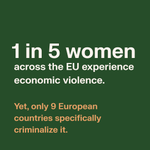
Digital IDs are designed for convenience and security, but in Europe, they’re fueling a specific kind of abuse against women.
We report on how they are becoming tools of economic control and what this means for women in abusive relationships.
Read: fullerproject.org/editions/c…

What does it take to unlearn the need to fit in?
Growing up as one of the only Black girls at her primary school in London, Imriel wanted to fit in.
She and her sisters pestered their mum to relax their hair. Her mom did something unconventional.
Read: fullerproject.org/we-wanted-…
"Women's justified anger at violence and poverty is being channelled not against those with the power to shape inequality, but against migrants and the marginalised."
From Natasha Walter's Feminism for a World on Fire. New extract at Fuller: fullerproject.org/editions/f…
Fuller's first print essay drops 15 June.
It's About Time by Zara Rahman examines how maternal time became society's most exploited resource.
100 numbered copies. Pre-order now: fullsetbooks.com/products/it…


Every Fuller edition starts with a research box — films, books, podcasts, art that shape how we think before we write.
The far right edition's box is live: Dworkin to resistance art to parody musicians to billionaire funders.
We go wide, then zoom in.
fullerproject.org/editions/f…


"My mother has seven children. She doesn't want any more. She's asked me to ask you how to stop." Julia Bunting was 16. That moment fuelled 35 years in reproductive health. We spoke to her at Women Deliver.
Read the interview: fullerproject.org/email/b8a5…

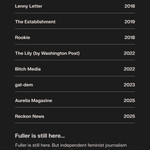
Eight feminist and progressive outlets closed in seven years. Lenny Letter. Rookie. The Establishment. The Lily. Bitch Media. gal-dem. Aurelia Magazine. Reckon News.
Fuller is still here. But not without you.
Support our work here: fullerproject.org/donate/


Who benefits when certain stories never get told?
We’re commissioning reporting on how gender shapes politics, labour, health, conflict, culture and technology.
If your story feels urgent and necessary, we want to read it.
Pitch us: form.asana.com/?k=lvkeBd9fzK…

Signed up yet?
Revolutions goes live tomorrow. Last chance to get early access before public release.
Women & girls have always been central to uprisings, organizing & resisting, yet are often the first to face violence and erasure.
Subscribe before 4 Feb: fullerproject.org


We’re launching a new chapter of Fuller with Revolutions – our first-ever edition.
It centres women in global uprisings, asking how women drive revolutions, why their labour is erased and what it takes for protest to last.
Sign up before 4 Feb!
fullerproject.org


What do you think? Does it sound about right to you?
It seems the question for all of us is this: how do we stay connected to the scale of human suffering without losing our ability to feel it?
Kristof was speaking at an event co-hosted by The Fuller Project and @MSIChoices.
So what should we do? Kristof says journalists should start with one life, then add the bigger picture. But if you've ever wondered why a single story stays with you while headlines about "thousands affected" don't, this may well be why.
Whether it’s about reproductive justice, climate displacement, or gender-based violence, it seems one story may break your heart but a hundred will numb you.
According to Kristof, compassion doesn't scale. Turns out we tune out when a story involves two or more people. Not two million, not two thousand. Just two. Our brains connect to individual human experiences, not statistics.
At an event in New York, on the sidelines of the UN General Assembly, New York Times columnist Nicholas Kristof shared research that explains just how challenging it is for storytellers to engage audiences on issues that often don’t affect them directly.
How many people do you think you have the capacity to care about in a story?
@NickKristof has an answer: we stop caring when the story is about more than one person!
Healthcare professionals in Ethiopia are organizing to counter the latest wave of abortion disinformation.
With ties to US hate groups, these campaigns are well-funded, organized, and have one goal: reverse Ethiopia’s liberal abortion policy.
fullerproject.org/story/ethi…
You’ve probably heard of the “pink tax”: the extra costs women pay for everyday products and services compared to men. Economist Anna Gifty Opoku-Agyeman says there’s a “double tax” too: the added cost Black women face as racial and gender inequality collide.

Alternatively, register for the event here: luma.com/7zjnt0xw
We can't wait to see you there!
