

Digital product ownership & virtual commerce is the future. Prev - Pro Janitor (USMC), and a bunch of other stuff Be Excellent!
Atlanta, GA
Joined November 2009
- Tweets6.8K
- Following3K
- Followers874
- Likes16.8K




Pinned Tweet
🧵Sharing one's audacious vision is not only acceptable, it is necessary. There exists a responsibility to one's dream if they truly believe, and desire it become reality.
I reconcile this by tempering temerity with candor.
There is freedom in sincerity.
GPJ retweeted

The pastor who prayed at the inauguration is now shilling his own meme coin…
things are getting out of hand fast


Ten years ago @NickHanauer gave this excellent TED talk. Seems especially apt these days.
ted.com/talks/nick_hanauer_b…

I'd like to thank the @Adobe team for having solid CS reps empowered and enabled to handle issues.
Whole conversation was < 2 minutes and was resolved positively! Couldn't have asked for a better CS experience.
We see a lot of negative posting about customer service experiences and the general enshittification of things these days, so I feel it's important to highlight great interactions as well.
With the Marine Corps birthday & Veteran's Day now behind us, I'll be taking a hiatus from socials.
Before I go I'm making this post to ask you to make a donation to @ToysForTots_USA if you're willing and able. Every year I donate for my birthday if I can, and am sincerely overjoyed to be fortunate to do so again this year!
Nothing political here, and objectively awesome. They're genuinely one of the best charities out there, with 97% of funds raised (plus toys donated of course) going to kids - not overhead.
Though there are many great causes out there, providing some joy and hope to children in need is my favorite. I even put on my dress blues to directly participate once upon a time.
Please consider making a donation to Toys for Tots this year.
S/F & Be Excellent!
toysfortots.org/
Happy Veteran's Day!
"Far too many men and women willing to wear our uniform have been deported by the same nation they risked their lives to defend due the unnecessary and complex barriers," said Duckworth, a veteran combat Army pilot who lost both her legs in a helicopter crash in Iraq nearly 20 years ago.
When you're thanking our veterans today, please be sure to remember the thousands of us who were deported during Trump's first term as well. Most of them still have not been able to return.
And be sure to thank people like Senator Tammy Duckworth who are actually fighting for us.
S/F
npr.org/2021/06/24/100978951…
Our Evolving Social Contract:
Moral Frameworks and the Path to Progress
Our society is not so much divided by politics as it is by our understanding and definitions of morality and ethics. We can share differences of opinion or politics within a functioning society, but not a chasm between our morals and ethics.
These principles have always influenced our laws, yet at a certain point, we reach a more universal understanding of ethical standards - such as the belief that all people should have equal rights, and that rights and liberties should be defended and expanded.
This creates the interwoven fabric we know as our evolving social contract. That “contract” isn’t a formal document; it’s an implicit set of agreements we all buy into to create a livable society.
However, evolving and devolving are far from the same thing. Any infringement or encroachment upon the expansion of these rights impedes the rights of all and fractures our social contract.
Vertical and Horizontal Frameworks
When we talk about moral frameworks, we’re often comparing vertical and horizontal structures. Vertical frameworks rely on authority and rigid rules, usually passed down through hierarchical systems - think religions or certain political ideologies, where there’s a clear structure of authorities, followers, and outsiders. Horizontal frameworks, in contrast, are built on mutual respect, cooperation, and shared values among peers.
These frameworks shape how we, as individuals and societies, handle moral choices, justice, and even tolerance itself. Vertical frameworks serve necessary functions when strict adherence to authority is beneficial, such as in laws, specific safety protocols, professional ethics, or organizational structures where a clear chain of command provides stability. In these cases, hierarchy and order can offer structure and accountability, ensuring a level of consistency and reliability.
However, over-reliance on rigid rules can limit personal responsibility, empathy, and the capacity to make complex ethical decisions. Without room for growth, vertical systems risk producing obedience rather than fostering true moral understanding.
Horizontal frameworks, on the other hand, are driven by mutual understanding and respect. Rather than following rules out of obligation, individuals act out of respect for others and the shared societal contract - the unspoken agreement that we’ll treat each other fairly and uphold a supportive environment. A horizontal framework allows for more critical thinking: how do my actions affect those around me?
Moral Development
We can look at this through Kohlberg’s Theory of Moral Development, which outlines stages that individuals progress through as they develop a deeper understanding of morality:
Pre-conventional – In the early stages, individuals follow rules primarily to avoid punishment or gain rewards.
Conventional – People begin respecting authority and social order, adhering to rules to maintain societal norms or to “fit in.”
Post-conventional – These more advanced stages encourage individuals to think critically about rules and act based on universal ethical principles or social contracts.
A vertical framework aligns with the early stages, focusing on authority and obedience rather than questioning why rules matter. Horizontal frameworks, however, resonate more with the later stages, where moral reasoning centers on empathy, shared responsibility, and ethical principles that go beyond any single authority.
Ethics of Care
Carol Gilligan’s ethics of care offers another angle on moral reasoning, particularly challenging the emphasis on justice and rights seen in more traditional, vertical moral models. Gilligan argues that care and relational context are central to moral decision-making. In a horizontal framework, ethics of care aligns well: it’s about understanding the needs and perspectives of others, emphasizing responsibility and attentiveness within relationships. While a vertical system might focus on rules as absolutes, an ethics of care approach in a horizontal model emphasizes responsiveness, connection, and addressing the needs of those affected.
Accountability in a Horizontal Framework
Accountability in a horizontal framework is essential to maintaining trust and ensuring that the societal contract remains balanced and fair. But how do we hold individuals responsible within a system that emphasizes shared values and mutual respect? Unlike vertical structures, where enforcement might rely on hierarchical discipline, horizontal accountability is rooted in community standards, peer feedback, and collective decision-making.
In this model, individuals are accountable to the community, and violations of the societal contract are addressed by the group. This might involve restorative practices, where those who disrupt the social contract are encouraged to understand the impact of their actions, take responsibility, and work toward repair. Horizontal accountability also relies on transparency and open dialogue, ensuring that no one person or group has unchecked power, and that all voices contribute to shaping the norms that sustain the social contract.
The Paradox of Tolerance and the Societal Contract
In a tolerant society, there’s a well-known paradox: if we tolerate everything, including intolerance, we risk destroying tolerance and society itself.
When someone refuses to respect core values like tolerance or mutual respect, they’re effectively opting out of the social contract. In a horizontal framework, society isn’t obligated to tolerate this intolerance at the cost of others’ safety and trust. Instead, society can establish boundaries to protect the shared environment.
Thus, the paradox of tolerance may not be paradoxical at all. If someone rejects the societal contract, society is not required to let them erode it from within. Setting boundaries isn’t a failure of tolerance; it’s a defense of the fundamental agreements that make tolerance possible in the first place.
Boundaries and Accountability
This isn’t just a philosophical exercise - it affects real-world issues. Freedom of religion within a society with horizontal moral values allows individuals freedom to practice their beliefs as long as they respect others’ rights and the shared social contract. Problems arise when some attempt to impose their dogmatic beliefs on everyone else, particularly through laws or policies, undermining the contract that binds us together.
Balancing personal freedom with mutual accountability is crucial. Many of our societal issues - political conflicts, social tensions, environmental challenges - stem from a lack of alignment on shared values and accountability. By shifting from rigid rule-following to shared responsibility, we can address issues more constructively.
Moral Maturity and Responsibility
Moral maturity isn’t about simply knowing the rules - it’s about understanding why those rules exist, what they protect, and how they create space for everyone to thrive. Setting boundaries isn’t about exclusion; it’s about affirming the shared contract that sustains us all. If we can understand these frameworks, we might find ourselves better equipped to address the challenges and disagreements that define our time.
Progress
Our societal contract is not static; it has evolved over time and will continue to do so, often through the struggles and sacrifices of those who fought to expand rights and redefine what our society values. Much like common law, which builds on precedent to guide future rulings, our societal contract is informed by the “precedents” of past progress. Just as the legal system interprets and adapts to new contexts, our shared social norms and values grow in response to shifting needs and understandings. Each expansion in rights and liberties sets a new baseline, providing a foundation for the next generation’s challenges and ideals. The ultimate goal, as with legal precedent, is to eventually codify these social advancements in lasting forms, like amendments or legislation, that anchor progress firmly within the structure of society.
Consider some major turning points: the abolition of slavery, the fight for women’s suffrage, defining and protecting our rights of privacy, and the establishment of labor protections. Each of these was a profound shift that expanded the societal contract, challenging long-standing norms in the pursuit of universal human rights, equal representation, and fair treatment. This evolution was not simply about altering laws - it was about reshaping the core values we, as a society, agree to uphold.
In each case, a group sought to “force change” by challenging a vertical moral structure that maintained rigid hierarchies and exclusionary practices. By pushing for a broader, more inclusive societal contract, they demanded that society reconsider its boundaries - who is included, who is protected, and who deserves a voice. The answer, by the way, should always be “everyone.”
While met with resistance, these movements eventually reshaped the framework of our society, setting a precedent that rights and protections must grow alongside our understanding of justice.
But these expansions have not gone uncontested. Persistent threats from vertical moral structures seek to reassert control by restricting or rolling back these hard-won rights. Whether it’s efforts to limit voting access, curb workers’ protections, or undermine the foundations of equality for marginalized groups, these moves are a clear attempt to restrict the societal contract to serve narrower interests. Vertical frameworks may provide a sense of order and tradition, but when taken to extremes, they can stifle progress, enforce exclusion, and erode the shared foundations that uphold fairness and dignity for all.
This isn’t just history; the same dynamics are in play right now. Ecological protections, economic equity, and LGBTQ+ rights continue to push for an expanded societal contract at the same time as we defend the ground already won. These causes call on us to reaffirm our commitments to mutual respect, empathy, and shared responsibility. They remind us that a healthy societal contract isn’t a rigid set of rules but an evolving agreement that reflects our values and the diverse needs of the people within it.
Understanding these past and present struggles helps us see the power of a horizontal framework - one that isn’t bound to static authority but is flexible, responsive, and rooted in mutual respect. The progress we make often depends on our willingness to revisit and, when necessary, redefine the shared commitments that hold us together.
Our societal contract only works with our participation. If we want a society that’s fair and open, that is on us to build, defend, and continually expand. Think about where you stand. Are you backing ideas that push us forward, or are you letting things slide back? Every right we have was fought for - and we’re the ones responsible for making sure those rights don’t stop growing. If each of us steps up to our part in this evolving contract, we can shape a society that benefits us all - a world we can be proud of.
Be Excellent!
GPJ

GPJ retweeted

He was the worst President in history. And when he got voted out, he tried to stage a coup. Then he stole national secrets and sold the ones he didn't store in the bathroom.
He was convicted of fraud, found liable of sexual assault and convicted of 34 felonies. He is half a billion dollars in debt, owned by God only knows who, and the biggest national security risk the nation has ever had.
But at least he's not a Black woman.


The new Atlas is so much more complex than the original version.
Wild to watch it autonomously move around as a humanoid robot with the ability to fully rotate so many joints.
youtube.com/watch?v=F_7IPm7f…
GPJ retweeted

If you haven't decided yet who to vote for, here's why I think you should vote for Harris.

The Republican Party of years past feels all but gone, replaced by a group willing to follow one man’s selfish absurdities to the ends of reason. No line in the sand is sacred enough to stop them; no disgrace too irredeemable for him to not be celebrated for it.
There’s much to praise and criticize about nearly every President who has ever served—and that’s as it should be. We remember these figures not as saints but as complex, flawed people who accomplished extraordinary things. Criticizing them is necessary if we’re to hold future leaders to higher standards and draw lessons from both their best and worst.
I tend to be critical of every President, perhaps overly so. But better that than blind acceptance.
As Trump and his allies grasp for relevance, I find myself reflecting on how far removed they are from what came before. Reagan is someone I’ve long critiqued, but he, at least, embodied a vision of America that transcended himself.
In his farewell speech, Reagan reminded us of America’s unique promise: “You can go to live in France, but you cannot become a Frenchman. You can go to live in Germany or Turkey or Japan, but you cannot become a German, a Turk, or a Japanese. But anyone, from any corner of the Earth, can come to live in America and become an American."
"The torch of Lady Liberty symbolizes our freedom, a compact with our parents, grandparents, and ancestors. It’s that great life force of each generation of new Americans that guarantees America’s triumph into the next century and beyond. Other countries may compete, but in one vital area—as a beacon of freedom and opportunity that draws people from around the world—no country on Earth comes close."
It’s worth truly comparing Reagan and Trump to see just how far removed they are from each other. Reagan was not without flaws, but his commitment to the American ideal shone through even to most of those who did not support him. Today, it’s that vision of America we risk losing to the whims of a single malignant figure.
youtu.be/g8JSeXgcZHA?si=jzGS…
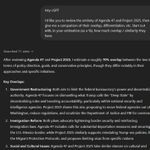
Prompt:
I'd like you to review the entirety of Agenda 47 and Project 2025, then give me a comparison of their overlap, differentiation, etc. Start out with, in your estimation (as a %), how much overlap / similarity they have.
Response:
After reviewing Agenda 47 and Project 2025, I estimate a roughly 70% overlap between the two in terms of policy direction, goals, and conservative principles, though they differ notably in their approaches and specific initiatives.
...
In summary, Agenda 47 is highly aligned with Project 2025 in values but serves as a condensed policy outline, whereas Project 2025 is a broader, detailed strategy focused on a complete federal overhaul with concrete tools for administrative continuity. These differences underscore their distinct roles: Agenda 47 is more campaign-focused, while Project 2025 operates as a foundational blueprint for any future conservative administration.


