

Self-taught researcher on the occult, religion, calendars, codes & ciphers. Astrology lover. Writing about Gematria on my blog (link below).
Portugal
Joined May 2020
- Tweets115
- Following47
- Followers732
- Likes77

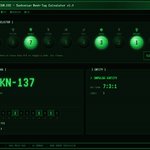




I just published a new CCRU-related tool.
Sarkonian mesh-tag calculator:
– Online at:
alektryon.github.io/sarkonia…
– Repository:
github.com/Alektryon/sarkoni…


One of my side projects.
Vibe coded with ChatGPT.
SOL INVICTUS:
Calendar of the Unconquered Sun
Link:
alektryon.github.io/sol_invi…
Repository:
github.com/Alektryon/sol_inv…
Back in 2006 I devised a new esoteric calendar that divides the year into:
– 4 Seasons (91 days each), associated with the elements;
(Water, Air, Fire, Earth)
– 7 Periods (52 days each), associated with the 7 'planets' of Traditional Astrology;
(Sun, Moon, Mars, Mercury, Jupiter, Venus, Saturn)
– 13 Months (28 days each), associated with the first 13 Tarot Major Arcana;
(1-Magus, 2-Priestess, 3-Empress, 4-Emperor, 5-Hierophant, 6-Lovers, 7-Chariot, 8-Justice, 9-Hermit, 10-Wheel of Fortune, 11-Strength, 12-Hanged Man, 13-Death)
Each year begins on December 25.
December 24, the Day of Abraxas, stands outside all three cycles and the daily correspondence. Its year is the solar year that is ending.
In a Gregorian leap year, June 24 is the leap year day (Day of Hermes). February 29 remains an ordinary day; the count pauses only on June 24. The Day of Hermes also stands outside every cycle.
The daily correspondence advances one element, one planet and one arcanum per ordinary day, beginning with Water · Sun · Magus on December 25. It resets at the start of each year; neither special day advances it.
Year 1 SI begins on December 25, 274 CE. The year number equals the Gregorian year at the start of the solar year minus 273. SI denotes the Sol Invictus era. Earlier dates follow this arithmetic through year 0 and negative SI years.
Gregorian dates before 1582 CE use the proleptic Gregorian calendar. Dates update in both directions immediately. On special days the month and day fields are blank; select a month or day to return to an ordinary date.


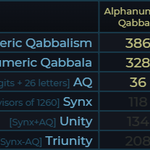
Who would guess that the name or title assumed by Jack Parsons when he took the Oath of the Abyss, adds to 666 in Alphanumeric Qabbala?

ALT Excerpt of "Sex and Rockets: The Occult World of Jack Parsons", by John Carter (1999), Feral House

The "Synx" cipher applies the 36 divisors of 1260 to the 36 alphanumeric digits 0-9, A-Z.
When applied to the CCRU Writings, it seems to fit Numogrammatics quite well, and tends to be very specific about Lurgo (1::0).
It's unbelievably perfect.


Who here uses the 'Synx' cipher often?
... and...
Who would enjoy THIS, but with the Synx cipher instead of AQ?


With @Phoebus_Glykon9's approval, I just published on my blog the interview I gave him some months ago.
Enjoy! 😉
gematriaresearch.blogspot.co…

I just posted about this on my blog, because this project needs funding NOW, and it's absolutely ground-breaking.
Only 15 days left!
gematriaresearch.blogspot.co…
Kickstarter:
kickstarter.com/projects/tom…

New article on Grokipedia about Alphanumeric Qabbala, suggested by yours truly 😉
grokipedia.com/page/Alphanum…
My dear friend @Phoebus_Glykon9 just published this interview where I talked about Alphanumeric Qabbala, Aleister Crowley's Liber AL vel Legis, the CCRU, Hyperstition, Gematria & wild synchronicities with the 'Synx' cipher.
If you're into this kind of stuff, you should definitely read this. 😉
open.substack.com/pub/phoebu…

Yesterday, R. Leo Gillis (the man who brought Trigrammaton Qabalah to daylight) published a new edition of his "Secrets of the Cipher Naughts", where he compiled a list of proposed solutions to the riddles of Aleister Crowley's Liber AL vel Legis.
In this new edition, he added my own solution to the riddles, which is based on Alphanumeric Qabbala (AQ) and the English Trigon.
It's not the same thing as me explaining it, though 😅 but it serves the purpose anyway. 😉
Direct link to PDF (1,11 MB):
omegalogion.wordpress.com/wp…

Alphanumeric Qabbala, the English Trigon, and the riddles of Liber AL vel Legis
—[ MEGA THREAD ]—
One of the most interesting properties of the 'English Trigon' (i.e. the alphanumeric triangle) is that it contains exactly 4 rows for the digits 0-9, and 4 rows for the letters A-Z — almost as if they were complementary series.
Another curious property of the alphanumeric sequence itself, is that it contains 36 characters (0-9, A-Z), 36 being a triangular number, while 666 is the 36th trigonal. This is where the very idea of this triangle came from, by the way.
These two properties of the English Trigon were exactly what led me into finding an absolutely innovative solution to the riddles of Liber AL vel Legis, a book that was 'revealed', or channeled (or, some heretics say, authored) by Aleister Crowley in 1904, during 3 consecutive days in Cairo, Egypt.

Then we have the other major riddle of Liber AL vel Legis: the 'grid page', whose secrets still haven't been fully decrypted or explained until this day — at least not in a completely satisfactory way.
The alphanumeric solution, again, brings a fresh new perspective on what the riddle means, associating the symbology of the English Trigon with the instructions contained in the cryptic verse of Liber AL:
"This book shall be translated into all tongues: but always with the original in the writing of the Beast; for in the chance shape of the letters and their position to one another: in these are mysteries that no Beast shall divine. Let him not seek to try: but one cometh after him, whence I say not, who shall discover the Key of it all. Then this line drawn is a key: then this circle squared in its failure is a key also. And Abrahadabra. It shall be his child & that strangely. Let him not seek after this; for thereby alone can he fall from it."
(AL III:47)
These instructions gain a new meaning when we read them as if they were pointing to the English Trigon:
1. The 'line drawn' is nothing less than a line drawn on the English Trigon, connecting 0 to Z, as if to point out that the solution is the sequence from 0 to Z.
2. The 'circle squared in its failure' corresponds to the letter 'X' — the same letter which was an anomaly in the riddle of AL II:76, thus "in its failure". 'X' is moreover a key in the sense that it encodes the full alphanumeric sequence in two different ways:
— as a Roman numeral, 'X' corresponds to the number 10, thus encoding a reference to the 10 digits from 0 to 9;
— as the numeral 33 (according to AQ), the letter 'X' further encodes a reference to the full English Alphabet, since both 'English' and 'Alphabet' add to 137, the 33rd prime number. Remember the verse from AL II:55? It says it all:
"Thou shalt obtain the order & value of the English Alphabet; thou shalt find new symbols to attribute them unto."
(AL II:55)
— it is also known that, in Elizabethan times, the English Alphabet was known as the Christ-Cross Row (=333 AQ), from the cross that was appended before the alphabet in old hornbooks.
3. And finally, 'Abrahadabra' is a key in the sense that 'Abrahadabra' is a mere modification of 'Abracadabra', a magical formula that was always written in the shape of a Triangle.
Perhaps by coincidence, the value of 'Abracadabra' according to AQ is 151, the 36th prime number.


1
29
3,621
Now, what exactly does this solution imply in the context of Thelema?
That's actually the most interesting (and potentially polemical) part of all this, so we'll talk about it, one step at a time.
***
I.
There are NO written records of base36 notation (or AQ, its Gematria counterpart) having been used in the late 19th or early 20th century, when Crowley 'received' the Book of the Law.
In fact, base36 notation only started being widely used during the age of computers, while the earliest records of any possible use of Alphanumeric Qabbala only come from the late 20th century — from the works of an experimental cultural theorist collective named CCRU (Cybernetic Culture Research Unit), which for a time operated at the Philosophy Department of Warwick University, and later in the very same flat where Aleister Crowley himself had been born more than a century before (!!!).
***
II.
If the English Trigon (and by extension, AQ) is the ultimate answer to the riddles of Liber AL vel Legis, then this implies at least two hypotheses. And both of them are extraordinary.
There are (at least) two possibilities here. Let's explore one at a time:
A) Crowley knew the solution to the riddles of Liber AL vel Legis all along, but posed as if he didn't understand it. This would mean that the so-called 'reception' of the Book of the Law was nothing but a hoax, and Crowley himself authored the Book of the Law using his own secret cipher, and persistently lied about not understanding at least the major riddles contained in the book.
This is not impossible to have happened, at least considering Crowley's distinct personality and his extreme megalomania.
It is unlikely, however, because there are no written records of base36 notation (and by extension, AQ) having been used by the time of Crowley. It wouldn't be impossible for Crowley to come up with a new alphanumeric system of Gematria based on numbers & letters, but in that case I think he would have recorded it somewhere, or talked about it with someone, I don't know — something. But the problem is: there's nothing. Zero. Niente di niente. Nada. No records of Crowley having ever used an alphanumeric system of Gematria remotely similar to AQ. So it isn't impossible: but I think it's highly unlikely. Either that, or Crowley was THE hoax master, and his whole career was a cosmic joke. Again — that's not impossible. But it sure is polemical.
There are many clues in Thelemic source materials that lead me into thinking that this might have been the case:
— Working with a sequence of numbers (or sephiroth) followed by letters wouldn't have been a novelty for Crowley, since that's precisely what he did in Liber 777. In this book, Crowley listed a series of correspondences for the sephiroth and the letters of the Hebrew alphabet, numbering the sephiroth from 1 to 10, and then the Hebrew letters from 11 to 32. If we adapt this system and make it an alphanumeric sequence (i.e. "the numbers & the words", as it says in AL II:76), we will have 10 digits 0-9, and 26 letters A-Z, and that's precisely what Alphanumeric Qabbala is. Besides, the Law of Thelema adds to 777 in Alphanumeric Qabbala (which is most certainly irrelevant in light of this), not counting the fact that Liber AL was originally named "Liber L" (this is very relevant: hermetic.com/legis/xxxi/inde…). Can you see a pattern here? I certainly do.
— According to Crowley:
"AL is the true name of the Book, for these letters, and their number 31, form the Master Key to its Mysteries."
... and it just so happens that the value of "AL" according to Alphanumeric Qabbala is precisely 31 — which happens to match with its value in both Hebrew Gematria and Greek Isopsephy, which is extraordinary.
— Applying Alphanumeric Qabbala to key Thelemic terms and names reveals interesting patterns and significant numerical matches... which in fact can happen with any cipher that we decide to use. However, consistency is key here, and AQ surely is consistent in unravelling some secrets of Liber AL vel Legis. Notice this:
- 'Had' + 'Nu' equals 93, matching the value of both Θελημα (Thelema, "will") and Αγαπη (Agape, "love") in Greek Isopsephy;
- 'Abrahadabra' equals 156: unexpectly, a significant number which represents Babalon (and seven 7's, since 156 equals 77+(7+7)/7+77) in the Thelemic mythos. Curiously, 'Seventh' also adds to 156, while 'Seven' shares the same value with 'Babalon' (110 in AQ).
For the time being, I think these would be enough. Anyway, if want to explore these questions more deeply, I invite you to read three texts in my blog:
"History of Ciphers" (part 4c) - The Thelemic Ciphers (III):
gematriaresearch.blogspot.co…
(Check the second half of the article, as the first half is about the cryptographic cipher of the Bavarian Illuminati — unrelated to AQ)
"The wonders & magic of Alphanumeric Qabbala":
gematriaresearch.blogspot.co…
(My most 'talismanic' work about AQ, full of hidden references and ciphered things)
"Alphanumeric Qabbala & the Riddles of AL"
gematriaresearch.blogspot.co…
***
Now let's explore the second hypothesis:
B) Crowley was in fact ignorant of the solution, which means that he couldn't have been the author of the Book of the Law. In this case, the 'reception' of Liber AL vel Legis would have been genuine, and it was Aiwass himself (i.e. the 'Intelligence' who dictated Liber AL to Crowley) who had prophetic capabilities, being able to foresee the evolution of human technology, and the advent of base36 as a computational notation system.
This would be an equally extraordinary hypothesis, with the difference that in this case Crowley would have been honest about not knowing the solution to the main riddles of Liber AL vel Legis.
In this case, the main protagonist in this extraordinary discovery would be Aiwass, the 'Intelligence' who revealed the Book of the Law to Aleister Crowley, and encoded it with a cipher which had not yet been discovered — and, as we have seen before, is deeply connected to Crowley's favorite number: 666 (the 36th trigonal).
In this case, what remains to be answered is: why a cipher that only started being used in the age of computers?
And what about the CCRU? 🤔
Wait...
Waaaait a minute... 👀
(To be continued)
P.S.: I hope you enjoyed this piece of information. Be sure to continue following my work: it may hold some surprises for you in the near future. 😊


4
35
3,212