

Digitizing Cairo Geniza documents since 1985. Director: Marina Rustow. PMs: Jessica Parker, Rachel Richman, Ksenia Ryzhova, Amel Bensalim. Tweets: Alan Elbaum
Princeton NJ USA
Joined December 2020
- Tweets1.9K
- Following440
- Followers7.8K
- Likes8K




Princeton Geniza Lab retweeted

🎉 The QMI Early Islamic Inscriptions Platform now features 160 inscriptions dated 32–132 AH, searchable and indexed to support digital research and studies of early Islamic epigraphy.
The catalogue: quranmss.com

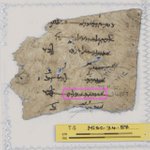
Rare example of a medieval scribe practicing Latin, Greek, and Hebrew on the same fragment.
Any medievalists out there who can shed light on the style of the Latin characters?
geniza.princeton.edu/en/docu…

Princeton Geniza Lab retweeted

I had a lot of fun writing for @invisible_east about Ms.Heb.8333.189, an early Arabic-Persian lexicon fragment from the Bamiyan Papers (the so-called Afghan Genizah) which includes body parts, defects & other oddities. Enjoy and thanks for reading! invisibleeast.site.ox.ac.uk/…

Thank you so much! We've updated the record with some of this information (and credit to you).
geniza.princeton.edu/en/docu…

Help! Is this fragment Armenian? Is anyone able to read it?
geniza.princeton.edu/en/docu…
Fascinating application of AI to decipher cryptic manuscripts - but there's still a long way to go. Notably, זהכיר (zihgīr) here means thumbguard (archer's ring) rather than penis.
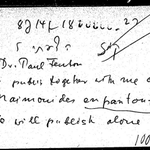
Analysis by Matthew Dudley on PGP:
geniza.princeton.edu/en/docu…
Image credit:
ngv.vic.gov.au/explore/colle…


A 500-year-old Cairo Geniza text nobody could read.
Princeton's note on it: "needs further examination".
It is an Ottoman sex remedy in Hebrew letters. I used GPT-6 Pro and Claude Fable 5.1 to read it, letter by letter.
@GenizaLab, check this one out 👇

S. D. Goitein and M. A. Friedman were the ones who pioneered the study of the Geniza documents on medieval India - brill.com/display/title/1151…
The Princeton Geniza Project team is indeed working on publishing all the Geniza documents (letters, legal docs, accounts, etc.) related to medieval India! We haven't included Moss. VIII,393.2 because it's from a literary work, but DM and we'll be glad to collaborate on it
Does anyone recognize these mysterious characters? Spotted on the back of an early modern page of business accounts in Judaeo-Arabic. geniza.princeton.edu/en/docu…

ALT string of mysterious characters on an old piece of paper
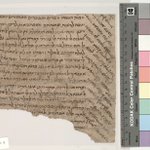
Anyone able to read anything from this manuscript? These fragments seem to join but are extremely difficult to decipher. Likely from 11th-13th century Egypt.

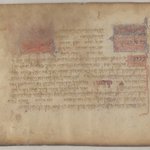
"The boy ʿAṭiyya has been weaned. . . please send sugar and halva. . . he wants to eat sweets all the time, and he is used to being pampered" - late medieval Judaeo-Arabic family letter 👶🍭🍭🍭
geniza.princeton.edu/en/docu…

ALT medieval manuscript (letter) with Judaeo-Arabic writing
"The wife of Satan" (imraʾat iblīs) - spotted on an alms distribution list from 12th century Cairo 💃👿
geniza.princeton.edu/en/docu…

ALT medieval manuscript with a list of names in Judaeo-Arabic
+ past and present! We look forward to seeing how researchers utilize and explore this collection in new ways!
Special thanks to director Prof. Marina Rustow, co-director Prof. Eve Krakowski, project managers Rachel Richman, Ksenia Ryzhova, Pratima Gopalakrishnan, and Amel Bensalim, as well as research software engineer Mohamed Abdellatif, the CDH's Rebecca Koeser, & all our researchers+
This represents structured metadata informed by scholarly research and meticulous cataloging by the PGP team, all of which is now available in .csv format for researchers and the public. The metadata will be updated quarterly.
For the first time since the Princeton Geniza Project began in 1986, we have published our metadata collated from over 30,000 Geniza documents and the People, Places, and histories of the Middle East and premodern Jewish communities found therein!
zenodo.org/records/15839056
here: (genizaprojects.princeton.edu…). Meanwhile keep enjoying our new site (geniza.princeton.edu/en/)!"
Given the expanded capabilities of the new PGP site (v4), we're finally retiring PGPv3. We chose April 3, 2025 as its final date, S. D. Goitein's 125th birthday. Many thanks to Ben Johnston of @mcgrawect for building the site & running it. You can find the archived content here: