

Astronomer at the ICRAR / University of Western Australia, planning to mostly tweet astro stuff here.
Perth, Western Australia
Joined April 2016
- Tweets346
- Following1.4K
- Followers508
- Likes3.7K





Recent #MassiveFIRE zoom-hydro sims show an IRX-beta relationship not extending as far as observed in single high-z gals or beta stacks. Is this a multiphase ISM issue? arxiv.org/abs/2009.13522

It was good hearing @AstroKatie back on the Australian airwaves on ABC's AM this morning telling us about the extraordinary exoplanet TOI 849b tinyurl.com/ycz2tptd
and here is the link to a press release on the story of TOI 849b eurekalert.org/pub_releases/…
1

I saw the recent review of globular cluster systems by Beasley (@astrobiologic arxiv.org/abs/2003.04093) and hoped it would mention our 2003 results on NGC2915 but alas no. In this thread maybe I can revive some interest in this odd system. 1/8

Reviewing the oddities of NGC2915: 1) BCD in the optical; 2) but Dark Matter dominated spiral in HI; 3) three very luminous globular clusters in its outskirts; 4) very weak star formation with a top-light IMF in the outer disk. 7/8
1
1

This is such an excellent graphic !

Adeene Denton @SpaceWhaleRider—Pluto’s farside is host to a lot of weird terrain. Using iSALE models, Adeene showed that seismic waves from the Sputnik impact could disrupt the antipode. It’s even more effective if Pluto has a thick subsurface ocean! #LPSC2020 #QPSC2020

This is a great thread, especially for new Masters and PhD students. Evolution of the field means you would want to check what is current every few years.
This quoted post is unavailable.
3
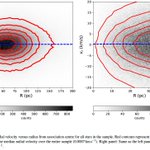
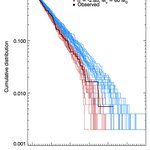
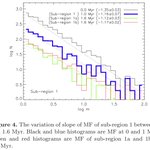
arXiv:2003.02965: Nice simulations show star clusters with fractal initial conditions and a normal #IMF forming near the GalCen will shred in to sub clusters with "apparent" IMF that is top heavy; low mass stars pref in tidal arms.

3
arXiv:1902.00027 = 2020MNRAS.492.3217C - nice Machine Learning "meta" study on automatically finding papers that measure the Hubble Constant H_0, could be a good way to keep up with the literature. I wonder how hard it is to set up....
5
Hey astro hive mind: what are the best papers on bars in galaxies? In particular how gas & SF in bars often is in a narrower skewed bar relative to the stars? Example NGC7424 (from our SINGG survey: orange H-alpha, cyan R-band) shown here

Star formation limited to clusters is a faulty pillar some use to infer that the IMF is constant; i.e. the IMF is constant in star clusters; all stars form in clusters; therefore the IMF is constant #ESOz2020 4/5
1
3
Modularizing our understanding of star formation into cookie-cutter clusters with identical IMFs certainly makes the Universe easier to understand. But we are scientists and need to accept complexity. End #rant 5/5
2