

Stares at a computer trying to figure out stuff about the Sun... Also rides bikes, and generally enjoys the outdoors (Scottish weather permitting)! they/he
Glasgow, Scotland
Joined February 2012
- Tweets186
- Following278
- Followers66
- Likes1.6K








It seems to me that the iterative method for NLTE radiative transfer is like monads and coroutines: when one understands it they then proceed to write a paper with their own subtle notation changes that rarely seem to help newcomers.
Yes, I am guilty of this too.
1
2
Continuing the trend, I guess I can plug Lightspinner here for people out there who (like me) prefer to learn through raw code
It's a simple annotated version of the RH92 method with equation numbers! Plus cool less annotated experiments in the branches...
github.com/Goobley/Lightspin…
2
A wonderful illustration of scattering through a very intuitive Monte Carlo method 👏

Updated my photon scattering animation script: resonant, Rayleigh and Thomson scattering. It now works in Python 3. mp4 files also available. Let me know if you find it useful! github.com/pjasimoes/scatter…
h/t to @jakevdp's animation tutorial & @matplotlib
7
It's been a while since I finished my thesis, but it is now available! theses.gla.ac.uk/82584/
If you're interested in how the document was made, all the code is here github.com/Goobley/Thesis! Thanks again to everyone who travelled this road with me (sorry if I missed anyone!)🌞🔭

ALT Preface and Acknowledgements pages from my thesis available at the attached link.


After quite a saga the paper desribing the Python non-LTE radiative transfer framework ✨ by myself and @WhisperinJay has wended its way through the rest of the publication process. I'm really excited about the different ways this will allow some problems to be approached! 🐍 1/6
As always, everything is open and permissively licensed (MIT). Use it how you will! Ping me for comments, problems, bugs... Or just show something cool!
I have personally been pumping radiation from a "flare" into the side of a 2D slab. It's been an adventure! #LightweaverRT Fin.

ALT Two plots showing the radiative response in a 2D slab. On the left, a statistical equilbrium treatment, which shows a constant width absorption profile close and far from the slab. On the right, the time-dependent treatment shows an absorption profile which narrows greatly towards the flare but balances out to the same solution at the far boundaries.
1
4

In an unusual turn of events for myself, we published a paper centred on science, rather than methods! It's a nice short one on how CaII photoionisation is likely substantially understimated in current flare models 😄
arxiv.org/abs/2107.11145
Of course, all methods and data are availble to peruse and download (see the end of the paper for details)! #OpenSource #OpenScience
"Standing" next to my virtual poster for the next hour and a half at the #AGU2020 flare modelling session. Feel free to drop by and chat about NLTE RT (in two-dimensions) and trying to use our exisiting RHD simulations in new ways! agu2020fallmeeting-agu.ipost…
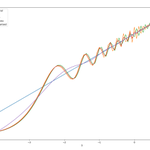
Spent most of the day implementing the Weno4 interpolation from Janett et al (2019) in python. It seems great -- well behaved, and by the power of numba, runs at least as fast as the scipy offerings (github.com/Goobley/Weno4Inte…)

1
7
The most obvious caveat is that as a trade-off for accuracy, the method can produce slight under- or overshoots around extrema, which can push strictly positive functions negative. In some cases this may be an issue, when it's not, I'm pretty happy.
1
2
Chris Osborne retweeted

I cannot overstate enough how important it is to have diverse representation on our bookshelves, especially in our Children's Departments. @Knightsof & @JacarandaBooks are doing incredible work, please consider supporting them if you can #inclusiveindies crowdfunder.co.uk/inclusive-…
