

Latest #DigitalHealth, #HealthIT news. #HIMSS #HITsmIND | Newsletter https://xitter.cf/t.co/3RUysshmiR | Editor @msharmas | Support Us - https://xitter.cf/t.co/zPE7p547Ht
India
Joined July 2012
- Tweets66.5K
- Following14.1K
- Followers15.5K
- Likes19.3K







Pinned Tweet
Building A Purpose Driven #Digital #Oncology #Platform To Deliver World Class #Cancer #Care By Venkataramanan R , Founder CEO, @karkinoshealth
hcitexpert.com/2021/08/build…
#healthcare #digitalhealth #health #oncology #innovation #research #ceo #cancercare
The HealthCare IT Experts Blog retweeted

V. consistent advice amongst my VC peers: If you are a healthcare services biz and you aren't profitable, you need to get profitable ASAP.
The HealthCare IT Experts Blog retweeted

Announcing Gemini 4 Argon, our new frontier model.
Argon is built to sustain deep reasoning across complex, long-horizon workflows and delivers frontier performance in complex workflows across real-world software engineering, enterprise knowledge work like legal and finance, and cybersecurity defense.
We’re also expanding the model’s output token limit to an industry-leading 1M tokens.
Argon is currently rolling out to a set of trusted cyber defenders in the Fairwind Program, with broader availability as soon as possible.

The HealthCare IT Experts Blog retweeted
🚨Here it is. My 16-page opus about the behavioral health market in 2026.
- What's driving growth?
- Who are the market leaders?
- Headwinds?
- Growth strategies?
& more
I talked to a mix of payers, clinicians & operators.
Hope it's useful!
secondopinion.media/behavior…

The HealthCare IT Experts Blog retweeted

Claude's watermark probably doesn't work how you think. As the CTO of GPTZero, I'll explain how Anthropic, Google and OpenAI are building text watermarking in this brief explainer and whether it can be defeated.
Almost all forms of watermarking that are fast and cheap enough for a frontier lab have the same formula, following the KGW method:
In generation:
1. Let's say you've generated n tokens so far. Take those n tokens + a secret key to generate a random hash
2. Use that hash to randomly reweight the probabilities for the n+1 token, and then sample from that new distribution. In the simple case, you could split 50% of all English words into a green or red set based on your hash, and boost the probability of words in the green set.
For watermark detection:
1. For each token, see if it was in the green or red set.
2. To do this, recreate the hash based on the secret key and the text preceding the current token. Then, recreate the green and red set of words.
3. Once you've checked all the words in the text, if the next token is selected disproportionally from the green set more than 50% of the time, you claim the text has the watermark.
I can tell you want to ask the following:
1) Isn't it easy to mess up the hash if you paraphrase the text? The answer is mostly yes, however, you can use a statistical model to get your hash instead of a deterministic function (SIR, Adaptive Watermark). Since the entire watermark is probabilistic, this is fine.
2) Doesn't this make the text much worse? The answer is yes, it does - Yes, it does – but for most people, it's imperceptible (Google claims in human feedback study with 20,000 texts), since there are exponentially many ways to write the same paragraph. DiPmark does something more sophisticated to avoid shifting the text distribution on average. Of course, watermarks fail on short text or highly predictable texts like "2+2=4".
3) Shouldn't it be easy to figure out the green and red sets? The answer is no. You would need an exponentially large number of samples from the watermarker to reconstruct those sets exactly, but it's a risk if the detector is open to the wild (Watermark Stealing)
Still, there are couple challenges that a frontier lab needs to overcome:
1. Their watermark needs to work token-by-token because they are streaming their text to users. Many watermark methods plan sentences or paragraphs at a time, or change the text after its entirely written, in order to make their watermark robust to paraphrasers, and a frontier lab cannot afford to do this yet (SemStamp, PostMark)
2. If the secret key leaks, the watermark is busted. To avoid a large blast damage from this, you need to have a couple secret keys in rotation.
3. There are some texts, like code, that cannot be arbitrarily changed, otherwise the code will break. In those cases, the watermark needs to selectively change words in parts of the text that can tolerate synonyms (i.e. like variable naming) - see SWEET, EWD, Invisible Entropy.
4. They will need to educate their users on how to deal with false positives and false negatives of a detector, which is a big challenge (one we put a lot of effort into)
So, how do I see this playing out in the next 6 months?
1. If Anthropic releases the watermark detector publically, I think they defeat their own watermark. People find reliable watermark removal strategies by testing against Anthropic (AI detectors like GPTZero have an advantage here because they can train against these adversaries once they become popular).
2. If they keep the detector private to the government, like Google has done, it's "safer". However, there are some papers showing trained approaches that work robustly to zero-shot break watermarks without any data, simply because they try to write the text just like a human (Zhang et al. 2024, Watermarks in the Sand). Also, making your detector makes it battle-tested and stronger long-term (my experience).
3. In my testing, the watermarks don't survive intense paraphrasing (especially if you combine word choice and syntax attacks), or human text substitution (rewrite your AI text by plagiarizing human authors). The free paraphrasers I've tried have quickly bypassed Google Deepmind's SynthId for what it's worth.
4. All-in-all, frontier labs are likely okay with this because they expect most users to not attack the watermark, and also because they + European regulators likely don't care past a certain point - its good enough.
5. Overall, I think users of frontier LLMs will not really care about this, because 1) they don't realize watermarks are there, 2) EU will force everyone to conform, 3) this seems more like regulatory hoop-jumping than an earnest effort from frontier labs to expose LLM use
Lastly, people's first concern shouldn't be watermarking, it should be AI detectors!
If you're posting, "its not X, its Y!!", I don't think the watermark is going to make a difference :)


The HealthCare IT Experts Blog retweeted

AI is great at structured tasks. It's bad at messy jobs - the ones tangled up with people, politics, and judgment.
Wrote about why that distinction matters for FF Life.
Please do check it out and let me know what you think:
foundingfuel.com/article/emb…

The HealthCare IT Experts Blog retweeted

Introducing Kitesurf: a browser built for agents, running entirely on Cloudflare Workers.
Chromium is too heavy to hand every agent one. Kitesurf is written in Rust, uses 3-7x less CPU and memory, and spins up per request.
Free in beta: blog.cloudflare.com/kitesurf…

The HealthCare IT Experts Blog retweeted

#HealthcareAI productions needs - "a working system needs the model, plus proprietary data, business rules, permissions, tools, interfaces, monitoring, and human oversight. Six of those seven are yours to build." @innovaccer #healthcare #AI

The HealthCare IT Experts Blog retweeted

Ex-Google Jeff Dean just released 1-hour lecture on full AI engineering: LLM → prompts → agent teams → graphs from 0% to 100%:
0% → 1:45 - LLM from scratch - that made Google
30% → 17:22 - how to actually use AI models
65% → 30:03 - prompt engineering
100% → 52:35 - one human coordinating 100 agents
this is 27 years of AI in Google compressed into one hour, by the person who lived it
watch it today - then read how to build graphs in the article below ↓


The HealthCare IT Experts Blog retweeted

My last open-source skill, /no-ai-slop, clearly hit a nerve with 4K GitHub stars.
Today, I’m introducing /human-review, another free AI skill I think you’ll love.
Let’s face it - giving feedback to AI in chat is painful. Asking it to “update the 3rd paragraph” or “update image size to X” is annoying when I just want to edit the text myself or give feedback to AI directly on the page.
/human-review opens HTML and Markdown files in a visual editor that lets you:
→ Edit and format text directly
→ Resize images
→ Leave comments for AI like a Google Doc
I've been using it to edit PRDs, landing pages, product copy, and much more. The whole review loop runs locally, so your data is safe and nothing is uploaded to the cloud.
📌 Get /human-review for free on GitHub:
github.com/petergyang/human-…
If you find it useful, please ⭐ the repo so more people can find it.
📌 Read my full post here for more on how I use /human-review:
creatoreconomy.so/p/use-my-h…
The HealthCare IT Experts Blog retweeted

Make something agents want

introducing anydoc
now your agents get 100x faster local parsing for pdf, docx, pptx & 10 more formats
- sub-5ms md conversion
- 500 docx files in 1.7s
- top quality across all 13 formats
- rust-based
- open source
already powering @firecrawl /parse
github.com/firecrawl/anydoc
The HealthCare IT Experts Blog retweeted

Google Brain founder, Andrew Ng:
"Prompting will die in 6 months.
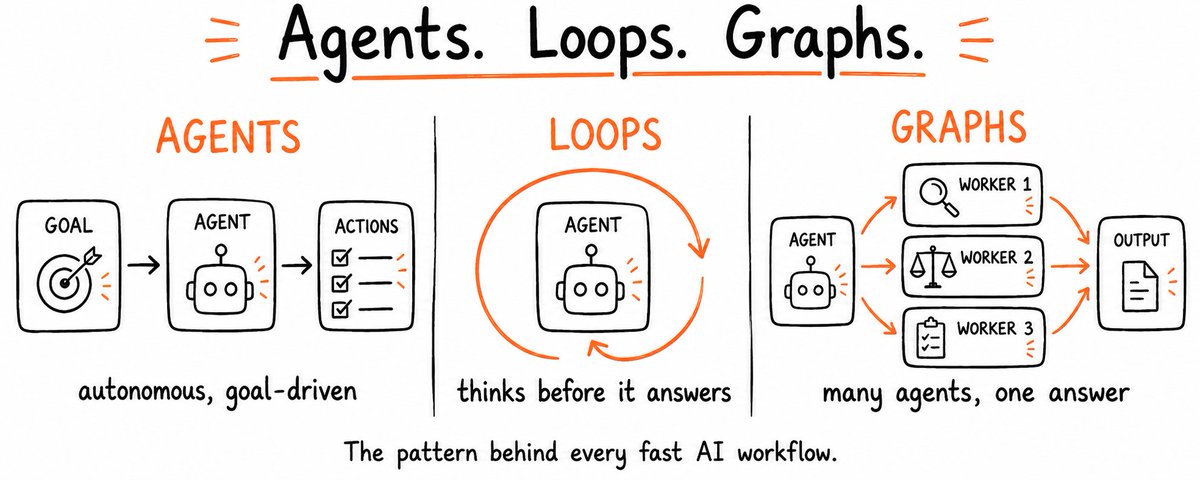
Loops and Graphs are what's replacing it."
In 2 hours, he shows exactly what the best engineers already build instead, and how to start building it yourself.
The missing piece most people skip: how to connect those loops into a graph that compounds every time it runs.
Watch it, then read the full guide on loops and graphs below.

The HealthCare IT Experts Blog retweeted

Massive breakthrough here!
Self-hosting LLMs just got ~75% cheaper:
Most agent pipelines now run 4-5 small models under the hood: an embedder for retrieval, a reranker for precision, an extractor for entities, and often a small LLM for routine generation.
The standard way to serve them is one server per model. vLLM holds the LLM, TEI holds the embedder, and everything else gets a custom FastAPI wrapper.
Each server reserves its own slice of GPU memory and holds it whether traffic arrives or not. GPUs are billed by the hour, so idle time costs the same as busy time.
This is why switching to small models rarely reduces the bill. The cost was never in the calls but rather in the servers.
The structural fix is serving every model from one process that loads and evicts models based on traffic.
Superlinked just open-sourced exactly that. SIE (Superlinked Inference Engine) is an Apache 2.0 server that runs 85+ models behind one API.
Four calls cover the whole pipeline:
- encode() returns vectors
- score() returns relevance scores
- extract() returns entity spans
- and generate() runs small open LLMs.
Models load on first request and are evicted least-recently-used, so one GPU serves a rotating set of models instead of sitting siloed behind one.
It runs anywhere from a laptop to a Kubernetes cluster, and it plugs into Qdrant, Weaviate, Chroma, LanceDB, LangChain, and LlamaIndex.
You can find the repo here: github.com/superlinked/sie
(don't forget to star 🌟)
I also wrote a hands-on guide to using SIE. It walks through a real-world example where we deploy and manage five models on a single GPU, including a small language model, an OCR model, an NER model, a reranker, and an object detector.
The article is quoted below.


