
Clerk k (@HHCILH) profile picture

currently reading: Plotting Hitler's Death: The German Resistance To Hitler, 1933–1945 by Joachim Fest. not a nazi

Joined October 2023
Photo by Clerk k (@HHCILH)Photo by Clerk k (@HHCILH)Photo by Clerk k (@HHCILH)Photo by Clerk k (@HHCILH)Photo by Clerk k (@HHCILH)Photo by Clerk k (@HHCILH)Photo by Clerk k (@HHCILH)Photo by Clerk k (@HHCILH)Photo by Clerk k (@HHCILH)Photo by Clerk k (@HHCILH)
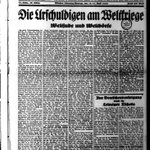
‘The whole of nature is a constant struggle between strength and weakness, a perpetual victory of the strong over the weak. Nature would be nothing but decay were it otherwise, and those states which refuse to recognise this law shall themselves fall into decay. And if you require an example of this decay, you need only look at the Reich of today.’ — Adolf Hitler München, 13. April 1923 „Weltjude und Weltbörse, die Urschuldigen am Weltkriege“ Rede auf einer NSDAP-Versammlung
1
2
14
1,424
“Yesterday: [...] With the Führer. [...] The Führer believes we might yet be able to relieve Narvik after all. It is a question of whether we are in a position to build an airfield; otherwise, the situation in Norway is perfectly clear. This country now belongs to us. Who would dare take it from us again? Throughout the entire Norwegian war, there has not been a single instance of underhandedness on the part of the Norwegians. In stark contrast to Poland. They are, after all, Germanic, whereas the Poles are a piece of botched Asia. The Führer, therefore, intends to release the Norwegian prisoners of war. It will be a very effective gesture. Himmler speaks of the Poles in the General Government. And above all, of the Jews. They are mere refuse. They must be kept under iron discipline. They partially govern themselves and then exercise the most cruel reign of terror over their own race. That is what the Jews are like, and how they will remain forever. The Führer is incensed that some blockhead is now assigning them to work alongside German workers. They must only be deployed in segregated groups; otherwise, they will rot the morale of the entire workforce.” —Joseph Goebbels Die Tagebücher von Joseph Goebbels, Eintrag vom 9. Mai 1940.
2
2
14
822
“This afternoon, Himmler reported to the Führer on the behaviour of the Jews in Poland. He stated that there, when given supervision over their racial comrades, they were the most merciless of workers. For example, compulsory labour had been introduced for them, yet the wealthy were able to buy their way out. They would pay the Jewish Community 20 Zloty for this; this community would then hire a poor Jew as a substitute for 3 Zloty and work him until he was skin and bones. The leaders pocketed the remaining 17 Zloty. The Führer quoted the words of Wagner. Once again, the decent behaviour of the Norwegians towards our wounded was highlighted. Referring to this fact, the Führer intends to release the Norwegian prisoners soon. Excellent! If only the preceding [matters] had not occurred.” —Alfred Rosenberg Alfred Rosenbergs Tagebucheintrag vom 8. Mai 1940
1
7
575
Noon with the Führer Heinrich Himmlers Taschenkalender Eintragung vom 8. Mai 1940.
7
412
Lunch with the Führer. Terminblatt aus dem Dienstkalenders Heinrich Himmlers für den 14. Dezember 1941.
Bormann's adjutant Heinrich Heim, recorded Hitler saying the following: "Pure Christianity, so-called ORIGINAL CHRISTIANITY, aims to make Christian theory true: It leads to the annihilation of humanity, is naked Bolshevism in metaphysical disguise" t.me/NSHeathenry/1020
1
10
982
“Yesterday: [...] With the Führer. He makes fun of the mendacity of the English. They have nothing left to record but paper victories. The Führer is drawing up plans for Norway. There, at some later point, he intends to establish a kind of super-Singapore: an eternal fortress against England. Aircraft hangars, bomb-proof. For the first time in history. He praises our cultural film production highly. He speaks out against modern trends in education and schooling. He praises – which surprises me greatly – humanistic education and classical training. In classical antiquity, he says, everything is contained that a young German must know. Everything else is learned through specialised training. That is entirely my opinion. Athens – Sparta – Rome: this triangle shows, even in its simplest form, the foundations of political and historical education. Athens – a commercial and cultural state; Sparta – a racial, ethnic state; Rome – an imperial power state. We must find the synthesis of all three. Then our state will never perish. To this end, the foundations must be laid in our education. Modern languages merely trivialise schooling. A purely utilitarian standpoint in education is altogether harmful. I am happy that the Führer also represents this standpoint. But we must also enforce it in practice. Himmler also fully shares my position on this matter. The Führer speaks about Christianity and science. Catholicism is placing itself in an ever sharper opposition to exact science. Its end is thereby being accelerated. Protestantism is, in a sense, already a waning of this creative force. See the cathedral in Berlin, for all Protestant humanity – a visible sign of impotence.” —Joseph Goebbels Die Tagebücher von Joseph Goebbels, Eintrag vom 23. April 1940.
2
3
1
18
2,999
Noon with the Führer Heinrich Himmlers Taschenkalender Eintragung vom 22. April 1940.
1
7
513
4
336
“On 25/26 January 1943 The prepared discussion with Himmler in Posen. I told him that after two decades of National Socialism a few Reich leaders had clearly emerged. They could not afford, in the eyes of history, to find themselves in conflict, either personally or through their collaborators. The diversity of the work was evident in the most important fields; where we worked together, loyalty had to be established. H[immler] emphasised the same point, referring to the ideological struggle after the war. Neither of us, he said, had wavered in this ideological struggle for twenty years, and we therefore had to act together. I stressed that this coming struggle against a two-thousand-year-old institution would have to be conducted on a grand scale. Minor agitators would have to be jointly restrained by us. H. would have to proceed in the sphere of the state; I would have to consolidate and lead the movement’s stance in ideological terms. We then agreed to urge our collaborators towards loyalty and to reject “successes” that were not achieved in this manner.” —Alfred Rosenberg Alfred Rosenbergs Tagebucheintrag vom 25/26. Januar 1943
1
1
9
848
Posen [...] Meeting with Rosenberg, Meyer, Stellrecht, Berger, Wolff, Greiser Einträge Heinrich Himmlers in seinen Tischkalender vom 25. Januar 1943. Posen with Rosenberg Einträge Heinrich Himmlers in seinen Tischkalender vom 26. Januar 1943.
5
292
“16 July 1941 will probably go down in history as a decisive day: on that date, at the Führer Headquarters, the division of the East European region—its structure, objectives, administration, and so forth—was decided, and I was appointed Reich Minister for the Occupied Eastern Territories (that is to say, in practice, for the territory of the entire European Soviet Union). Apart from the Führer and myself, those present were: Göring, Keitel, Lammers, and Bormann. The discussion began shortly before 3 o’clock and, with a brief interruption, ended at 8 o’clock in the evening. [...] Afterwards, dinner with the Führer. He then spoke very favourably of the Finns and their bravery. Papen was the object of his mockery. Of all people, he wanted to re-Christianise Russia. (The Führer repeated the same thing the following day and said to me: It is good that you are the gatekeeper of the East.)” —Alfred Rosenberg Alfred Rosenbergs Tagebucheintrag vom 20. Juli 1941 Führer Headquarters, 16 July 1941 Bo/Fu. TOP SECRET REICH MATTER! File note On the Führer’s orders, a meeting took place with him today at 15:00, attended by Reichsleiter Rosenberg, Reich Minister Lammers, Field Marshal Keitel, the Reich Marshal, and myself. The meeting began at 15:00 and, with a coffee break, lasted until around 20:00. [...] (Incidentally: the Führer emphasised that the activity of the churches was absolutely out of the question. Papen had already sent him a lengthy memorandum via the Foreign Office in which it was claimed that now was the right moment to reintroduce the churches; however, this was likewise absolutely out of the question.) [Martin Bormann]
5
8
1,061
“The Bishop of Münster, von Galen, has delivered a shameless and provocative speech. In doing so, he even had the effrontery to claim that our euthanasia efforts had gone so far that the wounded, once they were no longer of use for practical work, were being murdered by us. This speech will without doubt soon be taken up by enemy propaganda. It constitutes a stab in the back of the fighting front. One had not expected much from Catholicism in this war; but that a high prince of the Church should allow himself to perform the enemy’s dirty work—this is indeed a crime fit for the public prosecutor. If it were up to me, an example would be made here, and the high church dignitary would be shown that before the law everyone is equal, and that he will not be treated any differently from any ordinary man from the people. However, making an example of him is, at present, psychologically scarcely tenable. One must wait until the war is over; then we shall settle accounts with this politicising Catholic clergy.” —Joseph Goebbels Die Tagebücher von Joseph Goebbels, Eintrag vom 14. August 1941
2
1
7
1,121
National Socialism is a cool, reality-based doctrine, based upon the sharpest scientific knowledge and its mental expression.
3
13
682
Führer Headquarters, Saturday, 5 July 1941 H./Fu. At this morning’s breakfast the Chief expressed himself approximately in the following train of thought about Russia: What we lack is a clear overview of the will to live, the way of life of the peoples. The difference between the fascist and the Russian popular movements lies in this: the fascist one has, involuntarily, followed the path of the old Roman formation of community, whereas the Russian one tends in the direction of anarchy. The Russian, from the outset, does not strive towards forms of community of a higher order. Peoples can also live in such a way that there is no consolidation of family units into a whole; if Russia possesses a state form in the occidental sense, then this is merely the result of coercion. In a certain sense, all human culture, all that is beautiful, is a result of coercion — of that which we call education; the Aryan peoples, however, have a disposition towards activity; a man like Krümel is active from early until late, another is always thinking; the Italian is industrious; for the Russian, the highest cultural creation is vodka, the ideal: always to do only what is absolutely necessary; work in our sense, and still more work, as an Aryan perhaps demands of him, would be torture for him. It is questionable whether one can manage in Russia without the priest; the priest has comforted the Russian with the thought that he is condemned to labour here, but that he will fare well in the hereafter. The Russian will work when he stands under an iron organisation; but he is not capable of organising himself, he is merely capable of being organised; it is the drop of Aryan blood in individual veins that has given the Russian people inventions and state organisation. To the strong hand of rule belongs a just regimen; this he presupposes with every leadership; but just as the horse, if it is not constantly kept on the rein, throws off all training — in America some horses ran wild and after a few decades the country possessed enormous herds of wild horses — just as quickly as the horse has returned to nature, so there is always present in the Russian the primal drive to return to nature; these are for him the forms of life in which the family exists; like a mother hare the Russian woman will provide for her children, with everything that belongs to motherhood; but more than that the Russian does not want. His rebellion against the coercion of state organisation — and it always signifies coercion, because it restricts the freedom of the individual — is brutal and blindly cruel, like the reaction of the feminine; if he fails in this, he collapses into self-accusations; these are the revolutions in which he strives back towards nature. Thus nihilism remains for him the form of his revolution. The Chief further remarked: He believes that there is still oil in a thousand places; with coal we know how the coal reserves diminish — hollow spaces are created; with oil we do not know whether the cavities do not fill again from invisible reservoirs. Man may perhaps be the most dangerous microbe one can imagine: he consumes the whole earth without asking whether there may perhaps be substances of vital importance for the life of other regions; with the microscope one searches for the cause of devastations that make themselves noticeable on the surface of the earth.
1
2
5
828
4 July 1941 F.H.Q. The Chief at lunch. Table talk: Russia as a colonial land of the Germans. Russians fundamentally inclined towards the dissolution of all organisation and work compulsion. Hence the Russian revolution purely nihilistic. Fascist revolution on the basis of Roman imperial world order. Humanity as a whole, without coercion, would soon relapse into a rabbit-like existence. There are many types even within the same race that do not unite. The state is something artificial. Education: a boy does not wash himself of his own accord. Everything has to be forcefully pulled into shape. The Russian peasant does not work of his own accord. Hence the shipwreck of communist slogans and salvation in the collective system. Commissars instead of landowners. Always the same. Slavs cannot organise; they can only be organised. Hundreds of years of serfdom. Diligence arising from within is attributed to the Aryan race (Spaniards). Because of this nihilistic basic attitude there is also rebellion against “unnatural” domination whenever it shows weakness. Walther Hewels Tagebuch, Eintrag vom 4. Juli 1941
2
7
448
Führer Headquarters, 11/12 July 1941 The Chief expressed himself over tea in approximately the following train of thought: I believe that whoever looks at nature with open eyes becomes the most devout of men; not in the sense of church piety, but in the manner of inner self-reflection. At the end of the previous century, led astray by the advances of natural science and technology, liberalism proclaimed that man would master nature, that he would soon rule even in the air, and so forth. Yet all it takes is a hurricane to arise and everything collapses like a house of cards. At best, we shall come to know the laws according to which the life of natural beings is governed; if we are fortunate, we shall be able to make knowledge of natural law useful to our existence; but why the law prevails, we shall not learn. That goes without saying: our standpoint does not permit us to look into other planes. For this reason man has coined the wonderful concept of omnipotence, whose workings he reveres. We do not wish to educate towards atheism. In every human being lives the capacity for intuition concerning that which governs, which one calls God. The Church has understood how to make this intuitive capacity serve its purposes by threatening with punishment those who do not wish to believe what it claims to know. If one teaches a child to fear the dark, atavistic feelings of fear are awakened; such a child will be afflicted by fear in darkness for life, whereas another will go in and out of it untroubled. When someone says: Man needs a support from which he seeks comfort and help in times of distress — I do not believe that! That mankind follows these paths is a matter of tradition and habit. The Bolshevik front teaches us this: they know no God and yet understand how to die. If National Socialism were to rule for a longer period, one would no longer be able to think of anything else at all. In the long run, Church and National Socialism cannot exist side by side. To a remark by Chr. Schr. as to whether this would mean a new war: No, it would not mean a war; the ideal solution would be to place the churches in a state of gradual extinction, by allowing them to wither away slowly and without violence; in that case there would be no need to create a replacement, which would be dreadful. Naturally, this requires constant thought. Everything must happen in its own time. But it is a commandment of the honesty of the man in charge to reach that point one day. In England it is the reason of state that determines the relationship of the individual to the Church; in America it is the position of society. The Germans are the nation that takes the longest time, but also the only nation that can truly become active here, because it alone knows conscience as the sole power that determines action. The heaviest blow that has struck mankind is Christianity; Bolshevism is the illegitimate son of Christianity; both are offspring of the Jew. Through Christianity there entered into the world the infamous lie in matters of religion; in the same way Bolshevism lies when it claims to bring freedom, while it seeks only to see slaves. In the ancient world, a shimmering sense of reverence lay over the relationship of man to divinity; its hallmark was tolerance. Christianity reserved for itself the right to cruelly kill countless people in the name of love; its hallmark is intolerance. Without Christianity there would have been no Mohammedanism; the Roman Empire would have developed and expanded into world dominion under Germanic leadership; mankind would not have been thrown back fifteen hundred years in its development. One should not say that Christianity brought about inwardness; that would have arisen anyway. The consequence of the collapse of the Roman Empire was nothingness for centuries.
1
2
4
861
The Romans had no aversion to the Germans, as is shown by the fact that blond hair became fashionable; among the Goths there was also dark hair; the Italian, Spanish, French and English languages arose from this, through the elements of language from the migrations of peoples combining with the native tongues into a conglomerate that was initially a gibberish, until in the course of time the poet emerged who shaped from it the language of the nation. In five or six hundred years a language can arise. Whoever comes into a foreign land must, for the sake of understanding, adapt to the linguistic stock of that place. Language is therefore not the unchanging mark of a people’s ethno-national identity. Much more strongly do eating habits adhere to peoples, just as for every individual the cuisine of his parental home seems the best of his lifetime. When I tasted the soup of the Schleswig-Holsteiners, I knew that that of the Spartans could have been no different. The tribes of the migrations of peoples must be understood as superimpositions; what arrived in the south was not purely of the blood of the place of departure; one can imagine two hundred young Frisians pushing southward like an armoured vehicle through the landscape and dragging men of other tribes along with them. The Croats are certainly more Germanic than Slavic. Even in the eastern lands there is much Germanic blood. The Estonians are the best of the Baltic peoples; then come the Lithuanians, lastly the Latvians. For executions to which Russians would not bring themselves, Stalin made use of the assistance of Chinese and Latvians; they were also the executioners of the old Tsarist Empire. Stalin is one of the most peculiar figures in world history. He began as a minor secretary and never left the office, never delivered a speech. From the office he rules with a bureaucracy tailored to him. It is striking that Russian propaganda in its criticism of us still keeps very much within limits. This clever Caucasian is prepared to abandon European Russia if he must fear otherwise losing everything. One should not say that from the Urals he can reconquer Europe. That would be like my sitting in Slovakia and from there wanting to conquer the Reich. It is a catastrophe that the Soviet Empire will fall victim to.
1
1
3
373
Letter to my girlfriend from the Führer Headquarters “Wolfsschanze”, dated 13 July 1941: “At our evening discussions with the Chief, the Church plays a major role. It’s a pity you can’t be there sometimes. Everything the Chief says is so convincing, for example when he explains that Christianity, with its lies and hypocrisy, has set humanity back in its development — culturally speaking — by two thousand years. I really must finally start making notes afterwards on the Chief’s arguments. But these sessions always last an incredibly long time, and afterwards one is — even if not exactly ready to collapse — still so drained and lacking in energy that there is none left for writing. The night before last, when we came out from the Chief’s place, it was already light. Instead of going to bed, as sensible people would have done, we went into the kitchen, ate a few sandwiches, and then went for a two-hour walk straight into the sunrise. Past cattle and horse paddocks, past hills which, covered in red and white clover, looked simply fairytale-like in the morning sun, and which I could not look at enough — and then back to bed. Before two or three o’clock we are simply incapable of getting up. A mad life, isn’t it? Such a strange profession as the one Daranowski and I have will hardly ever exist again. Eating, drinking, sleeping, occasionally writing something, and in between providing company for hours on end. Lately we have been making ourselves useful inasmuch as we pick flowers for the Chief, so that the bunker does not look quite so bare …”
4
288
Führer Headquarters, Saturday, 5 July 1941 At lunch the Chief expressed himself regarding Russian emigration as follows: National Russia is more dangerous to us than Bolshevik Russia; the latter would require twenty years to recover once we have defeated it, whereas the leadership of national Russia has always seen us as the enemy; it is scarcely comprehensible how servilely the pre-war Reich conducted itself towards the Russian government: despite all reports from the military attachés, one continued to display this submissive attitude right up to the World War, although for years nothing had ever been reported except a hostility towards Germany at court; even the Tsarina had not been friendly towards Germany. The German way does not lie in the Russian nature; our sense of duty, cleanliness, sense of order, and diligence are unpleasant to the Russian; rather, the Russian feels drawn towards France; French light-heartedness, the absence of deeper problems, here and there a certain degree of dirt, and carefreeness are akin to his nature. This also explains why the emigration did not settle in Germany, but in Paris; the other centre was Belgrade. The emigrants all speak French, but scarcely any German. Should they come back to power, that rule would always be friendly towards France and hostile towards Germany. One should consider whether one ought not to leave a few political commissars in Russia, in order to hand over the princes to them should they set foot on Russian territory. The occasion for this remark by the Chief was a letter in which Grand Duke Vladimir, in his capacity as Tsar of Russia, informed the Führer that he was considering issuing an appeal to his people. He is to be made to understand that such a course is not desired.
3
8
791