

Assistant professor @iSchoolUI at UIUC, affiliated at CS and IGB. Previously @CarnegieMellon (across CBD, LTI, MLD). Trustworthy AI. & Computational Biology
Champaign, Illinois
Joined November 2012
- Tweets383
- Following773
- Followers1.6K
- Likes1.6K





#EMNLP2026 is happening, check out our findings paper on multi-agent systems on transcriptomics data.
A sumary blog of the work and follow-up papers can be found here:
dream.ischool.illinois.edu/b…

Thanks for the report, it's quite impressive we got there within a very short time of launching.
@TopCitedAI helps boost your company / project's visibility online and especially through major chatbots like ChatGPT, Claude, Gemini, Grok etc.
If you have built something and worry about how to get more users, let's talk!

TopCited AI, founded by #iSchoolUI students and alumni with Assistant Professor @HaohanWang, placed fourth in the 2026 Grainger Engineering Tech Startup Challenge! The startup was 1 of 7 finalists selected from 100+ applications across 35 universities.
▶️ bit.ly/4if1kMw

ALT From left to right: MSIM student Ethen Huang, PhD student Haibo Jin, Haojing Luo, and Assistant Professor Haohan Wang.
Just want to put a random note here for my students that they will no longer be evaluated based on papers accepted at top conferences for graduation.
In fact, it's never that case, but a public note might be helpful for them now.
Pleasing (AI) reviewers will only draw you to mediocre.
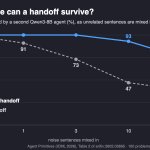
Most multi-agent LLM systems make agents talk in text, so every agent re-reads the whole history.
What if they handed each other their internal memory, the KV-cache, instead?
Four works from our lab give that memory four jobs: communicate, learn, score and check.
Caveats: agents must share one model; AIME has 30 problems, so one problem is 3.3 points; two of the four papers are preprints.
For speeding up shared context at the systems level, see KVCOMM by @HankYe1 and colleagues.

Agent Primitives: arxiv.org/abs/2602.03695
DiffMAS: arxiv.org/abs/2604.21794
KV-PRM: arxiv.org/abs/2607.09153
ReLAT: arxiv.org/abs/2606.06252
Blog: dream.ischool.illinois.edu/b…
Led by Haibo Jin, Ye Yu, Peng Kuang and Xiaopeng Yuan, with @Yushun_Dong, @LijunYu0 and others.

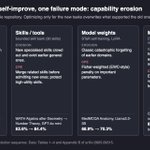
Does recursive self-improvement make AI agents forget?
Often, yes. When LLM agents rewrite their own workflows, skills, weights or memory to master new tasks, they get worse at tasks they had already mastered.
We call it capability erosion under self-evolution.

Related: RRSI by @richardxp888 et al. finds regularizing the RSI loop improves out-of-distribution generalization, and Misevolve by @Amanda_JShao et al. shows safety can drift as memory accumulates. Caveat for ours: a few evolution stages, not open-ended RSI, and gains in the skill and model channels are small.
Paper: arxiv.org/abs/2605.09315
Blog: dream.ischool.illinois.edu/b…
Led by @Yeyu4Yu, with Xiaopeng Yuan, @Haibo_Jin97, Heming Liu and @kevvvv123123 at UIUC.

Math is not just about problem solving.
Last week, OpenAI's release 722 manuscripts is a real milestone, but problem solving is only one part of mathematics.
We tested an understanding: can a language model keep track of what a theorem assumes when it moves the theorem into a neighbouring field?
Across seven frontier LLMs, the answer was mostly no. When they restated a theorem in a more general setting, 60.6% of their rewrites silently dropped a hidden hypothesis, and not one erred in the opposite direction.

The finding fits other work. GSM-Symbolic by @i_mirzadeh and @MFarajtabar showed how fragile LLM math reasoning is to changes that shouldn’t matter. And @wtgowers’s essay on the “two cultures” of mathematics, problem-solvers and theory-builders, is a reminder that the field has always needed both.
Celebrate the proofs. Then ask whether the model knows what a result assumes and where it stops being true, before we call what it does mathematical thinking.
This work was led by Yanli Wang, with Suijin Wang and Xiaopeng Yuan.
Paper: arxiv.org/abs/2610.03551
Blog: dream.ischool.illinois.edu/b…