

MTS @MicrosoftAI | Former Research Scientist @ Meta Superintelligence Labs | PhD in CS, UC Irvine | Ex-intern at Meta/Adobe/Tencent/Baidu
Irvine, CA
Joined September 2019
- Tweets30
- Following172
- Followers105
- Likes257

Introducing MAI-Image-2.7, our first model family to outperform GPT Image 2 across text-to-image, single-image editing, and multi-image editing!

MAI-Image-2.7 from @MicrosoftAI is out of preview and delivers on the Pareto frontier across all Image Arenas. A strong cost-effective option at $0.035 per image.


#1 again on image editing at the best price!

Microsoft AI has launched MAI-Image-2.7, the new #1 in AA-Image-Editing v2.1 at one sixth the price of the four models behind it
MAI-Image-2.7 and MAI-Image-2.7-Flash both take new places on the Quality vs Price frontier in Image Editing and Text to Image, at $34.82 and $10.24 per 1k images.
Both perform best in Image Editing: MAI-Image-2.7 ranks #1 for Text or Symbol, Scene & Style and Enhancement & Restoration edits, and MAI-Image-2.7-Flash ranks #3 for Scene & Style edits.
Congratulations to @MicrosoftAI on the launch of MAI-Image-2.7 and MAI-Image-2.7-Flash!
See below for our detailed analysis of both models in Image Editing and Text to Image 🧵
Haoyu Ma retweeted

MAI-Image is now the #2 image edit model in the world!
... once again beating Google, Meta, xAI, and GPT-Image-2.5-Flare.
Try it today on MAI Playground. Links below 👇
Microsoft's MAI-Image-2.7-Preview takes #2 on AA-Image-Editing v2.1, close behind OpenAI's GPT Image 2.5 Sunburst (max) and a clear step up from MAI-Image-2.6
MAI-Image-2.7-Preview is Microsoft AI's newest image editing model, succeeding MAI-Image-2.6, released in August.
In our testing, MAI-Image-2.7-Preview scores higher than MAI-Image-2.6 on all 7 editing actions we measure, and ranks #1 on 4 of them: Scene & Style Edit, Text or Symbol Edits, Reasoning-Based Edit, and Enhancement & Restoration. This new model improves on MAI-Image-2.6 with the biggest gains in Composition & Framing (+57 Elo), Text or Symbol Edits (+49) and Scene & Style Edit (+48). We see its best use cases to be in Live-Action Film, Consumer and Frontier edits, where it ranks #1.
MAI-Image-2.7-Preview is available today in MAI Playground for image editing only, with text to image stated to be coming soon.
Congratulations to @MicrosoftAI on the release!
See below for our detailed analysis and example outputs of MAI-Image-2.7-Preview in the Artificial Analysis Image Arena 🧵
MAI-Image-2.7 Preview is coming, better than GPT-Image-2 🚀

MAI-Image keeps climbing!
MAI Image 2.7 Preview is now #3 on @arena's image editing leaderboard. #2 by lab and ahead of GPT-Image-2. That's a +45 point jump from 2.6.
3
10
284
Haoyu Ma retweeted
MAI-Image-2.6 is the best image editing model on AA. We now hold 3 of the top 5 leaderboard positions.
Try it today here: playground.microsoft.ai/chat

Microsoft's MAI-Image-2.6-Preview lands at #1 on the Artificial Analysis Image Editing Leaderboard and takes #2 in Text to Image
MAI-Image-2.6 is the newest model in Microsoft AI's MAI-Image family, announced August 10. Microsoft highlights stronger text rendering, better portraits and 3D imagery, and more polished commercial and photorealistic outputs. Like the MAI-Image-2.5 family, it handles both text to image generation and image editing.
In the Artificial Analysis Image Arena, MAI-Image-2.6-Preview debuts at #1 on the Image Editing Leaderboard, ahead of Microsoft's own MAI-Image-2.5-Pro, Reve 2.1, and OpenAI's GPT Image 2, and giving Microsoft the top two spots on the board. In Text to Image it takes #2, behind only OpenAI's GPT Image 2 and ahead of Reve 2.1. On our refreshed Text to Image taxonomy, MAI-Image-2.6-Preview takes the top spot on 5 of the 19 category leaderboards (Material, Knowledge, Frontier, Retail & Ecommerce, and Marketing & Advertising), ahead of GPT Image 2, which leads every other category.
MAI-Image-2.6 extends a rapid run of strong image releases from Microsoft AI. MAI-Image-2.5 debuted at #2 in Text to Image in June. MAI-Image-2.5-Pro, launched July 23, took #1 in Image Editing when we published our results last week. MAI-Image-2.6 now takes that top spot from its own sibling, and sits at #2 in Text to Image against MAI-Image-2.5-Pro's #8.
MAI-Image-2.6 is available in the MAI Playground and in Private Preview on Microsoft Foundry.
Congratulations to @MicrosoftAI on the release!
See below for our analysis of MAI-Image-2.6-Preview and other leading models in the Artificial Analysis Image Arena 🧵
More to come
Microsoft's MAI-Image-2.5-Pro debuts at #1 on the Artificial Analysis Image Editing Leaderboard, and takes the #7 spot in Text to Image
MAI-Image-2.5-Pro is Microsoft AI's quality-focused image model, launched July 23 in preview on Microsoft Foundry. It joins MAI-Image-2.5 and MAI-Image-2.5-Flash in a family Microsoft positions as covering the quality-speed-cost curve, so builders can pick the point that fits their job. Pro sits at the quality end: Microsoft describes it as its highest-fidelity image model to date, aimed at hero imagery, detailed editing, and precise in-image text rendering.
In the Artificial Analysis Image Arena, MAI-Image-2.5-Pro debuts at #1 on the Image Editing Leaderboard, surpassing Reve 2.1, GPT Image 2, and Microsoft's own MAI-Image-2.5. In Text to Image it lands at #7.
On Microsoft Foundry, MAI-Image-2.5-Pro is priced per token: $5 per 1M text input tokens, $8 per 1M image input tokens, and $106 per 1M image output tokens, which works out to roughly $108.5 per 1k 1024x1024 images. That compares to $48 per 1k images for MAI-Image-2.5 and $20 per 1k for MAI-Image-2.5-Flash.
MAI-Image-2.5-Pro is available in preview on Microsoft Foundry across seven global-standard regions, and can be tried out in the MAI Playground.
Congratulations to @MicrosoftAI on the release!
See below for comparisons between MAI-Image-2.5-Pro and other leading models in the Artificial Analysis Image Arena 🧵
6
429
Haoyu Ma retweeted
We hit No.3 on the Image-editing benchmark! ... beating Google’s Nano Banana and Meta’s Muse Image models.
MAI-Image-2.6-Preview by @MicrosoftAI has landed at #3 in Single Image Edit with 1,420 pts!
This is +19 pts above MAI-Image-2.5, moving from #5 to #3. It sits 19 pts behind preliminary Grok Imagine Image 2.0 (low) at #2 and 43 pts behind GPT Image 2 (medium) at #1.
By category, MAI-Image-2.6-Preview is #3 in across:
- Product, Branding & Commercial Design
- 3D Imaging & Modeling
- Cartoon, Anime & Fantasy
- Photorealistic & Cinematic Imagery
#4 in Portraits and #8 in Text Rendering. The biggest jumps over MAI-Image-2.5 are in Text Rendering (+43 pts) and Product, Branding & Commercial Design (+38 pts).
Congrats again to the @MicrosoftAI team on this release!

Haoyu Ma retweeted
MAI-Image-2.6 is now the #2 text-to-image model in the world - beating out Nano Banana, Meta, and Grok! Fantastic moment for the team who've been hill climbing relentlessly. Try it out now on Arena!
MAI-Image-2.6 by @MicrosoftAI has landed in the Text-to-Image Arena at #2 (1336 pts)!
This release is just 45 pts behind GPT Image 2 (Medium) at #1, and ahead of #3 Grok Imagine Image 2.0 (Low) by 20 pts.
MAI-Image-2.6 is a significant improvement from MAI-Image-2.5 overall at #10 with (1256 pts), and across all categories. MAI will also be making it available on Playground with early API access on Foundry next week. See post below for more details.
Congrats to the @MicrosoftAI team on this release!

Excited to share that our first MAI image editing model, MAI-Image-2.5, is now ranked #2 on LMArena’s image editing leaderboard 🚀🚀🚀
It has been an amazing journey building this model from scratch alongside old friends and new teammates!
MAI-Image-2.5 has officially released from @MicrosoftAI landing at #2 in the Image Edit Arena (Single-Image-Edit) with a score of 1401 and advances the Pareto frontier!
This puts the model +10 pts over Nano Banana 2, Grok Imagine Image Quality and ChatGPT-Image-Latest-High Fidelity.
Congrats to the @MicrosoftAI team on this big accomplishment!

5
275
Haoyu Ma retweeted
Super excited to announce seven new world-class MAI models today. They represent what we consider a new era in AI designed to keep you in control and on the frontier.
First is our text foundation model, MAI-Thinking-1, exceptionally strong on reasoning and SWE tasks.
- It’s a 35B active parameter MoE with a 256K context window. Independent human raters on Surge prefer it for overall quality in blind side-by-sides versus Sonnet 4.6, and it’s achieved 97% on AIME 2025, the key measure of its general-purpose reasoning abilities.
- It's at 53% on SWE Bench Pro, placing it right alongside Opus 4.6 on one of the toughest coding benchmarks.
- And since we co-designed our models with our own silicon, MAI-Thinking-1 is optimized on our MAIA 200 chip. Benchmarking head-to-head against the GB200, we see 30% better performance per dollar as well as a 1.4x performance-per-watt gain when running our MAI models on the MAIA 200 end-to-end.
Next is MAI-Image-2.5 and its Flash variant. Two super strong models now at #2 on the leaderboards, surpassing the score of Nano Banana 2 on image editing.
Last for now is MAI-Code-1-Flash, our new inference efficient coding model, especially tuned for VS Code and GitHub Copilot CLI.
- Code-1-Flash achieves 51% on SWE Bench Pro, despite having just 5B parameters, putting it closer to Haiku in size but cheaper in cost.
All of this is the foundation for Microsoft Frontier Tuning. It lets you customize our models to create custom, company-specific agents that only you control. You can make our model, your model. Your data. Your agents. Your moat.
Early adopters are already seeing a difference. When we tuned our models for McKinsey’s tasks, MAI delivered the highest win rate, outperforming GPT-5.5 on quality, while being 10x lower on cost.
Also really excited to be collaborating with the amazing team at Mayo Clinic to jointly train a new frontier AI model for healthcare.
Our announcements today mark another milestone on the road to humanist superintelligence. You can learn more and about our other new models in our latest blog: microsoft.ai/news/building-a…

Haoyu Ma retweeted

Text is often the hardest part of image generation to get right. MAI-Image-2 improves consistency and legibility for in-image text across infographics, diagrams, and slides — reducing the gap between prompt and output. Try it for yourself. msft.it/6016QfiHQ
Haoyu Ma retweeted
Three models. Three top-tier results. All shipped within just a few months by the @MicrosoftAI team.
- MAI-Transcribe-1 dropped today, the most accurate transcription model in the world across 25 languages according to FLEURS WER benchmark.
- MAI-Voice-1 sets a new standard for natural speech.
- MAI-Image-2 lands as a top 3 model family on @arena.
We've been building with them - now you can too. All 3 available now on Microsoft Foundry.
Haoyu Ma retweeted

🚀 Introducing our fresh work at Stanford and Meta MSL:
UniT — Unified Multimodal Chain-of-Thought Test-time Scaling
What if a single model could generate an image, look at it, think about what's wrong, and fix it — all by itself?
That's exactly what UniT does. 🧵👇


Haoyu Ma retweeted

As generative models move toward real-world deployment, efficiency becomes a first-class research problem.
The 3rd EDGE Workshop @ CVPR 2026 — Efficient & On-Device Generation focuses on:
⚡ Efficient training & inference
📱 On-device multimodal generation
🎬 Real-time image & video models
🌍 Scalable, deployable GenAI
Submit & learn more: cvpr26-edge.github.io/
@CVPR
#CVPR2026 #EdgeAI #GenerativeModels #EfficientML

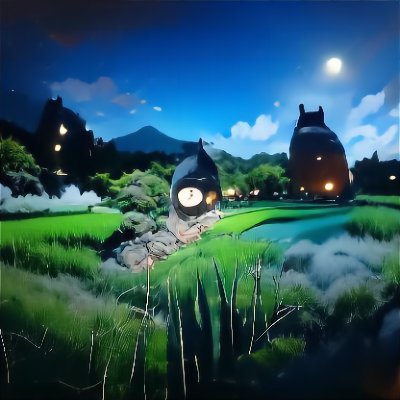


Excited to share our latest work, MoCha☕️, led by our incredible intern @CongWei1230! MoCha takes talking-character generation to the next level—unlike previous I2V-based methods, it directly generates movie-grade single- or multi-character videos from raw speech and text input!

🚀Thrilled to introduce ☕️MoCha: Towards Movie-Grade Talking Character Synthesis
Please unmute to hear the demo audio.
✨We defined a novel task: Talking Characters, which aims to generate character animations directly from Natural Language and Speech input.
✨We propose MoCha, the first-of-its-kind DiT model capable of achieving movie-grade talking character generation.
✨MoCha enables, for the first time, Multi-character Conversations with Turn-based Dialogue generation, pushing the boundaries of automated filmmaking.
Paper: arxiv.org/pdf/2503.23307
Project website: congwei1230.github.io/MoCha/
1
1
184
Super proud to be part of this amazing project, especially for the video personalization!

🎥 Today we’re premiering Meta Movie Gen: the most advanced media foundation models to-date.
Developed by AI research teams at Meta, Movie Gen delivers state-of-the-art results across a range of capabilities. We’re excited for the potential of this line of research to usher in entirely new possibilities for casual creators and creative professionals alike.
More details and examples of what Movie Gen can do ➡️ go.fb.me/kx1nqm
🛠️ Movie Gen models and capabilities
Movie Gen Video: 30B parameter transformer model that can generate high-quality and high-definition images and videos from a single text prompt.
Movie Gen Audio: A 13B parameter transformer model that can take a video input along with optional text prompts for controllability to generate high-fidelity audio synced to the video. It can generate ambient sound, instrumental background music and foley sound — delivering state-of-the-art results in audio quality, video-to-audio alignment and text-to-audio alignment.
Precise video editing: Using a generated or existing video and accompanying text instructions as an input it can perform localized edits such as adding, removing or replacing elements — or global changes like background or style changes.
Personalized videos: Using an image of a person and a text prompt, the model can generate a video with state-of-the-art results on character preservation and natural movement in video.
We’re continuing to work closely with creative professionals from across the field to integrate their feedback as we work towards a potential release. We look forward to sharing more on this work and the creative possibilities it will enable in the future.
3
207
Haoyu Ma retweeted
Meta presents Imagine yourself
Tuning-Free Personalized Image Generation
paper page: huggingface.co/papers/2409.1…
Diffusion models have demonstrated remarkable efficacy across various image-to-image tasks. In this research, we introduce Imagine yourself, a state-of-the-art model designed for personalized image generation. Unlike conventional tuning-based personalization techniques, Imagine yourself operates as a tuning-free model, enabling all users to leverage a shared framework without individualized adjustments. Moreover, previous work met challenges balancing identity preservation, following complex prompts and preserving good visual quality, resulting in models having strong copy-paste effect of the reference images. Thus, they can hardly generate images following prompts that require significant changes to the reference image, \eg, changing facial expression, head and body poses, and the diversity of the generated images is low. To address these limitations, our proposed method introduces 1) a new synthetic paired data generation mechanism to encourage image diversity, 2) a fully parallel attention architecture with three text encoders and a fully trainable vision encoder to improve the text faithfulness, and 3) a novel coarse-to-fine multi-stage finetuning methodology that gradually pushes the boundary of visual quality. Our study demonstrates that Imagine yourself surpasses the state-of-the-art personalization model, exhibiting superior capabilities in identity preservation, visual quality, and text alignment. This model establishes a robust foundation for various personalization applications. Human evaluation results validate the model's SOTA superiority across all aspects (identity preservation, text faithfulness, and visual appeal) compared to the previous personalization models.
