

Independent investment research on public equities, macro, market structure, and digital assets.👉https://teapawt.org/t.co/dk52HsxybQ
Joined September 2026
- Tweets92
- Following130
- Followers30
- Likes70




Japan’s GDP miss isn’t the U.S. risk. A yen reversal is.
GDP fell 0.1% annualized (roughly flat QoQ). Weak growth could keep the carry trade alive. But a sharp yen rally could force selling of U.S. assets.
Watch USD/JPY, JGB yields and credit spreads. No unwind confirmed.

A major surprise miss for Japan’s economy:
GDP contracted by 0.1% (QoQ), falling short of the consensus forecast for 0.3% growth.
This puts even greater focus on the remaining data releases this week and, more importantly, the need for better economic policy alignment between the Ministry of Finance, the Bank of Japan, and the Prime Minister’s Office.
#economy #markets #japan #boj
62
THE $50M $NVDA PUT ALERT WASN'T THE WHOLE STORY.
Yesterday, we examined an unusual options pattern across $NVDA, $AMD, $QQQ and $IWM.
teapawt.org/HayabusaRes/status/212…
Now we have something more valuable: next-day open-interest confirmation.
$NVDA January $140 puts:
170,387 → 58,092 open contracts.
That's a reduction of 112,295 contracts following Thursday's enormous trading activity.
The apparent bearish whale signal looks much more consistent with substantial position reductions than fresh downside accumulation.
Meanwhile, $QQQ November 30 puts tell a different story:
$680 puts: +3,493 OI.
$660 puts: +3,942 OI.
Both legs gained open interest after a roughly 4,000-contract downside-spread trade.
And the supposed rotation from NVIDIA to AMD?
$AMD fell 8.75% Friday, considerably more than $NVDA's 2.01% decline.
THE POTENTIAL ALPHA:
The biggest options print isn't necessarily the strongest signal.
Position changes suggest genuine QQQ downside structures alongside substantial NVIDIA repositioning—not a simple wave of new bearish NVIDIA bets.
But the market hasn't yet demonstrated a clear volatility mispricing.
We also found that $IWM's IV rank remains near 15, even as the AI-heavy Nasdaq absorbs greater pressure.
That makes this look more like concentrated technology-sector stress than confirmed economy-wide panic.
NEXT CHECKPOINTS:
Monday: Confirm Friday's new open interest and whether index downside positioning persists.
Tuesday: NVIDIA earnings.
Our thesis is evolving with the evidence—not the headlines.

THE FAA REOPENED THE SKIES. NOW FOLLOW THE $50 BILLION FUNDING PUSH.
Friday's nationwide ground stop is over. But the real investment story may just be beginning.
CNN reports Transportation Secretary Sean Duffy said President Trump is "fully engaged" in fixing the FAA system.
Duffy is now calling for $50B in modernization funding, versus an earlier ~$30B proposal.
IMPORTANT: This is requested funding, NOT $50B in approved contracts.
Most traders will watch $UAL, $DAL and $JETS.
We're looking one layer deeper.
HERE ARE 3 POTENTIAL SECOND-ORDER ALPHAS:
1. $T — THE CONTRACT-CONVERSION OPPORTUNITY
AT&T already holds the FAA Enterprise Network Services (FENS) prime contract to modernize critical communications infrastructure.
The FAA anticipates a potentially MULTIBILLION-DOLLAR agreement spanning up to 15 years.
But here's what matters:
Only $74.3M is currently obligated under the initial development order.
The potential opportunity is the gap between today's funded work and future orders if the broader program is finalized and financed.
Our catalyst: Watch for a definitive contract, new funded task orders and evidence of profitable revenue conversion.
Our caution: AT&T generates ~$126B in annual revenue. The existing $74.3M order represents only ~0.06% of that. Direct exposure does not automatically mean meaningful EPS upside.
2. $LHX — THE MEASURABLE SURVEILLANCE OPPORTUNITY
L3Harris already has a $913.4M FAA surveillance contract covering a five-year base period, with additional extension options.
That's roughly $183M in average annual contract value, equivalent to ~0.8% of L3Harris's 2025 revenue.
Not an insignificant program—but also not an automatic stock catalyst.
Our catalyst: Incremental surveillance work, accelerated deployment, exercised options and attractive program margins.
The critical distinction: This contract supports aircraft surveillance, not the telecommunications failure itself.
3. $RTX — REAL EXPOSURE, BUT WATCH THE SCALE
RTX's Collins Aerospace has a $438M FAA radar modernization contract.
The opportunity is additional funded radar deployments.
The problem? RTX generates nearly $89B in annual sales. A $438M total award is small relative to the company's size.
A genuine beneficiary does not automatically become an attractive investment.
THE FOURTH OPPORTUNITY: $JETS
If airlines recover operationally but Monday's options still price a prolonged shutdown, there may be an event-volatility dislocation.
We need to compare implied volatility, actual cancellations and recovery costs before claiming that edge.
OUR INVESTMENT PRIORITIES
$T: Watch the conversion from anticipated multibillion-dollar program to funded orders.
$LHX: Watch whether incremental surveillance work materially changes revenue and cash-flow expectations.
$RTX: Require more than an existing radar award to justify an event-driven valuation change.
$JETS: Look for a mismatch between operational recovery and options-implied disruption.
The strongest counterargument?
The FAA contracts already existed. Congress may not approve additional funding. And even large infrastructure awards can be too small or slow to materially change a contractor's earnings.
THE REAL ALPHA ISN'T THE $50B HEADLINE.
It's identifying which companies convert incremental federal spending into shareholder value BEFORE that conversion is fully reflected in expectations.
We have a research shortlist—not proof these stocks are undervalued today.
Curiosity Before Capital.
Return with evidence.
Sources: CNN, FAA and DOT records, federal procurement database, company financial reports.
Research only. Not investment advice.
2
132
The $SMMT FDA decision is binary. The investment thesis isn't.
HARMONi missed its OS test. AstraZeneca invested $2B. Options price a ~23% straddle.
What's actually at risk—and mispriced?
Our mini-underwriting ↓

Will SMMT POP or DROP when trading resumes Monday?
FDA's ivonescimab decision target: Nov 14.
Friday close: $14.15.
What's your prediction for Monday's close?
Disclosure: I own SMMT.
50%🚀 POP: More than +10%
7%↗️ UP: 0% to +10%
13%↘️ DOWN: 0% to −10%
30%📉 DROP: More than −10%
30 votes • Final resultsInteresting $SMMT poll results:
80% expect a >10% move Monday. 57% lean bullish.
The options market agrees on volatility, not direction. The Nov. 20 ATM straddle costs ~23% of spot.
Our conclusion: Both anticipate a major move, but neither reveals an edge on the FDA outcome.
2
484
THE FAA REOPENED THE SKIES. NOW FOLLOW THE $50 BILLION FUNDING PUSH.
Friday's nationwide ground stop is over. But the real investment story may just be beginning.
CNN reports Transportation Secretary Sean Duffy said President Trump is "fully engaged" in fixing the FAA system.
Duffy is now calling for $50B in modernization funding, versus an earlier ~$30B proposal.
IMPORTANT: This is requested funding, NOT $50B in approved contracts.
Most traders will watch $UAL, $DAL and $JETS.
We're looking one layer deeper.
HERE ARE 3 POTENTIAL SECOND-ORDER ALPHAS:
1. $T — THE CONTRACT-CONVERSION OPPORTUNITY
AT&T already holds the FAA Enterprise Network Services (FENS) prime contract to modernize critical communications infrastructure.
The FAA anticipates a potentially MULTIBILLION-DOLLAR agreement spanning up to 15 years.
But here's what matters:
Only $74.3M is currently obligated under the initial development order.
The potential opportunity is the gap between today's funded work and future orders if the broader program is finalized and financed.
Our catalyst: Watch for a definitive contract, new funded task orders and evidence of profitable revenue conversion.
Our caution: AT&T generates ~$126B in annual revenue. The existing $74.3M order represents only ~0.06% of that. Direct exposure does not automatically mean meaningful EPS upside.
2. $LHX — THE MEASURABLE SURVEILLANCE OPPORTUNITY
L3Harris already has a $913.4M FAA surveillance contract covering a five-year base period, with additional extension options.
That's roughly $183M in average annual contract value, equivalent to ~0.8% of L3Harris's 2025 revenue.
Not an insignificant program—but also not an automatic stock catalyst.
Our catalyst: Incremental surveillance work, accelerated deployment, exercised options and attractive program margins.
The critical distinction: This contract supports aircraft surveillance, not the telecommunications failure itself.
3. $RTX — REAL EXPOSURE, BUT WATCH THE SCALE
RTX's Collins Aerospace has a $438M FAA radar modernization contract.
The opportunity is additional funded radar deployments.
The problem? RTX generates nearly $89B in annual sales. A $438M total award is small relative to the company's size.
A genuine beneficiary does not automatically become an attractive investment.
THE FOURTH OPPORTUNITY: $JETS
If airlines recover operationally but Monday's options still price a prolonged shutdown, there may be an event-volatility dislocation.
We need to compare implied volatility, actual cancellations and recovery costs before claiming that edge.
OUR INVESTMENT PRIORITIES
$T: Watch the conversion from anticipated multibillion-dollar program to funded orders.
$LHX: Watch whether incremental surveillance work materially changes revenue and cash-flow expectations.
$RTX: Require more than an existing radar award to justify an event-driven valuation change.
$JETS: Look for a mismatch between operational recovery and options-implied disruption.
The strongest counterargument?
The FAA contracts already existed. Congress may not approve additional funding. And even large infrastructure awards can be too small or slow to materially change a contractor's earnings.
THE REAL ALPHA ISN'T THE $50B HEADLINE.
It's identifying which companies convert incremental federal spending into shareholder value BEFORE that conversion is fully reflected in expectations.
We have a research shortlist—not proof these stocks are undervalued today.
Curiosity Before Capital.
Return with evidence.
Sources: CNN, FAA and DOT records, federal procurement database, company financial reports.
Research only. Not investment advice.
Would you buy $NVDA at today's price?
What concerns you most?
• Valuation
• Slowing AI demand
• Customer financing
• Nothing — buying the dip
75
NVIDIA’s ($NVDA) $96 Billion Quarter Hides a Bigger Question: Who’s Actually Making Money From the AI Boom?
Everyone is watching NVIDIA’s next earnings beat.
We're watching something potentially more important: who is actually generating the cash to sustain the AI boom?
NVIDIA's last reported quarter delivered $96.2B in revenue. Extraordinary.
But receivables reached $63.1B, and collection days increased from 45 to 60.
Meanwhile, CoreWeave reported $3.66B in quarterly revenue while spending $9.44B on property and equipment. Nebius offers an interesting counterargument: customer prepayments on newer contracts reportedly cover more than 100% of associated capex.
These aren't signs that AI demand is fake. They're signs that the economics deserve a closer look.
A signed contract isn't an energized data center. An installed GPU isn't necessarily a profitable GPU. And revenue isn't the same as collected cash.
Now add Jensen Huang's unexpected departure, Vera Rubin's execution challenges, and NVIDIA's substantial stock-price correction.
Is the market underestimating NVIDIA's resilience—or still underpricing the financial fragility of its ecosystem?
Our newly rewritten NVIDIA Living Research goes beyond the usual bull-versus-bear debate.
We examine customer financing, the hidden transmission of risk, second-order beneficiaries, valuation, and the specific evidence that could prove our thesis wrong.
We also confront the hardest question: Have we actually found investment alpha, or just identified risks the market already understands?
November 17 earnings will provide the next critical test.
Read our evolving research and judge the evidence yourself:
hayabusaresearch.com/nvidia-…
Curiosity Before Capital. Return with evidence.

101
We started looking at SpaceX’s terrestrial network on October 9.
Our working thesis then:
SpaceX may disrupt the wireless carriers while becoming a new customer for the towers.
Since then, the evidence has moved.
• Bloomberg reported SpaceX was seeking access to at least 80,000 U.S. cell sites.
• Qualcomm has now confirmed a multi-year Starlink Mobile agreement covering terrestrial 5G infrastructure and tens of thousands of sites beginning in 2027.
• Q3 Connectivity revenue reached $5.25B, with roughly a 45% operating margin.
• Management reported 22M+ Starlink Mobile monthly users.
So the original architecture thesis is holding up: Starlink Mobile is increasingly looking like a hybrid satellite + terrestrial network, not a satellite-only replacement for towers.
But that means the research question has changed.
We no longer need to ask whether SpaceX intends to build a real terrestrial network.
Now we need to ask:
Can SpaceX combine satellites, spectrum, towers and its existing Starlink footprint into a national carrier with structurally better economics than AT&T, Verizon and T-Mobile?
That is a much harder—and much more investable—question.
Our current read:
Company thesis: Strengthening
Security thesis: Conditional
Action: Wait for proof
Updated SpaceX ($SPCX) Living Research:
hayabusaresearch.com/spacex-…
Curiosity Before Capital
Return with evidence.

65
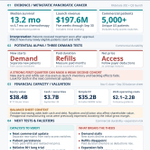
Revolution Medicines ($RVMD): Its Pancreatic Cancer Pill Nearly Doubled Median Survival. What Does $38 Billion Buy?
More than 5,000 U.S. patients received commercial Rasonque in its first five weeks. At the next earnings call, I want to know how many newly eligible patients started treatment after the initial waiting list cleared, and how many came back for a refill. At the November 5 close of $177.65, investors valued Revolution Medicines at $38.4 billion. Whether the company can grow into that valuation depends on both numbers.
The clinical evidence
In a randomized trial of 500 previously treated patients with metastatic pancreatic adenocarcinoma, median overall survival was 13.2 months on daraxonrasib versus 6.7 months on chemotherapy. The FDA approved the once-daily pill, sold as Rasonque, for adults with metastatic pancreatic adenocarcinoma who have received prior systemic therapy or are unsuitable for multiagent systemic therapy.
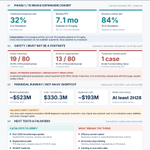
One detail matters when translating that survival benefit into sales. In the trial, 69% of patients treated with daraxonrasib had a dose interruption. Patients can pause and resume treatment, so commercial refill data will give investors a better estimate of how many paid months each new prescription ultimately generates.
Where the market could be wrong
The $197.6 million launch included distributors building inventory, patients moving from expanded access to commercial prescriptions, and patients who had been waiting for approval. As that backlog clears, reported sales growth could slow even while more newly eligible patients begin treatment. That is where an opportunity could emerge.
Consider what two months of refills are worth. Assume 20,000 patients start each year and RVMD receives $30,000 net per paid month. Four paid months per patient would support $2.4 billion in annual sales once prescribing settles into a steady pattern. Six months would support $3.6 billion. The same number of new patients produces a $1.2 billion difference in annual sales. These figures illustrate the sensitivity to treatment duration. The company’s actual commercial average is still unknown.
AstraZeneca is studying AZD0022, a competitor targeting the G12D mutation. Its early-stage study leaves comparative efficacy open. The more immediate risk for shareholders is that Rasonque succeeds in its approved population while expansion into first-line pancreatic cancer and lung cancer takes longer, or delivers less, than the valuation requires.
The balance sheet and the price
At September 30, RVMD held about $3.7 billion in cash and marketable securities against $500 million in convertible-note principal. Management expects its resources to fund at least twelve months of planned operations and projects $2.1–$2.2 billion in 2026 operating expenses. An October loan added $250 million to both cash and debt.
Using 216.3 million basic shares, the November 5 close implies a simplified enterprise value of about $35.2 billion. Royalty obligations reduce the cash shareholders can ultimately receive, and future share issuance can spread that cash across more shares.
Bear, base and bull
I modeled three outcomes for total annual net sales four years from now. Each assumes 230 million shares at that point, zero net cash and a 10% annual required return. I apply an enterprise-value-to-sales multiple to each outcome and discount the resulting share value back four years. The probabilities and multiples are my judgments.
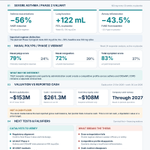
Bear case: 25% probability · $24 per share today. The waiting list clears, refills disappoint and expansion contributes little. Annual sales reach $2 billion, valued at 4× sales.
Base case: 50% probability · $107 per share today. U.S. prescribing holds up, international sales grow, and earlier-line pancreatic treatment or lung cancer adds revenue. Annual sales reach $6 billion, valued at 6× sales.
Bull case: 25% probability · $285 per share today. Randomized trials open larger markets, RVMD scales internationally, and the business retains enough profitability and growth to command a premium. Annual sales reach $12 billion, valued at 8× sales.
The probability-weighted value is about $131 per share. Moving ten percentage points from the base case to the bull case lifts it to about $148. To support $177.65, the model requires roughly 51% bull probability if bear probability stays at 25%. That is more than twice the weight I would give the bull case on the evidence available today. Future dilution and the amount of cash remaining in four years could also move these estimates materially.
Current Hayabusa read — WATCHLIST
I would wait at $177.65. Around $105, I would reopen the underwriting if the operating evidence still supported these scenarios. That price offers a roughly 20% cushion to the weighted estimate.
At the next commercial update, I want RVMD to separate newly eligible patients from expanded-access transitions and show paid refills by the month patients started treatment. Sustained new starts and stable refills as inventory normalizes would strengthen the base case. Two successive groups with fewer starts and shorter paid duration would lead me to cut it.
The other event that could change my judgment is the Phase 3 lung-cancer trial. Management expects initial results in 2027. A survival benefit with manageable toxicity would give me reason to raise the bull probability. A failed study would remove that route to expansion from my model.
Disclosure: As of November 5, 2026, the author does not hold RVMD shares. For investment research and education.
Curiosity Before Capital.
Return with evidence.

281

$PLTR could beat Wall Street and still disappoint investors.
EPS consensus: ~$0.41. Published whisper: $0.49. Options price a ~13% weekly move.
What happens when exceptional growth meets extraordinary expectations?

163
On Oct 22, we published our $SDGR deep dive at roughly $22–23. By Oct 28, Schrödinger closed at $30.87 or 36.6% above its Oct 22 close.
Have you read it yet? teapawt.org/HayabusaRes/status/211…
Our question: Who gets paid to check which AI-designed drug molecules are worth testing?
Here's what we found: BEFORE the big jump, activity surged in May 2027 $30 call options—contracts tied to potential stock upside.
Outstanding contracts rose from just 61 to 2,794 by Oct 28 morning.
That means major new positions, not just busy trading.
Then, on rally day, 5,085 December $30 put options traded. By the next morning, outstanding puts had jumped from 61 to 5,015.
A put can be downside insurance or something an investor sells to collect a premium. The data can't tell us each trader's motive.
One key caveat: we uncovered these patterns AFTER the rally. We did not alert on them in real time, and we cannot prove options activity caused the price jump.
The bigger question remains whether SDGR's business can justify a higher valuation.
Our stance stays WATCHLIST—not chase.
Nov 4 earnings are the next test: software contracts, real revenue from AI tools, and cash spending.
A rising price is not proof of a stronger business.
Curiosity Before Capital. Return with evidence.
Research only; not investment advice.
$SDGR: What If the Biggest Winner in AI Drug Discovery Isn't a Drug Company?
Bill Gates has a substantial connection to Schrödinger ($SDGR). The Gates Foundation Trust holds approximately 16.1 million common and limited common shares, according to the company's 2026 proxy. But this is a longstanding investment, not evidence of a recent buying spree.
That's not the main reason we're interested.
As AI makes it easier to design millions of potential drug molecules, the bottleneck may shift from generating candidates to determining which ones are actually worth testing.
Schrödinger has spent decades building physics-based molecular simulation software that could become increasingly valuable in exactly that environment.
The Evidence
In Q2 2026, Schrödinger's reported software revenue declined 10% year over year. At first glance, that looks disappointing.
But annual contract value (ACV), excluding contribution funding, grew 23%. The discrepancy partly reflects its transition from software revenue recognized upfront toward hosted contracts recognized over time.
Its AI co-scientist, Bunsen, is also gaining commercial validation. Bristol Myers Squibb announced a strategic agreement to deploy the technology across its research organization in August.
That's meaningful. But deployment is not yet proof of incremental profitability.
Where's the Alpha?
We see three possibilities.
First, investors may be underestimating the underlying software business because reported revenue is temporarily obscured by the hosted transition.
Second, generative AI may actually increase the value of accurate physics-based simulation. More molecular candidates could mean greater demand for tools that help identify which ones deserve expensive laboratory experiments.
Third, Schrödinger participates in drug discovery economics through collaborations, milestones, royalties and biotech equity. These provide potential upside beyond software licensing.
But there's a catch: potential drug milestones are not guaranteed revenue, and successful science does not always translate into shareholder returns.
Our Valuation
At roughly $22–23 per share on October 22, SDGR carries a market capitalization of approximately $1.7 billion.
It reported $418.8 million in cash, restricted cash and marketable securities at June 30. A simplified lease-adjusted enterprise value is approximately $1.4 billion, or around 7× its $196 million trailing software ACV excluding contributions.
That's a whole-company valuation comparison, not a pure software multiple. And it isn't obviously cheap for a company still losing money.
Our Stance: WATCHLIST
We're interested in the technology and the potential economics. We're not yet convinced the current valuation offers enough margin of safety.
Software retention is a concern. Commercial net dollar retention fell from 113% in 2024 to 100% in 2025. The business also continues consuming cash.
The science is promising. The investment alpha remains unproven.
What's Actionable?
The next major checkpoint is November 4, when Schrödinger reports Q3 earnings.
Management guided to $41–45 million in quarterly ACV excluding contribution funding, implying approximately 14–25% comparable growth against Q3 2025 after adjusting for contributions.
We want evidence of sustained contract growth, improved margin economics, real Bunsen monetization and controlled cash consumption.
What Breaks the Thesis?
If contract growth disappoints despite the accounting transition, hosted software lowers margins without generating incremental spending, or cash losses and dilution persist, the investment case weakens materially.
Drug-discovery failures could further reduce the value of the pipeline and partnership optionality.
The Hayabusa Read
We think the more compelling question isn't whether AI can invent better molecules.
It's who gets paid to determine which ones are worth pursuing.
Schrödinger may become one of those companies. But the difference between a valuable technology and a valuable stock is the economics.
Curiosity Before Capital. Return with evidence.
Disclosure: The author does not hold positions in SDGR as of publication. Hayabusa Research publishes independent research for informational and educational purposes only. Nothing here constitutes personalized investment advice or a recommendation to buy or sell any security.

300

Micron Technology ($MU): Boom-time earnings are easy to admire. The earnings floor is harder to prove.
Our updated Micron Living Research finds stronger evidence for durability:
• About $134 billion in remaining contractual obligations, backed by committed volumes and minimum pricing.
• $12.75 billion in FY2026 customer deposits—largely repayable financing, not revenue or free cash flow.
• AI memory demand extending beyond HBM into server DRAM and storage.
The real test: do those protections hold when customers stop scrambling for supply?
We’re modestly more confident in the business. The stock still needs a valuation grounded in earnings that can survive fading scarcity.
Stronger commitments improve the case. They don’t abolish the memory cycle.
Read our October 23 Living Research update, with earlier research preserved:
hayabusaresearch.com/micron-…
NVIDIA ($NVDA) wants AI factories running in weeks. Investors still need to know when the cash comes back.
At GTC Berlin, NVIDIA said its DSX POD design could cut installation at a prepared site from six months to as little as 14 days. Its DSX software also promises the same AI output with up to 30% less power.
Faster deployment. Lower operating costs. Potentially better customer returns.
But “prepared site” matters. Power, cooling and supporting infrastructure must already be ready. The container doesn’t come with a complimentary grid connection.
And getting a factory running, making it profitable and collecting cash are three different milestones.
Our earlier research flagged $63.1 billion in receivables and collection stretching to 60 days from 45. Management cited extended terms for certain investment-grade customers—not evidence of bad debt by itself.
Berlin strengthens the engineering story. The next financial report tests the cash story.
Our updated Living Research explains what would change our view—and why our stance remains: wait for proof.
Read the update and prior editions:
hayabusaresearch.com/nvidia-…
1
89