

Exploring history one clip at a time. Iconic photos, rare reels & stories that shaped our world. 🏺 Tap follow and discover the past 👇
Joined February 2023
- Tweets4K
- Following199
- Followers656
- Likes3.5K



By December 1945, General George S. Patton was just days from going home for good. He was scheduled to fly out of Germany on December 10, his time as a wartime commander effectively over.
On his last full day there, December 9, he went out for something almost absurdly ordinary, a pheasant hunt near Mannheim with his chief of staff. On the way, the hunting guide's dog looked cold riding in an open jeep behind them, so Patton had his driver pull over and climbed into the back seat himself so the dog could sit up front by the heater.
Not long after, his Cadillac collided with an Army truck at low speed. Everyone else in the car walked away with barely a scratch. Patton was thrown forward and broke his neck. He was paralyzed from the neck down.
He lived another 12 days, dying on December 21, 1945, from a blood clot related to the injury.
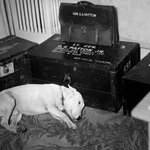
Back at his quarters, his own dog, an English Bull Terrier named Willie who'd slept in Patton's command van and gone through the entire European campaign with him, was left beside his trunks and briefcase, waiting for a homecoming that was never going to happen. This photo was taken in those days after his death.
Willie was eventually sent to live with Patton's family in California. He reportedly struggled badly with separation anxiety, but he lived on for almost another decade, until 1955.

On July 31, 1962, Sir Oswald Mosley, the former leader of Britain's fascist movement, tried to hold a rally on Ridley Road in Dalston, a working class, heavily Jewish part of London's East End. He didn't get far.
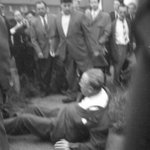
The moment he stepped out to address the crowd, more than a thousand people surged forward and knocked him to the ground. He tried to fight back from the pavement before police pulled him up onto the platform. Once there, he was met with a hail of rotten fruit, coins, and stones. Police shut the whole thing down within three minutes and arrested 54 people, one of them Mosley's own son, Max.
It wasn't even the first time that month. Just two days earlier, on July 29, Mosley had been knocked down the same way trying to march through Manchester.
Ridley Road had a long history with Mosley specifically. His original fascist movement, the British Union of Fascists, had clashed with the same neighborhood back in the 1930s. By 1962, a new generation of Jewish East Enders, some of them children of those earlier fights, had formed a group called the 62 Group specifically to make sure his rallies never went smoothly again.
That July, they made good on it. Twice in three days.

On August 15, 1961, just two days after East Germany started stringing barbed wire through Berlin, a 19-year-old border guard named Hans Conrad Schumann stood at his post for hours watching families on both sides of the new line, some of them being torn apart by it in real time.
A crowd on the West Berlin side had started shouting for him to come over. A young photographer named Peter Leibing had noticed him chain smoking nervously and stayed locked on him with his camera. Then, without much warning, Schumann dropped his cigarette, ran for the wire, threw his rifle away mid stride, and jumped.
Leibing caught the exact instant of the leap. The photo went out over the wire services within hours and ran on front pages around the world. Schumann became known as the first East German soldier to defect at what would soon become the Berlin Wall.
He never got to enjoy the fame. He spent years afraid the Stasi would come for him, and he said he didn't feel truly free until the Wall came down in 1989, twenty eight years later. Even then, he stayed distant from his own family back in Saxony.
On June 20, 1998, nearly a decade after the Wall he escaped finally fell, Schumann was found dead in his orchard in Bavaria. He had taken his own life.

The gap in the rubble was too wide and too dangerous for anyone to walk across, so on September 15, 2001, a 4-year-old Golden Retriever named Riley crossed it a different way: strapped into a basket, sent across roughly 60 feet of open air on a zipline, alone.
Riley was part of FEMA's Pennsylvania Task Force 1, trained to find people who were still alive in the wreckage of the World Trade Center. He almost never did. Most of what he found were the remains of firefighters who had run into the towers trying to save people and never made it out.
His handler, Chris Selfridge, later said Riley knew the difference, that he understood the people he kept finding weren't going to get up. Riley was never trained as a cadaver dog. His job was supposed to be finding the living.
So somewhere along the way, Riley picked up a second job nobody assigned him. Rescue workers would hug him in the middle of the wreckage, and he'd let them, over and over, day after day, like comforting them had become just as much his work as searching.
Riley went home to Pennsylvania when the search ended and lived until 2010. His handler remembered him simply as "my friend and partner.

One block from the World Trade Center, on the corner of Church and Liberty Street, this Burger King was one of the only buildings in the immediate area left structurally intact after the towers came down. Within days, the NYPD spray painted directions across the outside and turned it into a temporary headquarters.
This photo was taken September 13, 2001, two days after the attacks. Inside, the restaurant became a working police precinct, wired with radios and makeshift command posts. At different points it also served as a medical triage center for volunteer health workers, and for a short time, as a morgue.
It stayed that way for weeks while officers worked the wreckage a few hundred feet away.
Today, 25 years later, a Burger King still operates on that same corner. The exterior looks almost exactly the same as it does in this photo, just without the spray paint and the dust.

Patrick Witty was a freelance photographer living about a mile from the World Trade Center on September 11, 2001. A friend called and woke him up yelling that a plane had hit the tower. He grabbed his camera and ran outside.
By the time he got close to the towers, the second plane had already hit. He got within two blocks, watching what he thought was paper falling from the building. It wasn't paper. He later said the loud bangs sounded like car crashes. It was the sound of bodies hitting the ground.
He couldn't keep watching. He turned around, camera still in hand, and found himself facing a crowd of people frozen in place, all looking up in horror. As he raised his camera to photograph their faces, he heard a crack behind him. The South Tower was coming down. It was 9:59 in the morning.
He ran north with everyone else.
For years, nobody wanted the photo. The New Yorker, Time, and Newsweek all passed on it. It sat mostly unseen until 2013, when Witty posted it online and asked the internet for help identifying the strangers in it. He found a couple of them, including a man named Benjamin Tabile, who was actually supposed to be inside the World Trade Center that morning for a job interview. He was just running late.
Witty is still looking for the rest of them, more than two decades later.
2,753 people were killed in New York that day. Every face in this photo belonged to someone who survived it.

On the morning of September 11, 2001, these people were standing on a walkway in Jersey City, directly across the Hudson River from the World Trade Center. That's a fire chief's SUV parked behind them. They weren't tourists, they were just residents close enough that the towers were part of their everyday skyline.
At 9:59 that morning, the South Tower, the second building hit but the first to fall, collapsed straight down into a cloud of dust and debris that rolled out over lower Manhattan and across the water toward them. One local photojournalist working that same stretch of waterfront later described how you could hear it happening before you could really process what you were seeing, a low rumble as each floor gave way, then a heavier pounding sound as the debris hit the ground.
The North Tower, hit first at 8:46, was still standing when this photo was taken. You can just make out its antenna poking through the smoke. It would come down less than half an hour later, at 10:28.
By the end of the day, 2,977 people were dead across four hijacked flights, both towers, and the Pentagon.
Today marks 25 years since that morning. The people in this photo, hands on their heads, are watching history happen in real time, close enough to see it and just far enough away to survive it.

This woman showed up to Daytona Beach with a homemade sign that said "YOU ARE HEADED FOR HELL!" and just stood there, right in the middle of hundreds of sunbathing spring breakers in bikinis.
The photo is part of a long running project called "Rite of Passage" by photographer Keith McManus, who spent years starting in the early 1980s documenting spring break culture in Daytona Beach as it exploded into a national phenomenon. By the mid 1980s, MTV was broadcasting live from the beach every year, and hundreds of thousands of college kids were showing up every March.
Not everyone welcomed it. Religious protesters became a regular fixture on the sand, walking through rows of towels and coolers with signs warning sunbathers about damnation, while everyone around them just kept tanning like nothing was happening.
It's one photo, but it says a lot about America in the 1980s. The same stretch of beach holding a party the size of a small city, and one person in the middle of it convinced the whole thing was a one way ticket to hell.

On June 22, 1994, in the 35th minute of a World Cup match against the United States, Colombian defender Andrés Escobar stretched out his leg to block a low cross. He deflected it into his own net.
That one touch helped knock Colombia out of the tournament in the group stage. They'd gone into the World Cup as one of the favorites, unbeaten for 27 straight games, having just thrashed Argentina 5-0 in qualifying. Instead they were eliminated, and Escobar, the team captain, became the face of the collapse.
He knew what he was walking back into. His family warned him not to go home. He went anyway.
Ten days later, in the early hours of July 2, 1994, Escobar was out with friends at a nightclub in Medellín. In the parking lot afterward, a group of men confronted him, among them brothers tied to the city's drug trade who were said to have lost heavily betting on Colombia's World Cup run. An argument broke out. Their driver pulled a gun and shot Escobar six times, allegedly shouting "Gol!" with every shot.
Escobar died at the hospital less than an hour later. He was 27. More than 120,000 people came to his funeral.
The shooter confessed and was sentenced to 43 years, but served only 11 before he was released. The brothers got 15 months of house arrest for helping cover it up.
Earlier this year, Colombia's president announced that one of those brothers, Santiago Gallón, had been killed in Mexico, more than three decades after the night that made his name infamous.
A missed clearance. Ten days. A life.

On April 22, 2004, in a West Bank village called Biddu, a 13-year-old named Mohammed Badwan was watching a protest against Israel's newly built separation barrier when it turned into stone-throwing.
Israeli Border Police grabbed him, tied his arm to the metal grille over their jeep's windshield, and used him as a shield — parked right on the hood, directly in the line of the rocks being thrown at the vehicle. He stayed tied there for roughly four hours. "The soldiers would come by and slap me," he said afterward.
An Israeli rabbi named Arik Ascherman, who ran a group called Rabbis for Human Rights, saw it happen and tried to intervene. He didn't get an apology — he got grabbed by the throat and headbutted by the police commander on scene, then arrested himself.
A photographer caught the whole thing on film, and it ran in papers around the world. Israel's own Justice Ministry opened an investigation. A police spokesman didn't deny the incident, just said there'd been "serious rock throwing" and it was "unclear what happened."
The practice itself had already been under a temporary Supreme Court injunction since 2002 — but it would take until October 2005, over a year after this photo, for Israel's highest court to permanently and fully ban the military from using Palestinian civilians as human shields at all.
A 13-year-old boy, tied to the hood of an armored jeep, using his own body to stop rocks meant for a vehicle he had nothing to do with.

Just after midnight on June 5, 1968, a 17-year-old busboy named Juan Romero was having the best night of his young life.
He'd delivered room service to Robert Kennedy the night before. Shook his hand. Said walking out of that room he felt "10 feet tall." Kennedy had just won the California primary and was on track to be president. Romero, a Mexican immigrant going to Roosevelt High by day and working the Ambassador Hotel kitchen by night, wanted to shake his hand one more time.
He got his wish. Kennedy grabbed his hand in the hotel kitchen — and half a second later, Sirhan Sirhan opened fire.
Romero dropped to the ground with him. Put his own hand between the cold concrete floor and Kennedy's bleeding head so he wouldn't have to feel it.
Kennedy, barely conscious, asked "Is everybody OK?" Romero told him yes.
Then he remembered the rosary in his shirt pocket. He pulled it out and wrapped it around Kennedy's hand — not knowing if the senator was religious, just knowing he might need it.
LA Times photographer Boris Yaro caught the whole thing on film. The photo ran everywhere. Some papers even mistook Romero for a priest, because of the white smock and the beads.
Kennedy died the next day. He was 42.
Romero carried that night for the rest of his life. He always wondered — if he hadn't reached out his hand, would Kennedy have turned a different way and lived?
He died in 2018, still haunted, still remembered as the boy who held RFK's head.

Adolf Hitler with Joseph and Magda Goebbels and three of their children — Helga, Hilde, and Helmut — at Hitler's Berghof retreat in the Bavarian Alps, 1938. The Goebbels family was held up in Nazi propaganda as the ideal German household; that same year, Magda became the first woman awarded the 'Cross of Honor of the German Mother.' Behind the curated image, the marriage was strained by Joseph's many affairs. Just seven years later, on May 1, 1945, all six Goebbels children were murdered by their own parents in Hitler's Berlin bunker, hours before Joseph and Magda took their own lives — Magda writing in a farewell letter that she couldn't let her children grow up in a world without National Socialism.

On this day in 1935, Louisiana Senator Huey Long, known as "The Kingfish," died two days after being shot inside the state capitol in Baton Rouge. He had been a powerful and controversial populist figure widely seen as a future presidential contender.
On this day in 2008, scientists at CERN successfully circulated the first beam of protons around the Large Hadron Collider, the world's largest and most powerful particle accelerator. It would later be used to confirm the existence of the Higgs boson.
On this day in 1939, Canada formally declared war on Nazi Germany, joining World War II a week after Britain and France did. It marked the first time Canada declared war independently, without simply following Britain's lead.
On this day in 1846, Elias Howe was granted the first U.S. patent for a lockstitch sewing machine. His design could complete 250 stitches per minute, and it laid the groundwork for the industrial sewing machines that would transform clothing manufacturing.