

IHR is an independent think tank and publisher working to promote peace, understanding and justice through greater awareness of the past. History Matters!
Newport Beach, CA
Joined May 2019
- Tweets2.8K
- Following208
- Followers8.8K
- Likes2.4K





A 2013 public opinion poll found that 71 percent of Americans believed the signers of the Declaration of Independence would not be pleased with the United States today. That share had risen steadily since 2001.
Fifty-six men signed the Declaration in the summer of 1776. They pledged to each other “our lives, our fortunes and our sacred honor.”
At least eight of those signers risked their lives on the battlefield. British troops looted the country mansions of at least four. Carter Braxton’s great home in Virginia was burned to the ground.

George Wythe lost nearly everything he owned. William Hooper wrote: “The loss of property I treat with contempt... but the dread of my family suffering from want – Oh my God!”
Thomas McKean was “hunted like a fox by the enemy.” He was compelled to move his family five times in a few months; they settled in a log house on the banks of the Susquehanna, where they were harassed by hostile Indians.
In 1808 Benjamin Rush, one of the signers, wrote to John Adams that he sometimes wished he could erase his name from the Declaration of Independence.

John Adams replied: “You and I, in the Revolution, acted from principle. We did our duty, as we then believed, according to our best information, judgment and consciences. ... Repent? That is impossible. How can a man repent of his virtues?”
Robert E. Lee said: “Duty is the most sublime word in our language. Do your duty in all things. You cannot do more. You should never wish to do less.”Full text of Weber’s July 6, 2013 address: ihr.org/other/americasfounde…
The talk was given at a meeting of the American Freedom Party in southern California.
#History #FoundingFathers
Last school year, 32% of Hispanic eighth-graders in Palo Alto tested proficient in math, compared with 93% of Asian and 80% of white students.
Racial and socioeconomic achievement gaps between Black and Hispanic students and white and Asian students have been widening statewide since 2009, according to a report by Stanford professor Sean Reardon. The figures appear amid ongoing debate over math tracking in the Palo Alto Unified School District.
Ko Lyn Cheang, San Francisco Chronicle, October 25,
2026.
yahoo.com/news/us/articles/m…

Pat Buchanan opens Churchill, Hitler, and the Unnecessary War with the observation that “all about us, we can see clearly now that the West is passing away.”
Mark Weber said the book is the single volume he would recommend to a new reader on the most important development of the twentieth century.
Buchanan, a former speechwriter for Richard Nixon and communications director in the Reagan administration, synthesizes the work of more than one hundred historians into a readable account of how Britain’s balance-of-power policy produced two catastrophic wars.

Weber said that in 1939 Hitler sought an alliance with Poland and a settlement of the Danzig question.
British Ambassador Neville Henderson and former Prime Minister David Lloyd George both described Hitler’s proposals as reasonable.
Britain nonetheless gave Poland a guarantee it could not fulfill.
On 3 September 1939 Britain and France declared war on Germany. At the end of the war Poland was under Soviet control.
Weber noted that Franklin Roosevelt had already assured the British ambassador in 1939 of American support if Britain went to war, an assurance he said must not be made public or he could be impeached.

Churchill, upon becoming Prime Minister in 1940, declared the British goal to be “victory at any cost.”
Weber said Britain could not defeat Germany without the Soviet Union and the United States.
The Allies later insisted on unconditional surrender.
Weber said the war ended with Europe under the hegemony of the United States and the Soviet Union, each committed to a universalist order.
Buchanan writes that there cannot be a Western civilization without people of the West.
Full interview: bitchute.com/video/7ongRQY1x…
Book available
ihr-store.com/index.php?main…
#History #WWII

Harry Elmer Barnes died on August 25, 1968, at the age of 79.
Murray N. Rothbard, writing in the final issue of Left & Right, describes Barnes as a passionately committed scholar who was not content merely to set forth the truth but worked actively on its behalf. Like Beard and Flynn, Barnes was denounced as a “Nazi” for maintaining the liberal and pro-peace principles he had long held.
Full article:
mises.org/mises-daily/harry-…

These far-sighted writings counter the often-made claims of politicians and other establishment leaders about World War II to justify seemingly endless U.S. military intervention overseas.
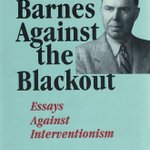
Harry Elmer Barnes’s collected essays, published by the Institute for Historical Review, examine the Second World War and the Cold War that followed. The volume of more than 350 pages contains the texts of nine of Barnes’s writings.
Available here:
ihr-store.com/index.php?main…

Vito Corleone arrives in New York as a poor orphan. He keeps a clear sense of who he is and places his wife and children first.
His son Michael is born into wealth and privilege. He joins the Marines against his father’s wishes and marries Kay Adams, who is not from the same background.
In a conversation with Senator Pat Geary of Nevada, Michael says, “Senator, we’re all part of the same hypocrisy.”
Weber said the film presents the same drive for personal advantage in the Corleone family and in ordinary American political life. The senator claims to care about family values while pursuing his own stature and gain.

In the final scene of The Godfather Part II, Michael Corleone sits alone at the lake as the leaves fall.
He has ordered the killing of his brother Fredo and of his brother-in-law. His wife has left him after an abortion of their third child.
Weber said the film is a tragedy in the classical sense. The outcome follows from the character of American society and from Michael’s own divided sense of identity.
A society organized around “what’s in it for me,” Weber said, dissolves the family, ethnic, cultural, and religious bonds that hold any healthy people together.
Full interview:
ihr.org/video/godfather-and-…
#History #America
The opening words of The Godfather (1972) are spoken by the undertaker Amerigo Bonasera: “I believe in America.”
He has come to Don Vito Corleone because the men who assaulted his daughter received only suspended sentences.
Mark Weber said the scene states a central theme of the film. The American judicial system fails to deliver justice, and the undertaker turns to Corleone for what the courts will not provide.
Weber noted that the same limitation appears throughout both films. People confront hypocrisy and corruption inside the system and must work around it to protect what they consider most important.

AIPAC had $19.5 million in assets in 2000 and nine times that amount in 2023.
Scott McConnell notes in The American Conservative (October 17, 2026) that the main institutions of the lobby are far richer than they were when Mearsheimer and Walt published their study. Clifton and Lustick write that these donors “form the backbone of an Israel First movement which crosses party lines.”
Full article: theamericanconservative.com/…

Institute for Historical Review retweeted

Aerial footage shows fire damage at Hitler’s Eagle’s Nest as a 33-year-old German citizen is arrested in connection with the blaze.
srael Shahak was raised as an Orthodox Jew. He survived the German concentration camp of Belsen and arrived in Israel in 1945. He later became a professor of chemistry at the Hebrew University of Jerusalem.
In Jewish History, Jewish Religion: The Weight of Three Thousand Years, Shahak examines the roots of what he calls the arrogant and invidious Jewish chauvinism of modern Israel in the Talmud and classical rabbinical laws. He condemns Israel’s systemic discrimination against the non-Jews under its rule. He writes that the Jewish religion, especially in its classical and Talmudic form, is “poisoning minds and hearts.”
Shahak argues that Israel’s identity as an emphatically Jewish ethno-religious state, and the policies based on that outlook, constitute a danger not only to itself and its inhabitants, but to Jews everywhere, as well as to the peoples and states of the Middle East. He warns that Israel’s right-wing Jewish religious communities and political parties pose a long-term threat to Israel and the Zionist movement.
The Noontide Press edition runs 166 pages and includes forewords by Gore Vidal, Ilan Pappé, and Edward Said.
Available for $25.95:
noontidepress.com/index.php?…

Paul R. Pillar on the Iran war
In an October 15, 2026 article for Responsible Statecraft, Paul R. Pillar wrote that President Trump does not regard the conflict with Iran as stalemated.
Pillar said the U.S. Navy’s operation in the Strait of Hormuz has blocked most of Iran’s imports and oil exports while restoring some non-Iranian oil trade through the strait.
What Trump would welcome as a “win,” Pillar wrote, could take one of two basic forms: either the Iranian regime somehow cries “uncle” and makes concessions that clearly and significantly go beyond anything it offered before, or the regime collapses. A regime that believes the United States is determined to destroy it has no incentive to make concessions.
The most feasible way out of the war, Pillar wrote, is a skeletal ceasefire agreement that defers most substantive negotiations, like the Memorandum of Understanding the parties agreed to in June, but without the ambiguous language concerning the Strait of Hormuz that led the MoU to break down.
responsiblestatecraft.org/di…

On February 1, 2025, Mark Weber appeared on The Political Cesspool with James Edwards.
Weber said the early actions of the second Trump administration on illegal immigration were long overdue. Both parties had ignored the problem for thirty, forty, or fifty years.
Ronald Reagan had been more popular than Donald Trump and had amnestied three million illegal aliens.
Even if all illegal immigration stopped tomorrow and a million or two million or three million people were deported, Weber said, the basic trajectory would not change.

Weber noted that in his inaugural address Trump thanked black and Hispanic supporters but did not express appreciation for the white working-class voters who elected him.
Trump does not talk about race.
Weber said Trump is not anti-white; he is indifferent.
Up until the 1940s, 1950s, or 1960s it was simply assumed that America was a white country, a European country, a Western country, and a Christian country.
That assumption was never made explicit enough.
During the Second World War, Franklin Roosevelt said the United States was not fighting for Western civilization but for a new world civilization.
In accepting the 1980 Republican nomination, Ronald Reagan said America is great because it is a beacon of freedom and welcomes people from everywhere in the world who are victims of oppression and poverty, including Haiti.
Weber said the pivot point now is the recognition that the post-war liberal democratic order is failing.
Until Americans are explicit about identity, the problems will continue and get worse.
Full interview: thepoliticalcesspool.org/rad…
#History #Immigration
Jean Raspail’s 1973 novel The Camp of the Saints depicts a fleet of a million refugees from the Third World arriving on the southern coast of France. The native population, shaped by decades of “brotherhood” and “equality” appeals, does not resist. Europe is submerged.
Raspail (1925–2020), a French explorer and novelist who received the Grand Prix de Littérature of the Académie française, wrote the book in ten months. The title is taken from Revelation 20. The novel has been called prophetic by readers who see parallels in later events.
A new English edition from Noontide Press runs 356 pages. It includes a new translation, an introduction by a scholar of French political thought, and Raspail’s 2011 preface. Linell Smith of the Baltimore Sun described it as “shocking and controversial … a macabre thriller.” Christopher Stevens of the Daily Mail wrote that Raspail “writes with such energy, like a man possessed, that the book’s 300 pages rush by.”
Available for $24.95:
noontidepress.com/index.php?…
