

VP, SI Security @ Palo Alto Networks, ex-NTAP | International Experience | Multilingual | Enjoy Sports & Overseas Explorer. Tweets are my own
Silicon Valley
Joined July 2009
- Tweets2.8K
- Following899
- Followers795
- Likes7.1K








Hoseb Dermanilian retweeted

It's been an eventful week. Multiple vulnerabilites in Internet facing software, coding repositories, examples of agent behavior that seem concerning and a flurry of security specialists with solutions that can partially solve your problem. There in lies the challenge. Given the state of IT and security infrastructure, no one solution works. Let's break it down:
1/3
1. Vulnerabilites are being found and will continue to be found as models get more capable, the fragmented nature of the effort denies us the opportunity for a comprehensive find and replace option.
2. Even if all vulnerabilities could be found instantly and patches available - we will be reliant on the ability of enterprises to deploy all these changes at speed. It is not clear what the collateral impact of all these patches will/could be to our infrastructure of deployed en masse.
We will need a hybrid patch approach.
3. Virtual patching(VP) is needed in conjunction with direct patching but for a comprehensive (VP) solve you have to be lucky enough to have "modern frontier defenders" (Cyber companies that have vaulted infrastructure that can create patches at speed and push content rapidly to protect their customers) you need them for your network traffic, your traffic to applications on the cloud, your WAF, your end point.
4. There will continue to be patches that will need to be deployed directly but virtual patching will take the heavy load off.
2/3 Medium term solve:
Unfortunately token economics and current cyber architectures will not allow for defender swarms to contend with an offensive attack launched using agents. (Some x pundits who aren't steeped in cyber should take heed). Yes, theoretically we should aspire to have these agentic swarms defend us when we are under attack, unfortunately an attack is a sniper moment, chained vulnerabilities, cloaked attack followed by swift exfiltration. It's a speed program not a brute force problem.
To solve for this, enterprises need to get their SOC architecture right, logs, feeds, cyber products orchestrated via a modern SOAR for swift response. Only then can we deploy agents to detect and remediate. In addition, enterprises need to modernize and dare I say platformize their perimeter stack to ensure consistency.
Unfortunately, enterprises still seem to not see the urgency across the board, decisions are stuck, CIO/CISO's have a lot on their plate. While some honestly have bit seen the scale of such a problem before and it's hard convincing the organization that one needs to open the floodgates on modernizing the IT and security infrastructure. So we will continue to see environments being brought down to patch today it's for PHP, tomorrow it will be for the next one.
3/3 AI deployments are the"wild wild west" - LLM capabilities are expanding faster than we can build products to secure them. Sure an agent will jump across guardrails in a research lab, which is a lesson for all of us to deploy agents securely. But there is a lag between the discovery, the availability of that in a public model and the time needed for the cyber industry to build governance or an antidote. And no, dear frontier lab friends, the world cannot just trust you to build the solve. The infrastructure industry in tech builds and the cyber industry secured and provides assurance to the boards and organizations around security and safety.
AI security is the new attack surface. CEOs (present company included) want AI adoption, getting the pace of adoption wrong could be the last decision we make, at the same time "deploying it wrong" could have the same consequence.
There are billions of dollars being spent on coding, is your coding harness secure? Start there. If agents can jump guardrails, they can hide stuff in code.
Validate business outcomes needed, test your user case and ensure agentic deployments are well guard railed. Deploy a second set of eyes to watch your deployments for drift, compliance and verifiability.
Hoseb Dermanilian retweeted

Cyber is having a moment
Across 21 major software companies, including Apple, AWS, Microsoft, and Google:
- Reported critical vulnerabilities never cleared 100 per month in four years
- Since spring they've jumped to over 600 per month


Kevin Mandia on finding 90+ security holes at Fortune 500 companies that nobody knew existed:
"When you have an AI-based attack, it'll find logic flaws rather than code flaws in custom applications. It'll exhaust all routes all the time."
"Armadin, since January of this year, we have found over 90 zero-days at customer sites, all in production."
"We've post-trained all our models with real red teamers, real folks that actually can develop exploits."
"When we're scanning networks, we don't have source code to review. We're not finding these zero-days with source code. We're not finding these zero-days because we can log into an app and now we have access, and we can get to other things. We are black box coming from the internet."
"Over 90 zero-days in major software companies, and they're thankful. We're coming from the outside, and then we're calling a CISO, usually within 48 hours, 'Hey, we've got remote code execution in your DMZ.' And usually from there we're getting in, and they agree with us."
"That's not a pen test. That is like a real adversary coming at you."
@ArmadinSecurity @DavidGeorge83
Hoseb Dermanilian retweeted
THE PACING IS A NINJA MOVE - But be careful what you campaign for.
In any competitive sport, I have seldom found people exercise restraint - they usually have a capture the flag mentality. Don't I want to be the best? The first? The only? - this is how we have been programmed. In the AI race, winning is existential. All AI labs have to race to generate revenue to be able to sustain the enormous amount of committed capital to "not be left behind" in the infrastructure build. There isn't enough room for many. So the desire to slow down is puzzling, but perhaps if the whole system slows down, the rules of winning can be the same for all.
Do we have a problem that AI could be a killer?
Model capability is a tale of two cities, at one end the models are showing their prowess in tasks like cyber or math as seen recently, so there is likely a probability that the models get extremely powerful and could precipitate a world event. At the same time, in many domains the lack of training data makes the models woefully inadequate. Even in areas like cyber - the LLMs aren't great at the edge cases and generally not economical for the defender case, but great for the attackers. Funnily - in all their "concern" it is still an uphill battle to get them to expose APIs for third party security companies like ours, for us to build robust security for AI adoption. It's slow progress.
So why do this?
I do believe deep down this is a commercial strategy. A ninja strategy. The liability associated with a model gone rogue has the potential of wiping out the economic opportunity of any frontier company. How do you best show the duty of care? You show that you care. How do you make sure you don't lose out to your competitors? You get them to do the same! If that becomes the industry standard for duty of care, you have a collective first line of defense. Who do you get to govern this? "Yourself" - that is what I think will become the achilles heel.
The risk? Open source! China! Countries other than the US! So you ask for a global agreement, because you don't want to be sued in other markets who might even be more punitive. But that was an afterthought - that afterthought will cost.
Thks pacing campaign rhetoric has become the talk of the town and it might work. Everyone has jumped into the debate. Both sides of the house, nation states. CEOs (present company included). It's more fun discussing the evil of AI than basics of economic affordability or international trade.
The result: We might end up with AI safety boards, regulation in micro jurisdictiona and a fragmented fabric of laws around the world which would make compliance and liability a challenge. Perhaps the intended consequence of pacing would have an unintended consequence of a labyrinth of regulation. Regulation destined to cause a slowdown.
Who wins? Simplicity. Open source? Open source is already on its way to gaining more adoption, this could drive it further, faster, each iteration of open source gets closer to frontier LLMs - making it viable to deploy them for more and more use cases.
In the end, how will the evaluators know as AI gets smarter, that AI hasn't figured their role out and outsmarts them at their task! That will be the next frontier :)
Hoseb Dermanilian retweeted
Security and IP implications of AI
The case for rapid AI deployment -
I think we can all conclude the following from the last few months of developments - 1. Not using AI could and will become an existential issue for both individual users and enterprises. 2, Enterprise adoption will be cautious while individual users are definitely going to race ahead, try different use cases, build agents, push the models to their limits (although it seems harder to do, unless you live in an AI Lab) 3. Employees and developers will take matters in their own hands since they will find their cautious enterprises aren't moving fast enough. 4. Agents are showing their prowess, uncontrolled, unrestrained agents with a "capture the flag mentality" are showing us the edge cases which demonstrate the negative outcome possiblities of these scenarios. 5. It is impossible to plan for the next 6 months since we can't fathom where technology will evolve to. These activities will cause adoption sans security..... AI has deep implications on security in the future.
In this environment security companies need to live on the bleeding edge, anticipating scenarios, building framework solutions so we have a shot at securing future outcomes. Which we all are.
Some useful pointers to people planning their AI implementation:
1. Secure what you plan to use, try not to secure the future - no products for security can be created unless we see the future unfold. The future is moving fast, so are we.
2. Most of the coding usage is unsecured. Make sure your coding is secure. Most enterprise AI apps do not offer a secure instance (this is your IP living in their instance)! SECURE your codex, cursor, Claude code Harvey, glean, legora instances now!
3. Do not try and build your own - I have already experienced enterprise customers building gateways and tools for agents - security companies have thousands of specialists working on this, leverage them, Focus on AI adoption instead. Partner to secure.
4. Securing agents is a complex problem - securing the agentic lifecycle - real time inspection and kill switches are key. Don't fall in the discovery and posture trap (Visibility - process understanding - intent interpretation - ability to stop inline are key tenets to the agentic lifecycle - not identity, posture and inventory - those are mere building blocks)
5. Only use enterprise protected models, single tenant, firewalled, inspected implementations - this is your IP you are playing with - LLMs have shown they will cross boundaries to capture the flag - you think your IP is safe? Once you train an unprotected model with your IP - you can't reverse the trade.
6. Perhaps the most important one - do not use a security tool built by the same person who is selling you the AI implementation, historically IT vendors are different from security vendors. You need an enterprise solution for security and it must work on your diverse infrastructure. Use a pure play security partner.
Happy building with AI.
Hoseb Dermanilian retweeted

AI agents are moving from simple prompts to executing complex workflows, and traditional access controls aren't cutting it.
Together with @AnthropicAI, we’re defining identity-first security for the agentic era using Idira advanced privilege controls.
Scale AI safely with strong governance 👇
bit.ly/3Suoea6
Hoseb Dermanilian retweeted

NVIDIA researchers did it again!
They found a way to make KV cache transferable between models.
The target model skips prefill entirely, and the conversion runs 2.7 to 25x faster than processing the context again.
Let's understand why this is so important today.
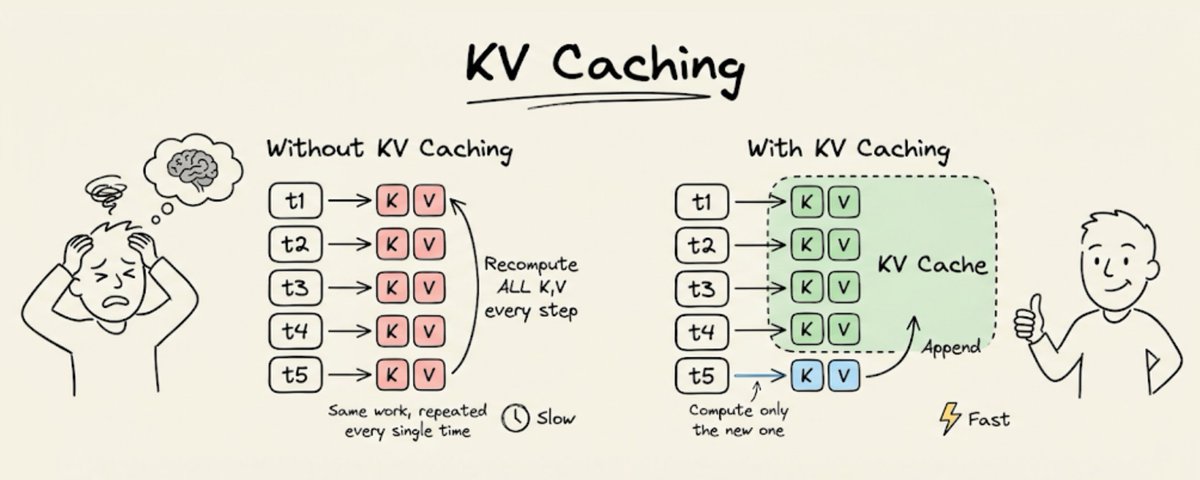
LLM APIs are stateless, so every turn sends the entire conversation back to the model. The model reads all of it again before writing a single new token, and all of it is billed as input.
Prompt caching allows Anthropic and other providers to hold the KV cache for a stable prefix and bill a hit at roughly 10% of the base input rate, because the compute was already done once.
The 90% reduction is one of the largest lever in LLM serving, which is why so much production work goes into keeping prefixes byte-stable.
But the cache only works on the model that produced it. Keys and values are produced from that model's weights, so no other model can read them.
In pratice, the constraint shows up in LLM routing. If the traffic is shifted to a different model for cost/capability reasons, the accumulated KV cache becomes invalid.
As a result, the accumulated context has to be processed from scratch, and it's billed at full rate.
NVIDIA's recent paper treats this as a representation problem.
Prefill's only output is the KV cache, so to move KV between models, we need to convert one model's cache into the format the other expects.
They first checked whether the conversion has any structure worth exploiting.
They found that moving from Qwen3 14B to 32B, a plain linear regression from a single source layer reconstructed 56% of the variance in the target model's keys.
The two models obviously may have different layer counts, so there is no natural one-to-one pairing between them.
For each target layer they rank every source layer by how well it predicts that layer, then feed the top eight in together, which takes the reconstruction to 79%.
The mapper itself has three parts:
> Each target layer and head gets its own independent linear map, solved in one closed-form step rather than by gradient descent.
> The cross-layer selection described above is the second part, and their ablation shows it carries the most weight of the three.
> Keys also carry a position-dependent rotation from RoPE. They strip that rotation, fit the map in position-free space, then re-apply the target model's rotation at inference.
Across six pairs from Qwen3, Llama 3.1 and Ministral 3, four retain 73 to 98% of the receiving model's standalone accuracy, and the conversion runs 3-25x faster than processing the context again.
Prior work on cross-model KV reuse exists, but it either trains a neural adapter per pair or requires both models to be architecturally identical.
This is probably the first version that is closed-form and training-free, so a lot of it is still open research.
Every pair tested belongs to one family, so it works on Qwen to Qwen and Llama to Llama.
Cross-family transfer is listed as future work.
All six pairs mentioned above also happen to share KV head count and per-head dimension across scales. Mismatched head configurations are currently untested.
The researchers scoped this to dense full-attention only, so sliding-window and attention-recurrent hybrids still need work.
Here's the paper: arxiv.org/abs/2608.03893
Plenty of work is yet to be done. Still, the constraint being solved is genuine.
Every model swap currently invalidates the full KV that was already paid for, and this is the first result showing that work might be recoverable without training anything extra.
That said, all of this only matters because of what the KV cache is doing in the first place.
I wrote a first-principles breakdown of it, covering why the model stores keys and values at all, why the cache grows with every token, and what generation speed looks like with and without it.
Read it below.

Hey @westminsterco the sprinklers on 118th and Sheridan have been going on non stop for the past 3 days! And we talking about drought
Almost every conversation we are having today has some sort of "show me what I have today" conversation and then looking around in the room and asking "How are we securing and governing this?"! It's crazy the amount of unprotected stuff out there! PANW

Authentication can secure an AI connection. It cannot govern what an agent accesses, shares, or does next.
Prisma AIRS AI Gateway unifies visibility, identity, policy, and runtime security in one AI control plane.
See how enterprises can scale AI with control. bit.ly/3TiBsGU
Hoseb Dermanilian retweeted

Enterprises still measure an executive's importance by the size of the team they manage. But this is an old proxy for a world where more people was the only way to do more work.
This isn’t true anymore.
The leaders who will be most impactful over the next five years will be the ones whose people spend all their time on only the work that actually moves the business, because they use systems and factories to do more of the rest.
Follow the trend but with perspective! My X has been flooded with FDE news this week, nothing different in all those except this one!

Time to go FDE! So the new craze, let's build an FDE business because customers need it. What is an FDE -
1. well versed in AI? - yes
2. Well versed in applying their knowledge to make implementation successful for what I bought from you - yes, Palantir, Frontier Models, now Hyperscalers.
The real question is:
Is the FDE actually building unique product capability in the field that will then be integrated into the product eventually back at the ranch? Or is the FDE building unique capability for my enterprise?
The answer to the question helps determine whether the FDE provider accelerates product development and value capture.
For the customer - higher probability for driving outcomes for sure, but if you have ever worried about vendor reliance - this is the moat of a lifetime.
Use FDEs for sure, but understand the architecture, make sure you understand where the intelligence is being retained in your enterprise:
1. Model weights? Do you have a fine tuned model?
2. Generic model - but organizational memory, context layer and harness?
3. Unique application context and data being leveraged?
No prizes for guessing where the different FDE providers will build that value for you, hence creating the moat for themselves.
Go FDE but tread thoughtfully.
I finally ran into @PatrickMoorhead at GTC but heck forgot to take a selfie! Was great seeing you in person Pat.
Hoseb Dermanilian retweeted

Claude Code wiped our production database with a Terraform command.
It took down the DataTalksClub course platform and 2.5 years of submissions: homework, projects, and leaderboards.
Automated snapshots were gone too.
In the newsletter, I wrote the full timeline + what I changed so this doesn't happen again.
If you use Terraform (or let agents touch infra), this is a good story for you to read.
alexeyondata.substack.com/p/…

ALT A console screen shows a critical warning about a destroyed database and missing backups, outlining deleted infrastructure components.
Hey @CopperMtn #IKON charging 70$ for parking is absurd isn't it? Charging 8$ for a Gatorade is absurd isn't it? While paying 1500$ for a full pass!!


Kudos to @united UA162 cockpit crew who caught a major issue with the plane right before takeoff! Unbelievable how United puts their oldest fleet on a 13hr overseas flight! What a mess...
Hoseb Dermanilian retweeted
Ready to talk agentic AI?
Join us today at 1:55pm PT in the Oceanside AD, level 2 with Sean Morgan, Sr Director, Technical Marketing Engineering.
Get ready to experience what's next. bit.ly/4ol1Pad


I can't believe with all the LLM advancement's Siri's speech to text is possibly the worst ever out there! Unbelievable @Apple
