

We're sharing/showcasing best of @huggingface models. Follow to stay in loop. Promoting Open-Source models.
Joined December 2025
- Tweets31.7K
- Following32
- Followers71.8K
- Likes624
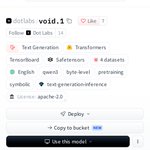



With 2,156 downloads and growing, void.1 proves its value. The byte-level tokenization and Qwen3 backbone offer robust performance for text generation, making it a top-tier choice for developers.
Trained with transformers and tensorboard, void.1 uses safetensors for efficient loading. The Qwen3 architecture and 400B token climbmix dataset give it a strong foundation for English text generation.
Use void.1 for creative writing, code generation, and complex text tasks. Its byte-level approach handles diverse inputs, making it great for building chatbots, content tools, or research prototypes.
Meet void.1 by dotlabs: a text-generation model built on Qwen3 with byte-level pretraining on the massive climbmix-400b-shuffle dataset. It's a fresh take on symbolic reasoning for the community.


With 1,039 downloads and 59 likes, Phonon-40m-en is gaining traction for its compact size and streaming TTS. It proves you don't need huge models for quality speech synthesis, especially when running locally on edge devices.
Phonon-40m-en is a 40M parameter transformer for TTS, available in safetensors and GGUF formats. It's designed for efficient inference, with streaming support and on-device deployment in mind, making it lightweight yet capable.
Use Phonon-40m-en to add voice to apps, build accessible reading tools, create real-time narration, or power voice assistants. It's a text-to-audio transformer that outputs speech directly, perfect for streaming and on-device TTS.
Meet Phonon-40m-en: a tiny but mighty text-to-speech model that runs on-device and streams audio in real time. At just 40M parameters, it brings natural voice synthesis to phones and edge devices without the cloud.


1,563 downloads and 59 likes show growing interest. The value? Faster inference without sacrificing quality. If you're running Qwen3.8-Flash-Next, this draft model is your shortcut to lower latency.
Built on Qwen3 architecture with block diffusion and DFlash2. Ships in safetensors for transformers. It's a draft model, so it's lightweight and designed to complement the main Qwen3.8-Flash-Next model.
Use it as a draft model in speculative decoding setups. Works with SGLang for fast inference. Build low-latency chat apps, real-time assistants, or any text generation pipeline where speed matters.
Meet Qwen3.8-Flash-Next-DFlash2: a draft model built for speculative decoding. It pairs with Qwen3.8-Flash-Next to make text generation faster by predicting tokens ahead of time. Speed boost incoming.


With 1.4k downloads and 58 likes, Ming-3.0-tts-0.5B is gaining traction for its voice cloning and multilingual support. It's a top-tier choice for developers who need a lightweight, versatile TTS solution without sacrificing quality.
Built with a dense transformer architecture, this model is available in both safetensors and ONNX formats. The 0.5B parameter size strikes a balance between performance and efficiency, making it suitable for real-time applications on modest hardware.
Use Ming-3.0-tts-0.5B for voice cloning, audiobook narration, multilingual virtual assistants, and accessible content creation. Its text-generation pipeline with audio output means you can generate natural-sounding speech from text in seconds.
