

The official account of Alvaro Lario, President of @IFAD and Chair of @UN_Water. #FinancingTheFirstMile
Joined February 2015
- Tweets2.6K
- Following483
- Followers20.2K
- Likes2.5K


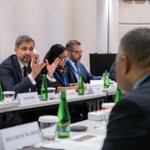


Today at the @FT Africa Summit in London, I made the case for investing in Africa's rural economies in a conversation with @Sabrinadhowre, IFAD Goodwill Ambassador, moderated by Andrew Hill. Farmers and rural entrepreneurs are building businesses that drive productivity, create jobs and strengthen food supply chains. Access to long-term capital is essential to realizing that potential.
Africa's small and medium-sized agribusinesses face a financing gap of around US$65 billion a year. As an international financial institution, @IFAD works with governments to strengthen the infrastructure, institutions and markets that make rural investment viable. We also use concessional finance to share risks and mobilize capital for businesses and producers underserved by commercial lenders.
These priorities also guided my bilateral discussions with UK
Development Minister @kirstyjmcneill and @NickDyerFCDO of @FCDOGovUK. We discussed how to advance shared objectives on food security, rural jobs and private investment, alongside cooperation through the #G20 and #G7 agendas to address the debt crisis and reform MDBs so they can deliver more financing but also achieve more depth and impact with coordinated action. IFAD can support the creation of the conditions that will make investments more impactful in rural areas.
The economic benefits of investing in the first mile extend beyond the farm. Investment in processing, storage and distribution helps businesses reduce losses, reach buyers and retain more value locally. It creates jobs and strengthens the supply chains on which domestic and international markets depend.
African leaders ambition to drive rural economic growth becomes visible in their strong commitment and pledges to
#IFAD14. Their contributions strengthen IFAD's capital base, enabling us to borrow and mobilize additional to invest in long-term growth, food security and economic stability.
#FinancingTheFirstMile | #FTAfrica | @ftlive


Pleased to welcome @WFOPresident to IFAD Headquarters in Rome and congratulate him on his election as President of the @worldfarmersorg. Our conversation focused the importance of creating opportunities for young people, promote rural farmer enterprise development, and digitalization of farmers.
We agreed on one key message: Farmers should be looked at as economic actors.
@IFAD is strongly commitment to the Farmers' Forum, which brings farmers' organisations, IFAD and governments together around priorities identified by farmers themselves. In practice, this means consulting and involving farmers' organisations in shaping our investments together with the national government.
This involvement of farmers' organisations matters. For example, in Senegal, a national farmers' organisation strengthened community ownership by requiring project participants to secure endorsement from family farm heads and local farmers' organisations. These experiences underline the importance of farmers shaping the investments that affect their livelihoods.
Our shared focus is on working with small-scale producers to access finance, reach markets and manage climate risks, while ensuring their experience informs decisions in global forums.
#FinancingTheFirstMile


Hunger has declined for a third consecutive year, but around 645 million people still face hunger and nearly 2.7 billion cannot afford a healthy diet. Progress is possible, but it remains uneven. At the opening of #CFS54, I highlighted the need to connect policy more closely with investment.
Making healthy diets affordable requires investment across the food system, from production and storage to processing, transport and markets. Small-scale producers need those systems to work so they can earn a better living and supply nutritious food reliably.
The Committee on World Food Security brings together governments, scientific evidence and the experience of communities to guide these decisions. @IFAD helps translate that guidance into investments shaped by countries’ priorities.
Through #IFAD14, we will focus on stronger markets, more rural jobs and greater resilience. Connecting farmers to buyers, reducing food losses and helping rural businesses grow are practical ways to improve both incomes and food affordability.
Our shared task is to ensure that global policy leads to better investment decisions and that those investments make healthy diets more affordable and rural livelihoods more secure.
#FinancingTheFirstMile


We can achieve more for rural communities when we design and invest together. That means bringing their needs into our joint investments from the outset, and connecting rural businesses and markets to larger infrastructure and financing.
As I conclude my participation in the World Bank and IMF Annual Meetings in Bangkok, this is the opportunity ahead of us. Our new co-financing agreements with @WorldBankGroup and @isdb_group will help us combine our resources and expertise at the first mile. We are also strengthening cooperation through #AgriConnect and #WaterForward, while working with private investors to expand opportunities for rural agribusinesses.
@IFAD brings almost 50 years of experience working with governments and rural communities to develop markets and bankable investments. That experience is essential to ensuring larger financing initiatives reach small-scale producers and rural entrepreneurs.
On #WorldFoodDay, the purpose of this cooperation is clear. More jobs, greater food security and more resilient rural economies.
#FinancingTheFirstMile | #WBGMeetings
Investing in rural economies strengthens food security, creates jobs and sustains trade, especially as climate shocks and instability put these foundations under pressure.
Today, I met Canada’s Secretary of State for International Development, @randeepssarai. Canada’s CAD263 million climate finance commitment through @IFAD supports three investments alongside US$403 million in partner financing, helping rural communities access investment and markets while managing climate risks.
With the Netherlands’ Minister of Foreign Trade and Development Cooperation, @ministerBHOS, I discussed how rural investment supports prosperity and stability, including in fragile contexts. Dutch partnerships are strengthening Nepal’s ginger value chain through work with SNV and a Dutch company, while our cooperation with Rabo Partnerships supports national development banks.
At @WorldBankGroup #AgriConnect roundtable, “Feeding Asia: The Next Trillion-Dollar Investment Opportunity”, we explored how to translate rural business opportunities into investment. There are ongoing discussions to mobilize US$30 million through IFAD operations in Papua New Guinea and Sri Lanka.
Rural investment belongs at the centre of the global financing agenda. Stronger economies, reliable food supplies and lasting stability depend on backing the people and businesses at the first mile with the capital to deliver.
#FinancingTheFirstMile | #WBGMeetings | @CanadaDev | @MinBZ


Alvaro Lario retweeted

US$1.25 billion in co-financing. More than 122 projects. A shared commitment to global food security.
Strengthening food security and building resilience were at the heart of discussions between our President Dr. Abdulhamid Alkhalifa and @IFADPresident Dr. Alvaro Lario, as they explored new opportunities to deepen cooperation.
Our partnership with @IFAD dates back to 1999 and continues to evolve in response to development challenges. Beyond our longstanding co-financing cooperation, IFAD is also a partner in the broader Vulnerability to Viability (V2V) Compact, which aims to help vulnerable countries access development financing and strengthen their resilience to economic and climate shocks.

Today, I held a series of bilateral discussions with Member States and development finance institutions, focused on deepening cooperation, expanding investment opportunities and translating shared priorities into concrete results for rural communities.
I met with Jeremy Wiggins of the U.S. Department of the Treasury, Nguyen Quoc Phuong, Director General at Viet Nams Ministry of Finance and Liao Min, China's Vice Minister of Finance. These discussions are important to deepening our engagement with Member States and identifying opportunities for stronger collaboration.
I also met Dr. Abdulhamid Alkhalifa, President of @TheOPECFund , and Michael Jongeneel, CEO of @FMO_development, to explore closer cooperation on development finance, private-sector investment and market creation, particularly in fragile contexts.
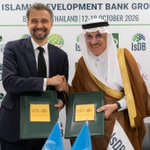
A key milestone was signing a new cooperation and co-financing agreement with @isdb_group, alongside its President, Dr. Muhammad Sulaiman Al Jasser. This provides an important foundation for expanding joint investments, strengthening institutional cooperation and bringing our complementary expertise together.
I also welcomed partners from the @arabcoordgroup for an exchange on how we can strengthen coordination, identify shared priorities and deliver greater collective impact.
By working more closely across governments, international financial institutions and development banks, we can turn shared priorities into coordinated action and greater impact for rural communities on the ground.
#FinancingTheFirstMile | #WBGMeetings | @IFAD


This morning, I hosted an #IFAD14 Asia and the Pacific Ministerial Roundtable, together with the Government of the Philippines on the margins of the @WorldBankGroup and @IMFNews Annual Meetings in Bangkok.
I was pleased to welcome Ministers and representatives from Bangladesh, Bhutan, Nepal, Viet Nam, Samoa, Solomon Islands and Kiribati among others. The strong participation of Pacific Island countries was particularly important, highlighting the need for greater investment in resilient rural economies.
The challenges are significant. Some countries in the region import over 85% of their fertilizer, while most Pacific small island developing states depend on imports for more than 60% of their food. Global supply chain disruptions and rising costs directly affect farmers, rural businesses and food security.
Yet the opportunities are equally significant.
Asia and the Pacific is @IFAD's largest regional portfolio, with deep domestic capital markets, dynamic private sectors and innovative financing models.
From mobilizing private co-financing for rural enterprises in Bangladesh to strengthening agricultural value chains in the Philippines, targeted public investment can reduce risks and unlock additional capital.
#FinancingTheFirstMile | #WBGMeetings | @IFADAsia


Alvaro Lario retweeted

IFAD and the @isdb_group will mobilize up to US$750 million in co-financing to drive sustainable agricultural development.
Under a newly signed agreement, the two institutions will combine their financing power, specialized expertise, and global reach to scale up investments that will transform rural economies, eradicate poverty and strengthen food security.
“Through this agreement, we are scaling up investment in the first mile of food systems to create jobs, increase incomes, and build more prosperous and resilient rural economies,” said @IFADPresident Alvaro Lario.
IsDB and IFAD will broaden their cooperation across critical areas, including agribusiness value chains, market access, rural finance and financial inclusion, climate adaptation, sustainable natural resource management and water access.
Read more at ifad.org/en/w/news/isdb-and-…
#FinancingTheFirstMile | #WBGmeetings

Global economic shocks are increasingly interconnected. When conflict, climate events and rising food, energy and fertilizer costs disrupt production at the first mile, the effects are felt across supply chains, markets and economies worldwide.
At the IMF–World Bank Group Annual Meetings in Bangkok, the signing of a new co-financing agreement with @WorldBankGroup President Ajay Banga marked a significant step forward. It creates opportunities to deepen our operational collaboration, including through #AgriConnect and #WaterForward, and connect larger pools of capital to investments in rural communities.
My discussions with Rashaid Ali Al-Bader, Director General of @KuwaitFund, Herman Saheruddin of Indonesia’s Ministry of Finance, and Samantha Bandara and Kapila Senanayake of Sri Lanka’s Ministry of Finance, focused on strengthening investment in rural economies, creating jobs and building more resilient food systems.
By strengthening partnerships with governments, development banks and the private sector, we can mobilize more capital and take proven investments to greater scale.
@IFAD | #IFAD14 | #FinancingTheFirstMile | #WBGMeetings


I leave India with a strong sense of what can be achieved when ambition is matched by investment and a clear focus on people at the first mile. Arriving in Bangkok, I am also reminded that no institution can deliver the scale of change we need alone.
I am now in Bangkok to open @IFAD's new regional office premises and participate in @WorldBankGroup and @IMFNews Annual Meetings where the focus turns to how we work together to mobilize more capital and make development finance go further, particularly in countries facing conflict, climate shocks and fragility.
As we advance #IFAD14, I see real potential to deepen our partnership with the World Bank, other MDBs and IFIs. IFAD brings five decades of experience and investment in rural communities. By connecting that reach and expertise with larger pools of capital, we can take successful investments to greater scale. The macro and micro must connect.
Ultimately, what matters is not just how much financing we mobilize, but whether it translates into jobs, higher incomes, greater resilience and stronger rural economies.
That is what financing the first mile is about.
#FinancingTheFirstMile | #WBGMeetings
Across my visit to India, I have seen how different parts of a rural economy reinforce each other through @IFAD's Meghalaya Livelihoods and Access to Markets Investment.
At Umwang, the foundation is strong community institutions and shared services through a community-led aggregation facility, collective marketing and affordable farm mechanization for regional crops like pineapple, ginger and bay leaves. .
At Bhoirymbong, it is community-led quality processing, value addition, and market linkages to higher-value regional and international markets.
And here in Jirang, it is diversified, commercially viable agriculture and processing, with a 100-acre model farm bringing together farmers from the community showcasing 18 high-value crops.
Rural transformation does not come from one intervention alone. It comes from connecting institutions, production, processing, finance and markets so that rural businesses can grow and communities can retain more value locally.
That is the model we want to deepen and take to scale.
#FinancingTheFirstMile


For a small-scale producers, access to machinery, finance and markets can make the difference between producing more and actually earning more.
Here in Umwang Village, this community-owned cooperative brings those pieces together under one platform, serving 167 members across 105 households.
Farmers growing pineapple, ginger and bay leaves can access shared machinery, reduce labour costs and market their produce collectively rather than relying on middlemen.
Strong community institutions give smallholders greater bargaining power, better access to services and a clearer path to scale.
This is what @IFAD financing the first mile looks like in practice.
#FinancingTheFirstMile
I’m in India this week, seeing first-hand how the country’s rural transformation is generating lessons that extend well beyond its borders. The real value is not in replicating individual models, but in understanding the institutions, finance and market linkages that have enabled successful approaches to work at scale.
Today I met Atish Chandra, Secretary of @AgriGoI, to discuss how @IFAD can work more closely with India’s agricultural institutions and programmes, take proven approaches to greater scale and create more opportunities for rural communities.
I also met Dr Shaji Krishnan, Chairman of @NABARDOnline. Building on the Letter of Intent signed earlier this year, we discussed how to deepen the IFAD-NABARD partnership on rural finance, innovation and South-South cooperation.
That same theme carried into the South-South and Triangular Cooperation (#SSTC) roundtable we hosted with Indian institutions and sector leaders. The opportunity now is to move beyond individual exchanges towards more structured partnerships that respond to demand from other countries, adapt proven solutions from the Indian experience to local contexts and connect expertise with finance and implementation.
#FinancingTheFirstMile


Leaving Germany and landing in India, I have been keen to see how global discussions about development finance are being successfully translated into economic opportunities for rural communities, and to understand where we can do more.
India offers an important perspective. Over nearly five decades, @IFAD has invested almost US$1.5 billion here, reaching 6 million rural households. Our new eight-year country strategy aims to reach another 3 million households, building resilience and expanding economic opportunities and access to markets.
Since arriving, my conversations with the Government of India, financial institutions and partners have focused on what comes next: scaling approaches that work, mobilizing more investment and sharing India's experience across the Global South.
In the coming days I'll travel to Meghalaya to meet farmers, rural businesses and small-scale producers and see this work first-hand, because ultimately, the real measure of development finance is what it delivers at the first mile.
#FinancingTheFirstMile
Alvaro Lario retweeted
@IFADPresident Alvaro Lario joined major Indian partner institutions and sector leaders for a South-South and Triangular Cooperation (#SSTC) roundtable to better leverage India’s wealth of expertise in responding to priorities in partner countries.
In an effort to move beyond individual exchanges and study visits, discussions at the roundtable focused on building a structured, demand-driven model that identifies where India’s experience can be adapted to local contexts, connecting knowledge with finance and institutions.
“Success will ultimately be measured not by how much knowledge is exchanged, but by whether cooperation translates into better opportunities, stronger institutions, and tangible results for smallholder farmers across the Global South,” said IFAD President Alvaro Lario.
@NABARDOnline | @NDDB_Coop | @ICRISAT | @UNinIndia | @RIS_NewDelhi | #FinancingTheFirstMile


Today, I was pleased to meet with India’s Finance Minister @nsitharaman, to discuss the next phase of IFAD-India partnership and how we reach the first mile, scale proven solutions, and share lessons learned in India and beyond.
The new India - @IFAD eight-year country strategy gives us a strong platform to build on our joint ongoing portfolio of USD 1.3 billion portfolio. It closely aligns with India’s national priorities and focused on resilience, economic opportunity and stronger access to finance and markets at the first mile.
I look forward to seeing this partnership on the ground in Meghalaya. India’s experience shows that rural prosperity depends on more than finance alone. It starts at the first mile by working directly with the communities at district level, introducing resilient practices, connecting small holders to markets, and building strong community institutions.
As #IFAD14 advances, India’s leadership will also matter beyond its borders. Its institutions, experience and rural development models can help shape solutions for rural communities across the Global South.
#FinancingTheFirstMile
@FinMinIndia | @nsitharamanoffc


