
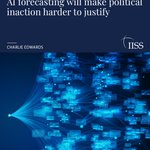





Artificial intelligence promises to improve intelligence forecasting. It could also make political decisions to delay preparing for a crisis harder to justify.
➡️ Read the latest analysis by Charlie Edwards: go.iiss.org/4yomWw3

A very special element of the IISS Manama Dialogue is the #MDYoungLeaders programme. Sponsored by @GCCSG and @UKinBahrain, the programme welcomes young professionals from across the Middle East to share fresh thinking on regional challenges | #IISS_MD26 Find out more: go.iiss.org/MDYLP26


Gold exports were legalised in Myanmar in 2018, with shipments made to Japan and South Korea, but they effectively stopped in 2020. That year, the government introduced stricter payment rules that were meant to counter money laundering, but which proved too impractical for exporters to comply with.
Meanwhile, large volumes of gold from Myanmar are being smuggled to India and increasingly to China, where it is accepted as a legal import despite the absence of recorded exports in Myanmar.
The latest IISS research analyses how conflict has shaped Myanmar’s gold supply chain.
Find out more: go.iiss.org/47ovBni

Post-patronage states' turn toward disempowering external actors is a structural response to dependence on a single guarantor, which creates vulnerability as well as resentment.
@eledinov analyses the relationship between the ‘Palace' and the ‘Road': go.iiss.org/3VQvtdt

With the recent announcement of SACEUR’s theory of victory, the EU should develop its own in response to Russia’s unconventional war on Europe.
It already has the means and legal instruments to coordinate a response across borders.
➡️Read the latest analysis by Charlie Edwards: go.iiss.org/4juP4de

To survive as geopolitical units and develop some form of strategic autonomy, major powers must internalise a more thorough integration of security and finance.
➡️ Analysis by @EAAHellendoorn: go.iiss.org/3VQvtdt

We are #hiring! Join our team in Washington DC:
💼 Office Manager, IISS-Americas
📆 Deadline for receipt of applications: 30 October 2026
We seek to appoint an Office Manager for the IISS-Americas office in Washington DC. This position will support the Managing Director in meeting the operational, management, and compliance requirements of a vibrant, fast-paced non-profit and work closely with colleagues in the London headquarters.
Apply here: go.iiss.org/3VGt850

IISS author, @maria_shagina, traces the transformation of Western economic statecraft and economic-security strategies, compares these developments with the evolution of Chinese and Russian approaches, and explores what this changing landscape means for governments and businesses operating in an increasingly contested geoeconomic environment.
Find out more: go.iiss.org/4s2GzIA

Prior to the war, the Gulf states perceived the US as a powerful, if fickle, partner whose commitment to them was often under strain. To mitigate the risk of US abandonment, the Gulf states sought to stabilise relations with the US by formalising US commitments to their defence and security.
Read the upcoming IISS Strategic Dossier's preview chapter ahead of the dossier's publication on 30 October 2026: go.iiss.org/4dMWQvp
IISS Manama Dialogue
30 October–1 November 2026
#IISS_MD26 | Go.iiss.org/MD26

Myanmar’s military-backed regime has sought to restrict several sources of revenue used by its opponents, including public donations and the alleged smuggling of goods from Thailand. It has also conducted airstrikes against dozens of opposition-held gold mines but on the ground, the regime has done little to stop the flow of fuel and equipment to mining sites or the flow of mined gold to major cities.
The regime's failure to clamp down is partly explained by corruption.
The latest IISS research analyses how conflict has shaped Myanmar’s gold supply chain.
Find out more: go.iiss.org/47ovBni

Minilateralism is a deliberate institutional choice whereby states select the size of the table, the composition of participants, the agenda and who is excluded.
@ash_sujata on why small clubs proliferate as multilateralism falters: go.iiss.org/3VQvtdt

Flávio Bolsonaro appears likely to become Brazil’s next president. His plans to tighten security, address organised crime and bring about closer alignment with the US could limit Brasilia’s strategic autonomy. However, domestic and economic realities may constrain his room for manoeuvre.
Read the latest analysis by Dr @_IreneMia: go.iiss.org/4e9us6H

The Czech defence industry is almost entirely privately owned, exports most of its output, and its rapid growth since 2022 has been driven by substantial funding from Western European governments seeking to buy military equipment for Ukraine. In 2021, Czech defence exports stood at USD0.64bn. By 2025, they were USD5.15bn – an eightfold increase in four years.
The IISS Strategic Dossier examines critical areas for improving NATO’s operational capability and Europe’s defence self-sufficiency.
FREE TO READ: go.iiss.org/4rfyYpG

IISS analysis of satellite imagery shows the extent to which US and Israeli strikes damaged two of Iran’s space-launch sites: one operated by the Iranian Space Agency and the other by the Islamic Revolutionary Guard Corps.
Read the latest analysis by @JosephHDempsey: go.iiss.org/4hMshIx

A rare keynote address on ‘Nuclear Deterrence and Strategic Stability in South Asia’ was delivered at the IISS in London by Lieutenant General (Retd) Mazhar Jamil – Adviser to the National Command Authority (NCA), Government of Pakistan, and former Director-General of the Strategic Plans Division (SPD) (2015–17) – at the 11th ‘track 1.5’ IISS–CISS workshop, on 13 October 2026. This was the first time a former Pakistan SPD chief had spoken in London since 2020.
Recording and transcript available: go.iiss.org/47ohb6F

With the recent announcement of SACEUR’s theory of victory, the EU should develop its own in response to Russia’s unconventional war on Europe.
It already has the means and legal instruments to coordinate a response across borders.
➡️Read the latest analysis by Charlie Edwards: go.iiss.org/4juP4de

Artificial intelligence promises to improve intelligence forecasting. It could also make political decisions to delay preparing for a crisis harder to justify.
➡️ Read the latest analysis by Charlie Edwards: go.iiss.org/4yomWw3

The war has exposed and exacerbated the differences in the Gulf states’ approaches to Iran, each informed by history, geography, risk appetite and strategic orientation.
The upcoming IISS Strategic Dossier examines the multifaceted implications of the 2026 United States–Israel war with Iran for the foreign policies and defence and economic priorities of the Gulf states.
Read the chapter preview ahead of the dossier's publication on 30 October 2026: go.iiss.org/4yYwHSE
IISS Manama Dialogue
30 October–1 November 2026
#IISS_MD26 | go.iiss.org/MD26

In this #JapanMemo, @RobertAlanWard speaks with Professor @nobu_akiyama, Dr Lami Kim and Dr Daniel Salisbury about:
➡️ China and North Korea's nuclear build-up
➡️ Japan's nuclear debate under PM Takaichi
➡️ US extended deterrence
🎧 Listen now: go.iiss.org/4jfOMqx | Transcript available.

Minilateralism is a deliberate institutional choice whereby states select the size of the table, the composition of participants, the agenda and who is excluded.
@ash_sujata on why small clubs proliferate as multilateralism falters: go.iiss.org/3VQvtdt
