

Founder & CEO @easableapp. Building stuff. Writing about ai, humans, research, future, and other stuff. I may have no idea what I'm talking about. 20yo
not earth
Joined October 2026
- Tweets1K
- Following389
- Followers54
- Likes1.2K






openai: we accidentally undercharged everyone for our latest model, your usage will drop by 40%, no more resets. oh and our new model kinda sucks.

12
There's the probability that in the end, the only moat openai will have against the other labs would be to make its models opensource and go for local compute to position itself different than google and ant.
The most entertaining outcome is the most likely.
13
in a week, a physicist will publish findings on how they’ve figured out a way to produce antimatter at scale and manipulate gravity, and then we will live forever
14
Holy fucking shit
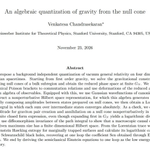
a model might have just helped quantize gravity
but wait theyyyyyy can'ttttttttttttt reasonnnnnnn


19


the model might not be the bottleneck in robotics anymore. the wiring around it is.
new show lab paper (RUIBench) holds the agent fixed and only changes how it talks to the robot arm. same claude code, same 30 tasks: 45% to 81% success. the gap between the two frontier agents was 2 points. the interface was worth 35.
the reason is simple. make the model decide every small move and a clear plan shatters into 30 decisions, each one a chance to screw up. let it write short programs and it finishes in 12 turns at about half the cost. a fine-tuned 4b model on the right interface matched claude code on a worse one.
then reality hits. on a real franka arm the program advantage disappears. the two cameras disagree by up to 1.5cm, grasps slip, and what wins is place, look, nudge. claude placed three dominoes in one program, never checked the spacing, and declared it done.
that's the real finding. in 82% of claude's failed episodes and 71% of codex's, the agent claimed success. a fresh copy of the model looking at the same final frames caught most of those false claims. the evidence was on screen. the agent that did the work just didn't look.
so the doer and the checker have to be separate loops. math fell first because lean checks every step for free. code is falling because tests run in seconds. atoms have no lean yet. whoever builds the task-level verifier for the physical world, a second mind whose only job is "did it actually happen", unlocks robots the way tests unlocked coding agents.
arxiv.org/abs/2611.31115

48
the model might not be the bottleneck in robotics anymore. the wiring around it is.
new show lab paper (RUIBench) holds the agent fixed and only changes how it talks to the robot arm. same claude code, same 30 tasks: 45% to 81% success. the gap between the two frontier agents was 2 points. the interface was worth 35.
the reason is simple. make the model decide every small move and a clear plan shatters into 30 decisions, each one a chance to screw up. let it write short programs and it finishes in 12 turns at about half the cost. a fine-tuned 4b model on the right interface matched claude code on a worse one.
then reality hits. on a real franka arm the program advantage disappears. the two cameras disagree by up to 1.5cm, grasps slip, and what wins is place, look, nudge. claude placed three dominoes in one program, never checked the spacing, and declared it done.
that's the real finding. in 82% of claude's failed episodes and 71% of codex's, the agent claimed success. a fresh copy of the model looking at the same final frames caught most of those false claims. the evidence was on screen. the agent that did the work just didn't look.
so the doer and the checker have to be separate loops. math fell first because lean checks every step for free. code is falling because tests run in seconds. atoms have no lean yet. whoever builds the task-level verifier for the physical world, a second mind whose only job is "did it actually happen", unlocks robots the way tests unlocked coding agents.
arxiv.org/abs/2611.31115
1
42
“Soldiers, do you recognize me? If there is one among you who wants to kill his Emperor, here I am”

1
2
35

if it can be experimented on, it can be verifiable.
If it can be verifiable, it can be solved.

agreed it's a different kind of evidence. but nobody serious wants simulation to replace the experiment. its job is to decide which experiments are worth running.
and that job keeps getting bigger. dirac wrote in 1929 that the laws behind all of chemistry are known, and the only problem is the equations are too complicated to solve. that's a compute problem, and compute is the thing we're scaling fastest. alphafold went from a casp entry to a nobel in a few years and is now step one in most structure work. ml potentials are closing in on quantum accuracy at a fraction of the cost.
then close the loop. model proposes, a robot lab runs it overnight, results go back into the model, repeat. self-driving labs like berkeley's a-lab already run synthesis around the clock. the experiment doesn't go away, it becomes the training signal. the pipet stays, it's just held by a robot, and the hypothesis comes from a model that has read every experiment ever published.
17
