
Security Researcher | Blockchain, AI & Robotics
Pakistan
Joined December 2013
- Tweets250
- Following896
- Followers81
- Likes78





Muhammad Idrees retweeted

A friendly reminder to take your crypto security seriously.
Start doing these things TODAY:
- Keep your long-term holdings offline.
Consider a hardware wallet or an air-gapped wallet on a dedicated offline device.
If you don't want to buy a hardware wallet, air-gapped storage is an alternative.
- Never use one wallet for everything.
Keep separate wallets for long-term holdings, trading, DeFi, airdrops, and unfamiliar protocols.
@Rabby_io and @phantom are the only wallets I use.
- Don't keep your entire portfolio in one place.
Avoid concentrating all your funds on a single CEX, hot wallet, protocol, or device.
- Don't use public Wi-Fi for crypto activity.
If you work from cafes or coworking spaces, use your phone's personal hotspot instead of connecting to public Wi-Fi networks.
- Protect your seed phrases.
Never store them in screens, cloud storage, emails, or password managers connected to the internet.
If your seed phrase has ever been stored on an internet-connected device - migrate to a fresh wallet NOW!
- Keep secure offline backups.
Store recovery backups somewhere safe, preferably with protection against fire/water and unauthorized access.
I recommend getting a fire-resistant and water-resistant document bag.
- Use a dedicated device for crypto.
Keep your hot wallets and high-value transactions on a separate device.
Don't use it for random downloads, gaming mods, unknown software, or everyday browsing.
- Use a separate browser for wallets.
Keep your wallet browser dedicated to trusted crypto activity.
Avoid unnecessary extensions and random websites.
- Never install cracked software on crypto devices.
Pirated applications, fake installers, and malicious updates can contain wallet-stealing malware.
If you need to run untrusted software, keep it completely isolated from your crypto environment.
- Keep your devices updated.
Update your OS, browser, and wallet software through official sources.
- Remove unnecessary browser extensions.
Even legitimate extensions can become dangerous after a compromised update or ownership change.
Keep only what you absolutely need.
- Stop using Google Search to find crypto websites.
Fake websites and malicious sponsored results can look almost identical to legitimate ones.
Use independently verified official links from bookmarks instead.
- Don't open random links from X or Telegram.
Especially not in the browser where your wallets are installed.
Never!!!
- Secure your CEX accounts.
Use passkeys or hardware security keys where supported.
Enable withdrawal address whitelists and avoid relying on SMS 2FA.
- Consider getting a YubiKey.
A physical security key can help protect your email and exchange accounts against phishing.
Buy only from the official manufacturer sellers.
- Review your Google-connected crypto accounts.
Check which crypto services use Google Sign-In.
Never disconnect your only login method without setting up an alternative first.
- Revoke unnecessary token approvals.
Use @RevokeCash to review and remove permissions you no longer need.
Disconnecting a wallet from a dApp does NOT revoke its token approvals.
- Avoid unlimited token approvals.
Whenever possible, approve only the amount you actually need.
Unlimited allowances can expose much larger balances if a spender is compromised.
- Review Permit2 permissions.
Permit2 signatures can authorize token transfers without a normal on-chain approval transaction.
Review existing allowances and permissions. Some malicious signatures can be exploited long after they're signed.
- Never blindly sign messages.
A signature doesn't need to cost gas to be dangerous.
Never get distracted while signing transactions. Either finish your transactions first or take care of everything else before you start.
Make this a rule.
- Be careful with custom RPC endpoints.
Don't add/delete now unknown RPC URLs.
Use trusted providers and verify network settings independently.
- Understand EIP-7702 authorization risks.
On supported networks, account delegation can grant powerful capabilities to other code.
Never approve an account delegation you don't understand. (That's why Binance was hacked)
- Never copy addresses blindly from transaction history.
Address poisoning attacks can place lookalike addresses in your transaction history.
Verify the full destination address against a trusted source.
- Watch out for clipboard malware.
Malware can replace a copied wallet address with an attacker's address.
Always verify the entire destination address after pasting, preferably on an independent trusted display.
- Verify token contracts and networks.
A familiar ticker or logo doesn't prove a token is legitimate.
Check the contract address and make sure the receiving platform supports the exact asset and network.
- Test large transfers first.
When sending funds to a new destination, start with a small test transaction.
- Ignore unexpected tokens and NFTs.
Random assets appearing in your wallet may contain phishing links or fake reward claims.
Don't interact with them just because they appeared in your balance.
- Don't trust unexpected job offers or collaboration requests.
Fake interviews, partnership offers, and test applications can be used to distribute wallet-stealing malware.
Never run unfamiliar software on your crypto device just to qualify for an opportunity.
- Never run terminal commands you don't understand.
Fake troubleshooting guides, verification pages, and job interviews may ask you to copy and paste commands into your terminal.
One malicious command can compromise your entire device, including your wallets.
- Never trust a QR code blindly.
QR code can contain a malicious website, payment request or an attacker's wallet address.
Avoid scanning unknown QR codes with devices that contain your crypto wallets or other sensitive data.
- Understand bridge and DeFi risks.
Before depositing significant funds, check contract upgradeability, admin privileges, timelocks, and bridge security assumptions.
Audits are useful, but they don't guarantee safety.
- Secure your multisig properly.
If you use @Safe or another multisig, keep signer keys on independent devices.
Review owners, signing thresholds, modules, and guards.
A malicious module may bypass normal multisig approval requirements.
- Monitor your wallets.
Set up alerts for unexpected transfers, approvals, and other sensitive activity where supported.
Use Codex/Claude to vibe-code a simple TG-bot that notifies you whenever something happens in your wallets.
- Have an emergency recovery plan.
Know what to do if a wallet, seed phrase, device, or exchange account is compromised.
If your seed phrase is exposed, move your assets to a new wallet generated from a fresh seed on a trusted device.
Revoking approvals alone won't fix a compromised private key.
- Keep your crypto holdings private.
Avoid publicly revealing wallet balances, screenshots of large portfolios, or details of your security setup.
Don't make yourself an easy target for social engineering or physical theft.
- Protect yourself from SIM swapping.
Attackers can hijack your phone number and intercept SMS verification codes.
Use authenticator apps, passkeys, or hardware security keys instead of SMS wherever possible. Secure your mobile carrier account too.
- Don't blindly trust familiar contacts.
A message from someone you know doesn't mean their account is still under their control.
Verify it through another channel first.
- And one last thing:
You don't need to be paranoid.
You just need to make it much harder for someone to steal what you've spent years building.
Protect your capital before you think about growing it.
Muhammad Idrees retweeted

Binance hot wallets lost ~$6.28B across 8 chains today. $6.07B went in the first 55 minutes, and the attacker kept re-sweeping one Ethereum wallet for two more hours.
Since then Tether, Circle, Ripple, Paxos, World Liberty and Binance have frozen ~$2.80B. About $3.27B can still move, mostly BTC and ETH.
I traced it all on-chain, including how the attacker raced the freezes 🧵


Muhammad Idrees retweeted

Our AI found a bug that let anyone mint infinite XRP, with $94B at risk. It had been hiding in one of the most audited codebases in crypto for nearly a decade, and earned us the maximum $250K bounty.
Here's how it went unnoticed, and how we found it.

Muhammad Idrees retweeted

better security, more confidence to ship.
@VulsightSec is now supporting Superteam Black teams with security reviews, audits, and direct support from their team.
another strong resource for founders as they scale.
dm us for access

Muhammad Idrees retweeted

The Avici attacker turned $190 into $670000 🔥
Wallet created yesterday at 13:40 UTC. Funded with $190 USDC bridged from Ethereum - just enough for gas. Drain started at 16:49. 8,857 transactions and counting.
Same pattern on every account:
1. submit a signature bundle
2. call AddCollateralAdmin and make yourself admin
3. withdraw
The second signature check pointed back at instruction 0. Solana verified the attacker’s own signature a second time. The program credited an admin key it should never have accepted.
That put the attacker as admin on 1,100+ collateral accounts.
Median take: $24. Largest in sample: $5,268.
First batch of ~$576K left the wallet between 18:19 and 18:34 UTC. The wallet kept filling after that.
This was not a treasury drain and not a stolen upgrade key. Every dollar came out of individual user accounts, one at a time.
Muhammad Idrees retweeted

Zero Cool recently published UniV4 Hook Harbinger, a new Zero Skill built to hunt for the recurring security failures that Uniswap v4’s PoolManager cannot guarantee against.
It probes hook permissions, pool isolation, custom accounting, settlement, dynamic fees, callbacks, and more, then tests how those risks compose across the protocol.
See the attached post for more details.

Muhammad Idrees retweeted

Make something agents want

introducing anydoc
now your agents get 100x faster local parsing for pdf, docx, pptx & 10 more formats
- sub-5ms md conversion
- 500 docx files in 1.7s
- top quality across all 13 formats
- rust-based
- open source
already powering @firecrawl /parse
github.com/firecrawl/anydoc
Muhammad Idrees retweeted

You don't get operated on by a hospital
You get operated on by a surgeon
Security audits work the same way: a brand signs the report, but specific individuals read your code
We just wrapped ours. Here's how we picked 🧵

Independent security review: complete. ✅
@VulsightSec ran an adversarial-style audit of the smart-account contracts that enforce Elios self-custody on HyperEVM.
Your funds stay yours until you spend them. Not policy, code. And we'll keep having independent experts attack that code.🔒

Muhammad Idrees retweeted

Engagement complete ✅
Vulsight performed an adversarial-style security audit of @eliospay's smart-account modules on HyperEVM: the ERC-7579 validator and hook enforcing their self-custodial model.
Sharp team, deep command of their own stack, and a security-first posture from day one. Great engagement.


Muhammad Idrees retweeted
Your dollars. Your savings. Your future. Yours to hold - not someone else's to sit on.
100 million Pakistanis were handed a system built to test their patience. We built one that respects it.
No limits. No delays. No one in the middle.
5 apps. Now 1. Handle 🇵🇰
Muhammad Idrees retweeted

what is agent looping
for the last two years we prompted agents one task at a time. that is starting to change
instead of asking an agent to build the landing page and then driving every step yourself, you set up a loop that handles discovery, planning, the work, checking, and iterating until the goal is met
looping is a setup you build. almost any agent harness can run it, it just depends on how you wire it up
at its simplest, looping is one agent working on itself:
> researches
> drafts
> checks the draft against a goal
> fixes what is weak
> runs that cycle again until the work clears the requirements
you are not prompting each step anymore. the agent repeats the cycle for you
the bigger version is a fleet looping. you give an orchestrator agent a goal, it breaks the goal into pieces, hands each piece to a specialist agent, and those specialists hand smaller jobs to their own subagents
the whole tree keeps looping through discovery, planning, execution, and verification until the goal is met
one agent looping is like a person redoing their own draft. a fleet looping is a whole team running a project end-to-end
you create a goal, and the system runs the loop until it finishes within the reqs you set
open and closed looping:
OPEN LOOPING is exploratory. it still has conditions and a goal, but you give the agent or the fleet a wide space to move in. it can try different paths, discover things, build something you did not fully spec out
this is the exciting end, it is what Peter and others are doing, and tbh it is where I want to spend more time
the catch is cost, an open loop with real room to explore burns an insane amount of tokens. for the 90 percent of people without an unlimited budget it is not runnable yet, and pointed at projects with a loose standard it turns into a slop machine
CLOSED LOOPING is bounded. a human designs the end-to-end path first:
> clear goal
> defined steps
> an eval at each step
> a point where it stops or hands back to you (and feeds back performance data)
the agents still loop, but inside framework you built. it gets better every run because each pass feeds the next, and it runs on a normal budget because the path is tight.
for most marketing work, closed is the one that pays off today.
> the orchestrator owns the goal
> the specialists own the steps
> the subagents do the narrow work
> an eval gate make sure its not slop


Muhammad Idrees retweeted

Agents need better tools for reversing! I'm releasing declib (previously libbs), with a new CLI today that gives agents CLI access to 4 decompilers (IDA, Ghidra, Binja, angr), parity feature support to most MCP (12 features), and the ability to sync those changes across decs!
Muhammad Idrees retweeted

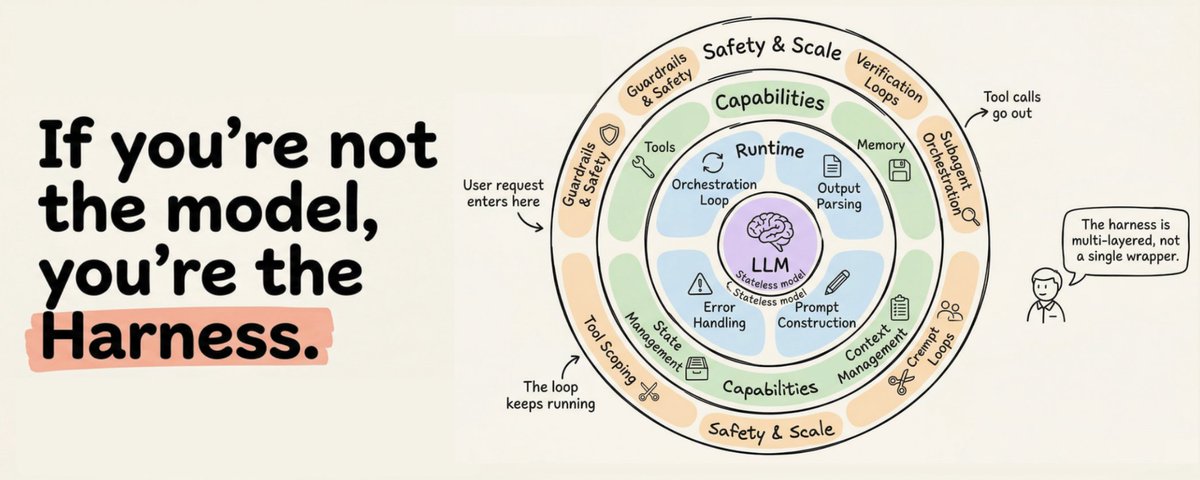
A harnessed LLM agent, clearly explained!
Most people picture this as a model with tools bolted on. The real architecture inverts that relationship.
The model itself is deliberately thin. Intelligence gets pushed outward, and the harness composes it at runtime.
Three dimensions orbit the harness core:
- 𝗠𝗲𝗺𝗼𝗿𝘆 holds the state a model shouldn't carry in weights or context. Working context, semantic knowledge, episodic experience, and personalized memory each have their own lifecycle.
- 𝗦𝗸𝗶𝗹𝗹𝘀 hold procedural knowledge. This can cover operational procedures, decision heuristics, and normative constraints that specialize the general model per task.
- 𝗣𝗿𝗼𝘁𝗼𝗰𝗼𝗹𝘀 hold the interaction contracts. Agent-to-user, agent-to-agent, and agent-to-tools are three distinct surfaces with their own failure modes.
Between the core and these modules sit the mediators, like sandboxing, observability, compression, evaluation, approval loops, and sub-agent orchestration.
They govern how the harness reaches out and how state flows back in.
The useful question this framing unlocks is: for any new capability, where should it live?
- Stable knowledge goes to memory
- Learned playbooks go to skills
- Communication contracts go to protocols
- Loop governance goes to the mediators
Harness design becomes a question of what to externalize, and how to mediate it.
I'm building a minimal agent harness from scratch and will open-source it soon.
In the meantime, my co-founder wrote an article about the anatomy of Agent Harness, covering the orchestration loop, tools, memory, context management, and everything else that transforms a stateless LLM into a capable agent.
Read it below.



Muhammad Idrees retweeted

THIS GUY JUST BUILT A DRONE THAT TRACKS TARGETS WITH A LASER USING CLAUDE
> No robotics team
> No engineering degree
> No budget
He used Claude Code to write the entire system in Python - a drone that locks onto a target, follows it with a laser and corrects its own aim automatically after every attempt.
The AI gets more accurate the longer it runs because it learns from every single shot.
He's still improving it and this is only the beginning.
You have the same tool he used.
The article below is about how to actually use it to its full potential.


Muhammad Idrees retweeted

Drafted a detailed list of all Hidden and unreleased features! Hail Opus!!
Claude Code — Hidden & Unreleased Features
cc-hidden-deploy.vercel.app/
cc-poster.vercel.app/

Muhammad Idrees retweeted

"A lot of intelligence is in how we reason, perceive, understand, and interact with the 3D spatial world."
Fei-Fei Li says human intelligence boils down to two buckets—language and spatial—but spatial is the key to unlocking the robotic revolution:
"The application is so wide. You can imagine this technology will help our doctors with patients. For example, elderly people living at home using spatial intelligence and assistive technology. We can help assess their health, medical situation, and life-threatening events."
"From a geopolitics point of view, this is part of the technology that goes straight into weapons. Whether it's drones or devices. It's also the technology that leads to robotic intelligence because every robot is a moving agent, including your Roomba, which is not very smart."
"As a moving agent, just like humans and animals, we use spatial intelligence to move around the world and interact with the world. When this technology is ready, the robotic revolution is going to start."
@drfeifei with @StanfordHAI