

Political Correspondent @MiddleEastEye. Author of The Indian Caliphate (2025) and The Crescent and the Commons (2027). Winner, Press Awards 30 Under 30 in 2025.
England, United Kingdom
Joined May 2017
- Tweets5.1K
- Following1.4K
- Followers9.4K
- Likes49.8K





Pinned Tweet
My book reviewed in the Wall Street Journal:
"An exceptional feat of investigative research... [Depicts] the historical moment when the modern overpowered the ancient—a world, now lost, of floridly costumed courtiers, fabled princes, exotic vices and perfumed palaces"


Imran Mulla retweeted

Analysis: UK Muslims face highest rate of hate crimes but police figures undercount them middleeasteye.net/news/analy…

Imran Mulla retweeted

I write on Sharjeel Imam as a committed democrat who deserves a place in a radical democratic project of the future, one focused on the liberty and equality of all.
telegraphindia.com/amp/opini…


Imran Mulla retweeted

We all know about Man City, but how much of UK does the UAE really own?
I investigated for @MiddleEastEye. Tracing Emirati-linked holdings in the UK took me from the glitz of Mayfair’s Berkeley Square to the pub and back, via the high street pound shop.
Thread below 1/

Imran Mulla retweeted

goethe was 65 when he read hafez in translation, called him his twin and wrote back to a man who’d been dead in shiraz for four hundred years with the west-östlicher divan. a century later iqbal read the divan, understood it as a letter and answered goethe with payam-e-mashriq.
Imran Mulla retweeted

Assam carried out a series of eviction in three districts demolishing the homes of more than 1,100 Muslim families living in the unauthorised land for decades.
"We were settled by the government in 1974,” Abdul Noor, a 44-y-o whose home was demolished.
scroll.in/latest/1096486/ass…

As @SarahHelm1 comes under ferocious attack, read her extraordinary piece for us @MiddleEastEye - an in-depth interview with the son of one of Israel's founding fathers, who explained how he had come to regret the entire Zionist project:
middleeasteye.net/big-story/…

Imran Mulla retweeted

Delighted to be able to write this piece for @EngelsbergIdeas on the Sufi ‘Abd al-Ghani al-Nabulusi and the Islamic Enlightenment. engelsbergideas.com/essays/i…

Exclusive: The UK’s largest “sharia-compliant” fund, HSBC’s Islamic Global Equity Index Fund, has purchased more than $100m worth of shares in 5 companies linked to the Israeli military in the first half of this year, a @MiddleEastEye analysis can reveal
middleeasteye.net/news/hsbc-…

The result is a victory for Burnham's Labour, but less of a catastrophe for Polanski than many of his critics are claiming.
With a volatile electorate there are clear signs that the Green Party can be optimistic about its potential for future growth:
middleeasteye.net/news/why-n…

EXCL: The British government wouldn't comment today after the Israeli foreign minister accused the UK of freezing "military dialogue and security cooperation" with Israel.
This was an extraordinary claim, for which there is no publicly available evidence:
middleeasteye.net/news/uk-wo…

Imran Mulla retweeted

Looks like it's all up, for the time being at least, with the British consulate in occupied East Jerusalem. It's been open for business since 1838.
middleeasteye.net/news/uk-co…


Imran Mulla retweeted

Very glad to have written my debut essay for @KasurianMag as the third piece for the trilogy on Jadidism.
It follows the journey of a Jadid intellectual through the tumults of the early 20th century, from the Ferghana Valley to Bukhara’s madrasas and Ottoman Istanbul, where the movement finds its way to Afghanistan, a country where the story wasn’t supposed to unfold. In a nation gripped by its own struggles over modernity and power, he played a foundational role in building its nascent education system and wrote its first modern short story, Panzdah Sal Qabl (Fifteen Years Ago).

How does a reform movement survive losing its homeland?
In A Son of Two Soils, Younus Ejazi traces the life of his great-grandfather, Hashim Shayeq: a Bukharan Jadid who came to Kabul as a diplomat and stayed to help build Afghanistan’s schools and literary culture.
The Jadids believed Muslim societies could secure their sovereignty through knowledge. They sought to reform schools, revive the press, and master the sciences of the age. Trained in Bukhara’s madrasas and Istanbul’s institutes, Shayeq carried that conviction into a world of collapsing empires and emerging states.
After securing control of its foreign affairs in 1919, Afghanistan sought teachers and expertise beyond its borders. Ottoman officers, printers, doctors, and engineers were already helping develop its institutions. As Soviet rule extinguished Bukharan autonomy, Kabul offered Shayeq a place to continue his work.
For three decades, he helped shape curricula, taught students, and led a bureau of compilation and translation. His journal, Ayna-i Irfan, introduced readers to science, philosophy, and literature from abroad. In its pages, he also published what is often considered Afghanistan’s first modern short story.
Kings fell, friends were executed, and educational reforms were curtailed. Shayeq continued teaching. His life follows the patient work through which a displaced generation’s ambitions found a home in the schools, books, and intellectual life of another country.
Read more on Kasurian. Link below:

Imran Mulla retweeted

Beyond the fact that the closure of the British consulate in East Jerusalem - occupied Palestinian territory - is not in Israel’s prerogative, it is yet another attempt by this far-right Israeli government to block a two-state solution.
It is illegal, and the UK must resist it.

Foreign Affairs Committee chair Emily Thornberry urges Andy Burnham to defy Israel over closure of British consulate. I report from occupied East Jerusalem for Middle East Eye:
middleeasteye.net/news/labou…

Imran Mulla retweeted

@Imran_posts you are prolific!

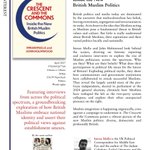
I'm delighted to announce my new book 'The Crescent and the Commons: Inside the New British Muslim Politics', co-authored with John Holmwood.
It's built on forensic, behind-the-scenes reporting on one of the most contested issues of our time.
Coming soon with @HurstPublishers!
