



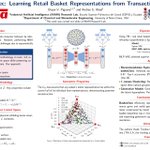


ALT Deep learning models tackle complex, high-dimensional data by first compressing it into a simpler, more meaningful summary called a latent space. Using autoencoders, the model learns to shrink data down to its essential features and then reconstruct it. This process forces the model to understand the underlying patterns in the data, making it much easier to work with. This compressed representation is incredibly powerful in the real world. For example, it enables scientists to design and optimize new molecules by performing simple operations in the latent space. In industry, this concept was used to create basket2vec, a system that analyzes millions of shopping baskets to build highly effective recommendation engines and better understand customer behavior. In essence, latent spaces transform messy, complex information into a clean, structured format where powerful analysis and generation can occur.


