

Publishing books on spirituality, the occult, ancient mysteries, new science, psychedelics, holistic health, and natural medicine since 1975.
Rochester, VT
Joined March 2009
- Tweets8K
- Following2.4K
- Followers7.1K
- Likes4K




The “white crow” argument is a simple way to understand why exceptions matter. If someone claims that all crows are black, one reliably documented white crow is enough to show that the rule cannot be universally true. The exception does not tell us how many white crows exist, why one is white, or what every other crow looks like. It does show that the original claim needs revision.
William James used this logic to defend the study of anomalies: reports that appear to challenge accepted assumptions about mind, matter, perception, or time. His point was methodological. A researcher does not need to prove that every unusual report is genuine before investigating the strongest cases. The first task is to establish whether even one apparent exception can withstand careful scrutiny.
That standard matters. A striking story, personal conviction, or unusual coincidence does not automatically become a white crow. The case needs documentation, independent checks where possible, reliable dates and records, attention to alternative explanations, and a clear account of what remains uncertain. A claimed exception that fails those tests cannot overturn a general rule.
In "Anomalous Phenomena," Keith Thompson applies the metaphor to what he calls “veridical anecdotal evidence”: reports that are vivid to witnesses and may be supported by sources such as legal records or witness logs. He discusses contested cases involving dreams, unusual lights, and purported communications, while acknowledging explanations such as coincidence, fraud, or telepathy among the living.
The white crow argument does not ask anyone to accept extraordinary claims on demand. It asks a sharper question: if one well-documented exception remains after serious investigation, does the existing rule still explain the full range of evidence?
Read "Anomalous Phenomena" by Keith Thompson—available now from Inner Traditions and wherever books are sold.
bit.ly/4d0czGR


Why are we drawn to symbols that unsettle, frighten, or challenge us?
In this clip, author Carl Abrahamsson explores the attraction to figures such as the devil and Loki, and why confronting the “dark side” can be part of rebellion, self-discovery, and the lifelong process of becoming who we truly are. Rather than simply accepting what we are taught, he suggests that we must sometimes embark on our own vision quest to find our path.
▶️ Watch the full interview to hear Abrahamsson unpack the deeper meaning behind our fascination with dark and controversial symbols: bit.ly/47g9G1i
📚 Learn more in "Occulture," Carl Abrahamsson’s exploration of the hidden currents connecting occultism with art, music, film, literature, and popular culture. Get your copy today: bit.ly/4h7UxoG
#Occulture #CarlAbrahamsson #OccultCulture #Esotericism #DarkSymbols #ShadowWork #SelfDiscovery #Individuation #AleisterCrowley #Loki #OccultHistory #InnerTraditions
What is bodhichitta? In Tibetan Buddhism, bodhichitta translates to the “mind of enlightenment.” It is the altruistic combination of impartial love, compassion, and the profound wish to attain enlightenment for the benefit of all sentient beings. According to this tradition, beings wander continuously through the cycle of life because they grasp at an illusory reality, pursuing one mirage after another. Bodhichitta is generated to help all beings relax into intrinsic awareness.
The teachings describe two main aspects of this principle: relative and absolute. Relative bodhichitta is the active wish to achieve liberation in order to help others. This is divided into wishing bodhichitta and actualizing bodhichitta. Wishing bodhichitta involves contemplating four boundless states: love, compassion, joy, and equanimity. It requires feeling this motivation deeply throughout your entire being, what Tibetans describe as feeling it in the mind, heart, and chest. Actualizing bodhichitta occurs when that internal motivation shines outward into daily physical and mental actions. Absolute bodhichitta is the true nature of mind itself. It is the open, vast clarity recognizing that all beings are primordially enlightened.
In "The Tibetan Buddhist Practice of Phowa," Ven. Khenchen Palden Sherab Rinpoche and Ven. Khenpo Tsewang Dongyal Rinpoche explain how these principles support meditation and the transition of death. The authors note that if absolute bodhichitta is difficult to grasp at first, beginners can steadily cultivate the relative wish for the well-being of family, friends, and their community. This focus causes the mind to gradually become more relaxed and peaceful, naturally expanding into the absolute state of awareness over time.
Understanding this term clarifies why this tradition emphasizes practical care in the present moment. The practice matters because it offers a structured, accessible way to transform everyday relationships into deep spiritual realization.
Read "The Tibetan Buddhist Practice" of Phowa by Ven. Khenchen Palden Sherab Rinpoche and Ven. Khenpo Tsewang Dongyal Rinpoche, available now from Inner Traditions and wherever books are sold.
bit.ly/4iKFMcy


Before it addresses desire between two people, the Kama Sutra addresses the formation of the person who desires. Its opening chapters set out sixty-four arts a cultivated man or woman is expected to know, and pleasure, in this text, grows out of that cultivation rather than apart from it.
The list ranges wide: singing and instrumental music, dancing, painting, and the arrangement of flowers into garlands sit beside perfumery and the blending of scents for body and home. Cookery, gardening, and a working knowledge of gems and metals appear alongside verse composition, skill in conversation, and games of wit and memory. Even small accomplishments, teaching a parrot to speak, solving a riddle, are named among them.
Read together, the list makes a quiet argument. A person capable of shaping a garland or turning a verse has trained an attention that carries into every other exchange with another person. The arts double as practice in the patience, precision, and care that character requires.
Choose one modest art from this range, arranging flowers, composing four lines of verse, blending a simple scent, and practice it once this week with real attention. Notice what the discipline of the small craft asks of you.
"The Complete Illustrated Kama Sutra," researched and archived by Lance Dane across five decades in India, gathers this teaching with 269 illustrations drawn from museums and collections worldwide. Written for readers curious to see a text on desire begin instead with an argument for a well-rounded, cultivated life. Available from Inner Traditions and wherever books are sold.
bit.ly/4y344DH


"Three Books of Occult Philosophy," Heinrich Cornelius Agrippa’s seminal guide to the hidden structure of the cosmos, brings together magic, astrology, number, symbolism, and natural philosophy in one of the great master texts of the Western esoteric tradition. Both visionary and systematic, it offers a disciplined account of how the visible and invisible worlds reflect one another.
Readers will discover how celestial forces, sacred numbers, elemental correspondences, images, language, music, and the human soul participate in a living metaphysical order, and how magic was understood as a rigorous art rooted in divine proportion and cosmic harmony.
This book is for serious students of occultism, Hermetic thought, alchemy, Renaissance philosophy, and the history of esoteric science. It is also for readers who want to move beyond modern simplifications and encounter a foundational work that still shapes the language and practice of Western magic.
Order now to explore the foundations of occult philosophy. Available now from Inner Traditions and wherever books are sold.
bit.ly/4uYVe7I
#OccultPhilosophy #HeinrichCorneliusAgrippa #WesternEsotericism #Hermeticism #Alchemy #EsotericBooks #OccultStudies #SpiritualWisdom #Mysticism #MagicAndAlchemy #InnerTraditions #SacredKnowledge #Metaphysical #EsotericScience #HiddenWisdom


As awareness of ibogaine continues to grow—and political, clinical, and cultural conversations around its therapeutic potential gain real force—“Ibogaine and the Bicameral Mind” arrives as an essential and authoritative work for this moment.
Drawing on decades of clinical experience, traditional knowledge, and interdisciplinary research, Jonathan Dickinson offers one of the most comprehensive examinations of ibogaine to date. Bridging neuroscience, consciousness studies, trauma treatment, and the sacred traditions that have preserved this medicine, the book expands the conversation far beyond hype and headlines.
Praised by leading voices in psychedelics, mental health, and the veteran community, this book is for anyone seeking a serious, informed understanding of why ibogaine is becoming central to the future of addiction treatment, trauma recovery, and mental health.
Pre-order your copy.
bit.ly/4xd5ETf
#IbogaineAndTheBicameralMind #Ibogaine #Psychedelics #MentalHealth #TraumaHealing #Consciousness #AddictionRecovery #HealingTrauma #Neuroscience #SpiritualHealing


Before you count breaths, lengthen an exhale, or try a named technique, there is a simpler practice: notice what is already happening.
Where do you first feel an inhale? At the nostrils? In the throat, chest, side ribs, belly, or back? Does the breath arrive smoothly, or does it hesitate? Does the exhale release on its own, or is there effort in the jaw, shoulders, throat, or abdomen?
Yoga calls this kind of inward attention interoception, which is the ability to sense internal bodily experience. Breath offers a particularly immediate field for it. Incoming air may feel relatively cool at the nostrils; outgoing air may feel warmer. The ribs may widen evenly or more on one side. The abdomen may expand freely, barely move, or tighten before it needs to. None of these observations requires correction. They provide information.
The quieter moments between breaths are worth noticing, too. After an inhale, there may be a brief moment before the exhale begins. After an exhale, another moment may appear before the next inhale. Let those pauses occur naturally. Their quality can be revealing: settled, rushed, spacious, uneasy, or almost imperceptible.
This is why breath awareness comes before more deliberate pranayama. It establishes a baseline. It can show how posture, activity, emotion, and attention affect breathing from one moment to the next. A tight neck, a hurried exhale, or uneven movement through the ribs may simply invite a change in position or a decision to leave the breath alone.
In "Breathing: The Art and Science of Pranayama," Mark Stephens builds from this observational foundation before introducing more structured breathing methods. He suggests beginning in a supported position, allowing the breath to remain effortless, and refining attention gradually: first to airflow, then to movement, then to the complete cycle.
The point is not to produce an ideal breath. It is to become more accurate about the breath you have.
Read "Breathing: The Art and Science of Pranayama" by internationally renowned Yoga Teacher Mark Stephens—available now from Inner Traditions and wherever books are sold.


Ink makes it possible to leave marks on different media, recording a specific moment of life and history through graphic representation. In magical practice, writing is used to give prayers, spells, invocations, and intentions a material form.
A grimoire may gather formulas and ritual knowledge over time. Parchment may hold an intention, a magic word, a sigil, a seal, or a rune. Sacred symbols can be carved into a candle and marked with ink. Ink may also be used in the creation of talismans, amulets, spell jars, and magical salts. Each application joins a written or drawn sign to a particular ritual purpose.
The words chosen for a formula have their own place in the operation. They express the will to act and help direct energy toward the desired objective. Spoken, sung, or chanted formulas establish a magical connection and project a wish or intention. The writing of a spell therefore belongs to the magical action itself.
In a luck ritual, a practitioner writes an intention on parchment with magical ink and draws a seal or symbol associated with prosperity. The parchment is placed in the magic circle. Hands are held over it while a formula is recited. The page is folded by bringing its corners toward the center, sealed with candle wax, and then kept in a wallet or purse.
The marked page remains connected to the purpose for which it was prepared. In other operations, writing may be dissolved in moon water or holy water as part of breaking a spell. Ink, parchment, speech, and ritual gesture work together, each carrying its own part of the operation.
"Grimoire of Magical Inks" by Noémie Myara considers the ritual uses of writing, from the grimoire and the spell formula to sigils, seals, parchment, talismans, and magical creations.
Read "Grimoire of Magical Inks: Recipes for Hexes, Hoodoo, and High Magic" by Noémie Myara, available now from Inner Traditions and wherever books are sold.
bit.ly/4zTBEx7


The current consensus in neuroscience is that long-term memory is stored entirely within the brain through a process called synaptic plasticity. Under this model, memories cannot exist without a nervous system. But striking cases in medical history suggest that memory and identity are much more ubiquitous phenomena.
Following major organ transplants, particularly heart transplants, some recipients undergo radical shifts in personality, dietary preferences, and even sexual orientation that precisely match those of their deceased donors, often before the recipient has any knowledge of the donor’s identity. In one famous 1988 case, a health-conscious dancer received a heart-lung transplant from an 18-year-old male and suddenly developed uncharacteristic cravings for beer and chicken nuggets; foods her donor loved.
In another documented case, a gay woman who regularly ate fast food received the heart of a young vegetarian. Following the surgery, the recipient developed a severe physiological aversion to meat and a newfound heterosexual attraction. Some recipients even report explicit, autobiographical nightmares mirroring the donor's fatal accidents or murders, such as feeling the crushing impact of a car crash in their chest.
Biologists have attempted to explain this through "cellular memory," suggesting that non-neural tissues can store information via bioelectric fields, a capacity observed in experiments with regenerating flatworms. However, researchers are also exploring a consciousness psi hypothesis: that a donor's consciousness remains tethered to the organ and, through a principle of mutual identification, directly interfaces with the recipient's neural networks.
These cases challenge the assumption that identity is strictly a brain-based phenomenon, suggesting instead that the brain acts as an interface for a much broader field of information.
Read "Stranger and Stranger" by Richard Silberstein, PhD—available now from Inner Traditions and wherever books are sold.
bit.ly/4rmMdVF


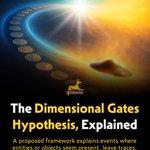
The Dimensional Gates hypothesis is a proposed way of interpreting reports in which an unusual entity, light, or object seems physically present, leaves a trace, and then disappears without an observable path. It does not establish that other dimensions exist or explain any specific event. It names a question raised when the available evidence appears incomplete.
Investigators confronting such reports begin with the ordinary possibilities: misidentification, unreliable memory, environmental conditions, hoaxing, incomplete observation, or an animal or object that simply escaped detection. They also document what can be checked: witness timelines, photographs, video, footprints, hair samples, ground marks, and radar data. When those records contain gaps—such as tracks that stop abruptly or an object that appears to vanish—the cause remains unresolved.
Former Navajo Nation Rangers Stanley Milford Jr. and Jonathan Dover used “dimensional gates” as a hypothesis after comparing reports of Bigfoot, UFOs, and skinwalkers. In one account, investigators found a 21-inch footprint with a five-foot stride, collected hair identified as an “unknown carnivore,” and reviewed grainy footage said to show a figure fading into the ground. They also examined reports of aerial lights that left impressions or appeared on radar before disappearing. Milford described a hypothesis as an educated guess rather than a final conclusion.
In "Anomalous Phenomena," Keith Thompson presents this framework alongside the Rangers’ evidence-based fieldwork and their engagement with Navajo teachings about layered worlds. Their method combined measurements, witness statements, casts, photographs, and cultural context without claiming that the proposed explanation had been proven.
The Dimensional Gates hypothesis matters because it separates a documented or reported trace from a settled mechanism. It keeps investigation focused on what can be tested, while acknowledging what has not yet been explained.
Read "Anomalous Phenomena" by Keith Thompson—available now from Inner Traditions and wherever books are sold.
bit.ly/4d0czGR


Discover the ancient wisdom growing all around you. In "Plant Power," ethnobotanist Wouter Bijdendijk explores 30 remarkable plants and mushrooms, from reishi and turmeric to blue lotus, through the lenses of tradition, ritual, wellness, and the natural world. With 60 vegetarian recipes from Michelin-star chef Joris Bijdendijk, it’s an invitation to bring plant knowledge to your table and reconnect with the living earth.
"Plant Power" is available wherever books are sold.
bit.ly/4hkzmyn
#PlantPower #Ethnobotany #HerbalWisdom #MedicinalPlants #MedicinalMushrooms #PlantBasedLiving #Herbalism #InnerTraditions
What are the bardos in Tibetan Buddhism? The Tibetan word bardo means an intermediate, or “in-between,” state. In Tibetan Buddhist teachings, bardos describe the transitions associated with dying, post-death experience, and rebirth.
The first is the bardo of the moment of death. Vajrayana teachings describe the body’s elements—earth, water, fire, wind, and space—as gradually dissolving. This process is associated with changes in physical and mental experience: heaviness, thirst, loss of warmth, slower movement, altered breathing, and shifts in awareness. After the final outer breath, four inner experiences are traditionally named: manifestation, increase, attainment, and full attainment.
The next stage is the bardo of true nature. In this tradition, clear light, or luminosity, is said to appear. For people trained in Dzogchen or related meditation practices, this can be understood as an opportunity to recognize the true nature of mind. The teachings emphasize that this experience may be brief.
Then comes the bardo of becoming: the transitional period before a new birth. It is traditionally described as variable in length. Forty-nine days is often given as an average, although the period may be shorter or longer. This sequence concludes with the bardo of birth and living.
"The Tibetan Buddhist Practice of Phowa" by Ven. Khenchen Palden Sherab Rinpoche and Ven. Khenpo Tsewang Dongyal Rinpoche explores these teachings through the Longchen Nyingtik tradition. It also introduces phowa, a practice of transferring consciousness at death for practitioners who have received the necessary preparation and guidance.
The bardos offer a Tibetan Buddhist framework for approaching death with preparation, compassion, and care. They are religious teachings about the nature of death and rebirth, rather than independently established accounts of what happens after death.
Read "The Tibetan Buddhist Practice of Phowa" by Ven. Khenchen Palden Sherab Rinpoche and Ven. Khenpo Tsewang Dongyal Rinpoche—available now from Inner Traditions and wherever books are sold.
bit.ly/4iKFMcy


The Kama Sutra grants pleasure real standing, but keeps it answerable to two companion aims. Kama, the enjoyment that rises through the senses, takes its place beside dharma, the ordering of right conduct, and artha, the pursuit and protection of worldly means. A mature life, the text holds, keeps the three in proportion.
The text opens by taking on an old objection: that desire, being natural, needs no teaching, since pleasure appears everywhere in the animal world. The Kama Sutra answers that human desire differs in kind. It touches another person and carries consequences beyond the moment of impulse, so it belongs, like conduct and livelihood, to the field of knowledge.
Kama, accordingly, is treated as a discipline rather than an instinct to be indulged. Pleasure belongs to the body's well-being, said to be "as necessary for the existence and well-being of the body as food." Yet the text insists on "moderation and caution." Its rule is practical: no one aim should be pursued in a way that damages the other two.
Self-control, in this scheme, keeps desire within its rightful measure. It asks a person to weigh an impulse against conduct, obligation, circumstance, and the claims of the other person involved. Such weighing sharpens desire rather than smothering it, giving it a shape sturdy enough to last within a well-ordered life.
When a strong desire arises, pause before acting on it. Ask what it requires of you: right conduct, sound means, real consideration for the other person. Weigh the consequences and the duties that must stay intact before you move.
"The Complete Illustrated Kama Sutra" by Lance Dane presents this teaching in full, with 269 illustrations and works of art drawn from museums and collections worldwide, illuminating a text composed nearly two thousand years ago. It is written for readers seeking a serious, well-illustrated encounter with classical Indian teachings on love, conduct, and the senses. Available from Inner Traditions and wherever books are sold.
bit.ly/4y344DH


How did occult ideas help shape rock’s most boundary-breaking voices? In this interview clip, Carl Abrahamsson explores how artists found creative fuel in the rebellious spirit of figures like Aleister Crowley, an “Oscar Wilde of the dark side”, and transformed it into their own bold musical identities.
▶️ Watch the full interview to hear how occult inspiration became a powerful driver of artistic expression in rock music. bit.ly/47g9G1i
📚 Discover more in "Occulture," a fascinating exploration of the enduring connections between esotericism, popular culture, art, film, music, and more. Get your copy today: bit.ly/4h7UxoG
#Occulture #CarlAbrahamsson #OccultCulture #OccultHistory #RockMusic #MusicHistory #Esotericism #AleisterCrowley #OccultInspiration #Counterculture #InnerTraditions
"Three Books of Occult Philosophy," Heinrich Cornelius Agrippa’s seminal guide to the hidden structure of the cosmos, brings together magic, astrology, number, symbolism, and natural philosophy in one of the great master texts of the Western esoteric tradition. Both visionary and systematic, it offers a disciplined account of how the visible and invisible worlds reflect one another.
Readers will discover how celestial forces, sacred numbers, elemental correspondences, images, language, music, and the human soul participate in a living metaphysical order, and how magic was understood as a rigorous art rooted in divine proportion and cosmic harmony.
This book is for serious students of occultism, Hermetic thought, alchemy, Renaissance philosophy, and the history of esoteric science. It is also for readers who want to move beyond modern simplifications and encounter a foundational work that still shapes the language and practice of Western magic.
Order now to explore the foundations of occult philosophy. Available now from Inner Traditions and wherever books are sold.
bit.ly/4uYVe7I
#OccultPhilosophy #HeinrichCorneliusAgrippa #WesternEsotericism #Hermeticism #Alchemy #EsotericBooks #OccultStudies #SpiritualWisdom #Mysticism #MagicAndAlchemy #InnerTraditions #SacredKnowledge #Metaphysical #EsotericScience #HiddenWisdom


Pranayama is the yogic practice of consciously extending and regulating the breath. The word combines prana, often translated as life force or vital breath, with ayama, meaning extension or regulation. In practice, pranayama means bringing deliberate attention to inhalation, exhalation, and the natural pauses that arise between them.
Breathing ordinarily happens without conscious direction. Pranayama begins by making that familiar process perceptible: noticing where the breath moves, how the ribs and belly respond, and whether the jaw, throat, shoulders, or abdomen are holding unnecessary tension. This basic awareness provides the foundation for more structured practices, such as steady nasal breathing, equal or unequal breath rhythms, alternate-nostril breathing, and breath retention.
Pranayama developed over centuries within several yogic traditions, with techniques and interpretations changing across historical periods. In Patanjali’s eight-limbed path, pranayama is the fourth limb, following ethical commitments, personal observances, and asana—the practice of steadiness and ease in posture. In that framework, breath practice helps prepare for the more inward-facing disciplines that follow, including concentration and meditation.
"Breathing: The Art and Science of Pranayama" places these traditional practices alongside contemporary anatomy and respiratory science. Mark Stephens begins with observation rather than performance: first, learn the qualities of your natural breath; then explore techniques gradually, with attention to your condition, capacity, and relevant precautions. The aim is to refine awareness and breathing patterns without forcing either one.
Pranayama matters because it offers a practical way to work with attention, effort, and pace through something that is already happening all the time: breathing. Begin simply. Sit or lie comfortably, let the breath remain natural, and observe a few unhurried cycles before trying to change anything.
Read "Breathing: The Art and Science of Pranayama" by internationally renowned Yoga Teacher Mark Stephens—available now from Inner Traditions and wherever books are sold.
bit.ly/4qTVFzr


Every second, the human nervous system is bombarded by information. Receptors on every square millimeter of skin send data about temperature, pressure, and vibration to the brain. If we were consciously aware of all these signals, we would be paralyzed by a veritable tsunami of sensation. To prevent this, the central nervous system has evolved an extensive network of inhibitory processes. These biological filters constantly suppress data that is irrelevant to the immediate moment, allowing the brain to focus strictly on what is necessary for physical survival.
This mechanism is universally recognized in standard sensory processing. Impairments in these filters can cause an overload of stimuli that severely overwhelms the individual. But this biological gatekeeping may do more than just manage physical sensations. Early theorists like William James and Henri Bergson suggested that the brain might function primarily as a "reducing valve," intentionally limiting our perception of a much broader reality.
In modern neuroscientific research, this concept takes on new dimensions. When these inhibitory networks are temporarily suppressed or damaged, such as through frontal lobe injuries or transcranial magnetic stimulation (rTMS), individuals sometimes exhibit sudden anomalous cognitive capacities or enhanced intuitive perceptions. The brain appears to act as a transducer, filtering out broader layers of consciousness to keep the organism anchored to immediate physical threats. When the filter is reduced, a wider spectrum of reality leaks into conscious awareness.
The filter theory demonstrates that our normal waking perception is a highly restricted evolutionary compromise. By recognizing the brain's role as a biological gatekeeper, we can understand why certain extraordinary cognitive and perceptual capacities remain hidden under normal conditions, only emerging when the brain's internal architecture shifts.
Read "Stranger and Stranger" by Richard Silberstein, PhD—available from Inner Traditions and wherever books are sold.
bit.ly/4rmMdVF


The preparation of magical ink begins with a question of purpose. What is the work intended to serve? Protection, divination, love, prosperity, healing, grounding, or another operation? Color provides one part of the symbolic language through which that purpose may be considered.
Black is associated with the New Moon, Pluto, Saturn, Earth, protection, banishment, grounding, mediumship, ancestors, and the nocturnal world. Purple is connected with Neptune, Uranus, Saturn, Water, Air, dreams, consciousness, intuition, divination, meditation, and the astral plane. Red is associated with the Sun, Mars, Venus, Fire, vitality, action, courage, love, sexuality, desire, and healing.
The color may then be joined to materials selected for their own correspondences. Acacia resin is used in high-magic rituals and is associated with subtle vibrations, intuition, mental strength, and prayer. Myrrh is a purifying resin that may be used as an offering. Dragon’s blood resin is used in purification and banishing work and is described as increasing the effects of the elements with which it is combined. Mugwort is associated with clairvoyance, dream work, and the astral plane. Rose belongs to preparations concerning friendship, love, passion, gentleness, beauty, sensuality, and healing.
These associations are offered as guidance, while personal values, beliefs, and culture also shape the meaning a color or material may hold in practice. The task is one of attentive selection: choosing materials according to their correspondences, the intention, and the purpose for which the ink is to be used.
"Grimoire of Magical Inks" by Noémie Myara explores the colors, plants, resins, minerals, and ritual correspondences that inform the creation of personalized magical inks.
Read "Grimoire of Magical Inks: Recipes for Hexes, Hoodoo, and High Magic" by Noémie Myara, available now from Inner Traditions and wherever books are sold.
bit.ly/4zTBEx7


When objects seem to arrive with no visible route, the reports are often called apports. The term refers to physical items said to materialize, disappear, or relocate without a known physical cause. Accounts describe coins, jewelry, flowers, letters, photographs, and documents turning up in rooms, sessions, or homes under circumstances witnesses could not explain.
An apport claim raises a practical question: how did the object get there? Witnesses may interpret an appearance as a spirit communication or gift. Investigators may look for ordinary explanations, including concealed handling, weak controls, mistaken observation, or fraud. The reported event and its explanation are separate questions. An object can be examined after an event, while the mechanism of its arrival remains disputed.
One widely discussed set of reports came from the Scole sessions in Norfolk, England. On April 4, 1994, participants reported that an 1891 penny and a silver Churchill crown struck a table in darkness. They also reported the appearance of an April 1, 1944, Daily Express, followed in later sessions by a brooch, dog tag, and quartz piece. The source describes the Society for Psychical Research checking locks and observing the sessions. It also reports that a newspaper sample was sent to the Paper Industry Research Association and identified as genuine wartime newsprint. Critics questioned the controls, while participants treated the objects as apports.
In "Anomalous Phenomena," Keith Thompson uses such accounts to examine the boundary between reported experience, physical evidence, and unresolved interpretation. Apports matter because they make a broad question concrete: what standards of observation, documentation, and explanation should extraordinary claims meet?
Read "Anomalous Phenomena" by Keith Thompson—available now from Inner Traditions and wherever books are sold.
bit.ly/4d0czGR


The middle passage can arrive as a sweeping fire.
It may move through a woman’s body as sleeplessness, restlessness, anxiety, anger, grief, shifting desires, and the deep exhaustion of carrying too much for too long. The roles that once gave shape to a life, mother, wife, daughter, worker, caretaker, lover, begin to loosen at the edges. Old expectations rise for examination. The soul voice, long pressed beneath the noise, begins to call.
Between the mother’s soft belly and the crone’s crooked fingers, another embodiment waits: the sovereign Wild Queen.
She lives within the holy darkness of the In-Between, where confusion belongs to the terrain. She gathers the scattered pieces of her life. She remembers what was given away for free. She learns the contours of her own territory of soul, building authority day by day from the lived material of grief, desire, rage, devotion, and becoming.
The Wild Queen “comfortably embodies all her own self inside her skin.” She has widened and thickened in places seen and unseen to accommodate all she has grown into, all she has housed, all she has become: multitudes.
In "Midlife Isis," Sarah La Rosa follows Isis through loss, wilderness, re-membering, and transformation, offering her journey as a map for women moving through midlife’s sacred threshold. Isis, Auset in Egyptian, means “throne.” Her story leads toward an inward seat of power, a place of containment, presence, and sovereign rulership.
Read "Midlife Isis: The Sacred Pilgrimage of the In Between" by Sarah La Rosa, available now from Inner Traditions and wherever books are sold.
bit.ly/46wBRZJ

