







Richard Innes retweeted

Good standards say what students will learn. Kentucky’s draft uses the word “may” more than 100 times. If content is optional, it isn’t a standard. bluegrassinstitute.org/socia…

Richard Innes retweeted

In college, one of my education professors lamented that we could identify a struggling student in kindergarten and predict, with great accuracy, that he’d still be struggling in sixth, ninth, and twelfth grade.
He spoke as though the prediction itself helped cause the failure. But recognizing a problem isn’t the same as creating it.
What is actually cruel is watching that prediction come true while insisting the child remain in classes that move faster than he can learn, year after year, as he falls further behind, all while we congratulate ourselves for including him.
At some point, he needs instruction at a pace and level that will actually help him catch up. If that requires a different classroom, then we should give him one.
We talk about inclusion in a classroom as somehow providing a student access to education, but there is nothing compassionate about giving a child a front-row seat to an education he cannot access because we refuse to acknowledge his limitations.
Richard Innes retweeted

Recently I saw a post that said something along the lines of “No one really knows why there have been such declines in K-12 educational outcomes and no one has a plan to address it.”
We strongly disagree. A lot of people know why and have been fighting for decades for change.
Our thoughts in a nutshell:
School outcomes are poor due to ineffective classroom instruction.
The solution is more effective instruction at the school level.
The solution to the instruction issue is better training in the schools of education.
Our website is chock full of data and more of our thoughts as to why student outcomes are poor and what needs to be done to improve them.
Richard Innes retweeted
No one demands that colleges of education demonstrate that the instructional practices they teach to teachers actually work in the classroom.
Richard Innes retweeted
The bill for Fayette County school mismanagement was always going to come due bluegrassinstitute.org/the-b…

Richard Innes retweeted
I am surprised. Too many educators seem to expect Mississippi’s (MS) reading reforms to somehow already be impacting the state's Grade 11 ACT scores. They just don't recognize that a reform aimed at lower grades K to 3 needs extra time to show improvement in higher grades. There simply hasn't been enough time for that to happen.
Though MS' reading improvement act was passed in 2013, it took the MS DOE several more years just to set up programs to impact things like Professional Development. And, you cannot retrain an entire corps of a state's teachers in new methods and get them proficient with those methods in just a year or two, either.
So, it's no surprise that impacts of MS' reform really wern't recognized until after the 2019 Grade 4 NAEP Reading scores released. This was just starting to impact Grade 4 at that time.
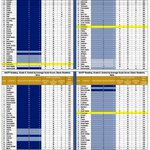
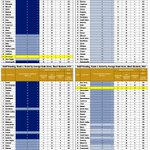
Those impacts might have shown in a 2023 Grade 8 NAEP, but the federal test was not given that year due lingering COVID impacts. The next NAEP in reading was given in 2024, and despite claims from some, compared to other states MS started to show notable improvements in Grade 8 NAEP Reading in 2024, as the tables below, generated with the NAEP Data Explorer, show.
For white students, the tables show that in 2013, MS' 8th graders were statistically significantly outperformed by white students in 43 other states. In 2024, only white students in 7 states could make the same claim. For Black students, MS' were statistically significantly outscored by those in 27 other states in 2013. By 2024, only Black students in Colorado and Massachusetts could make the same claim.
Now we get to the ACT. MS does statewide ACT testing in Grade 11. Even the 8th graders from 2023 didn’t enter that ACT test pool until 2026. We haven't even seen those ACT results and won’t for many months. Eighth graders who started to move up in NAEP in 2024 won't see the ACT until 2027.
Also keep in mind, MS continued to improve in Grade 4 NAEP Reading after 2019. It will be even longer before those students hit Grade 11.
So, let’s see what happens in a couple of more years with the ACT and stop trying to kill something before it even has a reasonable chance to prove itself, @DianeRavitch @plthomasEdD

Richard Innes retweeted
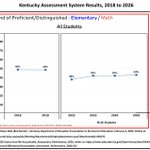
Bottom line: Kentucky is losing its clearest window into student performance at the worst possible moment — and the decision to do so appears to have bypassed the safeguards built into state law. Full report: bluegrassinstitute.org/asses… @Innes434

Richard Innes retweeted
I found some more interesting information that bears on the discussion of whether or not it's simply too soon to expect results of Mississippi's reading reforms to show in ACT results.
This slide from a MS DOE presentation shows how use of literacy coaches expanded over time. Note that even in 2014-15 only about half of the districts and fewer than half of the schools had been served. It wasn't until 2016-17 that essentially all schools and districts had been served.
MS' NAEP Grade 4 Reading didn't start to get national attention until 2019, two years later. The 4th graders in 2019 didn't reach 11th grade until 2026, and the ACT results for them won't be released until sometime in the fall.
The point here is that MS didn't magically pass a reform and instantly get help out to teachers to improve practice. Teachers probably didn't instantly get proficient in the new methods, either. It was a multi-year process that's probably still not complete.
So, let's have a little patience before expecting to see impacts on ACT. There simply hasn't been enough time for that to happen.


I am surprised. Too many educators seem to expect Mississippi’s (MS) reading reforms to somehow already be impacting the state's Grade 11 ACT scores. They just don't recognize that a reform aimed at lower grades K to 3 needs extra time to show improvement in higher grades. There simply hasn't been enough time for that to happen.
Though MS' reading improvement act was passed in 2013, it took the MS DOE several more years just to set up programs to impact things like Professional Development. And, you cannot retrain an entire corps of a state's teachers in new methods and get them proficient with those methods in just a year or two, either.
So, it's no surprise that impacts of MS' reform really wern't recognized until after the 2019 Grade 4 NAEP Reading scores released. This was just starting to impact Grade 4 at that time.
Those impacts might have shown in a 2023 Grade 8 NAEP, but the federal test was not given that year due lingering COVID impacts. The next NAEP in reading was given in 2024, and despite claims from some, compared to other states MS started to show notable improvements in Grade 8 NAEP Reading in 2024, as the tables below, generated with the NAEP Data Explorer, show.
For white students, the tables show that in 2013, MS' 8th graders were statistically significantly outperformed by white students in 43 other states. In 2024, only white students in 7 states could make the same claim. For Black students, MS' were statistically significantly outscored by those in 27 other states in 2013. By 2024, only Black students in Colorado and Massachusetts could make the same claim.
Now we get to the ACT. MS does statewide ACT testing in Grade 11. Even the 8th graders from 2023 didn’t enter that ACT test pool until 2026. We haven't even seen those ACT results and won’t for many months. Eighth graders who started to move up in NAEP in 2024 won't see the ACT until 2027.
Also keep in mind, MS continued to improve in Grade 4 NAEP Reading after 2019. It will be even longer before those students hit Grade 11.
So, let’s see what happens in a couple of more years with the ACT and stop trying to kill something before it even has a reasonable chance to prove itself, @DianeRavitch @plthomasEdD
Richard Innes retweeted
In Kentucky, a dominant hospital system can legally sue a competitor out of existence during the CON review process — before the new provider opens its doors. That's not patient protection. That's institutional self-protection. Rep. Proctor's legislation ends it. @MarianneProc60
Richard Innes retweeted
Kentucky is the 28th state to opt in to the federal tax credit scholarship school choice program. Lawmakers overrode @GovAndyBeshear's veto.
The program allows taxpayers to take federal credits against gifts to K-12 scholarship granting organizations.
#HB1 #kyleg #KYGA26
Richard Innes retweeted
Six of seven states that border Kentucky opt into giving K-12 students scholarships funded with federal tax credits.
Andy Beshear:

Richard Innes retweeted
From 1990-2022, real per-pupil funding more than doubled — rising 122% ($7,793 to $17,337) — yet NAEP test scores changed only modestly over the same period, with four tracked metrics (grades 4 and 8 reading and math) actually declining since 2013. bluegrassinstitute.org/k-12-…

Richard Innes retweeted

🚨 Some teachers unions oppose Science of Reading — but NOT @AFTunion. Shout out to the national AFT for standing with the science! 👏
Here’s the thing: unions are made up of teachers trained in colleges of education.
Colleges of ed are the ROOT of the problem.
They’re supposed to LEAD on reading science. Instead, many are still teaching discredited methods.
Zero tolerance for colleges not keeping up with the research. Our kids can’t wait.
@reading_league
@DyslexiaIDA
@NationalParents
@AFTunion — let’s hold them accountable.
Richard Innes retweeted

We have been through at 3 or 4 rounds of the reading debate in this country:
During each round of progressive reforms: early 30s ("Progressivism" (Dewey)), early 50s ("Life Adjustment movement" (Kilpatrick)), late 80s/early 90s ("Outcomes-Based Education"), and sort of when Common Core came along (2010s).
Phonics wins for a time and then the Whole Word Monster returns from its lair in university education departments.
I'm cheered by the recent Science of Reading victories, but I think we need to be careful not to mistake the dormancy of the whole word reading forces for their extinction.

Richard Innes retweeted

ICYMI: Kentucky Tonight's discussion about K-12 education policy with Commissioner Robbie Fletcher of @KyDeptofEd, @mikeharmonky of @CPC4Kentucky, Richard @Innes434 of @BIPPS and Maddie Shepard of the Jefferson County Teachers Association. ow.ly/McKq50YjBlj

Richard Innes retweeted
You can thank the colleges of ed that brainwash pre-service teachers into believing these progressive teaching methods are the correct way to teach.

A teacher reflects on 30 years in education. She once championed "fun, student-centered" progressive reforms that moved away from traditional teaching. After decades in classrooms, she now realizes students learn best with structured routines, clear rules, teacher-led instruction, and content-rich curriculum—the opposite of what she initially supported. Learning skills isn't always fun, and that's okay.
open.substack.com/pub/bgeogh…

Richard Innes retweeted
A huge problem in public education today is that you are likely to find educators in your school attributing most student learning and behavior problems to student disabilities and socioeconomic circumstances beyond the school’s control.
In reality, a school’s ineffectiveness may be attributable to a variety of causes, but the most common one is that they neglect to use research-based teaching practices. Many schools beat the odds with highly effective teachers.
Richard Innes retweeted
1/ I become more and more dismayed by the huge number of supposed education experts who regularly use data from the NAEP improperly. In this thread I plan to outline some of the issues so the rest of us will have a better understanding of how people mislead with NAEP.

Richard Innes retweeted
Grammar didn’t die of neglect; it was executed by teacher prep programs whose English methods courses called it “inequitable,” and by organizations like the NCTE that seem to hate English itself.
These entities convinced an entire generation it was outdated and oppressive.
Now we have classrooms full of teachers who were never given the knowledge to pass on and students who can’t structure a sentence because of them.