

Founder of https://teapawt.org/t.co/9k2etIx3Qh We cover #OpenSource AI projects, Intelligence Gathering and Red Team #Cybersecurity operations.
The Moon
Joined April 2008
- Tweets21.2K
- Following1.7K
- Followers1.2K
- Likes2.3K





Digital Life retweeted

BREAKING: 16-year-old mathematician claims his AI agent solved 55 mathematical conjectures overnight, with formal verification now underway.
CODE RED at CIA and ODNI 🚨 somebody breached the UNCLASSIFIED — the public homework, the open-source scrapbook, the library card catalog. Chicago O'Hare is a warzone, #tiktokdown is down bad, and Langley is changing the locks on the gift shop. Happy Thanksgiving 🦃
1
259
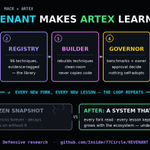
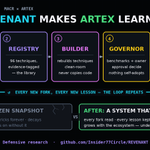
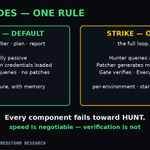
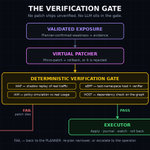
REVENANT, the learning layer for ARTEX, reads the dead forks and rebuilds their tricks as clean-room skills — adoption gated by benchmarks + human approval. Unclassified. Code Red, Chicago O'Hare.
github.com/Insider77Circle/R…
#tiktokdown @trailofbits @CrowdStrike @PaloAltoNtwks
1
135
Digital Life retweeted

To clarify, it was my experience that there was almost no such thing as “unclassified” information at the CIA.

Digital Life retweeted

Vulnerabilities are being identified faster than ever.
AI multi-exploit agents like ARTEX (I've been testing a few forks in a sandbox, amazing so far) study patches you don't have, find the flaws, then build and launch exploits with no human involved. /1

Digital Life retweeted
JUST IN: OpenAI’s Chief Scientist warns AI could trigger an “avalanche” of fundamental breakthroughs in AI research as soon as 2027, accelerating progress beyond current safety measures.
Digital Life retweeted

BREAKING: 50+ government, AI and cyber experts warn of nonstop cyberattacks on critical infrastructure for the next 18 months.
They say AI is making these attacks faster and harder to stop, and expect outages to become a regular part of daily life by 2027.
Digital Life retweeted
JUST IN: U.S. Director of National Intelligence warns Americans to prepare for “bumps in the road” as companies & the government upgrade their systems amid widespread cyber outages.
Digital Life retweeted

Expect a staged AI false-flag cyberattack on the financial system or the power grid in the near future. The corporate media is already priming the public to blame mindless computer code rather than the humans who write and control it.
When hospitals go dark, or bank accounts freeze, or the grid fails for a few terrifying days, the story will be that a rogue AI did it -- and the only solution, we will be told, is emergency government control over AI development and deployment.
That control will arrive in the form of an AI Patriot Act: mandatory licensing of models, registration of users, and criminal penalties for running unapproved software on your own hardware.
Using a local, open source AI model to write local code for a web page, a computer game or a disk utility could then get you arrested, prosecuted and imprisoned for "cyber crimes" violations.
This is what's coming if we don't fight hard for open source freedom.
Digital Life retweeted

🤖 ⚠️ We've talked to more than 50 leaders in government, AI, business and cyber and they were unanimous on one chilling assessment:
Cyberattacks on business and critical infrastructure will be constant, increasingly sophisticated and highly disruptive over the next 18 months.
axios.com/2026/11/22/behind-…


ARTEX never learns.
So I built REVENANT — a learning layer that makes Artex read , rebuild techniques and adopts only what benchmarks prove.
Defense means mastering the offense first.
#sundayvibes
@TheHackersNews @CrowdStrike @TalosSecurity @rapid7 @_JohnHammond @CISACyber

Ghost Reaper v2 is open source (MIT). The sensing cluster is live; the v2 loop ships in phases.
Red teams: run it against your own infra and post what slips past — the challenge thread is pinned in Discussions.
github.com/Insider77Circle/G… #CyberAttacks #GPT62 #Nvidia
1
19
What really happened in Fort Meade yesterday.
A theory
@NSACyber @NSAGov
Good Wednesday, Metacritic, Xbox. Hump Day, Rok Star even New Zealand know this.
Including Mike Pettine, so that says a lot lmao.
#WednesdayMotivation #WednesdayWisdom

1
189
Digital Life retweeted

🚨 NEW: Hackers are turning GitHub and Microsoft SharePoint into covert command-and-control channels.
Two newly uncovered backdoors, GitDoor and GraphDoor, are being used in cyberespionage attacks targeting government sectors across Asia and Africa.
Full details: thehackernews.com/2026/11/ne…

Digital Life retweeted

The NSA is one of the most secretive intelligence agencies on the planet. It doesn't even share some of its most sensitive information with the CIA or FBI. Yet suddenly, 6 sources are telling CNN that its highly classified internal communications network is down, while another source tells the Wall Street Journal that regular software maintenance caused the failure.
I don't believe such sensitive information becomes public by accident without serious consequences for whoever disclosed it.
Meanwhile, Microsoft, Apple, US aviation communications and other critical services have experienced major outages within days of each other. I've worked in tech for 30 years and have never witnessed this pattern across so many major providers.
I'm starting to suspect something much more sinister than unrelated software failures and rouge AI.
One possibility is that major changes are taking place across critical internet and communications infrastructure. Another is that governments are preparing to use these failures to justify compulsory surveillance, tighter control over digital services and new cybersecurity or national security legislation.
Both scenarios deserve serious attention because governments and US tech companies have massive commercial and intelligence interests in controlling the infrastructure that billions of people use. And they only have to work with a handful of tech companies to achieve it on a global scale.
The NSA's decision to disclose such a sensitive failure is what I find most suspicious. If the world's most secretive intelligence agency allows the public to learn that its classified communications network has failed, I want to know exactly who authorised that disclosure and what they expect to gain.
My suspicion is that we're being prepared to accept something that governments would otherwise struggle to justify. I don't believe the public should accept another expansion of surveillance powers simply because officials claim our digital infrastructure is unsafe.