

Researcher. Builder. Onchain lifer. Hunting asymmetric bets. Libertarian & Privacy Maxi 🛡️ Hypothesis → Test → Result → Repeat until you win
Joined January 2013
- Tweets6.1K
- Following394
- Followers654
- Likes11.7K





intelpocik retweeted

When people ask me why I keep building with @aztecnetwork and @NoirLang after 2 years, I tell them: privacy is one of those things where the difference between "real" and "marketing" is invisible to most users but brutally obvious to developers.
A quick background on me: I spent years at Disney + Hotstar building systems used by hundreds of millions of people, and I've now been building in crypto for the last 6 years. I've seen what it takes to build infrastructure that actually works at scale and what it takes to pretend you do.
Here's the uncomfortable truth: most "privacy-focused" chains today(you know which I’m talking about) have superficial privacy at best. A centralized sequencer. No client-side proving. A privacy toggle that mostly exists in the marketing deck. That's fine for fooling retail traders chasing the hot narrative, but ecosystem developers see right through it.
Real privacy tech is genuinely hard. It requires:
• Decentralization from day one, not as a roadmap promise
• Client-side proving as a first-class primitive, not an afterthought
• Years of unglamorous engineering, audits, and iteration before anything ships
That's exactly what Aztec has been quietly building for years. No hype cycles, no narrative-chasing, just deep, foundational work on true programmable privacy. As a developer who's actually built on the stack, I have tremendous respect for the team.
One wish: I'd love to see more open, honest discussion in this space about the difference between actual privacy and superficial privacy. The bar for calling yourself "privacy-focused" should be higher.
And a special shoutout tremendous respect for @zcash as well. The OGs who proved private digital money was possible. The space stands on their shoulders.
Privacy isn't a feature. It's an architecture. Build accordingly.
This is actually f*cking big for ethereum:0xa27ec0006e59f245217ff08cd52a7e8b169e62d2 stakers.
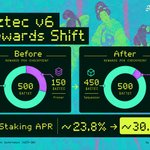
v6 raises staking APR from ~23.8% to ~30.6% with NO increase in emissions. Here’s the breakdown:
• Sequencer rewards: 350 → 450 ethereum:0xa27ec0006e59f245217ff08cd52a7e8b169e62d2 (+28.6%)
• Prover rewards: 150 → 50 ethereum:0xa27ec0006e59f245217ff08cd52a7e8b169e62d2 (−66.7%)
• Total rewards: still 500 ethereum:0xa27ec0006e59f245217ff08cd52a7e8b169e62d2 per checkpoint
Why cut prover rewards?
Too many redundant proofs were wasting $ETH on gas.
Provers likely sell some ethereum:0xa27ec0006e59f245217ff08cd52a7e8b169e62d2 to cover these costs.
v6 reduces that waste and potential sell pressure, redirecting more rewards to stakers.
Plus a new tokenomics lever:
v6 lets governance charge an extra protocol fee (starts at 0).
Once activated, the fees go to a burn address by default. Governance can later redirect them to the reward reserve.
As usage grows, fees can start offsetting new emissions.
Higher staking rewards + a path to more sustainable tokenomics.
The ~30.6% is an estimate if validator count and other conditions stay similar.
Still not bullish on ethereum:0xa27ec0006e59f245217ff08cd52a7e8b169e62d2? Read it again.
Then go stake your tokens.


$AZTEC holders have voted. Aztec Alpha V6 has passed the governance vote.
The network’s next version was approved by the people running it.
The network now enters an execution delay. Stay tuned for the official launch date.

don't blindly trust marketing or paid influencers.
always do your own research.
or at least ask AI the right questions and verify the answers.
hype doesn't change how the underlying tech actually works.


Think Venice AI is private?
Its Privacy Policy says otherwise: they collect IPs, device IDs and location data, and use Google Analytics.
UK users are forced to buy a Pro subscription just to access the service.
The receipts speak for themselves.

intelpocik retweeted

Are your private txns unstoppable?
Zama: stoppable
Starknet: stoppable
NEAR: stoppable
Miden: stoppable
ZKSync: stoppable
Canton: stoppable
Tempo: stoppable
Monad: stoppable
Aztec: unstoppable
It’s that simple
Rainbow generated over 5x more earnings than Safe in Q3 2026, yet its market cap is over 20x lower. An undervalued gem with 10x+ potential or not?
And it's not just Safe.
In this post, I want to compare @rainbowdotme with its closest competitors and figure out whether base:0xa53887f7e7c1bf5010b8627f1c1ba94fe7a5d6e0 is massively undervalued or the wallet token market is overvalued.
Let's go from the highest market cap to the lowest and compare wallet tokens based on their earnings and valuations.
→ Trust Wallet
• Q1 2026: $1.4M, Q2: $1M, Q3: $3.42M, Q4 (ongoing): $1.2M
• Market cap: $195M
• Total 2026 earnings: $7M
• Market cap / earnings: 28 years
→ SafePal
• No earnings data on DefiLlama, but its SafePal Card processed only $275K in volume over the last 30 days. I don't know anyone who uses their wallet, and I think their earnings are close to zero.
• Market cap: $122M
• Market cap / earnings: ∞ years
→ Safe
• Q1 2026: $332K, Q2: $110K, Q3: $100K, Q4 (ongoing): $19K
• Market cap: $82M
• Total 2026 earnings: $561K
• Market cap / earnings: 146 years
→ Rainbow
• Q1 2026: $593K, Q2: $366K, Q3: $512K, Q4 (ongoing): $81K
• Market cap: $4M
• Total 2026 earnings: $1.552M
• Market cap / earnings: 2.6 years
But maybe the projects I'm comparing @rainbowdotme with are simply overvalued?
Considering that these tokens are trading at much higher valuations, and many of them have even gone up since August, I think base:0xa53887f7e7c1bf5010b8627f1c1ba94fe7a5d6e0 is massively undervalued instead.
And there's more.
base:0xa53887f7e7c1bf5010b8627f1c1ba94fe7a5d6e0 is directly tied to the wallet's revenue.
By staking base:0xa53887f7e7c1bf5010b8627f1c1ba94fe7a5d6e0, you can get up to 100% of your swap fees back in base:0xa53887f7e7c1bf5010b8627f1c1ba94fe7a5d6e0, funded through token buybacks.
On top of that, 20% of Rainbow's equity is held for base:0xa53887f7e7c1bf5010b8627f1c1ba94fe7a5d6e0 holders through Rainbow Foundation.
Utility that NONE of its competitors have.
Rainbow Cash is also coming, allowing users to fund their crypto wallets with a bank card in one click, along with Solana integration.
Both features should increase the project's earnings, further reducing its market cap / earnings ratio and making the already insane valuation gap between wallet tokens even bigger.
Rainbow also publishes monthly financial metrics and management updates for token holders at investors.rainbow.me
You can actually track how the business behind your token is performing


One click crypto purchases with a bank card inside Rainbow Wallet are coming.
the feature is called Rainbow Cash.
you get a dollar balance directly inside @rainbowdotme, powered by $USDC on @base, complete KYC in the app, fund it with your debit card, and use that balance from the same wallet.
over the past few days, the team has been working on things that usually show up when a product is almost ready for real users:
→ a switch to stop new Cash signups if too many people arrive at once
→ handling accounts blocked for suspicious activity
→ restrictions for VPN, proxy and Tor users
→ checking which US states can access Cash
→ fixed phone verification
→ fixed account recovery
→ cleaning up small UI and input bugs
one of the recent PRs, #7863, was authored by Christian Baroni (@christianbaroni), Rainbow's Co-founder.
the strongest signal came from another change on October 1.
Rainbow added a cash_signup_enabled flag, with the PR description saying:
“At launch we need a way to stop new Cash sign ups if volume gets too high.”
they are clearly preparing for a potentially large wave of users, which honestly would not be surprising.
the feature solves a real problem, is easy to understand, and could bring a lot of new users into Rainbow Wallet.
Cash itself also sits behind a cash_enabled remote config flag, which means Rainbow can potentially enable it without shipping another app update.
the standard deposit fee is 3%, but there is a way to avoid it.
get Rainbow Black by staking 20,000 base:0xa53887f7e7c1bf5010b8627f1c1ba94fe7a5d6e0, and the deposit fee is waived.
this is exactly the kind of utility i want to see from a token.
especially because base:0xa53887f7e7c1bf5010b8627f1c1ba94fe7a5d6e0 already gives holders exposure to 20% of the company, while stakers also share in revenue generated from swaps and receive fees from other users exiting staking.
now Cash adds another reason to hold and stake the token through a product people may actually use every day.
i'm genuinely impressed with what @rainbowdotme is building and i'm waiting for the moment i can test Cash myself.
this is how a modern user friendly crypto wallet should look if we actually want mass adoption around the world.


Projects metrics & earnings:
TrustWallet → defillama.com/protocol/trust…
Safepal → defillama.com/protocol/safep…
Safe → defillama.com/protocol/safe
Rainbow → defillama.com/protocol/rainb…


intelpocik retweeted

This is exactly how privacy is going to be solved on Ethereum
@aztecnetwork is building toward this with @zk_money
Send and receive stablecoins privately by default, without exposing your transaction history
Ethereum L1 for security and settlement, L2 for private payments and dApps


if you don't want big companies to know everything about you and use that information to sell you whatever benefits them, START USING PRIVATE AI
in the age of AI, everyone should reveal as little personal information as possible
everything you share with nonprivate services can be collected, analyzed, and eventually used to influence or manipulate you.
that's why these three projects are so important:
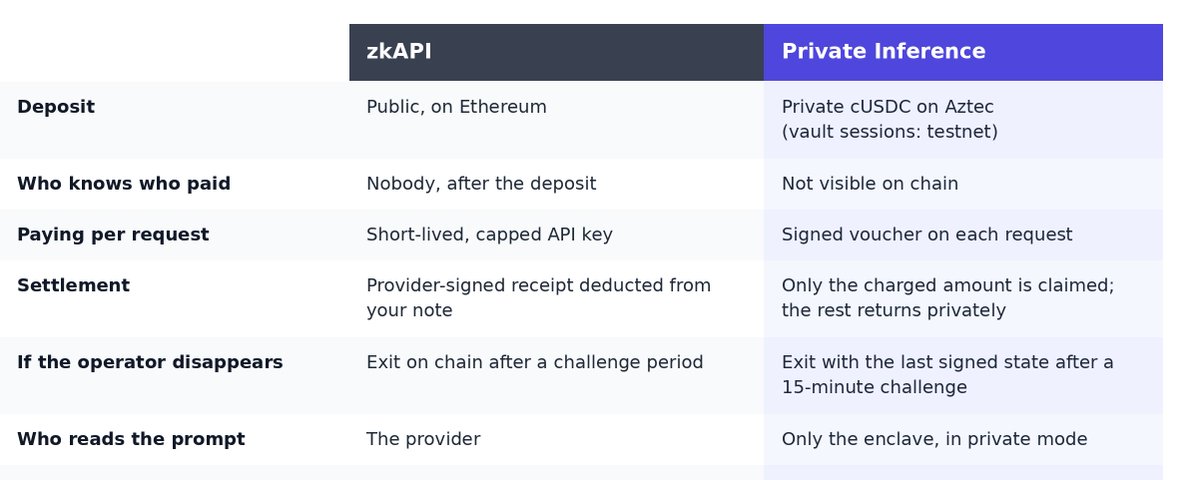
@P_Inference: private AI where your conversations are encrypted and processed inside secure enclaves, so even the service operator can't read your chats.
@zk_money: private, self-custodial banking where your funds are fully under your control, and even the service operator can't see your balances or transactions.
@aztecnetwork: a decentralized blockchain with fully programmable privacy, where developers can build virtually any kind of private application.
the less they know about you, the less power they have over you

intelpocik retweeted

Tempo is about using blockchains as a technology that increases efficiency.
@aztecnetwork and @zk_money is about fulfilling the OG crypto vision to its full potential.
Tempo just validated what Aztec has been building toward for years. But there's one fundamental difference: Tempo's approach to privacy still requires trusting an operator.
Tempo launched Zones, a framework for private blockchains built on top of its L1, with Deel as its first live customer.
This confirms the growing demand for private payments, balances and yield in real-world onchain finance.
Now let's look at the similarities:
Tempo → Zones → Deel
Ethereum → Aztec → zk.money
Both are moving in a similar direction, solving essentially the same problem, but with fundamentally different approaches to privacy.
Tempo Zones + Deel:
→ Private payments, balances and yield, but Zone operators can see your transactions and restrict access to funds
→ Limited financial functionality rather than fully programmable private applications
→ Relies on Tempo's own ecosystem, with significantly less liquidity than Ethereum
→ Traditional KYC through providers like Veriff.
Users submit identity documents and selfies to intermediaries, creating potential data breach risks.
Aztec + Zk[.]money:
→ Cryptographic privacy and self custody.
Even network operators can't see your private transactions, and zk.money has no admin key to arbitrarily freeze your funds.
→ Fully programmable privacy, enabling applications far beyond payments and savings.
→ Settles on @ethereum with access to its massive DeFi liquidity through integrations.
zk.money already offers private @SkyEcosystem Savings with a current 3.8% APY on stablecoins.
→ No KYC required for basic payments.
@ZKPassport integration is planned, allowing users to prove eligibility without exposing their identity documents.
So who are these products actually for?
Deel currently makes more sense for corporate payroll, where convenience, compliance and familiar financial services matter more than maximum privacy.
It's essentially a bank-like experience onchain. Your transactions are hidden from outsiders, but the operator can see your financial activity and restrict payments.
@zk_money is built for everyone who wants stronger privacy, self custody and control over their finances without having to trust a company with their entire financial history.
I've broken down the key differences in the comparison table attached to this post.
Tempo validates the demand.
@aztecnetwork shows how much further programmable privacy can go.
So which would you choose?
Privacy that depends on trusting an operator, or privacy enforced by cryptography?

Privacy is live on Tempo.
Tempo Zones let enterprises keep customer stablecoin balances and payments private, with built-in compliance controls and access to global liquidity.
@deel is the first customer with Zones live in production.
TL;DR of @aztecnetwork’s post-quantum roadmap:
no blockchain is fully quantum safe today, but Aztec was designed with this problem in mind from the beginning.
here’s what makes it interesting:
→ most public keys are hashed, protecting them from exposure to future quantum attackers
→ private notes can be delivered offchain, preventing attackers from collecting encrypted onchain data today and decrypting it years later
→ developers can already use post-quantum encryption and signatures without waiting for protocol upgrades
→ private state created today can be securely used by future post-quantum proving systems
→ Aztec has a clear roadmap to full quantum resistance while preserving programmable privacy, real zero knowledge, fast client-side proving and efficient recursion
the most important part?
Aztec already provides ways to protect private data from future quantum decryption, with a clear vision for making the entire network quantum resistant.
do you know any other decentralized blockchain where you can build fully programmable private apps, keep their execution hidden even from node operators, and already protect sensitive data from future quantum decryption?
genuinely curious who else even comes close

Quantum computers don't need to exist yet to threaten your privacy.
Attackers can harvest encrypted data today and decrypt it later.
Aztec was designed so apps can already protect against that.
Here's our roadmap to make the entire network post-quantum: aztec.network/blog/post-quan…

intelpocik retweeted

Aztec Alpha V6 has been brought to governance.
Voting will start for all ethereum:0xa27ec0006e59f245217ff08cd52a7e8b169e62d2 holders on Sat Oct 17th and run for a week.
Aztec is the only decentralized L2, and the new network will be brought to life by the community.
Follow the vote at: aztecgov.nethermind.io/

@GalacticaNet just launched a direct competitor to Venice AI, but with one major advantage: private payments.
when you use ChatGPT, Claude, or other AI services, you might be revealing much more about yourself than you realize.
your health, finances, work, personal life.
all of this information can be processed and stored on corporate servers, with your conversations linked to your account.
these companies get access to some of your most personal information, and if a data breach happens, your conversations could end up in the wrong hands.
and now that ads have arrived in ChatGPT, the question of how much personal data we share with AI companies is becoming even more relevant.
why share all of this information when you can use the same powerful AI models much more privately?
that's exactly what @P_Inference is building.
→ all your favorite AI models in one place.
GPT, Claude, Gemini, and more.
no need to create separate accounts or pay for multiple subscriptions.
→ pay only for what you actually use.
fund your balance with crypto through x402 and pay based on your actual AI usage.
no monthly subscriptions, no credit cards, no paying for limits you never use.
→ keep your conversations private.
in Private mode, your prompts are encrypted directly in your browser before being processed inside a Trusted Execution Environment (TEE).
the goal is to keep even Private Inference from reading your conversations.
sounds familiar?
that's because Venice AI offers pretty much the same features.
but there's one major problem Venice hasn't solved yet.
even if your AI conversations are encrypted, paying for those services on a public blockchain still leaves a trail.
your wallet address, payment amounts, and transaction history are publicly visible.
this doesn't reveal your actual prompts, but it allows others to track your spending and potentially link your wallet to your AI usage.
Private Inference solves this with @aztecnetwork.
thanks to private payments on Aztec, outside observers can't see the sender, recipient, or amount of a private transfer onchain.
so you get:
→ private AI conversations
→ encrypted requests
→ access to multiple AI models
→ private crypto payments
all in one platform.
Private Inference is currently in closed beta, with access available through invite codes.
the private AI era is just getting started 🛡️


If ethereum:0xa27ec0006e59f245217ff08cd52a7e8b169e62d2 has caught your attention, take a look at what Galactica is building on it.
@P_Inference lets you pay for AI privately through Aztec and your questions all the way to the model.
Talk to AI in confidence.
Sign up for access: privateinference.gg/aztecwhi…

Private Inference is currently invite only.
you can use my link to get access and test it yourself:
privateinference.gg/?ref=NfU…

intelpocik retweeted
I can tell you with 1000% confidence that the gap between Aztec tech and the attention the project gets is the biggest I’ve seen during my 10+ years in the industry.
Part of that is that it’s taken a while to reach stability as a decentralized protocol, another part is that we’ve shot ourself in the foot several times doing things the right way at the expense of hype.
But all forces are now converging. I think we’ll be seeing a massive closure of this gap.
intelpocik retweeted

I think people are vastly underestimating the fact that @aztecnetwork acquired @ZKPassport.
There’s nothing quite like it, and it actually makes sense beyond crypto because everyone who doesn’t want hacks to ruin user trust will want it.
As hacks go up, ZK will too.
intelpocik retweeted
The Alpha V6 code is ready.
V6 is a new version of Aztec focused on security, stability, speed.
It can now enter the governance process to head to mainnet.
Read the proposal below and follow along as the community brings it to life.
forum.aztec.network/t/azup-3…

> starkware, the team behind starknet launched a "VPN for Polymarket"
> tried this amazing tech
> blocked by IP
> meanwhile, Polymarket works fine with the same IP
> the first VPN that blocks access instead of enabling it
this is so absurd it doesn't even feel real


"A VPN for Polymarket."
@StarkWareLtd and @Zcash co-founder @EliBenSasson on what OffMarket is.
Same markets, same odds, and your positions aren't tied to your name.
The last PvE.
Get offmarket.cx
