
Political Scientist
Stockholm, Sweden
Joined October 2021
- Tweets10.8K
- Following853
- Followers12.2K
- Likes209


Pinned Tweet
WE SAY NO to Kings written by Kio Amachree SKJ Records 2025
(Verse 1)
We say no to Kings, we say no to would-be Caesars
We say no to Kings, we say no to third-rate convicted grifters
How can a man with a permanent suntan think he should be sitting on a throne?
Stick a fish bone down his throat, do him a favor, put him out of his misery
(Chorus)
We say no to Kings, we say no to would-be Caesars
We say no to Kings, we say no to third-rate convicted grifters
Democracy is sacred, as is the constitution
Democracy is our birthright — we say no to Kings
(Verse 2)
A third-class fat slob, incompetent, wants to wear the crown of America
He was too scared to fight for his country, but when it comes to corruption and money
He enriches himself and his crime family — we see him for what he is
(Chorus)
We say no to Kings, we say no to would-be Caesars
We say no to Kings, we say no to third-rate convicted grifters
Democracy is sacred, as is the constitution
Democracy is our birthright — we say no to Kings
(Bridge)
No six-time bankrupt, Hitler-loving slob will sit upon that throne
He’s out of his mind and so are his enablers
We say hell no to Kings, we say hell no to would-be Caesars
We say freedom for our children’s children — the rule of law forever
(Chorus — full)
We say no to Kings, we say no to would-be Caesars
We say no to Kings, we say no to third-rate convicted grifters
Democracy is sacred, as is the constitution
Democracy is our birthright — we say no to Kings
(Outro)
We say hell no to Kings — freedom and law forever.
#Hashtags
#Democracy #RuleOfLaw #NoToKings #Freedom #SayNo
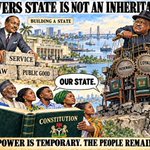
RIVERS STATE IS NOT WIKE'S INHERITANCE
Letters from Stockholm | The Kio Solution
By Kio Amachree
Nyesom Wike's politics rest on one assumption: that Rivers State cannot be allowed to move on without him. Governors come and go, institutions keep their constitutional titles, elections approach, and still he presents himself as the fixed point around which everyone else must arrange themselves.
His influence is real. Its permanence is another matter.
On Sunday, 18 October, Wike led a delegation to Governor Siminalayi Fubara's private residence in Port Harcourt. With him were the Speaker of the State House of Assembly, Martin Amaewhule, other lawmakers, all 23 local government chairmen and Kingsley Chinda, the APC governorship candidate for 2027. It was the first time Wike had visited Fubara at home. Reports of the meeting raised concerns that Wike's camp dominates the councils and the choice of 2027 candidates, and that Fubara's people have been left out. Other reports say Wike has ruled out a second term for the governor.
Look at what that picture shows. A former governor, now a federal minister in Abuja, arrives at the elected governor's home with the legislature, the councils and the next governorship candidate behind him. That is not a reconciliation between equals. It is a demonstration of who holds the keys.
The question for every one of those institutions is simple. Can it do its constitutional job when Wike's wishes collide with the public interest?
I have written about Wike before, and I will continue to. But none of this is personal. I do not know him. I have no private grievance against him. My concern is for the people of Rivers State and for the principle that public power must answer to them. Nothing personal, it is politics.
That concern has a personal foundation. I cannot be indifferent to the future of a state my late father, Chief Godfrey Kio Jaja Amachree QC, helped bring into being.
As I remember and understand our family history, my father committed resources from his oil interests and from Pan African Bank, which he founded, to help finance the new state's earliest projects. These were legitimate business interests, and I maintain their history can be documented. He made his law chambers at Western House, Broad Street, Lagos, available as office accommodation for the first governor. His airline, Delta Air Charter, flew between Lagos and Port Harcourt and beyond in those formative years.
These were practical contributions: offices in which a government could function, transport that connected people, money committed when the state needed help to stand up.
I know what my family gave. It gives me a responsibility to speak carefully and firmly. It gives me no hereditary entitlement to govern anyone.
It also gives me a standard by which to judge public leadership. What have you contributed? What have you built? Whose interests have you served?
The long confrontation between Wike and Fubara has given Rivers citizens something very different. On 18 March 2025, President Bola Tinubu invoked Section 305 of the Constitution and suspended the governor, his deputy and the entire House of Assembly. A retired vice admiral ran the state for six months, and council elections held under his watch were swept by Wike's allies. Elected government returned only on 18 September 2025. A quarrel between politicians had become a crisis in the constitutional life of an entire state.
Now there are reconciliation meetings. Peace is welcome. But the people of Rivers State deserve to know its terms, and those terms have not been disclosed.
Who has agreed to what? What freedom does the elected governor still have? Are appointments and candidacies being decided through accountable processes, or in private sitting rooms? What commitments have been made in the people's name?
A state cannot build confidence in government on arrangements its citizens are not allowed to see.
And I have a warning for the Wike fan club. Closeness to power is not permanent protection from accountability.
Those who celebrate the money that keeps a political machine running should be willing to ask where it comes from. Who pays for the mobilisation, the publicity, the displays of loyalty? What is privately funded? Has any public resource been misused? Where are the accounts?
My suspicion is that political patronage in Nigeria deserves far more financial scrutiny than it receives. A suspicion must be tested with evidence. Contracts, land allocations, company ownership and financial transactions should all be open to lawful, independent investigation.
Every naira and every dollar of public money should be traceable. If investigators establish that funds were stolen or diverted, those responsible must answer for it. Anyone who knowingly helped conceal, move or benefit from stolen assets should face scrutiny too, whatever their party.
Applause does not erase a financial trail. Loyalty does not make an unlawful transaction lawful.
Questions about Wike's wealth deserve documentary answers. Claims about properties in the United States or elsewhere require verified ownership records, purchase dates and evidence of how they were paid for. Neither his supporters' assurances nor his critics' suspicions can stand in for those records.
The same applies to his sons, Jordan and Joaquin. Their surname proves neither wrongdoing nor entitlement. If either seeks public influence, scrutiny comes with it, and any allegation against them must be established individually, on evidence. Rivers State must never become a family succession project.
Watching Wike in public, I find his confrontational manner and his apparent need to win every disagreement disturbing. But the real issue is his conduct in power: whether he accepts independent institutions, a legitimate opposition, and allies who develop minds of their own.
A leader who cannot tolerate those things leaves his people exposed to his personal grievances.
I have watched powerful men fall in Nigeria. I have seen entourages vanish and praise singers find new patrons. Men who seemed untouchable have found themselves answering questions without the protection they assumed would last forever.
The image of a seemingly invincible politician climbing into a Black Maria is a reminder of how quickly fortunes change. Whether Wike ever faces prosecution must depend on evidence and on a court's judgment, nothing else. My prediction is simpler: the dominance he projects will one day meet limits he cannot shout away.
He should think about his legacy while he still has the chance to shape it.
Rivers also needs a reckoning with the sycophancy and ethnic mobilisation that keep this style of politics alive. Its communities have distinct histories and legitimate interests. They deserve fair representation and honest negotiation, not to be used as raw material by patrons building rival camps.
The state needs lawyers prepared to defend constitutional limits, journalists willing to follow the money, traditional rulers who speak independently, and citizens who can organise peacefully across communal lines.
THE KIO SOLUTION
One. Publish the terms of the reconciliation, including any understanding on appointments, control of the councils and 2027 candidacies.
Two. Choose every candidate through open, verifiable primaries under the Electoral Act, not in a private residence.
Three. Commission an independent forensic audit of Rivers State and local government accounts, including the emergency rule period.
Four. Publish the Code of Conduct asset declarations of Wike and every senior Rivers office holder, with verified ownership records for any property abroad.
Five. Investigate any evidence of diverted public funds lawfully, and recover whatever is proven stolen, at home and abroad, following the Isabel Precedent.
The pioneers of Rivers State set out to build something that would protect its people and widen their opportunities. Those who govern it today should be measured against that purpose.
My father gave because there was work to be done and people who needed help. That spirit of service is worth defending.
Wike's influence is substantial. Rivers State's future is larger. Its people must find the confidence to insist on it.
This article expresses opinion and raises questions of public interest. It makes no finding of criminal wrongdoing against anyone named. Allegations are not convictions, and everyone named is entitled to the presumption of innocence.
Nigeria belongs to Nigerians.
#RiversState #Wike #Fubara #KioSolution #LettersFromStockholm #DiasporaVoice #Accountability #KioAmachree
🤖 Made with AI

WORLDVIEW INTERNATIONAL | SOCIAL COMMENTARY
Why Are Nigerians So Loud?
The Culture of Confidence, Arrogance and the Art of Being Heard
By Kio Amachree | November 1, 2026
I remember how embarrassed I used to feel at Heathrow Airport, watching British police break up fights at the Nigeria Airways check-in desk. Passengers would explode over overweight luggage, or over whatever else they had decided was worth a fight that day. Staff were shouted at, sometimes physically attacked, and the racket could be heard across the terminal.
It was a humiliating sight. Africa's most populous nation, flush with oil money, needed armed officers posted at its own check-in counter. Nobody had to explain what that said about us. The oil boom had handed many Nigerians money and a new sense of their own importance, but not the manners to carry either.
Nigeria Airways has been gone since 2003. The behaviour did not go with it. We have not recovered from that blight, nor improved ourselves. If anything, we have grown worse, and we can no longer even blame excess wealth. We are just as loud, and far poorer.
That memory has stayed with me for decades. It is time we discussed it honestly, without becoming defensive.
Walk into certain restaurants in London, hotel lobbies in Dubai, airport lounges in Paris or public spaces in Stockholm today, and you may still witness a version of that Heathrow scene: a group of Nigerians speaking at extraordinary volume, dominating the room, making elaborate declarations about their achievements, their wealth, their connections and their importance. There is laughter, gesticulation, argument, and an almost theatrical determination to be noticed.
Not every Nigerian behaves this way. Millions are quiet, courteous and unassuming. Yet the image of the loud, assertive and occasionally abrasive Nigerian is now recognisable enough, including among Nigerians themselves, to deserve serious examination. Why do some of us confuse confidence with superiority, assertiveness with aggression, and being visible with being important?
A Society Where the Loudest Voice Wins
Nigeria is a country of extraordinary energy. Its cities are crowded, its commerce fiercely competitive and its public discourse often confrontational. In Lagos especially, asserting yourself is a practical necessity. Haggling with traders, confronting bureaucrats, fighting through traffic or demanding basic services all require persistence and a good deal of vocal determination.
But what begins as a survival skill becomes a social habit.
Where institutions work predictably, citizens rarely need to fight for every small entitlement. A queue is a queue. An appointment is an appointment. Rules apply regardless of who you are. In Nigeria, connections, influence and the ability to command attention too often count for more than procedure. That teaches people that politeness is weakness, restraint is surrender and speaking softly means losing.
This is not an inherent Nigerian trait. It is an adaptation to a system that fails to reward patience and civility. Carried abroad, where queues and appointments actually mean something, it looks very different, which is exactly what those Heathrow staff saw.
Titles, Status and the Need to Be Seen
The oil boom did not invent our fascination with status, but it poured fuel on it.
Nigeria has built an elaborate culture of titles, ceremonies and public displays of wealth. Chief, Honourable, Doctor, Engineer, Alhaji, Pastor, Distinguished Senator: the list seems endless. A person's worth may be measured not by character or achievement but by the size of the house, the price of the car, the closeness to political power, or the number of people who rise when they enter a room. In some circles modesty has become a handicap, and success must be performed rather than simply lived.
Abroad, those expectations of deference collide with more egalitarian societies. In Sweden a millionaire may take the metro, a chief executive may dress casually, and a professor may introduce herself by her first name. Back home, the same informality might be read as a failure to recognise rank.
We have too often mistaken being important for being superior, and being wealthy for being worthy of respect. Real sophistication has nothing to do with the volume of one's voice or the number of people one can intimidate.
What the Research Actually Says
The evidence is more interesting than the stereotype.
A 2023 study in the International Journal of Conflict Management compared 186 Nigerians with 214 Americans. The Nigerians reported more direct approaches to conflict, but also greater emotional restraint. In other words, they were more willing to confront a disagreement, yet no more explosive. Directness is not rudeness, and expressive speech is not automatically aggression.
A 2026 study in the journal Sociology examined Nigerian mothers in Britain. Some described deliberately distancing themselves and their children from the stereotype of Nigerians as loud, flamboyant or brash. The perception clearly exists inside our own communities, not only in the minds of foreigners. But a perception is not proof that most Nigerians behave this way.
Research comparing Yoruba and Igbo communication styles, published in Inkanyiso: Journal of African Thought, shows that even within Nigeria, norms around respect, silence and expressiveness vary considerably. There is no single Nigerian manner.
No credible evidence shows that Nigerians are inherently louder or more arrogant than anyone else. What exists is a mix of real cultural differences, personal experience and stereotypes that magnify a conspicuous minority.
The Paradox of Nigerian Achievement
Nigerians abroad are not only conspicuous. They are remarkably accomplished. According to the Migration Policy Institute, about 533,000 Nigerian-born immigrants lived in the United States in 2024, and roughly 67 percent of those aged 25 and over held at least a bachelor's degree. That is an exceptional level of education by any measure.
We have excelled in medicine, engineering, finance, technology, law, literature and music. Yet degrees do not confer humility, and professional success does not guarantee emotional intelligence. One can hold several qualifications and still lack the elementary courtesy of treating a check-in clerk as a human being.
That is our troubling contradiction. We prize education but neglect character. We celebrate wealth but rarely ask how it was made. We admire power but seldom question how it is used. And we confuse the symbols of achievement with achievement itself.
Arrogance as Insecurity
Psychologists have long observed that loud displays of superiority can mask insecurity. Not every outspoken person is insecure, but the possibility deserves honesty.
Nigeria is fiercely competitive, and failure carries real social humiliation. Families compare children, communities compare wealth, friends compare lifestyles, and social media turns it all into a permanent contest. For some Nigerians abroad, the designer labels, the expensive watch, the loud phone call and the casual name-dropping become a performance with one message: I am somebody.
But knowing your worth is very different from demanding that strangers acknowledge it. Confidence needs no audience. Arrogance always does.
When Lagos Meets Stockholm
Having lived in Europe for decades, I find the contrast with Scandinavia especially revealing. Swedish society values personal space, moderation, quiet conversation and privacy. Loud talk on public transport, interrupting, flaunting wealth or demanding special treatment all draw disapproval.
A Nigerian used to a more expressive world may find that restraint cold or even condescending. A Swede may read an animated Nigerian conversation as aggression. Neither reading is automatically right, and cultural difference should be understood rather than condemned.
Still, travel carries an obligation to recognise that what is normal at home may not be acceptable elsewhere. There is nothing admirable about disturbing a whole train carriage, berating hotel staff or treating service workers as inferiors because you can afford the trip. That is not cultural pride. It is bad manners, and bad manners cannot be defended forever as culture.
The Example From the Top
We must also look at the example our leaders set. For decades our political culture has rewarded displays of power over acts of service. The politician who arrives with a convoy, armed escorts and an entourage demanding special treatment sends a clear message about what success looks like. Public office becomes personal elevation, and the citizen watches and learns.
Politicians did not create Nigerian assertiveness; our traditions are far older and richer than our modern institutions. But when arrogance is rewarded at the top, humility starts to look like a disadvantage at the bottom. That is a dangerous lesson to teach the young.
Beware the Stereotype
There is another side to this. Nigerians abroad face unfair assumptions about who they are. A study in the Journal of International and Intercultural Communication of 20 Nigerians living in the United States found they were credited with hard work and ambition, but also saddled with stereotypes of criminality and backwardness.
A loud Nigerian businessman is memorable. A quiet Nigerian surgeon finishing a twelve-hour shift is invisible. The conspicuous few become the stereotype while the millions who contradict it go unseen. And arrogance is hardly unique to us. The world has its share of obnoxious tourists, entitled Europeans and ostentatious Americans. Human vanity has no nationality.
The task is to examine ourselves without adopting other people's prejudices.
Pride Without Blindness
I am proud to be Nigerian: proud of our history, our diversity, our intellect and the resilience of our people. But patriotism should never require blindness. We cannot demand respect from the world while refusing to examine behaviour that undermines it, and not every criticism of Nigerian conduct is racism.
Sometimes we really are too loud. Sometimes we interrupt, dominate, insist on recognition and behave as if the rules were written for somebody else. And sometimes we forget that the people around us deserve exactly the consideration we demand for ourselves.
Nigeria does not need to shrink its ambitions. We need more intellectual confidence, more political courage, more enterprise and more willingness to challenge injustice. But we also need civility. Shouting does not make an argument smarter, wealth does not confer moral standing, and intimidating another person is not strength.
I still think about those police officers standing guard at the Nigeria Airways desk. No nation should need an armed escort to check in its own passengers. The day we no longer need one, wherever we travel, will say more about our progress than any oil price ever could.
Nigeria has never lacked people determined to be heard. What we need now are more people willing to listen. The most powerful voice in the room is rarely the loudest. It is usually the wisest.
Kio Amachree
President, Worldview International
Stockholm, Sweden
#Nigeria #NigerianDiaspora #NigerianCulture #SocialBehaviour #CulturalIntelligence #Leadership #Civility #WorldviewInternational
🤖 Made with AI

SEYI TINUBU, CITY BOY AI AND THE DANGERS OF PRESIDENTIAL FAMILY POWER: A LESSON FROM ISABEL DOS SANTOS
By Kio Amachree, Worldview International
1 November 2026
More and more Nigerians are saying out loud what I have felt for some time about Seyi Tinubu: a young man who has never been elected to anything, yet appears determined to make himself a permanent fixture of the Nigerian political landscape.
Everywhere one looks, there he is. Political rallies, state functions, expensive public spectacles, publicity exercises, all in the service of his father's administration and, increasingly, of his own standing within the establishment.
Let me be clear. I have no objection to a son campaigning for his father. What I object to is the steady erosion of the line between a family's private interests, its political influence and the institutions of the Nigerian state.
Nigeria is a republic. It is not the private inheritance of the Tinubu family.
THE CITY BOY CHATBOT
The latest spectacle is the so-called City Boy AI.
Last month the City Boy Movement, the political vehicle Seyi Tinubu built for his father's 2023 campaign, launched AskCityBoy, a chatbot that it says will give Nigerians "verifiable information" about President Bola Ahmed Tinubu's policies, reforms and achievements. Seyi Tinubu was filmed demonstrating it to Wale Edun, the former Minister of Finance who left office in April.
Then came the part that should trouble every Nigerian. At a gathering in Abuja billed as "An Evening with the Original City Boy", the President himself stood at the podium, praised the platform, encouraged "every Nigerian, including our critics" to visit askcityboy.com, and advised the movement to load his administration's legislative achievements into the system. The Deputy Senate President praised the organisation for being, in his words, AI-driven, and urged others to copy it. The President told the audience that the movement now has 4.8 million members, and when asked what Seyi was running for, replied that his son was "running after his father".
What an extraordinary piece of political theatre.
A chatbot built by a re-election movement, run by the President's son, with the President publicly instructing what it should say, is not an information service. It is a campaign tool with a microphone. An AI platform whose declared purpose is to promote one man's record cannot also be an independent assessment of that record.
Among the "achievements" it promotes is the Lagos-Calabar Coastal Highway, a project that has generated enormous controversy over its cost, its procurement, its transparency and the involvement of companies connected to Gilbert Chagoury.
Does Seyi Tinubu seriously believe Nigerians are so gullible that they will accept a politically programmed machine as an objective verdict on their government?
Artificial intelligence is only as honest as the people who build it and the data they feed it. So I ask the obvious questions. Who developed AskCityBoy? Who paid for it? What was it trained on? Who decides what it is allowed to say about fuel subsidy removal, about the naira, about the cost of living? Has anyone outside the movement tested it for accuracy?
Propaganda does not become truth because a computer delivers it.
THE CHAGOURY CONNECTION
Then there is the matter the Presidency would prefer Nigerians forgot.
In May 2024, Atiku Abubakar pointed out that Seyi Tinubu sits on the board of CDK Integrated Industries, a ceramic tiles and sanitary ware manufacturer in Sagamu that belongs to the Chagoury Group. The same group owns Hitech Construction, the company awarded the Lagos-Calabar Coastal Highway contract.
The Presidency did not deny it. Bayo Onanuga confirmed that Seyi joined the CDK board in 2018, said he represents an investor company in which he has an interest, insisted the President's son has every right to pursue legitimate business, and asked how a tile company's board could possibly conflict with a highway contract.
I will tell him how. The question has never been whether Seyi Tinubu may sit on a board. The question is whether the son of a sitting President should hold a directorship inside a corporate group that is simultaneously receiving one of the largest infrastructure contracts in the country's history, awarded by his father's government, while that same government publicly describes Gilbert Chagoury as the President's confidant and issues birthday tributes to him from the State House.
That is what a conflict of interest looks like. It does not require proof of wrongdoing. It requires only that the public can no longer tell where the family's interests end and the state's begin.
So where are the procurement documents? Where is the competitive bidding record? What safeguards were put in place? Who, outside the Presidency, examined these relationships? What is the full exposure of the Nigerian taxpayer?
These are legitimate questions, not insults.
And I have more. Who is financing the increasingly elaborate political operation around Seyi Tinubu and the City Boy Movement? Are these activities entirely privately funded? Who are the donors? Are any government resources being used, directly or indirectly? I would also like proper scrutiny of the reports concerning his security detail, his overseas properties, his private travel and the alleged use of government aircraft.
I am not prepared to accept that proximity to the presidency confers unlimited influence and immunity from questioning.
The same principle applies to the First Lady, Senator Oluremi Tinubu. Wherever public money touches her initiatives, her funding and her political activities, she too is answerable.
The Nigerian presidency is not a family business, and the national treasury is not a household account.
SEYI TINUBU SHOULD STUDY ISABEL DOS SANTOS
There is a lesson from Angola that every politically connected child of an African president would be wise to learn.
Isabel dos Santos, eldest daughter of President José Eduardo dos Santos, was once celebrated as Africa's richest woman. For nearly four decades her father ruled Angola, and in those years she accumulated stakes in banking, telecoms, oil and diamonds and a fortune estimated in the billions.
Then her father left power in 2017, and the protection went with him.
In 2020 the Luanda Leaks exposed the inner workings of her empire. Angola and Portugal froze her assets. In November 2022 Interpol issued a Red Notice at Angola's request. In October 2024 she lost her appeal in London against a worldwide freezing order of up to 733 million dollars. In November 2024 the United Kingdom placed her under sanctions, a travel ban and an asset freeze, and its Foreign Secretary called her a notorious kleptocrat. Forbes has long since dropped her from its billionaires' list.
Dos Santos denies every allegation and says the proceedings are politically motivated. She has not been convicted of any crime, and a Red Notice is not a conviction. But the point is not her guilt or innocence. The point is how completely the circumstances of a presidential family can change once the presidency is gone.
Political influence is temporary. Family connections do not guarantee permanent protection from investigation or legal accountability.
Those who believe their fathers will remain in power forever have not read African history.
I have said before that Seyi Tinubu's growing prominence carries serious political and reputational risk. The more influence he exercises, or appears to exercise, the greater his obligation to explain the sources of his wealth, his business relationships and the financing of his political activities.
There is nothing wrong with being wealthy. There is nothing wrong with being ambitious. There is nothing wrong with supporting one's father.
But there is everything wrong with allowing the boundaries between family privilege and public authority to become so blurred that citizens can no longer distinguish one from the other.
Nigeria has suffered enough from political entitlement.
It has suffered enough from the arrogance of those who behave as though proximity to power makes them superior to ordinary citizens.
It has suffered enough from vast government expenditures whose full details remain contested or unexplained.
And it has certainly suffered enough from political personalities more interested in public spectacle than public accountability.
NIGERIA IS A LIVING SOUL, NOT THE PROPERTY OF ONE FAMILY
There is something profoundly offensive about the pageantry of political privilege in a country where millions struggle to eat.
Nigerians deserve respect, transparency and institutions that operate independently of whoever occupies Aso Rock.
No president, spouse, son, daughter, political associate or business partner is above scrutiny.
I would remind Seyi Tinubu that history is littered with the shattered reputations of people who mistook temporary access to power for permanent ownership of the state.
The presidency will change hands. Every presidency does.
And when it does, the decisions made today, the contracts awarded, the money spent and the relationships cultivated will all remain open to examination.
If everything has been lawful and transparent, those involved should welcome that scrutiny.
If wrongdoing is established through credible investigation and due process, those responsible should face the consequences, whatever their surname.
Nigeria belongs to Nigerians, not to the Tinubus, the Chagourys or any other politically connected family.
No amount of City Boy AI can change that.
Kio Amachree
President, Worldview International
#SeyiTinubu #CityBoyAI #AskCityBoy #Tinubu #Nigeria #PoliticalAccountability #LagosCalabarHighway #Chagoury #IsabelDosSantos #Transparency #RuleOfLaw #WorldviewInternational #KioAmachree
Sources:
•City Boy Movement on X – AskCityBoy launch
•TVC News – Tinubu praises City Boy Movement, says group has 4.8m members
•Legit.ng – Tinubu praises son Seyi at City Boy Movement event
•Channels TV – Presidency replies Atiku on Seyi Tinubu and CDK
•TheCable – Atiku says Tinubu's son on Chagoury board is a conflict of interest
•CFR – Nigeria: Rumors of a Political Capture
•State House – Wale Edun resigned, not sacked (22 April 2026)
•Al Jazeera – Isabel dos Santos: from Africa's richest woman to 'dirty money' probe
•[ICIJ – UK sanctions Isabel dos Santos and
🤖 Made with AI

Nigeria: The Price of Silence
By Kio Amachree, Letters from Stockholm, 31 October 2026
STOCKHOLM — Nigerians care far too much about what other people think of them. We worry about being liked and being accepted, about offending powerful people, about losing friends and invitations. That hunger for approval has become one of the great obstacles to building the social conscience a broken country needs.
We have become a nation in which too many people would rather stay silent in the face of wrongdoing than risk becoming unpopular by naming it. The silence is polite. It is also expensive, and the bill is paid by people who cannot afford it.
So it is worth asking plainly what the silence has bought us.
The Arithmetic of a Short Life
A child born in Nigeria today can expect to live about 55 years. The United Nations' 2025 World Population Prospects puts the figure at 54.9, the lowest of any country it measures. The World Bank's 2023 data says 54.5. A child born in Monaco the same day can expect roughly 30 more years; a child born in Stockholm, where I write this, about 28.
That gap is not an act of God. It is the sum of a thousand decisions: a hospital not built, a road not maintained, a budget line padded, a contract awarded to a friend, a clinic without drugs because the money went somewhere else. Thirty years of life, per person, multiplied across 230 million people, is the real price of the way Nigeria is governed.
The World Bank reported in April that the poverty rate rose to 63 percent in 2025, roughly 140 million people, even as headline inflation fell from 34.8 percent to 15.2 percent over the year. Prices stopped rising as fast; incomes never caught up. The poorest households spend as much as 70 percent of their income on food, and the cost of a basic food basket rose fivefold between 2019 and 2024. PwC's August outlook expects poverty to stay at 63 percent through 2026 and notes that undernourishment has nearly doubled in a decade, to one Nigerian in five.
And yet we carry ourselves as though we had all the time in the world to put this right. We do not. Life is short in Nigeria in the most literal sense, and every year of silence is a year subtracted from someone who could not afford to lose it.
How Crime Became Ordinary
The normalisation of criminal behaviour in Nigerian politics has done something to our national character that no recession could. We have reached the point where an allegation of corruption barely raises an eyebrow. Politicians accused of serious misconduct are celebrated, protected and promoted. Public officials behave as though the treasury were a family inheritance, and ordinary Nigerians are expected to be grateful for whatever trickles down.
I urge Nigerians to start speaking. Make your concerns known. Challenge injustice when you see it. Question those who exercise power in your name, and demand an account from anyone entrusted with public money. None of this requires courage of the heroic kind. It requires only that you stop caring whether the powerful like you.
The silence is not confined to the poor and the frightened. Lawyers, academics, businessmen, journalists and religious leaders, people with every advantage of education and position, have become willing participants in a culture of looking away. Some are bought. Many are simply afraid of losing a contract, an appointment or an invitation. Either way, the effect is the same: the thief is reassured that nobody is watching.
I will say what I have said before. I could not care less whether people like me or hate me. Their opinions make no difference to my taxes, my principles or my conscience. When I encounter evil I find it impossible to turn away and pretend it is not there. Evil has to be confronted at its source, through exposure, accountability and the full force of the law, before it becomes so entrenched that a whole society accepts it as the weather.
The Highway, the Chagourys and the $20 Billion Question
Which brings me to Bola Ahmed Tinubu, the Chagoury family and the extraordinary sums of money that now surround Nigeria's infrastructure.
The Lagos–Calabar Coastal Highway, 750 kilometres along the southern coast through nine states, has become the symbol of everything Nigerians must ask about procurement, transparency and the marriage of political power to private wealth. The contractor is Hitech Construction, the engineering arm of the Chagoury Group founded by Gilbert and Ronald Chagoury. The Works Minister, David Umahi, confirmed in April 2024 that Hitech was awarded the project without competitive bidding, on the strength of its track record, and put the tentative cost at 15.356 trillion naira. At today's exchange rate that is roughly 10 billion dollars; add the 1.7 trillion naira Sokoto–Badagry award and the 1 billion dollar Lagos ports modernisation that went to another group subsidiary, ITB, and the Chagoury-linked ledger approaches 13 billion dollars. I distinguish, as I always have, between what has been contracted and what has actually been paid. Nobody outside government knows the second number, and that is the point.
The contract has grown since it was signed. Section I in Lagos was procured at 1.068 trillion naira, Section II at 1.6 trillion, Sections IIIA and IIIB jointly at 1.33 trillion. In May, the Lagos State Government approved dedicated mining sites at Ilamija, Kajola, Orimedu and Akodo so that Hitech could dig its own sand and gravel for the road it is already building, capturing both the engineering and the input cost of the largest active infrastructure project in the country.
Who is Gilbert Chagoury? In 2000 a Geneva court convicted him of money laundering and aiding a criminal organisation over transfers exceeding 120 million dollars to accounts tied to the family of Sani Abacha; he later returned funds to Nigeria and the conviction was expunged. In October 2019 he signed a deferred prosecution agreement with the United States Department of Justice and paid 1.8 million dollars to resolve an investigation into illegal foreign campaign contributions routed through straw donors across three election cycles. In January of this year President Tinubu conferred on him the Grand Commander of the Order of the Niger, one of the highest honours the republic can give. Mr. Chagoury has denied knowing that the Abacha-era funds were stolen. A man with that record is entitled to do business. A government that hands him a 10 billion dollar road without a tender is not entitled to our trust.
The transparency record speaks for itself. Tracka, the BudgIT initiative, wrote to the Works Minister on February 19, 2026, under the Freedom of Information Act asking for the justification for direct contracting, the bid and evaluation documents, the ownership structures of the contractors, the total cost and its funding sources. The ministry acknowledged the letter on March 2. By mid-April it had not answered. A lawsuit by the accountant Funso Doherty seeking to nullify the award and force open bidding remains before the courts.
Now comes the next request. On October 27, less than 100 days before the January 16 election, President Tinubu asked the National Assembly to approve a fresh external borrowing plan of 20.52 billion dollars and 1.04 billion euros. This comes on top of the 21 billion dollar plan the Senate approved in July 2025 and the 6 billion dollars approved in March. Nigeria's public debt stood at 166.79 trillion naira, about 121 billion dollars, at the end of June, up from 87.38 trillion naira when this administration took office. Debt service cost about 16 trillion naira in 2025.
I want to know precisely where the new money will go, who will receive the contracts, what competitive tendering will be followed, and whether a single dollar of it will reach any company connected to the Chagoury family. I do not assert that it will; the loan request has not been tied publicly to the highway or to any Chagoury company, and I will not pretend otherwise. But a government that has refused to answer a lawful FOI request about its flagship project for eight months has forfeited the benefit of the doubt on the next 20 billion dollars.
I am not prepared to accept that borrowing for development is automatically corruption. Neither am I prepared to accept that announcing a road removes the government's obligation to explain every dollar spent on it. Nigeria is not the private property of Mr. Tinubu, his family, his political associates or any foreign businessman.
The Question of Sovereignty
There is a second question that has troubled me for some time. Why does this administration seem so comfortable with arrangements that concentrate enormous economic influence in the hands of a small network of politically connected individuals, several of them based abroad?
I have asked in the past whether foreign intelligence interests might benefit from Nigeria's continuing instability. Let me be exact about what I know and what I do not. I have no evidence that Mr. Tinubu is an asset of the CIA, of French intelligence, or of anyone else, and I will not present suspicion as fact. What I will say is that the broader question of foreign influence over Nigeria's political and economic decisions deserves serious, public examination, and that a country whose president dines in Paris more readily than he stands at the United Nations has invited the question.
Nigeria is the most populous Black nation on earth. We possess extraordinary human capital, natural resources, entrepreneurial energy and strategic weight. Yet we remain exposed to external economic pressure, internal corruption, insecurity and political manipulation. A weakened Nigeria is easier to exploit than a prosperous, independent and institutionally strong one. That is precisely why our sovereignty has to be defended by transparent government, functioning institutions and a judiciary nobody can buy. A sovereignty that rests on one man's relationships is not sovereignty. It is a lease.
Name One Policy
So I put a simple question to my countrymen. Can you name a single policy of the Tinubu administration that has substantially and sustainably improved the daily life of an ordinary Nigerian?
Not an announcement. Not a speech. Not a promise about what the coastal highway will do in 2032. I mean a measurable improvement in the purchasing power of the average worker, in the price of garri and rice, in the chance of seeing a doctor, in the safety of the road to the farm, in the prospect of a job, in a family's ability to live with dignity.
The administration's defenders have an answer, and in fairness it should be stated. The petrol subsidy is gone, the exchange rate has been unified, foreign reserves have climbed, growth has returned and inflation has fallen by more than half from its peak. The World Bank itself credits tight monetary policy and reduced exchange-rate volatility for easing prices. These are real changes, and a serious critic acknowledges them.
But the same World Bank report says that for most Nigerians the recovery has not translated into better living conditions, that wages have lagged inflation and that poverty has yet to begin declining. The reforms stabilised the government's books. They have not yet stabilised a single household's. Diesel was up 44 percent year on year in April and kerosene 34 percent; the cost of a healthy diet reached 1,589 naira per adult per day. Macroeconomic stability that bypasses 140 million people is an accounting achievement, not a national one.
What I see is a country where too many people are struggling to survive while those in positions of privilege grow steadily more detached from the suffering around them. A president who removes the subsidy and asks the poor to endure, then buys a new presidential jet, is not asking for shared sacrifice. He is asking for sacrifice.
Loyalty to a Man Is Not Patriotism
I find the conduct of those who defend every government decision without question especially disturbing. Loyalty to a president must never become more important than loyalty to the Federal Republic of Nigeria. Patriotism is not blind obedience to political authority. Patriotism is the courage to hold that authority to account.
It is entirely possible to support a government and still condemn its wrongdoing. Anyone who believes in constitutional democracy should insist on the distinction. What I cannot understand is the willingness of otherwise intelligent, educated Nigerians to excuse conduct they would condemn in an instant if their political opponents had committed it. That hypocrisy is poisoning the country. It teaches every politician that the only crime is losing.
Every night I pray that those responsible for the abuse of public office, the misappropriation of public funds and the destruction of public trust will one day stand before an independent court and answer for it. I want investigations that are thorough, evidence-based and free of political interference. I want stolen assets recovered. I want officials who have committed crimes prosecuted and, where convicted, punished according to law. And I want everyone who has enriched himself through unlawful dealings with the Nigerian state to understand that leaving office does not erase criminal responsibility.
The damage done by corruption does not end when a term expires. It is paid out over generations: in unpaid debts, abandoned hospitals, broken schools, unsafe roads, unemployment and lives cut short. Nigeria cannot afford another twenty years of impunity.
What Accountability Would Look Like
None of this is abstract. The Kio Solution asks for five things, each of them lawful, each of them possible tomorrow.
One. Publish the Lagos–Calabar contracts in full: every section's award, price, variation, payment to date and lender, with the Bureau of Public Procurement's certificate of no objection or an explanation of why there is none.
Two. Answer Tracka's Freedom of Information request, and every other lawful request, within the time the Act allows. A ministry that ignores the law it is bound by has no standing to ask the public to obey any other.
Three. No vote on the new 20.52 billion dollar borrowing plan until the National Assembly publishes a project-by-project list of what the money funds, who will build it and how it was tendered. A loan approved in the dark is a loan the next generation repays in the dark.
Four. An independent forensic audit, with foreign auditors on the panel, of every contract awarded since 2023 to companies in which the Chagoury family or any member of the first family holds an interest, direct or beneficial.
Five. Apply the Isabel Precedent: ask the courts and financial authorities of Europe and the United States, where this money ultimately rests, to freeze and trace assets wherever the evidence leads, so that leaving office in Abuja offers no sanctuary abroad.
Speak, and Let Them Dislike You
We must restore civility, decency, honesty and respect for the Constitution to the centre of national life. But that restoration does not begin in Aso Rock. It begins with ordinary Nigerians finding the nerve to speak.
Stop worrying about whether powerful people will like you. Stop defending wrongdoing because the man responsible shares your tribe, your religion or your party. Stop confusing silence with wisdom and obedience with patriotism.
Our children will not judge us by how popular we were. They will judge us by what we did when the country was being damaged in front of our eyes. I would rather be disliked for telling the truth as I understand it than be celebrated for keeping quiet in the presence of injustice.
Nothing I have written here is personal. It is politics, and politics is the business of every citizen.
Nigeria belongs to Nigerians, not to its politicians. And the people must never surrender their right to demand better.
The contract, conviction and settlement facts above are drawn from court records, the United States Department of Justice, the Debt Management Office, the World Bank and published reporting. Allegations are reported as allegations; no person named has been convicted of any offence in connection with the Lagos–Calabar Coastal Highway, and Mr. Chagoury's denials are noted. Where I state a belief rather than a fact, I say so.
Kio Amachree
President, Worldview International
Stockholm, Sweden
#Nigeria #Accountability #RuleOfLaw #PoliticalCorruption #Tinubu #LagosCalabarCoastalHighway #Chagoury #GoodGovernance #NigerianPolitics #JusticeForNigeria #IsabelPrecedent #LettersFromStockholm #TheKioSolution

ROOTS BANGING DOWN (ONLY YOU)
Written and performed by Kio Amachree 2026
Oh yeah, yeah, yeah!
Roots banging down, feel the vibration,
Juju music rocking the nation!
Rock sucking in pop star blues,
But baby, baby, I’m crazy for you!
Oh yeah, only you!
Sweet loving, only you!
[Verse 1]
Roots banging down, juju music rock,
Sucking in pop star blues, don’t stop!
Got my feet on fire and my head in the clouds,
Living my life with the music so loud.
I’ve been running around in a crazy old world,
Looking for love in a thousand girls,
But nobody moves me the way you do,
Nobody makes me feel brand new!
[Pre-Chorus]
And it’s you, only you,
That makes my crazy life perfectly happy,
Everything I say, everything I do,
Comes right back to loving you!
[Chorus – Big Catchy Pop Hook]
So come on, jump in bed with me!
Come on, baby, set your loving free!
Oh na na, oh na na,
You’re the only one for me!
Come on, jump in bed with me!
Let’s make love to the melody!
Oh na na, oh na na,
You’re my sweet sweet harmony!
Only you! (Only you!)
Only you! (Only you!)
Make my crazy life perfectly happy,
And nobody does it like you do!
[Verse 2]
Juju guitar and a reggae bassline,
Sweet little darling, you’re looking so fine,
Rock and roll running through my veins,
Your sweet loving driving me insane!
I don’t need diamonds, I don’t need gold,
Just somebody warm when the nights get cold,
Give me your laughter, give me your smile,
Come on, baby, stay a little while!
[Pre-Chorus]
And it’s you, only you,
That makes my crazy life perfectly happy,
No matter what this world puts me through,
I keep coming home to you!
[Chorus]
So come on, jump in bed with me!
Come on, baby, set your loving free!
Oh na na, oh na na,
You’re the only one for me!
Come on, jump in bed with me!
Let’s make love to the melody!
Oh na na, oh na na,
You’re my sweet sweet harmony!
[Bridge – Juju Guitar Breakdown]
Roots in the morning, reggae at night,
Juju music makes everything right!
One little kiss and I’m losing control,
You got the rhythm inside my soul!
Hey, hey, hey, don’t you go away,
I want your loving every night and day!
Hey, hey, hey, come a little closer,
Sweet little darling, let me hold ya!
[Call and Response – Dance Break]
Who’s got the loving? (You got the loving!)
Who’s got the rhythm? (You got the rhythm!)
Who’s got my heart? (You got my heart!)
Who’s got me crazy? (You from the start!)
Roots banging down! (Down, down, down!)
Juju rocking all over town!
Pop star blues, but I got good news,
I’m perfectly happy when I’m with you!
[Final Chorus – Full Band]
Come on, jump in bed with me!
Come on, baby, set your loving free!
Oh na na, oh na na,
You’re the only one for me!
Come on, jump in bed with me!
Let’s make love to the melody!
Oh na na, oh na na,
You’re my sweet sweet harmony!
[Outro – Fade]
Only you, only you,
Make my crazy life perfectly happy!
Roots banging down, juju music rock,
Keep that loving going, don’t stop!
Oh na na, oh na na,
Come on, jump in bed with me!
Oh na na, oh na na,
You’re my sweet sweet harmony!
Only you…
Only you…
My crazy little world and you…
BOLA TINUBU AND THE APC MUST ANSWER: WHO ATTACKED OMOYELE SOWORE?
By Kio Amachree
I have written before that violence against the opposition is unacceptable. Now comes the allegation that Omoyele Sowore was attacked and badly beaten in Ekiti by APC thugs. This demands an immediate, independent investigation and the prosecution of everyone responsible.
This is not the Nigeria we want or need.
President Bola Ahmed Tinubu, the APC leadership and the Ekiti State government must address this allegation publicly. Nigerians deserve answers: who carried out the attack? Who organised them? Were security officers present? What did they do to protect Sowore, and what arrests have been made?
These are questions that demand names, evidence and action.
If Tinubu and his allies believe Nigerians can be bullied into accepting their leadership, they are badly mistaken. Opposition is a constitutional right. Criticising the President is not an offence. Nobody needs permission from the APC to speak, organise or demand its removal through democratic means.
I, for one, am not surprised by these allegations. I have long warned that desperation to remain in power breeds contempt for the law. A political movement that tolerates attacks on its opponents is helping to destroy the democracy that allows it to govern.
I demand the identification and arrest of the attackers, followed by a credible investigation into anyone who financed, organised or instructed them. Arresting hired fists while protecting their sponsors would be another insult to Nigerians.
The Ekiti State government must account for its response. Its responsibility is to protect everyone within the state, including its fiercest critics. The people of Ekiti must not have their name dragged through the mud by whoever committed this barbarism.
If officers of the Nigeria Police Force or the Department of State Services participated, facilitated the attack or deliberately failed in their duty to intervene, their conduct must be independently investigated. Every officer found complicit must face dismissal and prosecution where warranted. A badge cannot become a shield for political criminality.
Tinubu must understand that neither he nor his family owns Aso Rock. Nigerians have the right to reject his leadership, condemn his record and campaign for his departure. No beating can erase that right.
The political violence that scarred Western Nigeria during the First Republic should stand as a warning. To hear allegations of opposition figures being brutalised in 2026 is a bitter blow to every patriot. How long must this country endure politicians who treat public office as something to defend at any cost?
I have described the APC as a criminal organisation because of the impunity I believe it tolerates. Its leadership should answer that condemnation by supporting an independent investigation, exposing any perpetrators within its ranks and ensuring that nobody receives political protection.
Nigerians must respond with determined, peaceful organisation: document abuses, protect witnesses, demand prosecutions and sustain public pressure. We cannot allow outrage to disappear while those responsible return to business as usual.
Bola Tinubu and the APC leadership should understand this clearly: power is temporary. Their obligation to obey the law is not.
Who attacked Omoyele Sowore? Who, if anyone, sent them? Who will be held accountable?
Nigeria deserves answers. Sowore deserves justice. Every Nigerian deserves the freedom to oppose a government without being assaulted.
ENOUGH OF THE THUGGERY. ENOUGH OF THE IMPUNITY. NIGERIA BELONGS TO ALL OF US.
Kio Amachree

A Prayer for Nigeria, From a Concerned Citizen
Oct 29, 2026 · @Kio Amachree
This prayer did not cost a private jet
We do not have to fly to Mecca to pray for Nigeria. We cannot afford to fly to Mecca to pray for Nigeria. And we do not need to. A prayer for a country can be said in the comfort of our own homes, on a mat on a concrete floor, by a kerosene lamp when the light has gone again, with nothing in the pot and nothing in the account. God is not hard of hearing. He does not require a presidential jet, an entourage, a hotel floor and a security detail before He will listen to a Nigerian.
Yet in yet another splurge of taxpayer money, this man, from God knows where, has flown out again to play mind games with the suffering masses. The photographs will come. The aides will tell us he prayed for the nation. The nation he prayed for will still be queueing for fuel, counting the price of garri, burying the dead from the roads and the forests, and wondering how a prayer that costs more than a village's annual budget could be offered in our name.
So here is a prayer for Nigeria from a concerned citizen. It was said in Stockholm, at a kitchen table, at no charge to the Nigerian treasury. Every Nigerian who reads it can say it tonight, wherever they are, for the price of nothing. It is written for every faith and for those who have none left, because suffering in Nigeria has never checked anyone's religion before arriving.
A prayer for Nigeria, from her suffering people
Almighty God, Creator of all that is, hear us.
We are the people of Nigeria. We did not come to You in a jet. We came as we are: hungry, tired, afraid, and still, somehow, hoping. We speak from Maiduguri and Makurdi, from Buguma and Bonny, from Kano and Kaduna, from Ajegunle and Aba, from Zamfara's hills and the creeks of the Delta. We speak from the mats, the pews, the shrines and the quiet corners where no one is watching, because You see us there as clearly as You see any king.
We pray for the mother who put her children to bed without food tonight, and who will rise before dawn to find some tomorrow. Give her strength, Lord, and give her a country that does not make her beg for it.
We pray for the father whose salary has not come, whose pension has not come, whose contract has not come, and who has stopped asking because asking has become a kind of shame. Restore his dignity, Lord, for it was never his to lose.
We pray for the children in the forests and the camps, the ones taken from their schools and their farms, whose names the state has already forgotten. Bring them home, Lord, and judge those who priced their lives against a budget line.
We pray for the farmer who cannot reach his field, the trader whose stall was bulldozed, the graduate who has applied a hundred times, the nurse and the doctor who left because staying meant watching patients die for want of what the minister's convoy cost. Lord, let there be work, and let the work be paid.
We pray for the young, who are leaving in their thousands because they have looked at the future we built for them and declined it. Forgive us, Lord, for we did not build it; it was built over our heads and we were sent the invoice.
We pray for the dead on the Lagos–Ibadan road, the Abuja–Kaduna road, the Benin bypass and every road that was paid for three times and built once. We pray for those who drowned when the dam was opened and no one was warned. We pray for those who died in the hospital because the generator had no diesel. Lord, receive them, for their country did not.
We pray for our rulers, as we are commanded to, though it costs us something to do it. Not that they prosper, for they have prospered enough. We pray that they remember us. We pray that they feel, for one night, what it is to lie awake over a bill they cannot pay. We pray that the fear they spend our money to escape, in Riyadh and London and Paris, will turn and follow them home until they do something about it. We pray that their mind games fail, and that the people see them plainly.
We pray against the lie that says a leader's piety is measured by the distance he travels to display it. Lord, You know the difference between a pilgrim and a passenger. Let our country learn it too.
We pray for ourselves, that we do not lose our humanity in the struggle to survive. That we do not cheat the next man because we were cheated. That we do not give up on the ballot, the courts, the press, and the long, slow, unglamorous work of holding power to account, because that work is the only prayer that governments have ever actually answered.
And we pray for Nigeria herself, this difficult, beloved, impossible country. Lord, we have not stopped loving her. We are only asking that she be allowed to love us back.
We ask this in our own homes, in our own voices, with our own hearts, and at no cost to the public purse.
Amen. Amin. Ase.
The ledger of this prayer
Cost of this prayer to the Nigerian taxpayer: nothing. No aircraft, no fuel, no estacode, no hotel, no convoy, no photographer, no press statement from an aide telling the country what we prayed for. We know what we prayed for. We were there.
If a prayer said at home for free is worth less to God than one flown to Mecca at public expense, then every poor Nigerian has been praying in vain for sixty years, and that cannot be true. If it is worth the same, then the flight was never about the prayer. It was about the picture. And the picture was for us, to keep us looking up while our pockets were being emptied.
Say the prayer tonight. Send it to the person next to you. Then, tomorrow, do the other prayer: ask the question, demand the receipt, keep the record, and vote. God has always answered that one through the hands of the people who said it.
Kio Amachree writes Letters from Stockholm and is the founder of Worldview International, a diaspora accountability platform.
🤖 Made with AI

LETTERS FROM STOCKHOLM
NOT ONE MORE PENNY WITHOUT A FULL ACCOUNTING
Not one more penny should be committed to the Lagos–Calabar Coastal Highway until Nigerians receive a full, independently audited account of its contracts, its financing and its expenditure to date. That is the whole of my demand. Everything that follows is the reason for it.
Start with the number everyone quotes. The project was reported in 2024 at an estimated $13 billion. That is an estimate of the eventual cost, not evidence that $13 billion has been spent, and I will not pretend otherwise. But an estimate of that size, attached to a 700-kilometre road that will take more than a decade to finish, makes the demand for transparency more urgent, not less. Nobody hands a contractor a blank cheque of that order and asks for the receipts later. Except, it appears, Nigeria.
The contract went to Hitech Construction, the company associated with Gilbert Chagoury, President Tinubu's long-standing ally, without an open public tender. Works Minister David Umahi has never denied this. He has said on record that there was no public advertisement and no open competitive bidding, and that the company was chosen by direct or restrictive procurement because of its expertise in concrete paving. Let us take him at his word. The procurement law may indeed permit a direct award in narrow circumstances. The question Nigerians are entitled to ask is why a project of this magnitude, the largest single road contract in the country's history, was treated as one of those narrow circumstances.
Where are the competing prices? Where are the competing financing proposals? Where is the written justification that was placed before the Federal Executive Council, and when was it placed there? A minister's confidence in a contractor is not a substitute for a market test.
Chagoury's history is why that scrutiny is not optional. In 2000 he was convicted in Switzerland of money laundering in connection with funds looted by the Abacha regime. He was fined one million Swiss francs and agreed to return $66 million to Nigeria. His lawyer has since said the conviction was expunged, and I record that as fairly as I record the conviction. But a public contract is not a private friendship. When a government awards its biggest-ever road to a man whose name appears in the Abacha recovery files, the burden of proof shifts to the government. It has not discharged it.
Now consider what happened this week. On Tuesday the Senate President read a letter from the President asking the National Assembly to approve a supplementary external borrowing plan of $20.52 billion and €1.045 billion, roughly $21.7 billion in all, spread across roads, rail, power, ports and security. Sections 2, 3, 4 and 5 of the Lagos–Calabar highway are in it. So are two sections of the Sokoto–Badagry highway in Kebbi, the Kano–Kaduna metro rail, and a World Bank policy facility. Transport alone is said to account for about half of the package. This comes seven months after the same Assembly approved another $6 billion in external loans in March.
The President's answer, published today, is that the coastal highway could add two per cent to GDP and create 250,000 jobs. Those are projections, and projections are not accounts. Before a single senator votes, the government must set out in writing what has already been financed on this road, by whom, on what terms, and what exactly the new money is for. If Section 1 was paid for from the budget and from the approvals already granted, say so and show the figures. If the contractor was supposed to bring private finance, as the minister once said, explain what happened to it. If the road has been rerouted inland, as has been reported, explain who decided, why, and what it did to the price. A loan request that cannot answer those questions is not a financing plan. It is a request for trust from a government that has given Nigerians no reason to extend it.
Opposition figures have called the request a campaign fund in disguise. I report that as their claim, not as my finding. My own concern is narrower and, I think, harder to dismiss: when borrowing on this scale passes through a legislature that does not ask questions, into contracts that were never tendered, held by a friend of the President, in the months before an election, the conditions for abuse are complete whether or not abuse has occurred. That is a concern demanding investigation. It is not a finding that these loan proceeds have been diverted, and I do not assert one.
Then there is the President's own movement. He left Abuja today for Saudi Arabia, for what the Presidency describes as Umrah and prayers for Nigeria's peace, stability and, by its own account, his re-election. Return is expected next week. The Presidency has not published the list of officials travelling with him. By the count of the Nigerian press this is his fifty-third foreign trip, and it comes only weeks after a four-week stay in Europe that overran the three weeks originally announced. Let us watch whether the announced itinerary holds, and whether Paris appears again on the way home. Any onward visit deserves a clear public explanation, because the man who brokered so much of this contracting lives there. I say plainly: a journey, on its own, proves nothing about money. I will not pretend it does. But a pattern of travel that coincides with a pattern of contracting is something a serious country would at least ask about.
So here is what Nigerians should insist on, now, before the Assembly votes.
One. Publish the contracts. Every agreement with Hitech and any associated company, every variation, every addendum, in full and online.
Two. Publish the payments. Every naira and every dollar paid on this road to date, matched to certified work completed, section by section, kilometre by kilometre.
Three. Identify the lenders. Name every financier, the interest rate, the tenor, the guarantees given by the Federal Government, and the repayment schedule that Nigerians will carry for the next thirty years.
Four. Commission an independent forensic audit of the procurement, with international auditors who do not answer to the Ministry of Works, and publish the report before any further tranche is approved.
Five. Apply the Isabel Precedent. Any Nigerian official, contractor or intermediary found to have benefited improperly from this project should expect to have assets traced and frozen in every jurisdiction where they sit, not only in Nigeria.
Lawmakers who approve $21.7 billion without those five things are not legislators. They are signatories. And the people who will repay this money, the market woman in Oshodi and the mechanic in Aba and the teacher in Calabar whose grandchildren will still be servicing these loans, have every right to call them that to their faces: through peaceful protest, public petitions, Freedom of Information requests, and direct, relentless pressure on their representatives.
Nothing here is personal. It is politics, and it is arithmetic. Everything I have described is either on the public record or clearly marked as a question. Nobody named in this letter has been convicted of anything in connection with this road, and the government denies any impropriety. The questions stand regardless.
Nigeria's treasury belongs to Nigerians. No president, no contractor, no friend of a president and no political party has a private entitlement to it.
Not one more penny without a full accounting.
Nigeria belongs to Nigerians.
Kio Amachree
#Nigeria #Accountability #LagosCalabarHighway #PublicDebt #Transparency #GoodGovernance #KioSolution #LettersFromStockholm
Sources:
Sahara Reporters – Tinubu defends fresh borrowing
TheCable – Atiku asks N'Assembly to reject loan request
ThisDay – Tinubu seeks $20.5bn, €1.04bn loans
Newsheadline247 – breakdown of the $21.7bn plan
ICIR – Tinubu heads to Saudi for Umrah
Voice of Nigeria – Saudi trip not medical, Presidency
The Journal Nigeria – 53rd trip, entourage not published
Arise – Umahi: Hitech got contract through direct procurement

LETTERS FROM STOCKHOLM
NIGERIANS MUST RE-EDUCATE THEMSELVES: WE MUST NEVER ALLOW ANOTHER TINUBU TO RISE TO POWER
By Kio Amachree
It is important that Nigerians re-educate themselves. Read as much as possible, stimulate your minds, know your history, improve yourselves, and learn to distinguish right from wrong. Because in these evil times, the leadership of our country has become so furtive, so rotten and so destructive that it is attempting to normalise criminal behaviour, dishonesty and the lowest possible moral standards.
We are living through a period in which corruption is defended, incompetence is celebrated, dishonesty is rewarded, and men who should be held accountable are instead treated as national heroes.
Tinubu's apparent lack of intellectual depth, his questionable educational history and his upbringing are becoming more and more apparent in the way he conducts himself. His dishonesty, in my opinion, is ever present, and we have been overwhelmed by so many lies, contradictions and excuses from both the man and his inner circle that it has become clear to many Nigerians that the lunatics have taken over the asylum.
Something is seriously wrong, not only with Tinubu, a man whose rise to power has been surrounded by questions of deception, political manipulation and tactics that I consider totally unacceptable, but also with the people he has gathered around himself.
You turn on your television or go online and there is Nyesom Wike mouthing off, talking absolute rubbish, loving the sound of his own voice, apparently convinced that he is the best thing since sliced bread. This month his office announced that, as far as the Minister is concerned, it is Tinubu till 2031. Not Nigeria till 2031. Tinubu. The arrogance, the self-importance, the complete absence of humility and the contempt for public opinion are astonishing.
These are public servants who have forgotten that they are supposed to serve the people, not rule over them like medieval kings.
Then consider what happened in September. The President left Abuja on 30 August for what the Presidency called a working vacation. He spent a week in London, moved on to Paris, skipped the United Nations General Assembly, and did not return to Nigeria until 29 September. Thirty days. During that time the Secretary to the Government of the Federation was deputed to represent him at official events while Nigerians asked a simple question: who is actually running the country?
Section 145 of our Constitution exists for precisely this situation. When the President is on vacation or otherwise unable to discharge his functions, he transmits a letter to the National Assembly and the Vice President acts. It is not a humiliation. It is the law.
Instead, the Senate President stood up in Akwa Ibom and told Nigerians there was no vacancy in Aso Rock, that what the President could not do at home he was doing abroad, and that instructions could be given over the internet, so why was anybody complaining. Here is a man whose constitutional responsibility includes holding the executive accountable, publicly explaining away a President who governed Nigeria for a month from a hotel suite in Paris.
What has happened to the separation of powers? What has happened to the dignity of the National Assembly? What has happened to the principle that no man, not even the President, is above the law?
The Senate President is not employed to be Tinubu's personal spokesman. He is there to defend the Constitution and protect the interests of the Nigerian people.
Yet each time this administration is challenged, we hear another excuse, another justification, another attempt to convince Nigerians that what is plainly unacceptable should somehow be accepted as normal.
Each and every one of that inner circle appears to me to be warped by power. They are bathed in darkness, seemingly believing that nothing will ever bring an end to their greed, their arrogance and their political domination.
They have forgotten that history is littered with powerful men who believed themselves untouchable, only to discover that power is temporary and accountability can arrive when least expected.
That is why I say Nigerians must begin preparing themselves intellectually, politically and morally for life after Tinubu.
I do not believe this man will remain on the Aso Rock throne indefinitely. Whether through the ballot box in 2027, the natural passage of time or the end of his political career, his period in power will come to an end. And when Nigeria is finally free from this administration and its destructive political culture, we must never, ever allow such men to rise to the highest positions of power again.
We must not simply replace Tinubu with another Tinubu wearing a different agbada.
We must change the mentality that produces such leadership in the first place.
We must stop worshipping money. We must stop confusing wealth with intelligence, political influence with wisdom, and arrogance with strength. We must stop treating every wealthy politician as a superior human being simply because he has managed to accumulate money, often without explaining where it came from.
Education must mean more than collecting certificates. It must mean understanding history, developing independent thought, questioning authority, recognising dishonesty and having the moral courage to reject what is wrong even when it is politically convenient to remain silent.
Nigerians must read about their own country. Read about the First Republic, the military dictatorships, the civil war, the destruction of our institutions, the struggle for democracy and the extraordinary men and women who once believed Nigeria could become one of the greatest nations on earth.
Read about other countries too. Understand how successful societies built institutions, protected their constitutions, developed their economies and made public officials answerable to the law.
An educated population that thinks independently is much harder to deceive, manipulate or intimidate.
Sani Abacha should have been our final lesson. We should have emerged from that terrible period determined never again to surrender our country to men who consider public office their personal property.
But apparently we did not learn enough.
It has taken Tinubu and the extraordinary behaviour of his administration to awaken the minds of many decent Nigerians to the dangers of allowing political power to fall into the wrong hands. Perhaps that awakening will be the one positive legacy of this otherwise deeply troubling period in our national history.
Nigeria does not suffer from a shortage of intelligent people. It suffers from the elevation of the wrong people, the celebration of mediocrity and the willingness of educated men and women to abandon their principles in exchange for money, appointments and access to power.
That must end.
We must produce a new generation of Nigerians who cannot be bought with a bag of rice, a political appointment, a government contract or an envelope filled with money.
A generation that understands that patriotism is not loyalty to a President, a political party, a tribe or a religious institution. Patriotism is loyalty to the country, its Constitution, its people and the generations yet unborn.
I want Nigerians to rediscover their dignity, their intellectual curiosity and their moral courage.
Because when this chapter of our history finally closes, the greatest tragedy would be to discover that we have learnt absolutely nothing from it.
Never again should Nigeria allow dishonesty to become a qualification for leadership, corruption to become a profession, or political loyalty to become more important than competence and character.
Abacha should have been our final lesson. Tinubu must be the last warning.
Enough is enough.
Kio Amachree
President, Worldview International
Stockholm, Sweden
#LettersFromStockholm #KioAmachree #Nigeria #GoodGovernance #PoliticalAccountability #Education #RuleOfLaw #Nigeria2027 #Leadership #Democracy #TheKioSolution
Sources:
- [Akpabio: No Vacancy In Aso Rock, Tinubu Still Running Nigeria From Abroad – Leadership](leadership.ng/?p=708712)
- [Tinubu Finally Returns to Nigeria After Weeks Abroad – Legit.ng](legit.ng/politics/1733500-br…)
- [Tinubu departs Paris after 30 days abroad – The Nigeria Lawyer](thenigerialawyer.com/?p=4738…)
- [Tinubu arrives Lagos after 4-week vacation abroad – Blueprint](blueprint.ng/?p=849051)
- [Wike: "Tinubu till 2031" – Guardian Nigeria](guardian.ng/politics/wike-di…)
- [Wike loyal to Tinubu, not nursing presidential ambition – TheCable](thecable.ng/?p=1234103)
🤖 Made with AI

THE TITANS: Nigeria's First Generation of Lawyers
One Generation, One Atlantic
They came up together, almost as a single generation. King's College Lagos produced Godfrey Amachree, Adetokunbo Ademola, H.O. Davies, Remilekun Fani-Kayode and Charles Onyeama. CMS Grammar School produced Taslim Elias, Rotimi Williams and T.O.S. Benson.
Cambridge took Amachree to Pembroke, Ademola and Williams to Selwyn, Fani-Kayode to Downing. Oxford took Onyeama to Brasenose. The Inns of Court scattered them across Gray's Inn, where Amachree and Onyeama trained, Lincoln's Inn, Middle Temple and Inner Temple.
Different colleges, different Inns. But they crossed the same Atlantic, read the same books, and came home to the same Lagos.
The Men
Godfrey Amachree. Pembroke College, Cambridge; Gray's Inn. First Nigerian Solicitor-General. First Permanent Secretary of the Ministry of Justice. Queen's Counsel at thirty-nine. First Nigerian to chair the Football Association. First African Under-Secretary-General at the United Nations. Gowon's special representative to Washington during the civil war. Later one of the most successful private practitioners in the country. A man of impossible range.
Taslim Elias. Attorney-General and Minister of Justice. Dean of Law at Lagos. Chief Justice of Nigeria. Then President of the International Court of Justice at The Hague, the first African to lead the World Court.
Adetokunbo Ademola. First Nigerian Chief Justice, 1958 to 1972. Son of the Alake of Egbaland. Fourteen years of quiet authority at the top of the bench. With Elias, he was instrumental in founding the Nigerian Law School.
Rotimi Williams. "Timi the Law." Selwyn College, Cambridge; Gray's Inn. Among the first Nigerian Queen's Counsel, the first Senior Advocate of Nigeria, co-founder of the first indigenous law firm, chairman of the 1977 Constitution Drafting Committee, first President of the Nigerian Bar Association. Awolowo's admiration made the nickname stick.
Charles Onyeama. King's College Lagos, Achimota in Ghana, Brasenose College Oxford, Lincoln's Inn. Chief Magistrate of Lagos, High Court judge, Supreme Court Justice from 1964 to 1967, then the first Nigerian elected to the International Court of Justice, serving from 1967 to 1976. Father of Foreign Minister Geoffrey Onyeama and the writer Dillibe Onyeama.
H.O. Davies. Co-founder of the Lagos Youth Movement. President of the West African Students' Union in London. The only African lawyer on Kenyatta's defence team at the Mau Mau trial. Federal minister, Harvard fellow, author.
T.O.S. Benson. First Federal Minister of Information and creator of the Voice of Nigeria. Vice President of the NCNC. Detained after the 1966 coup. Later Baba Oba of Lagos and Senior Advocate.
Remilekun Fani-Kayode. King's College Lagos, Downing College Cambridge, where he topped the British Bar examinations across the entire Commonwealth. Called to Middle Temple in 1945. Queen's Counsel in 1960 at thirty-nine, the third and youngest Nigerian to receive it. Co-founded Thomas, Williams and Kayode in 1948, the first indigenous law firm. Deputy Premier of the Western Region. Detained by the British in 1952, alongside Williams and Bode Thomas, for the independence struggle.
Nabo Graham-Douglas. The second Senior Advocate of Nigeria, conferred in 1975 alongside Rotimi Williams. Attorney-General of the Federation. A Rivers man who rose to the very top of the federal legal system.
Richard Akinjide. Founded Akinjide and Company in Ibadan in 1955. President of the Nigerian Bar Association from 1970 to 1973. Minister of Education in the First Republic; Attorney-General and Minister of Justice in the Second.
Chuba Ikpeazu. Queen's Counsel. Founded Ikpeazu Chambers in Onitsha in 1946. One of the Eastern Region's most respected advocates.
Obafemi Awolowo. Called to the Inner Temple in 1946. Founder of the Action Group, first Premier of the Western Region. A lawyer who built a political movement on legal and constitutional argument.
Sobo Sowemimo. Middle Temple; later partnered with Fani-Kayode. His family gave Nigeria a Chief Justice in George Sodeinde Sowemimo.
Ben Nwabueze. The constitutional scholar whose work on Nigerian federalism laid the intellectual foundation of the profession.
What They Shared
It was not just schooling. It was formation.
A colonial education that was deliberately narrow and deliberately excellent: Latin, logic, rhetoric, the English legal canon. And a professional culture that treated the bar as a calling, not a trade.
They argued before colonial judges and expected to win on merit. They wrote constitutions. They defended the accused when it was dangerous to do so. They built institutions that outlasted them: the Law School, the Bar Association, the first indigenous chambers, the bench itself.
The Gap
Set that generation beside what Nigeria's judiciary produces today and the gap is not subtle. It is structural.
The titans were few because the system was small and the standards were absolute. Today's bench is large, politicised and compromised at every level, from the routine sale of judgments to the open capture of the courts by political interests. The profession that once gave the world a President of the International Court of Justice now produces judges who cannot explain their own rulings.
The titans were not saints. They were ambitious, competitive and human. But they believed the law was bigger than any one of them. That belief is what is missing now. Not the intellect. The belief.
The Kio Solution
Nigeria cannot manufacture another Elias or Ademola by decree. But it can rebuild the conditions that produced them. Five demands:
1. Reinstate absolute standards at entry: a Nigerian Law School pass that means what it meant in 1962, with results published.
2. Appoint judges on merit alone, through an open process with published shortlists and reasons.
3. Make the NJC publish every disciplinary finding, by name, and remove any judge who takes a house, a plot or a favour from a politician.
4. Require every ruling of the superior courts to be written, reasoned and published online within thirty days.
5. Teach this generation's story in every law faculty, so a young Nigerian lawyer knows what the bar once was and what it is supposed to be.
Nothing here is personal. It is the record.
Nigeria belongs to Nigerians.
Kio Amachree
#LettersFromStockholm #TheKioSolution #NigerianJudiciary #GodfreyAmachree #TaslimElias #RotimiWilliams #NigeriaBelongsToNigerians #KioAmachree
🤖 Made with AI

Nigerians Haven't Stopped Judging Their President. They've Stopped Expecting It to Matter.
The applause around Bola Tinubu is loud. It is also beside the point.
By Kio Amachree
Mr. Amachree is the founder of Worldview International, a Stockholm-based platform on Nigerian governance.
STOCKHOLM — I did my national service in Nigeria during the Shagari years, inside the National Assembly and the presidency, close enough to power to learn how it sounds. It sounds like applause. Ministers are cheered, loyalty is declared, and the noise is mistaken, by the men at the centre of it, for the country's opinion of them.
I think of that whenever I watch the ceremonies that now surround President Bola Tinubu. The politicians who praise him have reasons to. They have access, contracts, protection. The woman in Mushin who cannot afford a bag of rice has none of those things, and nobody is asking her to clap.
So the question I keep returning to is not whether Nigerians respect their president. It is whether they still believe that what they think of him makes any difference.
The answer, on the evidence, is that they mostly don't. In a survey conducted in 2024 and published last year, Afrobarometer found that 80 percent of Nigerians believed corruption had grown worse. Nine in ten rated the government's handling of it as poor. Only one in ten thought a citizen could report corruption without fear of retaliation. These are opinions, not verdicts. But a country in which nine out of ten people assume that honesty will be punished is not a country that expects to be heard.
What it has instead is a system in which loyalty functions as insurance. I cannot see into the motives of every presidential ally, and I don't pretend to. But when a politician's usefulness to the campaign appears to count for more than the unanswered questions about public money that follow him, or her, Nigerians are entitled to draw their own conclusions.
Take the Ministry of Humanitarian Affairs. In January 2024, the minister, Betta Edu, was suspended after a memo came to light directing that 585 million naira, about $661,000 at the time, be paid into a private bank account. Her office said procedure had been followed. Mr. Tinubu ordered an investigation, and he was right to.
By that April, the Economic and Financial Crimes Commission said its inquiry into the ministry, which covered past officials as well as current ones, had recovered 32.7 billion naira and a further $445,000, roughly $29 million all told. Not all of that can fairly be attached to Ms. Edu, who denied any part in it. But money on that scale demands a public account of who took it and what happened to them.
No such account has been given. On Aug. 22 this year, the presidency announced that Ms. Edu would serve as director of women mobilisation on Mr. Tinubu's 2027 re-election campaign. Asked the same day about her case, the commission told the newspaper Peoples Gazette that the investigation, nearly three years old, was still ongoing. A campaign spokeswoman later told Channels Television that who the party puts on its council is a party affair and not the public's business.
An open investigation is not a finding of guilt. I would say the same of anyone. But a government that brings a suspended minister back into the front rank before it has explained why she was suspended is telling the country something about the going rate for accountability, and the country is listening.
The Lagos–Calabar coastal highway tells the same story from another direction. In May 2024, Bloomberg reported that the project, then priced at $13 billion, had gone to Hitech, a company owned by Gilbert Chagoury, a businessman who has been close to Mr. Tinubu for decades. TheCable found that the president's son, Seyi Tinubu, was listed as a director of another Chagoury company. Atiku Abubakar, the opposition leader, called it a conflict of interest. The government calls the highway essential.
Both things can be true. Thirteen billion dollars is a price, not a theft, and I will not pretend otherwise. But a government that asks Nigerians to bear the pain of subsidy removal and a collapsing naira owes them the paperwork on a contract that size: how it was awarded, what it costs per kilometre, who checked. The refusal to produce it is not neutral. It is a choice.
Then there is the president's own past, which his defenders would prefer were off limits. In 1993, a federal court in Chicago ordered the forfeiture of $460,000 held in an account in Mr. Tinubu's name, in a civil case concerning the proceeds of heroin trafficking. There was no conviction. Mr. Tinubu has always denied wrongdoing. It was American money, not Nigeria's. All of that is so, and none of it makes the record disappear.
What disturbs me is not that ordinary people shrug at this. It is that the lawyers, the accountants, the professors, the communications men do. They know the difference between a criminal conviction and a conflict of interest, between a court's silence and a clean sheet. They know, too, the difference between a deal under discussion and a deal done. In September 2023, the president's spokesman announced that a meeting in Abu Dhabi had lifted the Emirati visa ban on Nigerians and restored Emirates and Etihad flights with immediate effect. A U.A.E. official told CNN that nothing had changed. Emirates came back to Lagos in October 2024, more than a year later. The educated men who celebrated the first announcement never got round to correcting it.
A university should teach a person to question power. When it teaches him to write its excuses instead, the degree is a disgrace.
A system that pays for loyalty will always find people willing to sell it, and the ones who come cheapest are those who measure the nation's progress by the growth of their own accounts. Hospitals can rot and they will prosper. Their cheering is sincere. It just isn't about Nigeria.
I should say where I stand. I am Yoruba on my mother's side and Kalabari on my father's. I owe Mr. Tinubu no deference on that account, and neither does anyone else. The attempt to recast criticism of the president as an assault on the Yoruba people collapses on the arithmetic: in 2023 he took more votes from the North-West than from the South-West, and he lost Lagos and Osun. His government is a national coalition, and the whole coalition owns its record. A hungry family gains nothing from sharing a surname with the man in Aso Rock.
Nor is it fair to call Nigerians cowards. People did march, in August 2024, and Amnesty International recorded what was done to them for it. It is easy to demand courage from a safe distance. I write from Stockholm. I know what that distance is worth, and what it costs.
The work is slower and duller than a protest: registering, voting, suing, reporting, asking the same questions after the news cycle has moved on. Nigerians deserve published findings, open contracts and consequences where guilt is proved. They deserve officials who can answer a question without treating the questioner as an enemy of the state.
Exhaustion is not consent. And the applause of the people who are paid to applaud should never be mistaken for the voice of the country.
Kio Amachree is a Swedish-Nigerian writer and the founder of Worldview International. He writes the Letters from Stockholm series.
🤖 Made with AI

LETTERS FROM STOCKHOLM
ANOTHER FLIGHT, ANOTHER EXPLANATION: NIGERIANS DESERVE THE TRUTH
By Kio Amachree
Being Nigeria’s leader should come with a health warning. Five of our national leaders have died in office, yet we still behave as though asking whether a president is fit enough to do his job is an insult.
Let us get the history right. Tafawa Balewa, Aguiyi-Ironsi and Murtala Muhammed were killed. Abacha died suddenly, while Yar’Adua died after a prolonged illness. They did not all die from poor health, and most were not elected. But we have experienced enough upheaval at the top to understand why the condition and availability of a president matter.
Now Tinubu is preparing to leave Nigeria again.
The Presidency says he is going to Makkah to perform Umrah and pray for the country, with his return expected next week. Atiku has alleged that he will make a brief appearance in Makkah before travelling to France. The announced itinerary does not include Paris, and the claim that this journey is for medical treatment has not been independently established.
Nevertheless, I understand why people are suspicious. We have heard so many explanations for foreign journeys that another announcement produces questions before the aircraft has even left the ground.
Why does Paris feature so regularly? Why are Nigerians expected to accept every explanation without asking what else might be involved? And why does the Presidency so often respond to concern with irritation?
According to its own account, Tinubu left Nigeria on August 30 and returned on September 29, spending a week in London before moving to Paris. His vacation was extended. Meetings with Macron and business figures were announced, and those engagements should be acknowledged. But a month abroad is a considerable absence for the president of a country with Nigeria’s problems.
He returned saying he was healthy and ready to work. I heard him. Nigerians are still entitled to ask questions.
The concerns about his physical condition have not appeared from nowhere. His public falls and apparent difficulties with balance have attracted attention, including in a recent analysis published by the Council on Foreign Relations. That does not tell us what medical condition, if any, he has. It does explain why simply dismissing everyone as a political mischief-maker will not settle the matter.
I cannot diagnose Tinubu from a television screen, and I will not attach diseases to him without evidence. What I can do is ask whether he has the stamina and capacity required to run Nigeria, and demand an honest answer.
That is a reasonable question about any president. It becomes more pressing when foreign absences and concerns about health keep returning to the public conversation.
I am approaching seventy myself. I know that age alone tells you very little about a person’s intelligence, judgement or usefulness. I also know that wanting to do something and having the strength to carry it through are different matters. Running Nigeria requires far more than turning up for a ceremony and signing the documents placed before you.
The country needs sustained attention. It needs a president who can question his ministers, follow through on decisions, respond to emergencies and explain himself to the people. Ambition does not provide that capacity. Neither does a party nomination.
What I find particularly offensive is the suggestion that Nigerians have no business asking. We pay for the aircraft, the security, the accommodation and the machinery of the presidency. We live with the consequences of its decisions. Of course we have a right to know whether the person in charge can discharge his responsibilities.
We do not need every private detail of his medical history. We need credible information about anything that materially affects his ability to govern, how long he will be unavailable and who exercises authority during that period.
We went through terrible uncertainty during Yar’Adua’s illness. He died in office in May 2010. Surely that experience should have taught us the importance of timely information and an orderly transfer of responsibilities when necessary.
If Tinubu needs treatment, he should get it. I wish him good health. But the country must also be looked after. Nobody’s personal desire to remain president should take precedence over the proper functioning of government.
And if medical treatment is part of a publicly funded foreign journey, the Presidency should explain its effect on his duties and account for the expenditure. Secrecy only encourages the rumours his spokesmen complain about.
As for praying in Makkah, I respect his right to practise his religion. But Nigerians also need him at his desk, dealing with the responsibilities he campaigned to assume. People are praying in their homes, churches and mosques every day. They elected a government because prayer alone cannot provide security, functioning hospitals or food they can afford.
There is something deeply wrong with a political culture in which ordinary people are expected to endure whatever healthcare is available while their leaders can board an aircraft whenever they need something better. Every leader who seeks care abroad should return determined to make comparable care available at home.
Instead, we keep arguing about destinations.
My position is straightforward. Publish the complete itinerary. Explain any changes. Give credible answers about fitness for duty. Follow the Constitution whenever a president cannot carry out his responsibilities.
And before another election, let voters assess candidates with honest information about their capacity to serve. We should not be discovering after inauguration that the demands of the office exceed the strength of the person occupying it.
Nigeria has capable people in every generation. We must stop behaving as though the country belongs to a small circle of men whose ambitions we are obliged to accommodate, whatever the cost.
Mr President, your health deserves care. The affairs of Nigeria deserve your full attention. If you cannot give the country that attention, you owe Nigerians the honesty to say so.
#LettersFromStockholm #KioAmachree #Nigeria #Tinubu #PresidentialAccountability #HealthTransparency #GoodGovernance #NigeriansDeserveBetter
🤖 Made with AI

LETTERS FROM STOCKHOLM
ALPHA-BETA IS STILL COLLECTING. NOW TINUBU WANTS $21.7 BILLION MORE.
By Kio Amachree
29 October 2026
There comes a point in the life of a nation when silence becomes almost as dangerous as the wrongdoing people are complaining about. Nigeria reached that point some time ago.
Two things have brought me back to the subject this week. The first is a company most Nigerians have heard of but few have ever seen properly explained. The second is a loan request so large that it deserves to be read aloud, slowly, in every market and motor park in the country.
Let me take them in order.
Alpha-Beta Consulting is the private company that has monitored and managed Lagos State's internally generated revenue since Bola Ahmed Tinubu was governor. It is not a company that vanished when the controversy around it became uncomfortable. It is trading today. Its website is live, advertising accounting, information technology and revenue-management services. Its name still appears on the Lagos State electronic revenue platform as a service provider.
So the company is real, the contract is real and the money is real. What has never been real is a public accounting.
In 2020, Oladapo Apara, a former managing director of Alpha-Beta, went to court. He alleged that Tinubu had arranged for associates to hold interests in the company on his behalf, concealing his involvement while Alpha-Beta earned a lucrative commission on Lagos revenue. He alleged that the commission under the original arrangement was around ten per cent, and that billions of naira had been diverted through questionable transactions.
These were not rumours from a social media account. They were allegations made by the company's own former chief executive, in legal proceedings, under his own name.
And what became of them?
The case was settled out of court in 2022.
No judge ruled on whether the central allegations were true or false. No comprehensive public accounting followed. A private settlement ended a dispute between businessmen. It did not, and could not, answer the questions that belong to the public.
A Carnegie Endowment study later found that Alpha-Beta continued to manage Lagos State's electronic tax payment system and continued to receive commissions, while the financial terms remained opaque. The study did not establish that Tinubu personally owned or profited from the company. I note that carefully, because I am not in the business of inventing verdicts. But opacity is itself a finding. When a company has sat on a government revenue contract for more than twenty years and nobody can tell you the terms, that is not an accident of paperwork.
In December 2025, a former employee accused Alpha-Beta of under-deducting and under-remitting employee taxes, and a civil rights organisation petitioned the EFCC and ICPC to investigate. Alpha-Beta denied the allegations, calling them false and malicious, and said it had complied with its tax obligations. That dispute, too, deserves resolution on the evidence, in public.
The people of Lagos State are entitled to know how much Alpha-Beta has been paid since 2002, what it actually does for that money, whether the commission represents value, and who its beneficial owners have been at every stage. Those are not hostile questions. They are the questions any auditor would ask on the first morning.
Then there is the matter of the files.
In July 2023, SaharaReporters reported allegations that operatives of the Department of State Services had removed files concerning Tinubu and his associates from the ICPC, the Code of Conduct Bureau and the EFCC. Both the ICPC and the Code of Conduct Bureau publicly denied it. I have seen no independently verified evidence that the seizure took place, and I will not pretend otherwise.
But the denials do not close the subject. They open a different one. Nigerians need to be able to trust that an investigative file on a powerful man cannot be lifted, lost or quietly shelved because of who he is. The EFCC and the ICPC should be able to show, as a matter of routine, that evidence is preserved, that politically sensitive matters are handled independently, and that nothing is buried because it concerns the occupants of Aso Rock. A country cannot claim to be fighting corruption while its citizens are left guessing whether the powerful are even subject to the fight.
Which brings me to the loan.
On 27 October 2026, the President asked the National Assembly to approve approximately $20.52 billion and €1.045 billion in new external borrowing for 2026 and 2027. Call it $21.7 billion.
Twenty-one billion, seven hundred million United States dollars.
The government says the money will fund infrastructure, agriculture, health, education, security and other development programmes.
Very well. Then publish the project list. All of it. The costs, the contractors, the locations, the loan agreements, the interest rates, the repayment schedules and the implementation arrangements. Let Nigerians see exactly what their children and grandchildren are being asked to repay, and to whom.
Senator Victor Umeh has already asked the obvious question about previous approvals: where did that money go, and why are contractors still unpaid and budgeted projects still unexecuted? He deserves an answer before a single new dollar is approved.
I cannot establish that this borrowing is intended to finance an election campaign, or to cushion anybody's landing if power changes hands in 2027. I say so plainly. But I also say this: when a government asks for $21.7 billion a few months before an election and declines to show the public a project-level ledger, it is the government that has created the suspicion, not the people who voice it. Secrecy is the seedbed of the very accusations the Presidency complains about.
And this is where I turn from the politicians to the rest of us.
What troubles me almost as much as the conduct of the political class is our own resignation. We complain endlessly. We circulate videos. We insult each other over tribe and religion. We argue about Obi, Atiku and Tinubu as though the future of the country were a football match. And while we shout, the basic questions of public money go unanswered.
I have heard people say Nigerians are cowards. I do not accept that. Too many Nigerians have challenged corruption at real personal cost for the word to be fair. The truer diagnosis is that we have been trained. We have normalised secrecy. We have normalised patronage. We have normalised the idea that an elected official may treat the treasury as a family inheritance. And we have let ethnicity, religion and party loyalty stand in for the elementary standards of honesty and competence.
I do not care whether the man in office is Yoruba, Igbo, Hausa, Fulani, Ijaw or anything else. The treasury belongs to Nigerians. It does not belong to the tribe or the party of whoever happens to hold the keys.
There is nothing patriotic about defending corruption because the accused is from your village. There is nothing democratic about exempting a man from questions because he won an election.
So here is The Kio Solution.
One. An independent, public examination of the Alpha-Beta contracts, payments and beneficial ownership from 2002 to date, with the findings published in full. Lagos State should open its books, and the EFCC and ICPC should state the status of every complaint and investigation concerning the company, subject only to genuine legal restrictions.
Two. The National Assembly must examine the $21.7 billion borrowing request in public, project by project, and refuse approval until the complete project list, contractors, loan terms and repayment schedules are published. No ledger, no loan.
Three. A public reconciliation of all previous external borrowing approvals under this administration, answering Senator Umeh's question: what was approved, what was drawn, what was spent, and on what.
Four. Independent, protected custody of investigative files on politically exposed persons, with the EFCC, ICPC and Code of Conduct Bureau required to confirm publicly that such files are intact and that no agency has interfered with them.
Five. A statutory bar on companies owned by, or connected to, serving public officials and their families receiving contracts funded by any of this borrowing, with beneficial ownership disclosed before award. And where money is found to have been diverted, the Isabel Precedent: freeze it, trace it, and bring it home.
Nothing in this letter is personal. It is politics.
Alpha-Beta is still collecting. The allegations about its history have never been resolved in public. And the President is asking the nation to sign for another enormous debt. Surely Nigerians are entitled to answers before they are handed another bill.
The question is no longer whether Nigerians understand what is wrong. The question is whether they will insist that the people entrusted with public power finally account for what they have done with it.
Nigeria belongs to Nigerians.
Kio Amachree
President, Worldview International
Stockholm, Sweden
#Tinubu #AlphaBeta #NigeriaDebt #LagosState #EFCC #ICPC #NationalAssembly #Accountability #TheKioSolution #LettersFromStockholm #NigeriaBelongsToNigerians #KioAmachree

From Africa's Richest Woman to a Gilded Cage in Dubai: Will Nigeria's Powerful Ever Face an Isabel dos Santos Moment?
Isabel dos Santos was once celebrated as Africa's first female billionaire. Forbes valued her fortune at around $2 billion. As the daughter of José Eduardo dos Santos, who ruled Angola for 38 years, she was a fixture on international business stages and, for a time, untouchable.
Today her assets are frozen in Angola, Portugal, the United Kingdom and the United States. Interpol has issued a red notice for her arrest. Britain has sanctioned her as a "notorious kleptocrat," frozen her UK holdings and barred her from entering the country. A London court froze up to £580 million of her assets in a claim brought by Unitel, the Angolan telecoms company she once helped run. Dutch rulings stripped her of a Galp energy stake worth about €422 million.
She now lives in Dubai, which has no extradition treaty with Angola. She also claims Russian citizenship, a fallback should Dubai ever stop being safe. She still posts poolside videos, but she cannot travel freely. Her children study in Britain, a country she is no longer allowed to enter.
She denies all wrongdoing and calls it political persecution. Whatever the truth, her fall carries a lesson.
How it happened
Foreign courts did not bring her down on their own. The decisive blow came from home. Her father's handpicked successor, João Lourenço, turned on the family, and the Angolan state followed: prosecutors, the state oil company Sonangol, Unitel, and a formal request to Interpol. The 2020 Luanda Leaks gave investigators a documentary trail to follow. Western courts and governments acted, but only because Angola itself kept pushing.
That is the part Nigerians should study. The reckoning started in Luanda, not in London.
Can it happen in Nigeria?
Nigerians are asking whether the powerful here, including those at the very top, could one day face the same fate. The honest answer is yes in theory, but not under present conditions.
Immunity. Section 308 of the Constitution shields a sitting president from prosecution.
Political cover. Allies of those in power rarely face serious action from our anti-corruption agencies, which too often behave as instruments of the incumbent.
Weak cases abroad. Former petroleum minister Diezani Alison-Madueke was acquitted by a London jury in June 2026 after a 13-year investigation. Her defence argued that key documents had gone missing in Nigeria. Foreign courts cannot convict on evidence that Nigeria will not, or cannot, produce.
Safe havens. Dubai and places like it still welcome politically exposed wealth, no questions asked.
To be fair, allegations are not convictions. No sitting Nigerian leader has been found guilty of corruption, and all deny wrongdoing.
What a reckoning would take
• A change of power, and a successor willing to pursue cases against predecessors and allies rather than protect them.
• Anti-corruption agencies that are independent in fact, not just on paper.
• Investigative journalism and leaks that build an evidence trail across borders.
• Western governments enforcing the sanctions and asset-freeze laws they already have.
Angola shows that untouchable status can end quickly, and from within. The question for Nigeria is not whether it is possible. It is whether the system will ever allow it.
What do you think? Will Nigeria ever see its own Isabel dos Santos moment?
#IsabelDosSantos #Angola #Nigeria #Corruption #Accountability #LuandaLeaks #AssetRecovery #Governance #RuleOfLaw #NigerianPolitics #Kleptocracy #EFCC #Transparency #Africa
🤖 Made with AI

LETTERS FROM STOCKHOLM
TINUBU AND HIS ENABLERS HAVE GONE TOO FAR. NIGERIA CANNOT CONTINUE LIKE THIS.
By Kio Amachree
27 October 2026
It is getting to the point where I will soon advise the Nigerian people to withdraw their political consent from the Tinubu regime and to regard him and his enablers as enemies of everything a democratic Nigerian state is supposed to stand for. The contempt coming from this man, his family and his political associates is simply too much to stomach anymore.
Laws are broken. The Constitution is treated as an inconvenience. The police and the security services are misused. The institutions built to protect Nigerians are being turned against the very people they exist to serve.
As I wrote the other week, I regard the APC not as a political party but as an organisation whose conduct raises serious questions of criminality, abuse of power and institutional corruption. Its leaders behave as if winning an election placed them above accountability. That belief is the most dangerous thing in Nigeria today.
I have studied political history long enough to recognise the danger of a political organisation becoming indistinguishable from the state. The judges at Nuremberg established that individuals remain accountable for crimes committed under the protection of political authority. I am not saying Nigeria is Nazi Germany. I am saying that political office must never become a shield.
And before anybody accuses me of exaggerating, let us go through what has actually happened under this administration. Not rumour. Record.
THE KILLING OF PROTESTERS
In August 2024, Nigerians went onto the streets to protest against hunger, corruption and economic hardship. Amnesty International documented at least 24 people killed by police during the EndBadGovernance demonstrations. More than 1,200 were detained, minors among them. Children were arraigned on treason-related charges and only released after the images of them collapsing in court shamed the government into retreat.
Imagine that. Children protesting hunger were treated as threats to the Nigerian state.
A year later, Amnesty reported that not one member of the security forces had been prosecuted for those killings. Not one.
What sort of government shoots hungry people, charges children with treason, prosecutes nobody, and then lectures Nigerians about democracy and the rule of law?
THE SILENCING OF CRITICS
Section 39 of the Constitution guarantees freedom of expression. Section 40 guarantees peaceful assembly. Yet journalists, activists and ordinary citizens are arrested or intimidated for criticising those in power, and the Cybercrimes Act has become the weapon of choice against political speech.
In 2025, police assaulted journalists covering a peaceful protest in Port Harcourt. The National Broadcasting Commission banned Eedris Abdulkareem’s Tell Your Papa from the airwaves because it mocked the President and his son.
I have spent my life in the music business. I have been in the company of artists who sang against presidents and prime ministers and nobody banned them. A government that cannot survive a song is a government that has already lost the argument.
THE INSECURITY THEY SAY HAS ENDED
My eyes nearly popped out when that lackey of a Senate President claimed that Tinubu had ended insecurity in Nigeria.
What country is this man living in?
Amnesty International reported in May 2025 that at least 10,217 people had been killed by armed groups in seven states during Tinubu’s first two years in office. Ten thousand, two hundred and seventeen human beings. In seven states only.
In June 2025, gunmen slaughtered scores of people in Yelewata, Benue State. Villages are burned, communities displaced, people kidnapped for ransom as a matter of routine. And the Nigerian military, which is supposed to protect civilians, keeps killing them from the air: Human Rights Watch documented airstrikes in 2025, including one in Zamfara in which at least 20 people reportedly died. Where are the inquiries? Where are the prosecutions? Where is the compensation for the families?
Section 14(2)(b) of the Constitution says the security and welfare of the people shall be the primary purpose of government. Not a purpose. The primary purpose.
The gunmen pull the triggers, not the President. But a government that fails this primary purpose year after year is politically accountable for that failure, and a Senate President who declares the problem solved while the bodies are still being counted is complicit in the lie.
THE RIVERS STATE PRECEDENT
In March 2025, Tinubu declared a state of emergency in Rivers State, suspended the elected governor, his deputy and the entire House of Assembly, and installed a retired admiral as sole administrator. Six months later, emergency rule was lifted and the elected officials returned, as if nothing had happened.
In December 2025, the Supreme Court dismissed the challenge brought by eleven PDP states, by a majority of six to one. The judgment affirmed the President’s power to declare an emergency and, in the majority’s reading, to suspend elected officials for a limited period. One justice dissented. Eminent lawyers, including Femi Falana, insist the judgment confers no power to remove a governor at all. The lawyers can argue over what the court said. I will say what any citizen can see: a precedent now exists under which a President of Nigeria can displace an elected state government, and the next occupant of Aso Rock will not be shy about using it.
Should one man be able to suspend the elected government of a state in a federal democracy? I say no. The Constitution must be amended to say no in plain words, so that no court ever has to guess again.
THE HIGHWAY NOBODY TENDERED
Now to the money.
The Lagos–Calabar Coastal Highway, a project running into trillions of naira, was awarded to Hitech Construction, a company associated with the Chagoury business interests, whose relationship with Tinubu goes back decades. There was no open competitive tender. That is not my allegation. It has been reported for two years and never denied in substance. Questions over procurement approvals, costs, financing, route changes and conflicts of interest remain unanswered.
The Public Procurement Act makes competitive bidding the rule. Exceptions exist, but they must be justified and documented.
So I ask David Umahi and Bola Tinubu a simple question. Where are the documents showing that this contract was awarded in full compliance with Nigerian law?
Publish the contracts. Publish the financing. Publish the cost variations and the approvals. Let independent auditors examine the whole project.
If everything is legitimate, what is there to hide?
I am not prepared to accept that friendship with the President is a procurement procedure. Nigerians are entitled to proof that it was not.
THE PARDONS
In October 2025, Tinubu granted clemency to 175 people. The list included convicted drug traffickers, illegal miners, kidnappers and murderers, among them a woman sentenced to death for killing her husband. Amnesty International warned that pardoning people convicted of human rights crimes entrenched impunity and denied victims any hope of justice. The outrage was so loud that the Presidency was forced to revise the list and withdraw clemency from dozens of names.
Think about what that tells you. The President of the Federal Republic signed off on a list of drug traffickers and killers without, by his own spokesman’s account, having looked at it properly, and only retreated when Nigerians shouted. That is not leadership. That is a man signing whatever is placed in front of him.
Clemency is a constitutional power. Possessing a power does not make every use of it defensible.
THE DEBT
While all this goes on, the Debt Management Office records Nigeria’s total public debt at roughly 159 trillion naira as of March 2026, against about 87 trillion when Tinubu took office. Exchange rates account for part of that. Borrowing accounts for the rest.
The question is not the number. The question is what Nigerians got for it. Where are the hospitals, the schools, the electricity, the safe roads, the secure villages? Why are ordinary Nigerians told to make sacrifices while the political class flies abroad on holiday?
THE FOREIGN QUESTION
I have repeatedly questioned the relationship between Tinubu and foreign interests, particularly the United States. The documented record is the 1993 civil forfeiture in Chicago, in which Tinubu surrendered funds without any criminal charge or conviction. Beyond that record, it is my personal belief, and I state it as belief and not as fact, that deeper intelligence and political relationships may exist that Nigerians have never been told about. I have even wondered whether Tinubu serves interests that would prefer Nigeria weak and dependent.
I cannot prove that and I do not pretend otherwise. But any credible evidence of improper foreign influence over the Nigerian presidency deserves independent investigation, because the alternative explanation for the state of our country is hardly more reassuring: incompetence, patronage and a total absence of accountability.
THE ENABLERS
The Presidency is not a family business. Nigeria does not belong to Bola Tinubu, his wife, his children, his friends or the APC. It belongs to more than 200 million Nigerians, including the millions who did not vote for him.
Where is the National Assembly? Where is the oversight, the investigation, the legislator prepared to challenge Aso Rock instead of applauding it? A Senate that behaves as an extension of the executive has abandoned its democratic function, whatever party its members belong to.
The same goes for the judiciary, the police, the DSS and every other institution that exists to serve Nigerians rather than the government of the day. Every official who looks away now should remember that the record is being kept, and that the day of lawful reckoning always comes.
2027
I have said before that the January 2027 election will be a defining moment. If there is credible evidence of manipulation, Nigerians must challenge it through every lawful and peaceful means available. Civil disobedience is a legitimate tradition of peaceful resistance to injustice, and I believe it will become a feature of Nigerian life if the public loses confidence in that election.
INEC must understand that Nigerians are entitled to transparent elections and accurate results. Aso Rock must understand that power is not a permanent entitlement. The APC must understand that winning an election does not give any government the right to disregard the Constitution or silence its critics.
THE KIO SOLUTION
One. An independent judicial inquiry into the August 2024 protest killings, with named officers prosecuted and victims’ families compensated.
Two. Publication of every Lagos–Calabar Coastal Highway contract, financing agreement, approval and cost variation, followed by a forensic audit by auditors with no Nigerian political connections.
Three. A constitutional amendment to Section 305 stating in plain words that no state of emergency may suspend or remove any elected official.
Four. Repeal of the speech provisions of the Cybercrimes Act and enactment of a Dele Giwa Law protecting journalists and critics from politically ordered arrest, detention and torture.
Five. The Isabel Precedent: publication of the asset declarations of the President, Vice-President, ministers and governors, and cooperation with foreign authorities in tracing and recovering assets held abroad by Nigerian officials.
I am ashamed of what Nigeria has become in the eyes of the world. A country with this much talent, this many resources and this much potential should be leading Africa, not explaining itself.
I refuse to accept that Nigerians cannot produce better leaders. There are thousands of competent, honest, patriotic Nigerians who could run this country far better than the people currently in charge. What we lack is not talent. What we lack is a system that rewards it.
I have spent much of my life studying governments and the rule of law. I did not spend those years learning about democracy to stay silent while my own country is dragged into institutional decay. I want a Nigeria where the Constitution means something, where public officials can be prosecuted, where the police protect rather than intimidate, where contracts are awarded in the open and where no President, minister, governor or godfather is above the law.
Nothing I write is personal. It is politics.
Nothing in this article asserts that any person named has been convicted of a crime. Allegations are reported as allegations, court findings as court findings, and my own beliefs as my own beliefs. Those distinctions are what separate accountability from slander, and I keep them deliberately.
Tinubu and his enablers must be held to account by constitutional, democratic and peaceful means. Four more years of this would be intolerable. We have already lost too many lives, too much money and too much respect.
Enough is enough.
Nigeria belongs to Nigerians. Not to Tinubu. Not to his family. Not to the APC.
And Nigeria must come first.
Kio Amachree
President, Worldview International
Letters from Stockholm
#Tinubu #APC #EndBadGovernance #RiversState #LagosCalabarHighway #Chagoury #NigeriaDecides2027 #TheKioSolution #LettersFromStockholm #NigeriaBelongsToNigerians #KioAmachree
Sources:
- [Supreme Court Upholds President's Power To Declare Emergency Rule — Channels TV](channelstv.com/2025/12/15/su…)
- [Supreme Court confirms Tinubu's power to sack governors — Peoples Gazette](gazettengr.com/?p=431506)
- [Fagbemi hails Supreme Court ruling; Falana's contrary reading — Arise TV](arise.tv/fagbemi-hails-supre…)
- [Amnesty faults Tinubu's pardons — Channels TV](channelstv.com/2025/10/13/re…)
- [Tinubu cancels pardon for drug offenders, kidnappers after outcry — AllAfrica/Premium Times](allafrica.com/stories/202510…)
🤖 Made with AI

LETTERS FROM STOCKHOLM
BIAFRA, BIGOTRY AND 2027: NIGERIA CANNOT BUILD ITS FUTURE ON INHERITED HATRED
By Kio Amachree
An Igbo candidate should have to defend his record, his policies and his competence. He should not have to stand trial for Biafra before Nigerians will consider voting for him.
That is the question Nigeria must confront as we approach 2027. Will Peter Obi be judged on what he proposes to do for the country, or will some politicians once again exploit ethnicity and religion to prevent a serious discussion about leadership?
This is not an endorsement of Obi. Every candidate deserves scrutiny. But scrutiny becomes bigotry when a man’s ancestry is treated as sufficient reason to disqualify him.
Anti-Igbo hostility in parts of northern Nigeria has a documented and deeply disturbing history. Yet the North is not one people with one opinion. Its communities, political traditions and religious identities are diverse. Any argument that begins by treating every northerner as an enemy repeats the collective thinking we should be challenging.
The historical sequence matters. The anti-Igbo massacres of 1966 preceded Biafra’s declaration of independence in 1967. Scholarship documents how the January coup became interpreted as an Igbo conspiracy and how suspicions of ethnic domination contributed to violence against civilians. We cannot honestly explain all anti-Igbo hostility as a response to separatism when mass violence helped produce the conditions in which separation occurred.
Nor did this dangerous thinking disappear with the war.
In June 2017, northern youth organisations demanded that Igbo residents leave northern Nigeria. United Nations experts condemned the ultimatum and accompanying messages calling for attacks on Igbo people and their property. These were threats against citizens because of their ethnicity.
Professor Ango Abdullahi, speaking as a Northern Elders Forum spokesman, supported the demand and explicitly linked it to Biafran agitation. His position demonstrated how a prominent elder could use separatist politics to justify collective exclusion. But other northern leaders opposed the ultimatum, and consultations involving northern and Igbo representatives helped secure its suspension. The record contains both incitement and resistance to it.
We should therefore be precise about older people. Some influential elders have promoted exclusionary positions. That does not establish that older northerners generally hate Igbos, or that younger northerners are automatically more tolerant. I found no reliable comparative survey proving either proposition. Indeed, the 2017 episode involved organisations identifying themselves as youth groups.
Age alone will not rescue Nigeria. A younger politician can inherit the prejudices and practices of an older patron. Generational change becomes meaningful when it changes how power is exercised.
For Obi, the electoral danger is that legitimate arguments about his record could become entangled with historical suspicion. Opponents could attempt to associate his candidacy with separatism merely because he is Igbo, or present support for him as disloyalty to another community. That is a plausible political risk, rather than a measured prediction of how northern voters will behave.
It would also be wrong to explain every northern vote against Obi as ethnic prejudice. Voters can disagree with his economic proposals, question his achievements, prefer another candidate or distrust his political alliances. Those are legitimate democratic judgments. The distinction is whether the argument concerns his fitness for office or assumes that an Igbo person is inherently unfit to hold it.
Recent reporting places Obi and Rabiu Kwankwaso together in the Nigeria Democratic Congress’s 2027 presidential campaign. That partnership demonstrates an attempt to build support across regional boundaries. It does not establish that prejudice has disappeared, or that either politician can deliver the automatic loyalty of an entire population.
There is another danger: treating prejudice as the only obstacle while neglecting organisation, policy and opposition divisions. Reporting in October describes continuing disagreements over a common opposition ticket. Electoral outcomes will depend on those practical political questions as well as identity.
Meanwhile, the urgent questions facing northern communities remain education, livelihoods and physical security.
UNICEF-supported research in Katsina, Zamfara and Niger states documents how armed conflict, banditry and community violence disrupt schooling and jeopardise children’s futures. These are concrete failures with consequences that last far beyond an election.
A child denied education is not evidence of an inferior people. That child is evidence of an unmet obligation. Poverty is not a cultural destiny. Ignorance is not an inherited northern characteristic. These conditions demand investment, functioning institutions and accountable leadership.
The exclusion of young people from meaningful decisions deserves particular attention. Their role in public life should extend beyond campaign crowds and online arguments. Across Nigeria, democratic renewal requires space for younger people to contest office, influence party decisions, scrutinise spending and help shape education and employment policy.
But responsibility for fixing these problems cannot simply be transferred to the young. Governors, legislators, ministers, party leaders and public officials already hold power and control resources. They must answer for their performance.
We also need honesty about what is sometimes called “orchestrated insecurity”. Persistent violence understandably produces suspicions about complicity, protection and profiteering. However, a claim that particular politicians organise attacks requires specific evidence. Failure to stop insecurity does not, by itself, prove that every incident was deliberately arranged.
The proper demand is for independent investigation wherever credible allegations identify sponsors, collaborators or officials obstructing justice. Security expenditure should be scrutinised, victims protected and proven wrongdoing prosecuted. Unanswered questions must lead to investigation rather than harden into unsupported certainty.
Ethnic blame offers no solution to these failures. An Igbo neighbour did not become responsible for a missing school budget because a separatist made an inflammatory speech. A Hausa farmer does not become responsible for a politician’s misconduct because they share a language. Ordinary Nigerians should not be made to carry the guilt of powerful people they neither control nor benefit from.
The same standard applies to Obi and every other presidential contender: explain how you will protect communities, improve learning, create economic opportunity and make public money accountable. Answer difficult questions. Accept scrutiny. Earn support.
Nigeria cannot keep asking its citizens to inherit the quarrels of 1966 while abandoning the obligations of 2026.
Biafra must be studied honestly. Bigotry must be challenged wherever it appears. Leadership must be judged by competence, integrity and results. And citizenship must mean that every Nigerian belongs without having to seek permission from an ethnic gatekeeper.
THE GROVELLING IS DRAGGING NIGERIAN POLITICS INTO THE GUTTER
By Kio Amachree
Letters from Stockholm
Peter Obi in the Sultan's palace. Peter Obi at the mosque. Peter Obi waiting his turn in yet another reception room. Watching the pictures, one question would not leave me alone: why does seeking public office in Nigeria require so much grovelling?
Why must a man who wants to run the country spend the campaign making other men feel important?
I understand the value of meeting people and respecting their customs. What I am tired of is a political culture in which candidates audition for the approval of powerful men instead of presenting themselves for examination by ordinary citizens.
I learnt a long time ago that in Nigeria everyone is a big man. Everyone is chairman of the board. Everyone expects recognition, flattery and an elaborate acknowledgment of his importance before you are allowed to get down to business. Bring a serious idea into that room and you will spend half your time nursing wounded egos before anyone asks whether the idea is any good.
This is how progressive people get dragged into the gutter. A candidate arrives with a programme and soon finds himself negotiating personalities, observing endless protocol and making promises that will one day compromise his ability to govern.
What exactly are we electing a president to do? Manage Nigeria, or spend four years repaying the people who let him into their drawing rooms?
My concern is not really Peter Obi. He happens to be the man whose pictures prompted these thoughts. The same questions should be put to every candidate, whatever his party, religion or ethnic background.
A Christian can visit a mosque sincerely. A Muslim can visit a church sincerely. Nobody has to abandon his convictions to show respect for another person's faith, and no photograph can tell us what is in a man's heart.
But voters are entitled to ask about the theatre. Why must faith become another campaign stage? Why should a candidate feel obliged to perform religious belonging in order to prove he can govern fairly? I want a president whose commitment to Muslims, Christians and everyone else is shown through equal protection, competent government and respect for their rights, and who goes on showing it long after the cameras have gone.
The same goes for the traditional institutions. Respecting a ruler's customs is one thing. Allowing political gatekeepers to behave as though they own the votes of everyone in their community is another. A citizen's vote belongs to the citizen. It is not palace property.
And beneath all this deference lies a dangerous bargain. If a powerful man believes he delivered your presidency, what will he expect when you arrive? An appointment? A contract? Protection from investigation? The right to telephone you and overrule a minister?
A candidate must be able to say, before he takes office: I respect you, but I cannot promise you a share of the government. Otherwise the obligations begin before the oath is sworn.
We all know what follows. The candidate who waited patiently in your reception room becomes president and your calls go unanswered. The host feels used. The president resents being reminded of his dependence. What was presented as friendship is exposed as a transaction. And the ordinary voter is still waiting for electricity, security and a hospital that works.
What troubles me most is how little room this leaves for serious thought. We need candidates explaining how they will modernise agriculture, fix the schools, attract investment, create jobs and make public institutions function. Instead the attention goes to who received whom, who endorsed whom, who knelt, who bowed and whose ego was properly attended to.
There are times when Nigerian politics seems to demand that an educated man use only half his brain. Speak with precision and you are called arrogant. Explain a hard problem honestly and someone tells you ordinary people will not understand. Ordinary Nigerians understand hardship perfectly well. They deserve politicians willing to explain solutions without insulting their intelligence.
Accessibility does not require deceit. Humility does not require surrendering your judgment. Respect does not require becoming somebody's political servant.
I want candidates who can enter any community with courtesy, speak honestly and leave without having mortgaged their independence. Nigeria needs leaders with the confidence to say what they can deliver, what they cannot and what nobody has the right to demand of them.
If a man must spend his whole campaign pretending, flattering and incurring debts he cannot honour, then tell us: on which day does the honest government begin?
#Nigeria #Leadership #Accountability #NigerianPolitics #LettersFromStockholm
🤖 Made with AI

I AM AN ANGRY DEMOCRAT
By Kio Amachree
Letters from Stockholm
One of my followers called me a revolutionary the other day. I smiled to myself, because that is about as far from the truth as you can get. I am not a revolutionary. I am a democrat. An angry one.
My anger comes from disgust at the status quo. I find the leadership of Nigeria wanting, and what makes it worse is knowing how many Nigerians there are who would make excellent leaders of government and will never be allowed near it.
I come from a conservative background, but I have socialist leanings. I do not believe that an accident of birth gives a man the right to the top spot in life. I believe in merit, hard work, education and knowing right from wrong. Whatever your surname, your wealth, your tribe or your connections, you should have to prove that you can do the job.
I also believe that a country's wealth should serve its people. Education, healthcare, security and the chance to earn a decent living are the foundations of government, not favours. Nigerians should not have to beg politicians for what their taxes and their national resources ought to provide as a matter of course.
But a revolution? In a country as ethnically divided as Nigeria, I do not believe a revolution would work the way some people imagine. What begins in one part of the country would be rejected in another, where people hold different beliefs, answer to different institutions and owe different political loyalties. Anger alone cannot hold such a country together.
The military managed sudden changes of government only because it had the guns and the tanks to force its decisions down the throats of the Nigerian people. That is hardly a model we should wish to repeat.
I do, however, believe that something drastic must be done to establish true democracy. Holding elections is not enough if those who emerge from them behave as though the country belongs to them, and the institutions meant to restrain them simply fall into line.
In my view we are drifting dangerously towards autocracy. When a political system allows a leader to capture power and then dismantle the checks on his authority, Nigerians should question the system itself, not just the man. We cannot keep placing our faith in arrangements that leave us so exposed to abuse.
Take the National Assembly. In my opinion it has become a total waste of the enormous resources spent maintaining it. It behaves like a rubber stamp, filled with men and women who seem far more interested in making money and enjoying the privileges of office than in defending the people who elected them.
Where is the serious scrutiny? Where is the determination to challenge executive excess? Why should Nigerians go on paying so much for representatives so reluctant to represent them?
I want the present arrangement dismantled through a lawful constitutional process and replaced with a smaller, cheaper and more accountable legislature. An institution that actually monitors the executive, scrutinises public spending and protects the Constitution. Its members should understand that their duty is to the Nigerian people, and they should face consequences when they betray it.
The Constitution itself needs rewriting through a genuinely representative civilian process. Nigerians must have a meaningful say in the rules under which they live, the powers government exercises and the protections citizens can actually enforce.
We need a constitution fit for Nigeria in 2026 and beyond. One that addresses our diversity, makes public office accountable and prevents any president from treating the country as a personal possession.
None of this requires a gun. It requires peaceful public pressure, political organisation and constitutional reform. It requires Nigerians to work together across the very divisions that politicians have found so useful for keeping us apart.
My anger comes from knowing that Nigeria can do better. We have the people, the intelligence and the ability. What we lack is a system that consistently brings capable people into government and holds them to account once they get there.
If demanding that makes me a revolutionary in somebody's eyes, so be it. I call it expecting my country to be properly governed. That is not revolution. That is democracy, and I am angry that we still do not have it.
Nigeria belongs to Nigerians.
#TheKioSolution #LettersFromStockholm #NigeriaDecides2027 #ConstitutionalReform #NationalAssembly #Accountability #DiasporaVoice #KioAmachree
🤖 Made with AI

La-Cram, La-Pour: How Nigeria Educated Itself Into a Zombie State�
Letters from Stockholm,
by Kio Amachree
I watch them on television. I listen to them at podiums. Ministers, governors, senators, heads of agencies, men who hold the fate of over two hundred million people in their hands. And one thought keeps entering my head, and it will not leave.
These men crammed.
They memorised the book. They memorised the lecture. They memorised the past questions, the cut-off marks, the definitions, the dates. They can recite. What they cannot do is understand. And a man who can recite but cannot understand is a dangerous thing to hand power to, because he will perform the appearance of a job without ever grasping what the job is for.
Nigerians have a phrase for it that needs no translation at home: la-cram, la-pour. Cram it in, pour it out, forget it by Monday. A Nigerian doctoral researcher writing in TheCable put it bluntly: our system teaches students that learning means being told facts, remembering them, and saying them back flawlessly to someone else. Professor Peter Okebukola, a former Executive Secretary of the National Universities Commission, has said the same thing in his own way, that a curriculum overloaded to cover the syllabus produces cramming, not thinking.
I was not educated in Nigeria. I was sent to England at eight, and from Holmewood House to Eton to Wharton I was taught by men and women whose job was to make me argue, to make me defend a position and then attack it, to make me ask why before I was allowed to say what. My history master at Eton did not want me to tell him what happened in 1832. He wanted me to tell him why it mattered and whether the textbook was wrong. That is the difference. That is the whole difference. One system produces a mind. The other produces a parrot with a certificate.
And then I came home for National Service and sat in the National Assembly and the Presidency and watched the parrots run the country.
Let me be clear about what I am not saying. I am not saying Nigerians are stupid. I am saying the opposite. Nigerians are among the most naturally intelligent people on earth, and the proof is what they do the moment they leave: they run hospitals in Houston, banks in London, engineering firms in Stockholm. The raw material is magnificent. The factory is broken.
Look at what the factory is producing.
In the 2025 UTME, 1.5 million of the 1.9 million candidates, more than 78 per cent, scored below 200 out of 400. Only 12,414 candidates, 0.63 per cent, scored 300 or above. In 2024 the share below 200 was 76 per cent. In 2022 it was 78 per cent. JAMB itself has published that since computer-based testing began in 2013, the share of candidates scoring 200 and above has swung between 11 and 34 per cent. Read that again. In the best year on record, two out of three candidates could not reach half marks. This is not a bad year. This is the system working exactly as designed.
In the 2026 WASSCE for school candidates, released this summer, 61.54 per cent obtained five credits including English and Mathematics. Sixty-one per cent sounds respectable until you notice that WAEC withheld the results of 167,486 candidates, 8.59 per cent of everyone who sat, over examination malpractice. Nearly one in twelve. The fake question papers, the "miracle centres", the parents who pay for answers: that is cramming's natural child. When the certificate is the goal and understanding is irrelevant, cheating is not a deviation from the system.
It is a shortcut through it.
And beneath the exam halls there is a deeper rot. The World Bank's estimate is that more than 70 per cent of Nigerian ten-year-olds cannot read and understand a simple sentence. UNICEF and the World Bank put foundational literacy among children aged seven to fourteen at roughly one in four. Even among children who are in school at the right age, only four in ten can read at a basic level. A UNICEF official in Kano said it without decoration: on top of the 10.5 million out-of-school children, 70 per cent of the children who are in school are not learning.
So picture the pipeline. UNICEF counts 10.2 million primary-age children and 8.1 million junior-secondary-age children out of school entirely. The Minister of Education disputes the figure and says a full count will show seven to eight million; I note the dispute and I note that even his number is a catastrophe. Of the children who get in, most cannot read by ten. Of those who reach the exam hall, three in four cannot score half marks. And of the survivors who crawl through to a university, the universities themselves teach by dictation and test by regurgitation.
Now ask yourself what kind of man emerges at the top of that pipeline forty years later, clutching his certificates, and is handed a ministry.
He is a man who has never once been rewarded for asking why. Every reward in his life came from reproducing what he was told. So when he is appointed to run power, or petroleum, or health, he does not ask what the ministry is for, what the numbers mean, what the consequences will be in five years. He asks what he is supposed to say. He reads the speech his aides wrote. He signs what is placed in front of him. He memorises the talking points and pours them out at the press conference. And when the policy fails, as it must, he is genuinely bewildered, because he did everything correctly. He said all the right words.
That is the zombie. Not a stupid man. A man who was trained from the age of five never to think, and who now holds power he does not understand over jobs he cannot see.
This is why I have argued, and will keep arguing, for a law requiring verified educational qualifications and certified good health before anyone can be President. But I now understand that is only the floor. A verified certificate from a cramming factory still proves nothing about whether the holder can think. We must fix what the certificate measures.
The Kio Solution has five demands.
One. A national foundational literacy emergency. Every Nigerian child reads with comprehension by age ten, measured annually by an independent body, with results published state by state so that governors can be shamed by name.
Two. End the memory exam. WAEC, NECO and JAMB must be directed, by law, to shift the weight of every paper toward reasoning, application and argument, with an independent review of question papers every year. If the exam rewards thinking, the classroom will follow. If it rewards cramming, nothing else we do will matter.
Three. Retrain the teachers before you reprint the textbooks. A curriculum is only as good as the person delivering it. A national teacher-retraining programme in questioning, discussion and problem-based methods, funded from the federal budget and tied to pay progression.
Four. Treat examination malpractice as organised crime. Prosecute the miracle centres, the paper sellers and the officials who feed them, and publish the convictions. A country that lets one in twelve results be withheld for cheating every year has told its children exactly what it values.
Five. A thinking test for public office. Any nominee for ministerial or agency headship should face a published, televised confirmation hearing in which senators ask them to explain, in their own words, what the ministry does, what its budget is, and what they would change. No notes. No aides. If they cannot explain the job, they cannot have the job.
Nigeria does not have a shortage of certificates. It has a surplus of certificates and a famine of understanding. We have built a country run by men who can recite the constitution but cannot tell you what Section 145 is for. We did this to ourselves, one past-question booklet at a time.
Nothing I write here is personal. It is politics. And the politics of a nation begins in the classroom, where we decide whether to raise citizens or parrots.
Nigeria belongs to Nigerians.
#TheKioSolution #LettersFromStockholm #NigeriaEducation #LaCramLaPour #JAMB #WAEC #OutOfSchoolChildren #LearningPoverty #NigeriaShameOnYou #DiasporaVoice #KioAmachree
Sources:
• UTME 2025 – 1.5 million candidates scored below 200 – JAMB (Premium Times)
• Nearly 80% of 2025 UTME candidates score below 200 (ICIR)
• UTME Results: Over 70% of candidates score below 200, says JAMB – 2024 (Peoples Gazette)
• JAMB full statement: comparison of UTME results since inception of CBT in 2013
• WAEC releases 2026 WASSCE results, 61.54% pass rate (Premium Times via AllAfrica)
• WAEC releases 2026 WASSCE results – 167,486 withheld for malpractice (The Guardian Nigeria)
• Kano, Katsina, Jigawa have 16% of Nigeria's 10.2 million out-of-school children – UNICEF (AllAfrica)
• Nigeria's education faces challenge of retaining students – UNICEF: 10.2m primary and 8.1m junior secondary out of school (The Guardian Nigeria)
• Literacy, insecurity and Nigeria's children – minister disputes out-of-school figure (Daily Trust)
• Nigeria's 37m children can't read, understand simple text – World Bank (BusinessDay)
• UNICEF: 70% of schoolchildren in Nigeria not getting quality education (TheCable)
• La-cram, la-pour and higher education (TheCable)
• Experts advocate inclusion of critical thinking in Nigeria's education curriculum – Okebukola (BusinessDay) See less
🤖 Made with AI
