

Lover of co-operatives. Co-founder @mutualnterest
Joined January 2014
- Tweets27.5K
- Following2.9K
- Followers3.6K
- Likes86.4K






Iwan Doherty retweeted

Britain desperately needs tree surgeons, electricians, landscapers, railway technicians etc.
We are going to pay the private sector to have the young stack shelves. They will build no human and career capital, they will be disposable. Give them life changing skills.


Social Democrats need to join the idea that ever increasing "affordable" obligations are not the correct way for the state to intervene to create affordable homes. They are a liberal sticking plaster and we should return to the state building homes out of general taxation

Government imposed policy costs make up 57% of the clearing price of a new flat in London and 42% of a new home in the Home Counties.
Despite a big housing shortage and positive planning reforms, new home starts in England are declining from 182,000 in 2022 to under 125,000 last year.
While the macroeconomic context has worsened with build cost inflation and high interest rates, the Government is imposing more burdens on new homes, not fewer.
Taxes, levies, planning, and mandates add over £440,000 to the cost of delivering a home in London and nearly £225,000 nearby, with several of these imposed recently like the Second Staircase, Future Homes Standard, Building Safety Levy, Biodiversity Net Gain and Residential Property Developer Tax.
Individually these may be justified, but together they are making new homes unviable.
As a result, large developers are buying less land and small builders are going out of business; nearly 4,000 construction firms went bust just last year.
If we want to build more homes, we should be easing the burdens on them, not adding more.
Making housebuilding viable again is the most important issue in housing policy and my co-author, Edward Donovan, has completed excellent modelling showing how big the challenge is.
Read the full report: cps.org.uk/wp-content/upload…
And simulate what changing the policies does with Edward's modelling here: easing-the-burdens.cps.org.u…


teapawt.org/IwanDoherty98/status/2… I go back to this- Neo-liberalism created a failure that required a statist fix but was unwilling to do so, so it added regulation that only helped compound the issue

1
2
140
Yes it's almost like concentrating most public investment in one part of the country will have a negative impact on productivity elsewhere.....
Can't believe those who support devolution haven't mentioned this
Frankly jaw dropping the number of constituencies where welfare spend exceeds income tax and NI raise.
Real devolution would halt the extreme extent of current fiscal transfer away from the productive bits of the country.
Funny how our leading devo maxxers never address this.

1
22
1,128
Iwan Doherty retweeted

When Britain's energy industry was under public ownership, the standard critique was *overinvestment*.
1950–79 (public ownership): energy investment averaged 1.5% of GDP
Since privatisation: about 0.5%.
State has lower capital costs so the incentives run the other way too.

Capital investment is nearly always underfunded when it’s owned by the state. There are always more pressing, political demands on the public purse — like a pay rise for nurses instead of electrifying a line. That was the story of British Rail under Labour/Tory governments, of state-owned Network Rail — and it will be with so-called Great British Rail. Indeed the Transport dept budget is already being raided. So predictable. So obvious from history rail these past 70 years. But people never learn.
Iwan Doherty retweeted

For near 40 years, Whitehall set to destroy Brum! No new factory without a government permit. Car firms forced to Merseyside, Lucas to South Wales, 200,000 residents earmarked to leave, a population growth cap and all agglomeration benefits strangled. Then we ask why it declined!

ZERO constituencies in Birmingham are fiscally solvent. That compares to 47 in London.
It is an uncomfortable fact, but Britain’s welfare state depends on high earners in London and the South East footing the bill for the rest of the country.
See the @ASI Welfare Sustainability Tracker. 👇

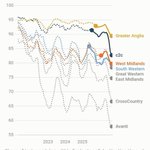
And it seems that the original article bashing the public operators may be a little less honest in its headline than thought....
I still think this government can do more with it's public railways given it's failure to exploit the advantages public ownership can bring

The right might call this predictable but it's actually amusing that Tory nationalisation's of operators like Trans Pennine, Northern and LNER dramatically improved services, and yet Labour can't pull the same trick


Possibly one of the most dangerous and disappointing statements an MP could make
Courts are not the place to decide policy. They are too adversial, have no democratic oversight and care little for morals or sense unless they have been written down as 'precedent'
This quoted post is unavailable.
Don't let the Treasury hear you talking like that

EXC: Andy Burnham tells @TimesRadio his plans to get young people into work will require “investment up front” - and then “in time, the savings will come”
thetimes.com/uk/politics/art…
No one wants this. Either bring them into public ownership or don't - Don't add another layer of bureaucracy that'll serve no purpose other than to make reform even more difficult and pretend it's what the public wants
Iwan Doherty retweeted

Some really depressing facts in here - as a young man much of it rings true amongst my friends.
While housing isn't the only solution, a lot would be improved if young people had the same opportunities as older generations to live in a place of our own and be truly independent.


"Talents from Abroad: Foreign Managers and Productivity in the United Kingdom" showed how British firms who recruited foreign leadership became 23.3% more capital intensive resulting in 4.9% rise in productivity
It's quite funny that while the UK government does share a great deal of blame for our productivity crisis arguably our own business leadership is equally, if not more, at fault because of their anti-investment, short termist approach
