

✝ 🇰🇷 Seoul. Watching from the ground. Markets, money flows & life as I see it. Independent observations. No noise.
Seoul, Republic of Korea
Joined August 2025
- Tweets4.5K
- Following690
- Followers1K
- Likes4.3K



Pinned Tweet
CITI SEES 115% UPSIDE IN MICRON AND 230% IN SANDISK
But the most interesting part of Citi's latest research is its memory demand stress test.
Even if all NVIDIA-related financing projects were halted, Citi estimates the impact on total memory demand at:
• DRAM: −12%
• NAND: −7%
Citi argues that the recent sell-off has gone well beyond what the underlying fundamentals justify.
Its target prices:
• $MU : $1,300
• $SNDK : $262.50
Citi also expects DRAM and HBM supply constraints to persist into 2027–2028.
What I find interesting is the growing divergence between brokerage assumptions about the duration of this memory cycle.
Some are already pricing in a severe downturn, while others believe the market is significantly underestimating the duration of supply shortages.
The difference matters enormously for valuations.
Source: Citi research, as reported by Taiwan's Commercial Times | Nov. 23
ctee.com.tw/news/20261123701…

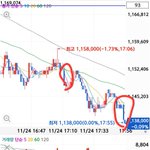
SK HYNIX EXTENDS DECLINE IN AFTER-HOURS TRADING, DOWN 7.7% FROM MORNING HIGH
17:56 KST | Nov. 24
• Pre-market high: ₩1,233,000
• Regular session close: ₩1,158,000
• NXT current price: ₩1,138,000
• Since regular session close: -1.73%
What concerns me is the persistence of the selling pressure.
The one-minute chart continues to show lower highs, lower lows and downward-sloping 20, 60 and 120-period moving averages.
Even after the regular session ended, selling pressure persisted.
The stock is still up 4.88% on the day, but I'm not seeing a convincing reversal signal yet.


GOLDMAN SACHS: TAIWAN AND KOREA ARE EXPERIENCING TWO DIFFERENT CHIP BOOMS
Goldman Sachs economist Kwon Goohoon made an interesting distinction at a press briefing in Seoul today.
Taiwan's semiconductor boom is volume-driven, while Korea's is largely price-driven.
In Taiwan, rising production volumes benefit a broader network of suppliers, materials and equipment manufacturers.
In Korea, rising memory prices concentrate excess profits at Samsung Electronics and SK hynix. Significant capacity and production expansion is not expected to gain momentum until 2028.
The employment figures are particularly striking:
• Taiwan: IT accounts for 10–15% of total employment.
• Korea: IT accounts for 2.5%, including 2% in semiconductors.
Goldman expects Korea's GDP to grow 3.2% in 2027, potentially reaching 3.5%, but anticipates a slow and weak recovery in private consumption.
A semiconductor supercycle does not necessarily translate into a broad economic boom.
Source: The Korea Economic Daily, Nov. 24, 2026.
hankyung.com/article/2026112…

1
5
496
SAMSUNG & SK HYNIX: THE RANGE BREAKDOWN CONTINUES
17:33 KST | Nov. 24
The scenario I was concerned about earlier today is playing out.
Both stocks broke below their intraday trading ranges and continued moving lower in after-hours trading.
From today's highs:
• Samsung Electronics: -3.88%
• SK hynix: -5.15%
Despite the impressive headline gains, the 3-minute charts show deteriorating momentum, particularly in SK hynix.

SAMSUNG AND SK HYNIX BREAK BELOW THEIR INTRADAY RANGES
15:14 KST | November 24
After trading sideways for much of the afternoon, both stocks are breaking below their intraday support levels on rising volume.
Samsung Electronics: ₩189,700
SK hynix: ₩1,162,000
Meanwhile, KOSPI investor flows:
Retail: −₩2.32T
Foreign investors: +₩1.02T
Institutions: +₩861B
Despite substantial foreign and institutional net buying, the market is losing momentum heading into the close.
Still a strong rally on the day.


AI DEMAND IS PUSHING UP PCB COSTS BY 10–15% EVEN IN THE LED DISPLAY INDUSTRY
An interesting development from TrendForce today.
AI computing and high-speed substrates are absorbing upstream electronic-grade glass fiber cloth production capacity.
The ripple effects in 4Q26:
• Four-layer PCB costs: +10–15% QoQ
• COB/SMD LED display material costs: +2%
• Longer delivery lead times
• Low glass fiber cloth inventories
Suppliers are prioritizing higher-value applications, while capacity expansion takes time.
TrendForce expects high-end PCB prices to continue rising in 1Q27, although at a slower pace.
The AI supply bottleneck extends well beyond GPUs and memory. Even manufacturers outside the AI ecosystem are competing for the same upstream materials.
Source: TrendForce, Nov. 24
trendforce.com/presscenter/n…

1
227
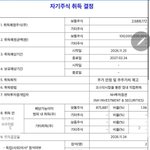
HPSP ANNOUNCES ₩100 BILLION SHARE BUYBACK — 3.25% OF OUTSTANDING SHARES
The Korean semiconductor equipment maker will begin buying back shares tomorrow.
• Total: ₩100 billion
• Target: 2.69 million shares
• Daily purchase order limit: 366,054 shares
• Period: Nov. 25 – Feb. 24, 2027
The daily order limit translates to roughly ₩13.6 billion at the reference price.
Interesting timing, given Korea's temporary easing of share buyback limits effective today.
I'll be watching how aggressively HPSP actually executes the buyback.
Source: HPSP regulatory filing, Nov. 24


HANWHA PLANS ₩10 TRILLION DEFENSE AI DATA CENTER IN SOUTH KOREA
Interesting news today Hanwha Aerospace plans to build a dedicated defense AI data center in Changwon.
• ₩10 trillion in phase-one investment
• 180 MW of planned final capacity
• Initial operations in July 2028
• High-density GPU servers
Under a proposed operating model, the military would retain ownership and control of its data while private defense companies operate the infrastructure.
Hanwha's export strategy...
The company is exploring the possibility of bundling AI data centers with Korean weapons systems sold overseas.
Hanwha also plans to leverage its power generation assets to expand its AI data center footprint.
Korean defense exports could eventually extend beyond tanks, artillery and missile systems to include the computing infrastructure behind them.
Source: ChosunBiz, Nov. 24
biz.chosun.com/industry/comp…

133
TSMC'S CoWoS CAPACITY PROJECTED TO GROW 43% IN 2027
An interesting perspective from Taiwan on Jensen Huang's return.
According to Economic Daily News, Taiwanese analysts expect:
• TSMC's monthly CoWoS capacity to reach 200,000 wafers by end-2027, up from 140,000 at end-2026.
• Rubin Ultra and Feynman to drive larger GPU dies, greater HBM integration and larger package sizes.
• ASE to benefit from NVIDIA's multibillion-dollar funding support for SPIL's advanced packaging expansion.
What caught my attention is NVIDIA's increasing involvement in building its suppliers' manufacturing capacity.
The competitive landscape is also shifting toward rack-scale computing, energy efficiency and cost per token.
$TSM and ASE are positioned to benefit from both GPU and ASIC demand. They don't necessarily need to pick a winner.
Source: Taiwan's Economic Daily News, Nov. 24
money.udn.com/money/story/56…

TAIWAN SEMICONDUCTORS SURGE 9.8% AS AI SUPPLY CHAIN STOCKS HIT DAILY PRICE LIMITS
What stands out in Taiwan today is the breadth of the rally.
All gained 9.9–10.0% today.
• Foundry: $TSM , UMC, PSMC
• Memory: Nanya, Winbond, MXIC
• ASIC: Alchip, Global Unichip
• Packaging: ASE, ChipMOS
• Server manufacturing: Hon Hai, Quanta, Compal
The Philadelphia Semiconductor Index surged 14%, while $MU gained 19%.
Are Taiwan's short-selling restrictions and National Financial Stabilization Fund intervention contributing factors to surge?

6
431
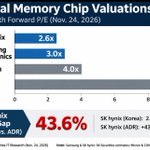
SK HYNIX AT 2.6x FORWARD EARNINGS, SAMSUNG AT 3.0x
SK Securities' latest memory sector valuation update (Nov. 24):
• SK hynix: 2.6x
• Samsung Electronics: 3.0x
• Micron ($MU): 4.0x
• CXMT: 9.7x
Also notable: a 43.6% price gap between SK hynix's Korean-listed shares and ADRs.
Note: Korean companies are based on SK Securities estimates; Micron and CXMT on Bloomberg consensus.
Source: SK Securities IT Research

1
311
SK HYNIX: 19 CONSECUTIVE SESSIONS OF CORPORATE BUYING — 6 MILLION SHARES
I've been tracking the investor flows in SK hynix.
The other corporations category has recorded net buying every trading session since October 29.
What's particularly interesting is the change on November 6.
Average daily corporate net buying:
Oct. 29–Nov. 5: 250,273 shares
Nov. 6–24: 346,393 shares
An increase of 38.4%.
Meanwhile, foreign investors have been net sellers for nine consecutive sessions, and retail, foreign and institutional investors have all been net sellers for the past two sessions.
The consistency of corporate buying closely resembles the company's ongoing share buyback, although the category is not exclusively buybacks.
I'm watching what happens when this source of demand ends.
Source: Kiwoom Securities | Nov. 24, 2026.


SK HYNIX: FOREIGN INVESTORS SELL FOR A NINTH CONSECUTIVE SESSION
Despite today's 6.73% rally at the regular market close, foreign investors continued selling SK hynix.
More interestingly, retail, foreign and institutional investors were all net sellers for the second consecutive session.
Net flows today:
• Retail: −₩271.2B
• Foreign: −₩135.1B
• Institutional: −₩2.1B
Combined net selling: ₩408.4B.
Foreign brokerage data also showed substantial selling volume through Citi and JPMorgan.
The question is how much of the selling is being absorbed by corporate buyers, including SK hynix's ongoing share buyback.
A sharp rebound, but the foreign selling streak remains intact.
Source: Kiwoom Securities | Nov. 24, 2026


KOREA MARKET CLOSE: SAMSUNG AND SK HYNIX GAIN NEARLY 7% BUT BREAK BELOW AFTERNOON TRADING RANGES
KOSPI closed above 5,000, up 6.32%.
But the intraday charts tell a more nuanced story.
Samsung Electronics:
• +6.70%
• Foreign net buying: ₩422.4B
• Institutional net buying: ₩223.0B
SK hynix:
• +6.73%
• Foreign net selling: ₩135.1B
• Ninth consecutive session of foreign net selling.
Both stocks broke below their afternoon trading ranges toward the close.
SK hynix finished 6.08% below its pre-market high.
A strong rebound, but not a particularly convincing finish.
Source: Kiwoom Securities, Nov. 24, 15:38 KST.


3
543
SOUTH KOREA UNVEILS NEW DIGITAL ASSET FRAMEWORK
Korea's Financial Services Commission unveiled its proposed digital asset legislation today.
Key provisions:
• Crypto exchange ownership capped at 20%, with exceptions allowing up to 34%.
• Up to six years to comply with ownership restrictions.
• Banks must collectively own more than 50% of won-denominated stablecoin issuers.
• Tech companies can still become the largest individual shareholder.
• Domestic ICOs to be permitted again after nine years.
What stands out to me is the ownership structure for stablecoin issuers.
Korea wants banks to retain majority ownership while leaving room for technology companies to lead innovation.
I'd watch how Naver, Kakao and Korea's major financial groups position themselves.
This is a government proposal, not yet enacted legislation.
Source: Maeil Business Newspaper | Nov. 24
mk.co.kr/news/stock/12217102

3
394
SAMSUNG AND SK HYNIX BREAK BELOW THEIR INTRADAY RANGES
15:14 KST | November 24
After trading sideways for much of the afternoon, both stocks are breaking below their intraday support levels on rising volume.
Samsung Electronics: ₩189,700
SK hynix: ₩1,162,000
Meanwhile, KOSPI investor flows:
Retail: −₩2.32T
Foreign investors: +₩1.02T
Institutions: +₩861B
Despite substantial foreign and institutional net buying, the market is losing momentum heading into the close.
Still a strong rally on the day.
SC26 INSIGHTS (1/5) | SK HYNIX WANTS TO MOVE COMPUTATION INTO MEMORY
One of the most interesting findings from LS Securities' visit to SC26 Chicago was SK hynix's approach to AI inference.
Instead of constantly moving data between memory and GPUs, why not perform some of the computation inside memory itself?
SK hynix presented a comparison using a 175B-parameter LLM:
• Memory capacity: 400GB in both configurations
• Memory bandwidth: 15TB/s (5 GPUs) vs. 200TB/s (25 AiMX cards, internal bandwidth)
• Weight-reading time for 261 tokens: 6.0s vs. 0.46s
• GEMV energy consumption: 17% of the GPU baseline
That's roughly 13x faster weight reading and 83% lower energy consumption for the specified operation.
These are workload-specific figures, not end-to-end inference benchmarks.
What interests me even more is Custom HBM.
By integrating customer-specific computing and control functions into the HBM base die, memory manufacturers could move beyond supplying bandwidth and capacity toward designing parts of the computing architecture itself.
$SKHY hynix isn't trying to replace the GPU. It's trying to change where computation happens.
That could have significant implications for the value captured by memory manufacturers.
Source: LS Securities, SC26 Chicago Field Report, Nov. 24, 2026, pp. 9–14.


1
3
253
AI SUPPLY CHAIN: ABF SUBSTRATE LEAD TIMES REMAIN AT UP TO 56 WEEKS
Everyone watches GPUs and memory, but look at the other components in TrendForce's latest supply chain update.
Current lead times vs. balanced-market levels:
• ABF substrates: 48–56 vs. 12 weeks
• HDD: 50 vs. 16 weeks
• MLCC: 40 vs. 12 weeks
• DRAM: 18 vs. 8 weeks
• Enterprise SSD: 16 vs. 8 weeks
All seven component supply classifications remain unchanged from last week.
The physical constraints on AI infrastructure expansion remain significant.
I'm particularly interested in ABF substrates and MLCCs. Both deserve more attention in the AI infrastructure discussion.
Source: TrendForce, Nov. 23
insights.trendforce.com/p/we…

2
251
AI STOCKS REBOUND, BUT CREDIT MARKETS REMAIN CAUTIOUS
One observation from Korean analyst Huh Jae-hwan of Eugene Investment & Securities caught my attention in today's Reuters report.
"Unlike Nvidia's share price, CDS premiums have not yet returned to the levels of late October, prior to the US midterm elections."
The next major test is whether US hyperscalers maintain their CAPEX guidance.
My read: Jensen's return has addressed an immediate leadership crisis, but the broader questions surrounding AI infrastructure financing remain.
I'm watching credit spreads as closely as semiconductor stocks.
Source: Reuters | Nov. 24
reuters.com/business/analyst…

9
554
MIRAE ASSET'S TOP 1% INVESTORS ARE SELLING SAMSUNG AND SK HYNIX INTO THE RALLY
Despite today's sharp rebound, the best-performing 1% of Mirae Asset Securities customers over the past month were net sellers of Korea's two memory giants.
Top net sells as of 11 AM KST:
1. Samsung Electronics (+7.72%)
2. LG Electronics (+15.70%)
3. SK hynix (+8.48%)
But look at what they were buying.
Top net buys:
1. Samsung Electronics preferred shares
2. NAVER
3. SK Square
The buying list is arguably more interesting than the selling list.
Samsung preferred shares and SK Square still offer exposure to the memory semiconductor industry.
This looks more like selective rotation than a wholesale exit from the semiconductor trade.
Worth watching whether this pattern continues after today's relief rally.
Source: Seoul Economic Daily / Mirae Asset Securities, Nov. 24
m.sedaily.com/article/201182…

8
1,230