

Keeping an eye on nearby space rocks
West Berkshire, England
Joined December 2015
- Tweets79
- Following12
- Followers190
- Likes7





A picture of mine from Jan 20th of (probably) rocket booster 2014-065B, to hit far side of the Moon later today is now in a BBC news story: bbc.co.uk/news/science-envir…
For those that like a good fast-moving object, it was moving at about 460 arc-seconds per minute at the time.

3
5
Yes, asteroid Bennu is definitely a rubble pile! See how much movement can be seen in the surrounding surface the moment after @OSIRISREx touches down once the spacecraft's motion is removed - hi res: birtwhistle.org.uk/images/OS…
4
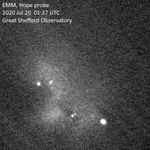
At least 9 separate moving objects surrounded in a glowing cloud tracked tonight after the @HopeMarsMission launch

Two images separated by 24 h show expanding dust shells around Comet NEOWISE. On July 12 distance on plane of sky from centre to the inner shell is about 12,500 km, or the same as the diameter of the Earth. 0.40-m Schmidt-Cassegrain + CCD, field is 8'x8'.
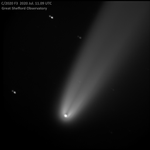
A nice problem to have, the comet is so bright that 1 second exposures were saturating the camera. This is 40 1/2 second exposures, stacked in Maxim and DDP processed with an FFT low-pass filter. 0.40-m Schmidt-Cassegrain + CCD, field is 18'x18'. 2020 July 11.0875 UTC.

Two HST images of C/2019 Y4 taken 3 hours apart, aligned to keep frag.B (thought to be more massive part) stationary, showing smaller fragments generally falling behind as expected, but several pieces apparently moving sunward (to right). Thanks @NASAHubble, D. Jewitt & @Yeqzids
The C/2019 Y4 Hubble image was taken almost exactly half way between these 2 (v. magnified!) images from Great Shefford Obs.
A good opportunity to appreciate the quality of the HST images and see what can be hidden in a single ground based pixel, thanks @NASAHubble and @Yeqzids
Differential movement in fragments of disintegrating comet C/2019 Y4 (ATLAS) over 24 hours.
66.7 mins exposure on Apr.9 and 44.5 mins on Apr. 10 with a 0.40-m Schmidt-cass + CCD.
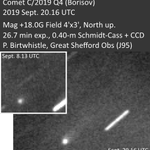
#InterstellarComet C/2019 Q4 (Borisov) taken with exactly same equipment and exposure shows noticeably more tail activity this morning than 12 days ago (inset), only 7% closer to Sun 2.67 AU today, down from 2.85 AU on Sept. 8. Perihelion at 2.0 AU in December.

New (probably interstellar) Comet C/2019 Q4 (Borisov) on Sept. 8, showing a slightly fuzzy coma and just the hint of a tail to the top right.

Just a 15 minute window this morning between the comet rising over rooftops & twilight getting too bright, maybe my last chance to get what is left of Comet C/2017 S3 (PanSTARRS). Aug 03 02:21 UT, 0.48 AU from Sun, 0.78 AU from Earth, elong 27.3°, alt 10°, Sun 15° below horizon.

Comet C/2017 S3 (PanSTARRS) from the middle of second outburst on July 17 to disintegrating diffuse cloud on Aug 01 02:25 UT when it was 0.53 AU from the Sun, at an elongation of 31.5°, altitude 15° and the Sun 15° below horizon.
NEO 2018 CB passed within 5.5 Earth diameters on Feb. 9th.
The lightcurve shape evolves rapidly as phase changes from gibbous to crescent.
See how the weak secondary peak at phase 0.2 becomes as bright as the main peak.
Equivalent Moon phase shown to help visualise phase angle.
Peter Birtwhistle retweeted

RIP Thomas J. Bopp (1949-2018), co-discoverer of comet Hale-Bopp in 1995 (with Alan Hale) en.m.wikipedia.org/wiki/Thom…

Interstellar interloper A/2017 U1 now getting v faint, last night about 300,000 times fainter than the mag +8 star to the west

2017 MB1 NEO. Unconfirmed poss. v.faint, thin, straight tail in pa 260°, see CBET 4415 cbat.eps.harvard.edu/iau/cbe…. PsAng=Anti-solar direction

C/2017 K2 excess FWHM of 1.7" over nearby field star of similar brightness equates to ~20,000 km diameter at distance of 15.9 AU
1
8


