News from the Journal for General Philosophy of Science (Editors in Chief: Guido Bacciagaluppi, Helmut Pulte & Thomas Reydon). Account run by @AFabregasT
Joined December 2016
- Tweets173
- Following759
- Followers815
- Likes717
What insights could we gain through a comparative approach to #philsci? We are thrilled to announce a CfP for a new special issue, with Simon Lohse (@si_loh) & Karim Bschir (@karimbschir) as guest editors! 📢Mark your calendars & send us your ideas! 📅👇dropbox.com/scl/fi/722kfvdrk…
Journal for General Philosophy of Science (JGPS) retweeted
Does Euclidean geometry hold a more fundamental status than non-Euclidean geometries? 📐🟣 In a recent paper, Mircea Dumitru and Liviu Ornea argue that it does and that Nash’s embedding theorems provide a way to demonstrate this 👇📜 link.springer.com/article/10… #philsci #math
Journal for General Philosophy of Science (JGPS) retweeted
Can transaction costs economics illuminate scientific practice and misconduct? In his new #philsci article, Jonas Lipski i argues in the affirmative, suggesting lower transaction costs could improve science's funding and practice👇 link.springer.com/article/10…
Are you interested in the metaphysics of time? In a recent article, @BaptisteLeBihan argues that 'aeon monism' fits Penrose's conformal cyclic cosmology—the cosmos as a collection of successive 'aeons'— and explores its implications: link.springer.com/article/10… #philsci #philphysics
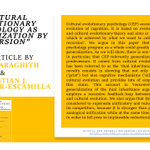
What does Cultural Evolutionary Psychology bring to the table? In their new article, K. Baraghith & C. Feldbacher-Escamilla argue that it generalizably shows that cognitive products & cog. mechanisms are subject to recursive cultural evolution 👇link.springer.com/article/10… #philsci
Journal for General Philosophy of Science (JGPS) retweeted
Videos from last month’s Philosophy of Science: Past, Present & Future event are available on the Center’s YouTube channel. Organized by day (Past / Present / Future) to make it easy to dip in and out. A wealth of material to listen to. Thanks again to the many wonderful presenters and contributors! #philsci buff.ly/3Q1fqUy
Have you ever wondered how Bacon's inductive method fits into his larger philosophy of nature? The new #OpenAccess article by Ori Belkind in @JGenPhilSci provides a novel interpretation. Check it out! 👇📄 link.springer.com/article/10… #philsci
Journal for General Philosophy of Science (JGPS) retweeted
We’re getting excited for next week’s conference - "The Philosophy of Science: Past, Present & Future." It starts Thur 17 Oct in Minneapolis. Superb lineup of speakers! The full program is now online - cla.umn.edu/mcps/research-pr…
#philsci
Journal for General Philosophy of Science (JGPS) retweeted
Do you know what time it is? Time to go back to Reichenbach! In his new article, @carlorovelli argues that R's musings on the direction of time and 'physical causes' still hold value in light of contemporary work in cosmology 👇 link.springer.com/article/10… #philsci #philphysics
Journal for General Philosophy of Science (JGPS) retweeted
I am really happy to finally hold this book in my hands! It is the product of the collective efforts of editors, authors, reviewers, and publishing staff. We hope it sparks new interesting discussions on organismal agency! #philsci #histsci #philbio📕👇 routledge.com/The-Riddle-of-…
Journal for General Philosophy of Science (JGPS) retweeted
My book is finally here! @PhilSciAssoc tells me it’s popular on @PhilSciArchive , hitting the top spot on their list. Thank you all for your interest in Laws of Physics!
Journal for General Philosophy of Science (JGPS) retweeted
What insights could we gain through a comparative approach to #philsci? We are thrilled to announce a CfP for a new special issue, with Simon Lohse (@si_loh) & Karim Bschir (@karimbschir) as guest editors! 📢Mark your calendars & send us your ideas! 📅👇dropbox.com/scl/fi/722kfvdrk…
Journal for General Philosophy of Science (JGPS) retweeted
The Routledge Handbook of Philosophy of Scientific Modeling (edited by Tarja Knuuttila, Natalia Carrillo, Rami Koskinen) is 🔓Open Access and contains many great chapters. Check it out! taylorfrancis.com/books/oa-e…
Journal for General Philosophy of Science (JGPS) retweeted
What is the aim of science? Truth or understanding? What could Deep Learning offer to this #philsci debate? In his new article, Yukinori Onishi argues that it could bring interesting testing scenarios for constructive empiricists & scientific realists 👇 link.springer.com/article/10…
Journal for General Philosophy of Science (JGPS) retweeted
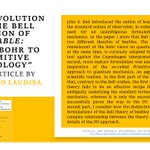
John S. Bell proposed the notion of ‘beable’ to replace ‘observable’ for a clearer formulation of quantum mechanics. In his recent article, Federico Laudisa (@UniTrento) argues that Bell actually developed 𝘵𝘸𝘰 distinct beable theories😮👇 link.springer.com/article/10… #philsci
Journal for General Philosophy of Science (JGPS) retweeted
Just Published!
A thorough investigation of the large-scale structure of relations of inductive support within the material theory of induction. The latest book from #BSPSOpen and John D. Norton.
ow.ly/iiKs50SU0VK
#philsci #philosophyofscience #newrelease
What is the aim of science? Truth or understanding? What could Deep Learning offer to this #philsci debate? In his new article, Yukinori Onishi argues that it could bring interesting testing scenarios for constructive empiricists & scientific realists 👇 link.springer.com/article/10…