





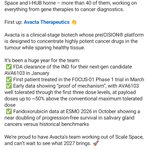


AVA6103 featured in a new paper by Chinese researchers in the International Journal of Peptide Research and Therapeutics (full text unfortunately paywalled)
researchgate.net/publication…
#AVCT


#AVCT covered in today's Cambridge Biocapital weekly roundup
cambridgebiocapital.substack…

Very similar coverage published again today by New Perspectives in Medicine on Shanghai - 31k followers on this platform
m.163.com/dy/article/LC6T426…
#AVCT


AVA6103 covered by Pharmaceutical Observer in Shanghai this morning.
m.163.com/dy/article/LBF3V98…
#AVCT


EUROPEAN BIOTECH
$AVCT — One drug damages cancer cells’ DNA. The other gives them less time to repair it.
Today, November 19, Avacta Therapeutics, a British biotech listed in London, reported new results from its AVA6207 program at the EORTC–NCI–AACR cancer research symposium in Barcelona.
Avacta tested a single molecule carrying two drugs, exatecan and berzosertib, in mice implanted with tumor tissue from patients. Here’s what happened in two small studies.
Ovarian cancer. Tumors regressed completely in 4/4 mice given the two-drug compound. Exatecan alone also produced complete regressions in 2/4 mice.
Non-small cell lung cancer. Tumors regressed completely in 4/5 mice given the compound. With exatecan alone, the best result was a partial regression in 1/5 mice.
Why pair these two drugs?
Exatecan traps an enzyme called topoisomerase I on DNA. When a cancer cell tries to copy that DNA, it can suffer breaks. Some cells survive because a protein called ATR helps them slow down and deal with the damage before they divide.
Berzosertib blocks ATR. The idea is to make damage that a cancer cell could otherwise survive harder to recover from.
How do both drugs reach the tumor?
Avacta’s pre|CISION technology links both drugs to a short peptide. An enzyme called fibroblast activation protein (FAP), found on cells that support many solid tumors, can cut that peptide. A single cut triggers the release of both drugs nearby.
In a separate mouse experiment, exposure to each released drug was much higher in tumor tissue than in blood plasma over the first 48 hours.
Which tumors might be especially vulnerable?
Both tumor models had low levels of SLFN11, a protein whose loss can make cancer cells less responsive to drugs like exatecan. The lung model also had low levels of ATM, another protein that helps cells respond to DNA damage.
In separate lab experiments, cells with impaired ATM function were roughly ten times more sensitive to dual-drug compounds from the program than cells with working ATM. That gives Avacta two possible markers to investigate in future trials. Whether either can predict which patients will benefit remains an open question.
What does this mean for patients?
The lung result is encouraging because exatecan alone had little activity in that model. Each cancer type, however, was represented by a single model, with only four or five mice per group. The experiments also leave open how the conjugate would compare with giving the same two drugs together as separate medicines.
AVA6207 is still preclinical. Avacta has already tested two other pre|CISION drugs in people. AVA6000 delivers doxorubicin, and AVA6103 delivers exatecan alone.
For AVA6207, Avacta plans to begin the formal studies needed to apply for a first human trial in the fourth quarter of 2026.
The question for patients is whether a dose they can tolerate will deliver enough of both drugs to shrink a resistant tumor.
Avacta’s results are an encouraging step toward tackling cancers that resist DNA-damaging treatments.
The next challenge is to translate this activity in mice into a treatment that patients can tolerate and benefit from.
23
1,791

Posted again separately in English and French by Sygnature Discovery North America 👍🏻
linkedin.com/posts/avacta-ca…

1
192
#AVCT press release picked up by FirstWord Pharma just now.
firstwordpharma.com/story/84…

#AVCT coverage published this morning by Chinese biotech publisher ChujieBio
mp.weixin.qq.com/s?__biz=MzU…


AVA6103 covered by Pharmaceutical Observer in Shanghai this morning.
m.163.com/dy/article/LBF3V98…
#AVCT
AVA6103 added to the US National Cancer Institute's NCI Thesaurus on 26 October 2026, receiving its own standardised biomedical terminology entry (C229108).
evsexplore.semantics.cancer.…
#AVCT


Ongoing patent activity around #AVCT's Affimer immunotherapy platform - divisional patent application filed in May and published this morning in Japan.
Serum Half-Life Prolonging PD-L1 Inhibiting Polypeptide.
j-platpat.inpit.go.jp/c1801/…


"A number of very interesting combinations" for AVA6207.
#AVCT


FW in a new podcast interview published this morning.
podcasts.apple.com/gb/podcas…
#AVCT


