







Jacob King retweeted
Howard Lutnick is arguably one of the slickest and most corrupt operators in modern finance.
We now know he was close friends with Jeffrey Epstein, despite him previously denying it. That link was confirmed in the Epstein files. He also has documented ties to Tether and Bitcoin market manipulation.
Now a brand new scheme has surfaced involving Cantor Fitzgerald, run by one of his sons.
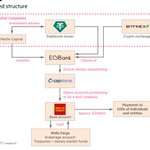
The firm has been buying the rights to U.S. tariff refunds at massive discounts.
Here is how this scam works:
1. U.S. companies paid billions in tariffs that were later ruled illegal.
2. Cantor approaches those companies and offers immediate cash: 25 cents for every dollar they are owed.
3. Companies take the money to avoid waiting years for litigation and bureaucracy.
4. When refunds are issued, Cantor collects the full dollar.
They bought claims at 25 cents on the dollar. After today’s Supreme Court ruling, those claims could be worth 80 to 90 cents.
It’s worth nothing that Lutnick also literally helped architect the tariff regime. He pushed Trump to implement it, likely knowing it would collapse and create this exact arbitrage opportunity.
The potential payout is in the billions. This is insider-level extraction hiding in plain sight.

Jacob King retweeted
Michael Saylor is one of the biggest fraudsters in the financial markets.
He will eventually face criminal charges, file for bankruptcy, and spend the rest of his life behind bars. He is this era’s version of Bernie Madoff.
His playbook, which I exposed over 12 months ago, is clear: raise capital → buy BTC → hype up price → raise more → repeat. It's a circular scheme built on hopium and hype.

Jacob King retweeted
To understand how dumb Michael Saylor is, he started investing in Bitcoin at 11K, and it’s currently 60K, but he’s down a whopping $15 billion, more than anyone else on earth.
He will go down as one of the worst investors of all time.
Jacob King retweeted
European Commission President Ursula von der Leyen says that to fix Europe’s energy crisis, people should stay home, not drive, and not use electricity.
Let me guess: next week’s update to solve the food shortage will be, stay hungry, don’t chew, avoid calories.
Groundbreaking stuff from the European Commission.
Jacob King retweeted
"We've had all kinds of financial crises, but we've never really had a successful cyber attack on a large financial utility or financial institution."
- Federal Reserve Chair, Jerome Powell
They're literally telling you what will happen next.
Jacob King retweeted
Interesting how no one is stockpiling more gold faster than the scammy Bitcoiners who said a few years ago that Gold was worthless…


Jacob King retweeted
Bill Ackman literally gave a 44-minute masterclass that explains money better than any business school:
Jacob King retweeted
The New Yorker just published what may be one of its most damning articles in recent years, alongside major investigations like its exposé of Harvey Weinstein, focusing not just on a darker, manipulative side of Sam Altman, the CEO of OpenAI, but also his repeated deception and reckless leadership.
The article draws on more than 100+ interviews, over 200+ pages of private notes from Dario Amodei, former OpenAI VP of Research, and previously undisclosed memos from Ilya Sutskever, OpenAI’s co-founder and chief scientist.
The investigation found that Sam Altman’s issues didn’t just start with the creation of OpenAI. Back at Loopt, senior staff pushed to remove him as CEO twice over concerns about honesty and leadership. During his time at Y Combinator, partners raised similar complaints, and Paul Graham reportedly told others that Sam had been consistently dishonest.
Inside OpenAI, Ilya Sutskever gathered around 70 pages of internal evidence, including Slack messages, HR records, and photos taken off company devices to avoid tracking. He shared them with board members using disappearing messages. The first memo opened by calling out a repeated pattern, starting with lying.
Dario Amodei kept detailed private notes over several years, more than 200 pages, documenting his experience at the company. His conclusion was blunt: the core issue at OpenAI was Sam himself.
There were also repeated problems with transparency around safety. Sam told the board that certain GPT-4 safety features had been approved, but when Helen Toner checked, some of the most controversial ones had never gone through proper review. He also failed to disclose that Microsoft had launched an early version of ChatGPT in India before required safety checks were completed.
The superalignment team was publicly promised a large share of compute resources, around 20%. In reality, people working with the team say they received closer to 1 to 2%, often on outdated hardware. The effort was eventually shut down before it could finish its work.
Sam also made side arrangements that cut around formal governance. At one point, he privately agreed with Greg Brockman and Ilya Sutskever that he would step down if the two of them decided it was necessary, effectively creating a separate power structure. The actual board was not aware of this.
When it came to leadership, he played different sides. He struck a deal with Greg to become CEO, while telling researchers that Greg’s role would be reduced, and telling Greg something entirely different.
After he was removed, the response turned aggressive. Sam told Mira Murati that his allies were actively trying to dig up damaging information on her. Around the same time, Thrive Capital paused a massive investment and signaled it would only move forward if Sam returned, putting pressure on employees who stood to gain financially.
He also directly involved himself in reshaping oversight. He texted Satya Nadella suggesting a new board, including himself as CEO, and proposed who would run the investigation into his own conduct. The people later chosen to oversee that inquiry had been discussed with him beforehand.
In the New Yorker article, one board member described him as someone who wants to please people in the moment but shows little concern for the consequences of misleading them. Several others independently used the word sociopathic. Altman was a literal “sociopath,” one OpenAI board member alleged.
“He’s unconstrained by truth,” they told The New Yorker. “He has two traits that are almost never seen in the same person. The first is a strong desire to please people, to be liked in any given interaction. The second is almost a sociopathic lack of concern for the consequences that may come from deceiving someone.”
Aaron Swartz, the famed coder and hacktivist who mysteriously died by suicide in 2013, used similar language to describe Altman. Swartz had been batchmates with Altman in the inaugural class of 2005 at the Silicon Valley incubator Y Combinator and warned friends about him just before his death.
“You need to understand that Sam can never be trusted,” Swartz told one confidante. “He is a sociopath. He would do anything.”
Among all of these new revelations, there is also a renewed civil lawsuit filed by Altmans younger sister, Annie Altman, who alleges he sexually abused her as a child beginning when she was 3 and he was 12.
All of this is happening as OpenAI moves toward a potential trillion-dollar valuation and secures government contracts connected to surveillance, immigration enforcement, and military operations. Leadership like this raises urgent questions about who is really in control and what the stakes are.
This is not about a single misstep or an internal dispute. It is a consistent pattern of deception, power plays, and sidestepping oversight at the helm of one of the world’s most influential AI companies.
The deeper concern is not just what occurred inside OpenAI. It is what it signals for the future. A company shaping global technology, backed by massive capital and government influence, appears to have been guided by someone repeatedly accused of flouting rules designed to keep that power in check.


Jacob King retweeted
JUST IN: Professor Steve Keen who predicted the 2008 financial crash now is warning people "Bitcoin is going to zero."

Jacob King retweeted
BREAKING: Tether has fired two top gold traders just months after hiring them from HSBC.
Tether let go of two senior hires it brought in during late 2025 to expand into gold trading, reversing a strategy it had called a major priority.
The company had recruited Vincent Domien (former global head of metals trading at HSBC) and Mathew O’Neill (who led precious metals deals across Europe, the Middle East, and Africa).
CEO Paolo Ardoino had said they would help build a world-class gold trading operation to compete with major banks.
At the same time, Tether had been quietly stockpiling about 140 tons of physical gold—worth around $24B—stored in Switzerland, making it one of the largest private holders.
The sudden firings suggest tension between crypto firms and the traditional, relationship-heavy gold market. Tether had planned to actively trade its gold holdings to profit from price differences.
No reason has been given, and neither trader has commented.


Jacob King retweeted
Google Quantum AI released a white paper today warning that cracking 256-bit ECC, which is widely used in Bitcoin wallets, requires MUCH fewer resources than originally expected.
With under 500,000 physical qubits, any private key could theoretically be cracked in under 9 minutes. Wow.
This is one of the many reasons why whales and insiders have been quietly offloading Bitcoin in droves. Bitcoin’s days may be numbered. In a short time, quantum computing can and will completely abolish the space.

Jacob King retweeted
JUST IN: France's 10-year yield hit 4%, highest since 2009.
These are levels not seen since the world was crawling out of the 2008 financial crisis.
The trigger is the Iran War, with oil up 8%, European gas up 20%, reigniting inflation fears across the continent.


