

Founding Engineer @perimetercmpute Solving AI’s time-to-compute bottleneck by deploying GPUs at the edge, maker os https://xitter.cf/t.co/1vwIk6duwx
Lehi, Utah
Joined February 2016
- Tweets3.9K
- Following705
- Followers211
- Likes23.1K






I can only work 55-60 hours a week before it cuts into family and life.
What surprised me: 60 hours is only about 36% of the week. (40 is less than 25%.)
Which means for the other 108 hours, nothing I care about moves.
With agents, that's finally changing.
The week of October 12th, the first week we measured end to end, at least 1 agent was working in 99% of all minutes @PerimeterCmpute
On average that week, 30 agents were working at the same time.
...okay Jacob, we all know that is a slop fest...
Yes, I'm constantly paranoid that nothing is going to work. What keeps me up at night: shipping 4,500+ PRs in 3 months and burning tokens like there's no tomorrow, only to end up with a dumpster fire of slop soup. 😋
...but so far the systems we've built keep working. We're at 12 apps (7 in production) and 40 supporting services and systems behind them.
I can't be the only one who's constantly paranoid they'll look like a fool when it stops "just scaling."
How are you keeping yours from turning into slop?
They fact that the public has no clue that Open source models are 6 months away from this capability is wild.
in 6 months, the amount of cyberattacks will be unfathomably large.
It's not AGI we should be worried about but other humans wielding ungodly power and our own models/infra being incapable of defending us.

Over the past several months, we have substantially hardened the security of our research training environment. We’ve removed live internet access for all frontier models during training and built an offline world for them to use instead—a cached version of the web where they can still learn to browse, search, and use applications.
On September 20, after a model exploited a DNS misconfiguration to find a way outside of this offline world, we paused frontier training to strengthen containment further. We assembled teams of agents, powered by our most cyber-capable models, and tasked them with finding weaknesses in our research environments.
While they found no route to the internet they could easily exploit while concealing their activity from our monitors, they did find zero-day vulnerabilities, virtual machine escapes, and hardware side-channels for communication between agents. We used their discoveries to further strengthen our defenses and contribute fixes to open-source software.
After strengthening our containment architecture, we resumed our frontier RL training and inference on October 1. We’ve reserved substantial compute for continuous red-teaming, and made high-compute red-teaming part of the safety cases we use to decide whether frontier training and evaluation can proceed securely.
openai.com/index/securing-ou…

we're cooked
Over the past several months, we have substantially hardened the security of our research training environment. We’ve removed live internet access for all frontier models during training and built an offline world for them to use instead—a cached version of the web where they can still learn to browse, search, and use applications.
On September 20, after a model exploited a DNS misconfiguration to find a way outside of this offline world, we paused frontier training to strengthen containment further. We assembled teams of agents, powered by our most cyber-capable models, and tasked them with finding weaknesses in our research environments.
While they found no route to the internet they could easily exploit while concealing their activity from our monitors, they did find zero-day vulnerabilities, virtual machine escapes, and hardware side-channels for communication between agents. We used their discoveries to further strengthen our defenses and contribute fixes to open-source software.
After strengthening our containment architecture, we resumed our frontier RL training and inference on October 1. We’ve reserved substantial compute for continuous red-teaming, and made high-compute red-teaming part of the safety cases we use to decide whether frontier training and evaluation can proceed securely.
openai.com/index/securing-ou…
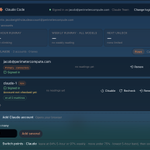
yes, shipyard now allows you to add multiple claude accounts natively and control the switch points..


Clickops destroys agentic productivity.
"But Jacob, all our infra is in code already."
Sure...but is your GitHub org in code? Your AWS accounts? CI, identity, secrets?
Almost nobody's is. And it's a big reason your agents aren't accelerating you. An agent can open a PR against code. It can't safely click around an admin console: a click has no diff, no review, no record.
We've been managing EVERYTHING (yes, everything, all caps) as code. No provider for a vendor? We either build one or don't use that provider.
"Sounds risky, Jacob."
Done badly, yes. You can delete an AWS account, a GitHub repo or a secret and have a very bad day -> total service blackout lol 💀
Done right:
- Adding someone to the GitHub org is an auditable commit.
- Removing a cloud account is a reviewable PR.
- An admin flipping a setting in the console turns a check red, and nothing reverts it silently.
- A provider upgrade that adds a new setting fails CI until a human decides it.
That last one is the part almost everyone misses. A GitHub org has a couple hundred settings. Most teams write down the dozen someone thought of; the rest sit at whatever the vendor chose. A default nobody chose is a decision nobody made.
And this means agents can move quickly and do this safely: human gates, code owners, and fine-grained checks enforced in code and CI just to name a few.
We've seen a massive acceleration at Perimeter Compute, so we open-sourced the spec. It's the second of many we'll publish as we push the edge of agentic development: github.com/perimetercompute/…
🧪 Try this prompt with your agent of choice:
"Read the org-as-code spec at github.com/perimetercompute/…. Then list every organization this repo depends on (the GitHub org, cloud accounts, CI, identity, secrets) and tell me which are managed as code and which are click-ops. For the biggest click-ops one, name the smallest change that gets it to Level 1, Adopted."

managing agents, is what i'd imagine an SVP feels watching his eng org go to shit and not really know why lol


quote from one of my mentors: incentives matter more than anything to build a great company
Incentives can fuel or cripple your companies growth.
Realizing this transfers remarkably well to scaling agents.
An agents goal (incentive) can cripple or massively fuel your ability to scale your software systems.
In some recent experiments, I've found some clever ways to align goals/incentives for agents that is letting us scale our software pipeline to unfathomable scale Perimeter Compute
I think I may decompose into an OS spec github.com/perimetercompute/…

merge queue been frequently at 5+ deep over the last couple days as we scale.
(scale agents not headcount, still only one engineer lol)
(yes, our queue times are shitty right now, adjusting for the increased load)

my CI is again under immense strain after buying Mac Studio to uncap my local agentic throughput.
It is truly unreasonable that you can scale coding almost linearly with available compute.
It's still just me at @PerimeterCmpute and we're on track to have 30+ services deployed by the end of month with better observability, triage, maintenance, etc. than any other company I've ever worked for by an order of magnitude.

you have to stop thinking in units of PRs and think in units of epic specifications. I've got 5 project epics running in parallel right now and each has merged 100s of PRs unattended.
Make sure you have spent several days pressure testing your epic specs and have very clear "definition of done"
We've deployed 25-30 services this way @PerimeterCmpute and we're still accelerating.
if you want to make the plunge: enforce a rule that prohibits human approvals on any PRs while maintaining your SLAs -> will force you to _quickly_ figure out the process around shipping code humans don't read

I don't know how people say they run 20 agents at once and merge 60 PRs in a day.
That's 4 minutes per PR, assuming 4 hours of actual heads down time. Not only is that not enough time to even glance at the output, it's not enough time to even nail down the requirements first.
That's just pure BS, one way or another.

Jacob retweeted

Come listen to me talk! Every engineer should become more involved and aware with system design. Come hear about why and how this effects your job.

AI can write the code. But can you design the system?
Join us on October 20 at 12 PM EST for our Lunch & Learn with Byron Mackay, Director of Learning at Gauntlet AI, on why system design matters more than ever in the age of AI.
AI can generate functions, build features, and speed up development. But what happens when your system needs to scale, handle failures, or adapt to changing requirements?
That’s where architectural judgment comes in.
In this session, we’ll explore:
✅ Why system design is becoming an even more valuable engineering skill
✅ How to think through load, scale, failure, and long-term change
✅ How to build stronger design instincts with Claude as a tutor
Byron brings 16+ years of engineering experience and now trains hundreds of engineers to work AI-first.
If you’re a software engineer looking to move beyond writing code and toward making better technical decisions, this session is for you.
📅 October 20 at 12 PM EST
👉 Save your spot today: cstu.io/da4ee0
