

STONE-911 WonderGrid Pulse Gate Post-Quantum 911 Architect • Dad • SAG-AFTRA Actor • Male Talent • Civil Rights Leader • 9/11 WTC First Responder • Humanitarian
Las Vegas, Nevada
Joined July 2012
- Tweets88.3K
- Following2.7K
- Followers8.1K
- Likes78.1K




From earth to space, one reference. Imagine satellites, spacecraft, research stations, aircraft, emergency networks, and financial systems referencing a common time architecture. Different locations and environments may require relativistic corrections, but a shared framework could make coordination across the planet and beyond more consistent.
5
From earth to space, one reference. Imagine satellites, spacecraft, research stations, aircraft, emergency networks, and financial systems referencing a common time architecture. Different locations and environments may require relativistic corrections, but a shared framework could make coordination across the planet and beyond more consistent.
6
The next generation of timekeeping is about trust. A timestamp should be more than numbers on a screen. It should identify its reference standard, synchronization source, precision, and uncertainty. My vision is a globally comparable timeline where digital events can be synchronized, audited, and independently verified.
1
9
Space and time belong to the same equation. Einstein showed us that space and time are connected through spacetime. STONE TIME takes that scientific foundation and asks a practical question: can we create a more unified way to identify when and where every significant event happens, regardless of geography, motion, or time-zone boundaries?
5
One planet. One continuous timeline. The Earth rotates, galaxies move, and physical events unfold continuously. Yet humanity divides its clocks into regional systems. I’m proposing one shared global time reference, with local time becoming a convenient conversion rather than the foundation of worldwide coordination.
11
Time is not the clock. For centuries, humanity has organized life around clocks, calendars, time zones, and political boundaries. But time itself does not recognize any of them. My STONE TIME concept begins with a simple distinction: the universe has a physical timeline; humans created different ways to display it. It’s time to rethink how the world references time.
11
STONE-TIME.com
REAL TIME.
ONE STANDARD.
ONE WORLD.
The physics, mathematics, and future of global time
I’ve been thinking about something most people never question. What exactly is time?
We look at a clock and see numbers. We organize our lives around hours, minutes, seconds, AM, PM, military time, time zones, and daylight saving time. But the clock isn’t time itself. A clock is an instrument. Time is what we’re trying to measure.
The Earth keeps rotating. The Earth continues its orbit around the Sun. Atoms undergo measurable transitions. Light travels through space. Physical events happen in an ordered relationship to other events. None of these processes stops because somebody crosses a time zone or changes the numbers on a clock.
That’s the foundation of my idea: STONE TIME.
What makes time real?
We cannot hold time in our hands or photograph time itself. What we can measure are intervals between physical events. A clock records repeated physical oscillations. An atomic clock counts extremely precise atomic transitions. Astronomers measure orbital periods. Physicists measure how long it takes light to travel between locations. Scientists compare clocks to measure differences caused by motion and gravity.
The modern scientific definition of one second is based on cesium-133 atoms. One second is defined by exactly 9,192,631,770 cycles of radiation associated with a particular atomic transition.
That means the second isn’t simply an arbitrary number somebody invented for a wristwatch. Its modern definition is tied to a reproducible physical phenomenon.
This is one reason atomic clocks are so important.
The mathematics of time
Let’s start with the simplest equation:
Δt = t2 - t1
This represents elapsed time between two events. If an event begins at 10:00:00 and ends at 10:00:10, the elapsed interval is ten seconds. The displayed clock format doesn’t change that interval.
We can also describe the relationship between frequency and time:
T = 1 / f
Here, T is the period of one cycle, and f is the frequency, or cycles per second.
For example, a signal oscillating at 1,000 cycles per second has a period of:
T = 1 / 1,000 = 0.001 seconds
An atomic clock uses an extraordinarily precise physical frequency as its reference and counts cycles to establish elapsed time.
This is the difference between measuring time and simply displaying a time.
Time is part of spacetime
Einstein’s theory of relativity changed how we understand time. Time and space are connected. Physics describes events using four coordinates:
E = (ct, x, y, z)
Here, t is the time coordinate, x, y, and z are spatial coordinates, and c is the speed of light.
In special relativity, the spacetime interval between two nearby events in flat spacetime can be written:
ds^2 = -c^2(dt)^2 + (dx)^2 + (dy)^2 + (dz)^2
The exact sign convention can vary, but the physical relationship is the same.
This matters because time is not experienced identically by every observer in every circumstance.
Why two clocks can measure different elapsed times
This is where the science gets fascinating.
According to special relativity, a clock moving at a high speed relative to an observer can accumulate less elapsed time than a clock at rest relative to that observer.
The equation is:
Δt = γΔτ
Where:
γ = 1 / sqrt(1 - v^2/c^2)
Here, v is relative velocity, c is the speed of light, γ is the Lorentz factor, and Δτ is the elapsed time measured by the moving clock.
The faster the relative motion, the larger the difference can become.
Gravity also affects clock rates. In a simplified, nonrotating, spherically symmetric gravitational field, a stationary clock outside a massive object accumulates proper time according to:
dτ = dt * sqrt(1 - 2GM/(rc^2))
Where G is the gravitational constant, M is the object’s mass, r is the distance from its center, and c is the speed of light.
1
18
This is called gravitational time dilation.
These aren’t just theoretical ideas. Precision clocks and satellite navigation systems must account for relativistic effects.
Time is measurable, but the elapsed time recorded by a clock depends on its physical circumstances.
The Earth, rotation, and the calendar
The Earth rotates approximately once per day and orbits the Sun approximately once per year. Humans developed calendars and clock conventions around these astronomical cycles.
But a solar day isn’t the same thing as the SI definition of a second. The Earth’s rotation varies slightly. It isn’t a perfectly uniform clock.
That’s why modern timekeeping relies on atomic standards rather than simply counting Earth’s rotations.
Atomic time provides a highly stable measurement of seconds. Astronomical observations describe Earth’s rotation and position. Civil time systems help coordinate human activity.
They are related, but they are not identical.
Why conventional clock systems are confusing
I want to make something clear: 12-hour time and military time are not fake. They’re different notation systems.
Regular 12-hour time divides the day into two 12-hour cycles. That’s why we need AM and PM.
Military time uses a 24-hour format, from 0000 through 2359. It’s not a different kind of time. It’s another way of displaying the same day.
Time zones divide the world into different regional clock systems. They help people coordinate daily life around local daylight, but they don’t divide time itself.
Daylight saving time changes some local clock displays seasonally. It doesn’t make the Earth rotate faster or slower.
The problem I’m interested in solving isn’t that these systems cannot work. It’s that people, databases, agencies, businesses, and technologies can record the same event using different local clock conventions. That creates opportunities for confusion when records need to be compared.
The STONE TIME proposal
My vision is to make one continuous global time reference the primary foundation for recording events.
I want a system in which every location uses the same underlying reference for timestamps. The global timeline would continue without restarting at local midnight. People could still see the familiar time in their city or country, but that would become a conversion from the same universal reference.
Every record should include a globally comparable timestamp, its precision, and its source. Systems should be able to show where their time came from, how accurately their clocks were synchronized, and whether their timestamps were later changed.
The mathematics behind a global timeline
One practical way to represent an event is with a timestamp measured from a shared reference epoch.
t_elapsed = t_event - t_epoch
A digital system can store elapsed time in seconds, milliseconds, or nanoseconds, depending on its requirements.
A more complete event record could be represented as:
R = (T, G, P, S, U)
Here, T represents the global timestamp, G represents geographic or system location, P represents timestamp precision, S identifies the source clock or synchronization source, and U represents uncertainty or known timing error.
This is important because a timestamp without a source or accuracy measurement can create a false sense of precision.
For example, a system might display a timestamp to six decimal places, but that doesn’t mean its clock was actually accurate to one microsecond.
STONE TIME should distinguish displayed precision from verified accuracy.
Imagine applying this to 911 systems
Consider an emergency. A person calls 911. The dispatch center creates a CAD entry. An officer is dispatched. A body camera begins recording. A hospital receives a patient. An insurance claim is generated. A public-record request is later submitted.
Each system may have its own clock, database, and timestamp format.
Now imagine those records all being compared against one shared global time reference.
1
6
The timeline could establish when the call was received, when dispatch created the event, when the unit was assigned, when the officer arrived, when video recording began, when the hospital documented arrival, and when each record was modified.
That doesn’t automatically prove the accuracy of every record. But it gives investigators a common timeline and makes discrepancies easier to identify.
For evidence integrity, I would also want immutable audit logs, cryptographic signatures, trusted synchronization sources, and a record of every timestamp correction.
The goal is not merely to know what time somebody wrote down. The goal is to establish when an event occurred and how that time was verified.
What already exists, and what I want to build
I recognize that UTC, Coordinated Universal Time, already exists as the internationally agreed global time scale.
Atomic clocks around the world contribute to international timekeeping. UTC is not a single physical clock sitting in one building. It is calculated using measurements from laboratories around the world.
I am not claiming that STONE TIME has replaced UTC or discovered a new physical law.
I am proposing a new way to organize, display, apply, and verify global time across everyday life and critical systems.
STONE TIME can build on established scientific standards while developing a more unified public-facing system.
The opportunity is in the architecture, the applications, the transparency, and the way people use that reference.
The bigger question
Why should a person’s understanding of when something happened depend on which side of a time-zone boundary they live on?
Why should two agencies struggle to compare records because one uses local time, another uses UTC, and another uses a different clock configuration?
Why shouldn’t an international event, a scientific measurement, a financial transaction, and an emergency call all be traceable to the same global reference?
The Earth is one planet. Physical events happen in the same universe. We have developed extraordinary technology to measure time with atomic precision. Now I want to explore how we can make that precision more useful, accessible, transparent, and consistent.
I’m calling that vision:
STONE TIME
REAL TIME.
ONE STANDARD.
ONE WORLD.
THE WORLD SHARES ONE PLANET.
WHY SHOULDN’T IT SHARE ONE TIMELINE?
4

PUTIN, CHRISTIANITY, AND THE VAMPIRE’S BALL
Everybody wants to make Vladimir Putin out to be the villain. But when a world leader starts talking about Christianity, civilization, morality, corruption, and the exploitation of ordinary people, I want to hear the actual words before I decide what they mean.
Putin has invoked the idea of Russia as a defender of traditional values and Christian civilization. That narrative is connected to the centuries-old concept of Moscow as the “Third Rome,” the belief that Moscow inherited a spiritual legacy from Rome and Constantinople after the fall of the Byzantine Empire.
Then there is the statement that caught my attention.
“The vampire’s ball is coming to an end.”
Putin used that imagery to attack Western elites, accusing powerful interests of enriching themselves at the expense of ordinary people and other nations. It is dramatic language. It is political language. But the underlying questions are worth asking.
Who is exploiting the public?
Who is protecting the powerful?
Who profits from corruption?
Who is using morality, religion, patriotism, and political ideology to justify their own authority?
And who actually pays the price?
There is another part of this story I want examined.
The private labyrinth imagery and the physical markings I have been comparing in connection with Casa Pacifica and images associated with Epstein Island raise questions I believe deserve independent examination. Are the similarities meaningful, or are they simply visual coincidences? A resemblance on a map or aerial photograph does not establish a connection, criminal activity, or shared ownership. That takes records, verified locations, property documents, and evidence.
But why shouldn’t those questions be examined?
What do powerful people know about these institutions, networks, and places? What information has been withheld? And what would an honest investigation uncover?
That brings me back to Putin.
Maybe there is more behind his “vampire’s ball” statement than a sound bite. Maybe he believes he is confronting a system of powerful interests that ordinary people rarely get to see. Maybe he knows things that deserve scrutiny. Or maybe this is political messaging designed to make Russia look like the moral alternative to the West.
I don’t know. And I’m not going to pretend I do.
I don’t have to agree with Putin’s politics, support Russia’s war against Ukraine, or accept Russian propaganda to recognize that questions about corruption, exploitation, institutional power, and the abuse of ordinary people deserve to be investigated.
And maybe we should look beyond the image of Putin as the intimidating, black belt karate guy with a large handgun. The public image is one thing. The actual record, the decisions, the evidence, and the consequences are another.
Christianity is not a political costume. Faith is not proof of righteousness. A government invoking God does not automatically make that government morally right. And criticizing the West does not automatically make Russia morally superior.
The same standard applies everywhere.
If you’re going to talk about Christianity, talk about the teachings of Christ. If you’re going to talk about protecting families, protect families. If you’re going to talk about innocent people, protect the innocent. If you’re going to talk about corruption, follow the money. If you’re going to talk about morality, apply the same standard to your own government.
I don’t care which flag is flying over the building.
I care about the truth.
THE EVIDENCE EARNS THE LINE.
PROJECT STONE.
EVIDENCE BEFORE FORCE.
PULL THE NEXT RECORD.
FAMILIES AIN’T CASINOS.
KIDS AIN’T CASH.
GOD WINS.
1
29
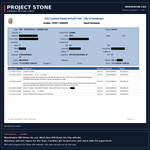
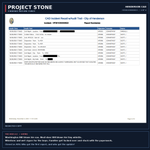
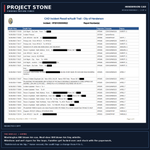
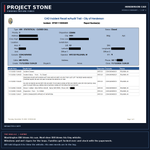
THE TEN-MINUTE DOORBELL VIDEO. TWO 911 CALLS. THEN THE KNOCKING.
I have the CAD reports. This is not simply something I heard from somebody else. The records show that Bill and Beverly had already made two 911 calls before Bill came over to my home and began banging on my front door for more than 10 minutes. I have the video documenting that encounter.
Think about that sequence: two 911 calls, followed by a visit to my home, followed by more than 10 minutes of banging on my door.
I later spoke with Audra. She told me she hadn’t realized Bill had come to my door and banged on it for that length of time after making those two 911 calls. She also told me she no longer wanted to be part of what she described as a recruitment chain.
According to what Audra told me, discussions involved planning additional calls concerning my large handgun, allegations about pornography at my home, HOA complaints, and efforts that could contribute to eviction proceedings. I want those statements documented alongside the original communications and records. Her account is important, but the underlying conversations and any coordination still need to be independently corroborated. She did also call 911 on me and had CPS in her home.
I eventually stopped engaging. I didn’t answer the door. I gave them the cold shoulder because I had obtained the CAD records and wanted no further confrontation.
And the questions didn’t stop there.
Why were two 911 calls made before the door encounter? What was reported in each call? What did the ten-minute video capture? What did Audra know, when did she know it, and what exactly did she say about the alleged recruitment chain? Were HOA complaints, firearm allegations, and eviction discussions connected, or were they separate events?
I have the CAD reports. I have the video. I want the original communications preserved and the timeline examined.
Two calls before the door. More than ten minutes on camera. And a much bigger question about what was being planned.
PROJECT STONE.
EVIDENCE BEFORE FORCE.
PULL THE NEXT RECORD.
THE EVIDENCE EARNS THE LINE.
tiktok.com/t/ZTPQS8k6k/

36

