

Second-year Ph.D. student @ SJTU. Working on Robot Learning 🤖
Shanghai, China
Joined July 2023
- Tweets67
- Following431
- Followers100
- Likes171





Pinned Tweet
When a robot folds a T-shirt, similar observations may indicate lost contact or a successful re-grasp. During box assembly, similar presses may occur just before a flap engages or when it is stuck. How can the robot distinguish these states and continually learn from experience?
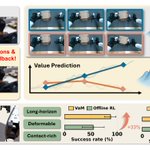
Introducing 📈 Value as Memory (VaM): Online Value-Guided Post-training for General Robot Policies!
VaM uses recent value predictions as task-progress memory and learns online from demonstrations, off-policy human corrections, and on-policy autonomous rollouts.
In the box assembly task, VaM achieves a task success rate above 95% during 4 hours of continuous autonomous operation. We also evaluate VaM on laundry folding and magnetic bus assembly. 👇
🌐 Project: virlus.github.io/vam/
📄 Paper: arxiv.org/abs/2610.22368
💻 Code: github.com/Virlus/vam
Really impressive loco-manipulation performance! Congrats @chenwang_j @zipengfu

We deploy OM-1 on more humanoid tasks in both indoor and outdoor environments. OM-1 can power humanoids to do useful things robustly that other models or form factors cannot.
- last-mile delivery from a Cybertruck
- manipulation on stairs
10
413
(10/10) This work couldn't be done without my amazing collaborators: Yijin Chen, Kaiyi Xiong, Wenbo Han, @wendi_chen_, @Yang__Jin, @HanXue012, @JunLv98, @Cewu_Lu, and @ChuanWen15. Let's keep pushing the boundaries of real-world RL for reliable deployment!
88
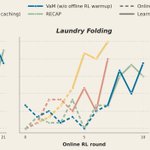
(9/10) How does concurrent collection and training improve time efficiency? VaM runs data collection, value-model training, and policy training concurrently. Compared with the sequential offline schedule, this reduces experimental wall-clock time per gradient step by 57.8% on average across the three tasks.

49
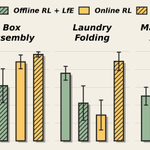
(8/10) How much does online RL improve sample efficiency? Online RL achieves a 32.8% absolute gain in mean success rate over offline RL after autonomous learning, under matched training and data-collection budgets. We attribute the advantage to faster closed-loop feedback and more frequent policy and value-model updates.

51
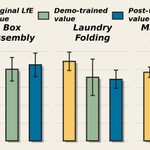
(7/10) How does value replacement affect action prediction? We hold the action expert and all observation inputs fixed. With the original value history, the policy predicts reopening and repositioning the right gripper after lost contact, but keeping it closed after re-grasping. Earlier value models predict opening near the end of the re-grasped action sequence.


55
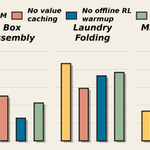
(6/n) The source of the cached values matters. To test this, we freeze the action expert and replace the value model with snapshots from demonstration initialization or offline RL warmup. Both replacements reduce success rates on all three tasks.

56
(5/n) Value caching helps mitigate partial observability. VaM achieves higher recovery rates than its no-value-caching ablation on all three tasks, with the largest differences in laundry folding (86.4% vs. 58.8%) and magnetic bus assembly (33.3% vs. 7.4%).

68
(4/n) How much does value caching improve online RL performance? VaM achieves a 29.4% absolute gain in mean success rate over its no-value-caching ablation. The gap is especially pronounced during the LfE stage, supporting VaM's ability to learn autonomously from experience without collecting new human corrections.

78
(3/n) We design a four-stage real-world RL framework: Initialization → offline RL warmup → Online DAgger with human corrections → Learn from Experience (LfE). During the LfE stage, VaM learns from sparse terminal rewards while reusing earlier demonstrations and intervention data.

111
(2/n) Value caching supplies recent value predictions as policy inputs.
Together with visual and proprioceptive observations, these predictions help the policy distinguish improving, stalled, or declining task progress. The policy uses previously computed values, allowing action generation to proceed without waiting for the current value prediction.

180
Human-friendly steering interface is what makes on-site post-training accessible! Nice work @YanwenZou .

🏠For robots to work in homes, we may not need to wait for a general policy. What matters is an interface that let people steer robots intuitively during execution.
🤖Introduce RoboPrompt: users steer policies with sparse inputs like sketches, while steered rollouts are used for DAgger to improve the policy and reduce human intervention.
4
455
Thrilled to release Noe-0, a general World-Action Model built on tens of thousands of in-the-wild data, with no teleoperation.

Wenye Yu retweeted

We've improved how GEN-1 learns to adapt to new actuators and new robots at the lowest level, with up to 10-20x gains on internal benchmarks. This significantly boosts performance on high-precision tasks like disassembling parts from a NIST board.
Read more about GEN-1 in our blog posts in the comments below.


Wenye Yu retweeted

Autoresearch just left the sandbox and entered the embodied world.
We are excited to introduce 𝐄𝐍𝐏𝐈𝐑𝐄: a system that drops frontier coding agents onto a fleet of real robots and hands them the entire loop:
reset the environment → search the literature → implement ideas and build the infra → train and deploy → self-verify → analyze the logs and rewrite the code → repeat, until the policy is reliable in the real world. No human in the loop.
Guided only by the robot's self-proposed, heuristic-based success signal, the agents hill-climb to 99% on dexterous real-world tasks: organizing pins into a box, seating GPUs, tying zip-ties.
We envision the bottleneck in robotics shifting — from building smarter algorithms to building the closed physical feedback loops an agent can finally turn on its own.
🔗 research.nvidia.com/labs/gea…
From @NVIDIA @CMU_Robotics @Berkeley_AI
🧵
Wenye Yu retweeted

Excited to share LWD: Learning While Deploying. Our robots learn while doing real tasks—restocking groceries, brewing Gongfu tea, making cocktails, making juice, and packing shoes. Deployment is no longer just evaluation; it becomes the training loop.
🧵
Wenye Yu retweeted

To truly capture human intelligence, robot data collection must align with human nature along two fundamental dimensions: manipulation and perception.
We built ActiveGlasses around this principle, enabling robot active vision and manipulation as a naturally coordinated behavior.
Wenye Yu retweeted

What's different between these two BC policies? It's the same architecture, training budget, and data collection setup — the only difference is the controller gains!
Controller gains are an understudied design parameter in robot learning. In our new work (w/ @BronarsToni*, @pulkitology), we show how they act as an inductive bias across BC, RL, and Sim2Real transfer, with real consequences on performance. Here's what we found 🧵
* Equal Contribution
📄arxiv: arxiv.org/abs/2604.02523
🔗website: younghyopark.me/tune-to-lear…