

Ginni Rometty Prof @NorthwesternCS, Fellow @IPRatNU AI, decisions, metascience Blog @statmodeling https://xitter.cf/t.co/br1aalgbf8 Lab https://xitter.cf/t.co/v6jI8mwvmO
Chicago, IL
Joined June 2013
- Tweets4.1K
- Following1K
- Followers8.2K
- Likes9.3K







Pinned Tweet
New paper: People use LLMs as decision assistants, e.g. to estimate risk & recommend treatment.
To align w/our goals, we need to know:
When a model makes a bad call, why? Did it fail to arrive at correct beliefs, or not optimize its action under the utility? 🧵

Yeah, this study making the rounds is primarily about perceptions of review quality, and primarily about AI's perceptions. I find it odd honestly that the authors are advertising it as an analysis of "every measure we could construct."

Seeing this study being widely re-shared with the take away that now AI >= human in peer review, in every dimension. People need to tone it down a little... This is primarily GPT evaluating Claude's comments. To me, the more useful signal is the 3 past editors of unnamed journals rating human vs Claude reviews, but this is only related to just 10 papers, it's not clear the editors have specific expertise in the paper topics or methods, and it reads as though the editors looked at the reviews but not the actual papers. I know we will need AI in the loop in some fashion to manage the paper deluge. I also realize that AI is already widely used in peer review and it's better to step in to manage / govern that process than let people do whatever they want. In my experience, AI certainly surfaces useful / good comments, particularly on methods, but many of the comments can be pedantic. Many models also still have terrible judgment about the other aspects that determine a study's value, e.g., whether the question is important. We're not yet at the point of ditching the human. Note: I'm pushing back here on the interpretations people are sharing when circulating this work, not the discussion in the paper itself.
TLDR: Science is not naturally aligned. You will never arrive at something meaningful by removing human judgment.

as a founder of @RefineDotInk, discussion around this new paper is v. interesting!
The results confirm that AI reviews are incredible for detailed, actionable feedback to improve a manuscript.
If AI is better, should AI replace human review?
Quick view from the trenches
1/
Jessica Hullman retweeted

Take from the trenches:
AI produces amazing "improve this paper" feedback.
Its judgment about big-picture "what matters and why" is currently, imho, terrible.
That’s why @RefineDotInk focuses on making the argument better, not deciding whether the study is worthwhile.
1/

New paper: "AI Article Reviews Dominate Human Peer Reviews at Their Best: Evidence and Policy Choices" See: GaryKing.org/peerless. with Steven Worthington. Comments welcome!

Jessica Hullman retweeted

New Substack post with @soumitrashukla9. Work has never been just about the income earned sans effort costs, as typical in economic models. Key aspects of people’s identity, their meaning, and sense of agency are all wrapped up with what they do for a living.
There has been a lot of conversation lately about how technological change, particularly AI, may disrupt this relationship, from Ezra Klein's column on his own mathematician father’s grapplings with losing meaning in mathematics, to Francis Fukuyama's post on AI, agency, and recognition. In this piece we take a historical perspective on how technological transformation has disrupted identity and meaning by affecting jobs, and how workers and society responded to these changes.
Much of the debate around AI and jobs has centered on wages and material consequences, but losing one's work is also intertwined with how people view their place in society. Most people know about the Luddites—skilled weavers and knitters—who protested the devaluation of their mastery. What’s less known is that the Luddites were actually experts in using the machines as well, and that their protests prompted prominent economists like David Ricardo to rethink the role of automation in society, and later inspired the Arts and Crafts movement. A century later, when recorded sound displaced 20,000 cinema musicians, their campaign against "canned music" and two-year recording ban pressured labels into funding live performance.
Soumitra and I have been working on versions of this essay for months. He led the piece, and we’re both really excited to get it out there.
Link to the post here: aleximas.substack.com/p/tech…


The most revealing part of this conversation between Jon Stewart and Jacob Coxon wasn't Coxon's warning about A.I. doom, but his description of A.I. utopia, and Stewart's incredulous response. I wrote about it — and Francis Fukuyama's "Last Man," and A.I. easily solving the problems that bedeviled my father's field of mathematics for decades — here: nytimes.com/2026/10/18/opini…

Haven’t looked closely at papers I’m AC for yet, but I’m hearing left & right from reviewers that their ICLR 2027 loads are mostly impenetrable slop.
I really hope we can save ML conferences. If the conservative bent to only implement minimal limits continues, I worry we won’t.
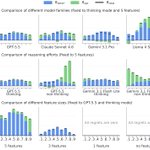
These findings persist when we test transfer to held out decision problems (i.e., utility functions).
Overall, results suggest it’s easy for models to ‘action hack’ without beliefs necessarily becoming legible. But rigorous measurement can get us closer to trustworthy decisions.
Work with Huaman Sun, Dingcheng Wang, and @jasondhartline
arxiv.org/pdf/2609.38005
Yes, it can be. When the reader is looking for accountability, then in this new equilibrium they are at least assured someone on the author team had to read the thing. And accountability is ultimately what we need for assertions to become knowledge (more philsci 101)

Jessica Hullman retweeted

Princeton is seeking an AI Postdoctoral Research Fellow in Natural and Artificial Minds. An amazing program! Deadline is Feb. 28
apply.interfolio.com/194534
Jessica Hullman retweeted

Very happy to share a new paper, “Technology Bottlenecks: Measuring Where AI Could Raise the Value of Work It Cannot Yet Do.”
AI exposure measures ask about the work AI is capable of doing. We ask instead where the marginal value of work AI cannot yet do may rise as AI speeds up the rest of the job.
To do so, we employ 288 million U.S. job postings mapped line by line to their closest O*NET tasks and GPT-4 feasibility ratings from Eloundou et al. (2024) to construct a measure, “bottleneck pressure,” for each task in each occupation that posts it.
Using a simple task-based framework, we derive this pressure at the task level, showing that for an AI-infeasible task it is the exposure of the occupation that posts it, so the same task can face very different bottleneck pressure in different jobs.
Reporting bottleneck pressure alongside AI exposure shows both the scope for AI to perform work and where improving the work it cannot do may pay off more as capabilities expand.

So much outrage over people using Pangram scores to decide how much weight to give a text boils down to denial of a basic fact: it’s rational to rely on a signal when it’s informative.
Good luck convincing people it’s in their best interest to make worse decisions!