

Journal of Systematics and Evolution (JSE) is a bi-monthly international English language journal dedicated to the understanding of biodiversity and evolution.
- Tweets598
- Following1.6K
- Followers491
- Likes1.5K



ALT Annotated phylogeny and data analysis supporting this study of phylogenomic relationships of the East African Zanthoxylum and Vepris genera in the family Rutaceae.

ALT Poster illustrating results of APG-V.

ALT Diagram describing how insect endosymbionts act as crucial evolutionary drivers, ultimately leading to the formation of morphologically similar yet genetically distinct cryptic insect species through multiple mechanisms. These mechanisms include promoting ecological adaptation divergence through enhanced nutrient metabolism and stress resistance, facilitating genetic integration via horizontal gene transfer, and inducing reproductive isolation, such as cytoplasmic incompatibility.

ALT Satellite-style view of the biogeographic region of Southwest China that is home to the dry-hot Red River valleys and a newly identified monotypic liana genus, Xua hongheensis (in situ morphology shown in a map inset), endemic to the region.

ALT Panel of figures: (Top) Fossil morphology of a new basal opilioacarid from mid-Cretaceous amber, and (bottom) phylogenetic analysis providing insights into early Parasitiformes evolution.

ALT Poster illustrating results of APG-V.


ALT Summary APG V tree showing relationships of orders based on nuclear gene sequences (e.g., One Thousand Plant Transcriptomes Initiative, 2019; Stull et al., 2020; Yang et al., 2020; Xiang et al., 2024; Zuntini et al., 2024).

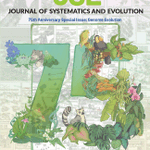
ALT Cover of JSE September 2026 special issue celebrating JSE’s 75th Anniversary. The central “75” artwork depicts a diverse terrestrial ecosystem featuring plants, animals, and microbes, and the background showcases a series of previous JSE covers. This design emphasizes genome evolution and celebrates 75 years of advancing phylogeny and evolutionary biology. Cover design by Taikui Zhang, illustration by Zhiling Li.
ALT Cover of JSE September 2026 special issue celebrating JSE’s 75th Anniversary. The central “75” artwork depicts a diverse terrestrial ecosystem featuring plants, animals, and microbes, and the background showcases a series of previous JSE covers. This design emphasizes genome evolution and celebrates 75 years of advancing phylogeny and evolutionary biology. Cover design by Taikui Zhang, illustration by Zhiling Li.


ALT Panel of diagrams describing the single-nucleus atlas of early rice seed development (top) and EEI-enriched OsBZR4 coordination of embryogenesis (bottom).

ALT Diagram summarizing how plants forage for nitrate by integrating local root signals with systemic shoot responses.

ALT Infographic announcing the Botanical Society of America 2026 Corresponding Members, Dr. Hongzhi Kong and Dr. Thomas R. Meagher. The image includes headshots of the two scientists, a QR code linking to the BSW Corresponding Author Award page, and the BSA logo.

ALT Morphology and phylogenetic analysis of Elongatitarsus falcatus gen. & sp. nov., a conspecific male–female pair from mid-Cretaceous Kachin amber (~99 Ma) that bridges the morphological gap between extant Gryllidae systematics and the fragmentary compression-fossil record. Maximum parsimony analyses across three character partitions demonstrate that venation-only matrices yield unstable topologies with low support, whereas integrative morphological data recover well-supported relationships partially congruent with molecular phylogenies. This integrative framework establishes a transferable baseline for placing fragmentary fossil taxa.

ALT Phylogenetic tree derived from integrative phylogenomics, polyphasic taxonomy, and metagenomics expands the characterized diversity of Thermoleophilia, revealing novel families, genera, and species across cultured and metagenome-assembled lineages.


ALT two people are sitting at a wooden table in a library surrounded by shelves of books and there are sheets of paper with pressed plants attached to them spread out in front of them

ALT Diagram summarizing parts of a proposed integrated research framework to facilitate predictive sugarcane breeding and provide valuable references for genetic improvement of other complex polyploid crops.

ALT Panel of data figures summarizing the development and genome assembly of the Ogura CMS restorer R206, and its application in mechanized hybrid seed production technology.

ALT Diagrams illustrating the difference in soil-nitrogen conditions between paddy fields (mainly in the form of ammonium, NH4+) and dry fields (mainly in the form of nitrate, NO3−), highlighting that these conditions form a main environmental factor driving adaptive differentiation between upland and lowland rice ecotypes.