

🇮🇪🇮🇪🇮🇪 @Stanford Energy postdoctoral fellow. Previously @Strankslab @Cambridge_Uni | @tcddublin. Working on hard problems to tackle climate change.
Joined August 2018
- Tweets394
- Following59
- Followers779
- Likes657






Pinned Tweet
If you want to brush up on solid state #physics(or learn for the first time), @spinespresso has a full lecture series on YouTube about solid state physics and another higher end series about quantum transport. A phenomenal resource! youtube.com/playlist?list=PL…
Excited to be in Seattle at Spring MRS 25. I'll be speaking tomorrow morning (Wednesday)in session EL10.04 in room 434 on some of our operando microscopy work on perovskite solar cell stability and performance. Drop by if you can, and get in touch if you fancy grabbing a coffee!

Kyle Frohna retweeted

Fantastic write up in @NaturePortfolio News & views of @StranksLab work led by @KFrohna & @CullenChosy and published in @NatureEnergyJnl last year.

nature.com/articles/s41560-0…
Kyle Frohna retweeted

We investigated the effect of different anions for piperazinium salts. We found and explained an anticorrelation of stability and efficiency (1.68 eV bandgap perovskite)
Good balance for PTsO with 96.4% of initial efficiency after 1000h ISOS-LC-1I
onlinelibrary.wiley.com/doi/…


Kyle Frohna retweeted

New research in Nature Energy reveals advanced microscopy techniques that enhance perovskite solar cells' performance and stability. This work is a significant step toward more durable and efficient renewable energy solutions!
ceb.cam.ac.uk/news/energisin…
#Sustainability
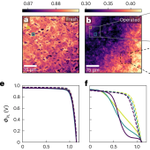
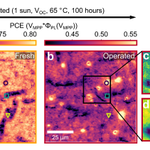
Our work linking microscopic variations in recombination and charge extraction of #perovskite solar cells to performance and stability using operando microscopy is out now! nature.com/articles/s41560-0… 1/5

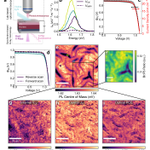
.@KFrohna, @CullenChosy, @SamStranks, @MAnayaLab and team show a multimodal operando microscopy toolkit to link the interfacial quality and nanoscale performance disorder to the stability of #perovskite #SolarCells. buff.ly/3NNEXio

@CullenChosy the legend co-led this project. @MAnayaLab @SMSLabnews and @SamStranks steered the ship. incredible devices from @AmranLux @FlorianScheler @AlbrechtLab. Important contributions from many @StranksLab @milosdubajic and the great team @I14Diamond 4/5
Final thanks of course to all supporting bodies - @EPSRC for funding, @cebcambridge @DeptofPhysics @TrinCollCam and @DiamondLightSou 5/5

Excited to have been awarded the 2023 Woodruff Thesis prize for my PhD thesis on microscopy of halide perovskites by the Institute of Physics' thin films and surfaces group! @PhysicsNews @ioptfsg. Thanks to all @StranksLab and beyond for the support and collaboration!

📢 Kyle Frohna is winner of the Woodruff Thesis Prize 2023, for this excellent thesis "In-Situ and Operando Multimodal Microscopy of Metal Halide Perovskite Optoelectronic Devices", completed @StranksLab, University of Cambridge. Congratulations Kyle! 😀


Kyle Frohna retweeted

Join us at 5pm CET on Wednesday for the next @NGSE_conf seminar with @KFrohna from @Stanford, formerly @StranksLab @Cambridge_Uni, on the power of multimodal microscopy 🔬 in the realm of halide perovskites. More info and sign up link can be found here: ngse.info/phd-postdoc-series…

Kyle Frohna retweeted

Ever wondered how the A-site cation affects the local structure of lead halide perovskites and how this local structure in turn influences their macroscopic properties? 🤔 Check out our new preprint. 1
arxiv.org/abs/2404.14598
This was a big collab, feat. co-first author and superstar @CullenChosy! @MAnayaLab and @SamStranks @StranksLab as core microscopy+supervision team. @AmranLux @FlorianScheler @AlbrechtLab as core device team. @I14Diamond beamline wizards @jessmwalk @therealjep @DiamondLightSou 5
As well as important contributions from @milosdubajic, Lea Zimmermann, Tom Selby, Yang Lu and Bart Roose.
We would love additional feedback from the community while it's peer reviewed, so please do reach out if you have any thoughts! 😇6/6
Interfacial tuning via transport layers or passivation can boost performance and homogenise performance spatially at t=0, but can destabilise the cell in the worst case. So we must both:
✅ stabilise interfaces
✅ minimise local PCE variations
to maximise stability+efficiency. 4
Using state-of-the-art devices from @AlbrechtLab we show that compositional tuning has large effects on microscopic device metrics and chemical distribution which can seed degradation and local phase segregation (we directly probe the performance of phase segregated regions) 3

Our new preprint using operando microscopy to understand performance and stability in a large perovskite solar cell device space is out. We show that micro variations in PCE and interfacial chemistry at t=0 determine performance and long-term stability. 1
arxiv.org/abs/2403.16988
