Kavli Institute for Particle Astrophysics and Cosmology

Stanford University, SLAC
Joined November 2012
We are now on Bluesky! Follow us for events and research: bsky.app/profile/kipac.bsky.…
1
1
424
🌌 This Tuesday! Free lecture: “Measuring the Impossible: How We Detected Gravitational Waves” with Dr. Alexandra Mitchell 🔭 🗓️ Oct 27, 7 PM 📍 Sapp Center Rm 111, Stanford (or livestream 💻) Sign up 👇 eventbrite.com/e/public-lect… #GravitationalWaves
60
🌌 Why did Ana Ennis choose KIPAC? 2027 KIPAC Postdoctoral Fellowships are open! Apply by Nov 2: academicjobsonline.org/ajo/S… #KIPAC #Postdoc #Astrophysics
71
Every time the shutter closes on @VRubinObs 3.2-gigapixel camera, 25 GB of raw pixels start a year-long journey: cleaned up, turned into alerts within a minute, reprocessed, and validated against 3,000+ requirements. Here’s what happens to each image 🔭 kipac.stanford.edu/news/what…
2
63
The @SimonsObs is now fully online, mapping the universe’s oldest light. 🔭 KIPAC’s Susan Clark, Kaitlyn Karpovich, Frank Qu, Bernardita Ried Guachalla, Toby Satterthwaite, and Manu Schaan are part of the story. science.org/content/article/…
1
68
“I chose KIPAC for the incredible people and the freedom to explore big ideas.” 🌌 2027 KIPAC Postdoctoral Fellowships are open. Apply by Nov 2: academicjobsonline.org/ajo/S… #postdoc #astro #cosmology
67
Our first public stargazing night of the year was a hit! 🔭 Clear skies and ~140 attendees at the Stanford Student Observatory on Tuesday. Thanks to everyone who came with such great curiosity! More events coming this quarter. Join our mailing: shorturl.at/qHxPJhttps://sho…
1
5
131
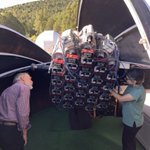
How do you "see" a magnetic field you can't touch? Take 48 stacked camera lenses and turn them into a polarization camera. 🔭 Meet DragonflyPol, born from a single KIPAC Innovation Grant. kipac.stanford.edu/news/how-…
41
Welcome to the dark site 🕸️ We have a whole new news collection web page for our dark matter content! Not quite 85% of all SLAC matters, but still plenty to explore: stanford.io/3VypOsw
2
7
21
1,362
🎧 KIPAC senior member Dan Akerib joins @seanmcarroll's Mindscape podcast to talk about a faint hint of dark matter in the LZ experiment: one intriguing event, low significance, big questions. preposterousuniverse.com/pod…
1
3
280
A single weird particle just lit up the world's biggest dark matter detector, buried nearly a mile underground. 🕳️ Not a discovery yet (2.6σ) — but physicists can't explain it away. 🔗 science.org/content/article/… #DarkMatter #KIPAC
1
80
Could this unexpected signal be our first detection of dark matter? The LUX-ZEPLIN experiment, world-leading dark matter detector, has observed a particle interaction that is the most compelling hint of dark matter reported by the experiment to date: stanford.io/4gvEi4D
16
45
7
199
52,402
KIPAC's Tina Cartaro just helped flip the switch on one of the world's most sensitive dark matter hunts. 🌌 Dark matter makes up 85% of everything in the universe — but no one has ever directly detected it. That's about to change. news.stanford.edu/stories/20…
2
100
We know dark matter exists from its gravity — we've just never caught it directly. Our own scientists are chasing that first catch. #KIPAC #DarkMatter #SLAC #Stanford
28
SuperCDMS SNOLAB, led by @SLAClab, just started collecting real data more than a mile underground in Canada. Its detectors are chilled colder than outer space itself — designed to catch the faint signal of a dark matter particle finally striking a crystal.
1
39
Totality in action! ☀️🌑 KIPAC grad student Pam Stark and fellow Invisibles26 Workshop attendees caught the total solar eclipse while in Spain — during a workshop on invisible matter in the Universe. A reminder there's always more to learn about our Sun!
1
87
Curious what eclipses can teach us about our closest star? Watch our public lecture on solar physics and space weather, held right after the 2023 U.S. eclipse: youtube.com/watch?v=SECe-9ij…
68
(3/3) Transformative science doesn't begin with discovery alone. It begins by building the tools that make discovery possible. Learn more about the next generation of astrophysics instrumentation: bit.ly/4hGkNak
(2/3) Following a gathering of leading astrophysicists, we've identified where investment in new instrumentation can have a great scientific impact, from skipper-CCDs and near-infrared light recovery to improved observation precision and the SuperFIRE spectrometer.
1
1
634
(2/3) Following a gathering of leading astrophysicists, we've identified where investment in new instrumentation can have a great scientific impact, from skipper-CCDs and near-infrared light recovery to improved observation precision and the SuperFIRE spectrometer.
(1/3) For centuries, advances in instrumentation have expanded humanity's view of the universe. But many of astrophysics' biggest mysteries remain unseen, and answering them will require capabilities that don't yet exist.
1
1
1
1,026
(1/3) For centuries, advances in instrumentation have expanded humanity's view of the universe. But many of astrophysics' biggest mysteries remain unseen, and answering them will require capabilities that don't yet exist.
1
1
3
741