
Chief Shilling Officer (CSO) @xangle_official Ex-Reality Analyst @ TradiFi, but now researching virtual chaos
Joined March 2020
- Tweets1.4K
- Following1.5K
- Followers1.8K
- Likes4.2K





Pinned Tweet
Web1: Read-only
Web2: Read-Write
Web3: Read-Write-Distribute
‘Distribute’ — this is how I see Web3
Airdrop, Yapping, Farming… these are not just events, but new forms of social contracts and culture built around the idea of distribution.
In a time when Gen Z has lost access to opportunities, Web3 can rise as the spirit of our era.


KP I Xangle retweeted

🚀 Xangle data is now LIVE on NAVER.
Price data, project updates, and Asset Profile content from Xangle are now delivered to NAVER Stock via API — bringing institutional-grade digital asset information to one of Korea's largest retail finance platforms.
🚀 쟁글의 데이터가 이제 네이버에서 제공됩니다.
쟁글이 제공하는 가격 정보, 프로젝트의 주요 소식, 종목 개요 콘텐츠가 API를 통해 네이버 증권에서 제공됩니다.
이제 더 많은 투자자들이 네이버 증권에서 기관 수준의 디지털 자산 정보를 확인할 수 있습니다.
🔗 m.stock.naver.com/crypto




(Below is the English translation of the text written in Korean)
Is There Truly an Oasis in the Crypto Space?
Amidst the widening wealth gap and intensifying social conflicts, modern life has gradually turned into a barren desert. In this parched reality, the crypto market emerged like a final oasis promising to quench our thirst. Early on, cypherpunks resisting centralized control paved the way, followed by early adopters who sensed the shift. Their success stories drew countless retail investors into the fray, and now, global financial titans and corporate executives have begun discussing the potential of this oasis. However, the journey toward it has not been as lush as expected. The reality we face is harsher than imagined, and the path has been anything but smooth.
To be sure, there have been meaningful achievements. The approval of Bitcoin Spot ETFs proved that this asset class has earned institutional trust, while DeFi and PerpDEXs have technically realized the possibility of finance without intermediaries. The proliferation of stablecoins and the revitalization of prediction markets were clear "streams" of water we discovered. Yet, before these streams could form rivers or lakes, far too many bandits appeared around the oasis to prey on the thirsty. Constant scams and hacks, founders obsessed with "early exits" rather than product-market fit, and the gambling dens fostered by exchanges have led to the bankruptcy of countless investors, drying up market trust. Consequently, nihilism has become pervasive.
The problem is that this is a complex crisis involving both internal and external factors. Internally, the market is flooded with crude services that can hardly be called "innovation," while "Degens" in their exclusive circles are mostly occupied with PvP games—stealing money from one another. In particular, the predatory structure of "VC Investment → CEX Listing → Retail Dumping" has blocked new inflows and exhausted existing participants. As the line between entrepreneur and scammer blurs, external technologies like AI and robotics are absorbing capital and talent at an overwhelming pace. These technologies are evolving rapidly and beginning to tangibly change lives. The old method of attracting idle capital through mere narratives has lost its "sexiness" in the face of these more compelling alternatives. In this chaos, we are forced to ask ourselves:
Could it be that we mistook a mirage for an oasis?
I believe the crypto market currently stands at a critical crossroads. If we continue to tolerate the practice of assigning value to projects without substance, the market’s development will stall or become obsolete. We must bid farewell to the era of selling dreams to enrich insiders. It is time to reclaim capital flowing to fake innovators and concentrate it on exceptional builders—like Hyperliquid—who prove actual utility. Only when our standards of evaluation become rigorous will the soil be prepared for talented entrepreneurs to return.
The only way to defeat nihilism is through the proof of utility.
Despite the need for painful self-reflection within the industry, I believe my thesis from last year—"Web3 is the Zeitgeist"—remains valid. In an era where AI and Big Tech monopolize wealth and the value of labor fades, the "distribution culture" of Web3—which recognizes user contribution and returns the fruits to the community—is the only alternative capable of correcting a distorting capitalism. Whether what we see is a mirage or a true oasis ultimately depends on the standards we use to purify the market and the values into which we inject capital. The power to transform a barren desert into an oasis will come not from vague narratives, but from whether actual value is created and whether capital is properly redistributed to those efforts.


24
35
371
KP I Xangle retweeted

Integrity has always been one of Hyperliquid's core values.
The house of all finance must be credibly neutral. This means no private investors, no market maker deals, and no protocol fees to any company.
The initial state of any blockchain is a crucial part of its story that can never be erased. The original ethos of Bitcoin was a permissionless network accessible to all. Hyperliquid's genesis distribution followed this spirit, going entirely to early users with core contributors excluded. The full distribution is verifiable onchain without obfuscation.
This principle of fairness frustrates a few users and builders who are used to special treatment. It means that Labs has zero tolerance for team members with integrity yellow flags. It means we do things the hard way as a community. But the world deserves a financial system owned by the people, where fairness to all users is in the DNA. Nothing else is worth building.

Thoughts on the AI Bubble and Valuations
Discussions around an “AI bubble” continue to surface, and whenever noise emerges around data center capex—such as the recent Oracle-related issues—we see both Nasdaq equities and crypto assets sell off. Statistics showing that historical returns have been close to 0% when the S&P 500’s 12-month forward P/E reaches around 24x further reinforce the narrative that equity markets are currently overvalued.
Is this truly a time to be cautious?
Is the phrase “this time is different” once again a dangerous mantra that will ultimately lead bulls to defeat?
Personally, I view the AI cycle as fundamentally different from previous cycles. This time really is different. The difference lies in the nature of the cycle itself: AI is likely to create a much more powerful cycle (a much higher peak) and one that lasts significantly longer. The reason is that we are gradually entering an era in which past patterns and historical statistics are becoming less meaningful.
Throughout human history, there has never been an entity that fundamentally surpassed human intelligence. Today, however, AI is beginning to cross that line and is preparing to enter the realm of superintelligence, far beyond human capability. In 2025, concrete examples supporting this shift have started to emerge. For instance, the team led by Demis Hassabis accomplished in just a few years what would have taken humans roughly one billion years—predicting the structures of 200 million proteins. At Goldman Sachs, tasks such as IPO documentation, which previously required weeks of work by senior investment banking professionals, are now completed in minutes, dramatically improving efficiency (and this is a very basic example). What once improved in a linear fashion is now advancing exponentially alongside AI.
(Source: Waitbutwhy.com)
The chart above best illustrates this transformation. Human progress is no longer expected to follow a linear path. If we are indeed at that point on the curve, should we still evaluate today’s capital markets using the same yardsticks as the past? Would an AI arms race—where the cost of losing is extraordinarily high—really come to a halt simply because leverage has increased somewhat? More likely, 2026 and 2027 will be years in which this competition intensifies even further. With the cycle only three years into its formation, it is still too early to declare a bubble.
And historically, whenever the dominant question in the market has been “Is this a bubble?”, it never actually was.

34
47
403
KP I Xangle retweeted
Hyperliquid supports permissionless perps on anything. As all of finance moves onchain, there is a billion dollar opportunity to build a mobile app for non-crypto users.
The two keys are:
1. seamless fiat onboarding
2. a mobile UX that non-crypto users love
Hyperliquid and HIP-3 perps offer the full backend liquidity infrastructure. Solve 1 and 2, and you have a product that markets itself: global, permissionless finance at your fingertips. Builder codes allow monetization proportional to volume flowing through the app, fully configurable per-trade.
Hyperliquid’s ethos is to let talented, hungry teams reinvent the pillars of finance. For those who specialize in UX and building magical user experiences, nothing stands between you and the empires to be built.



KP I Xangle retweeted

Some keywords I'm watching for in 2026:
▪️USDT superapp: @stable
▪️Stablecoin clearing house: @ubyx_
▪️Prediction market becoming new trading interface: @Polymarket @Kalshi
▪️Stablecoin FX: @stable @MentoLabs @arc
▪️Tokenized Stocks: @BackedFi @Securitize @RobinhoodApp
▪️Native BTC Utilization: @arch_prime
▪️Stablecoin-as-a-Service: @Stablecoin @Paxos @m0
▪️Fully vertically integrated payments: @tempo
▪️A variety of yield-bearing stablecoins: @Neutrl @capapp
▪️Tokenized deposits: @jpmorgan
▪️High performance EVM chains: @monad @megaeth
▪️AI agents payments: @eigencloud @base
and... @FourPillarsFP
<Coinbase’s ICO: A Strategic Move to Reclaim U.S. Crypto Dominance>
@coinbase just acquired a launchpad and picked @monad as its first ICO project. For a U.S. company that’s long been cautious about ICOs, this is a bold pivot — backed by the upcoming Clarity Act, which could legalize token offerings in early 2026.
The U.S. has walked this path before.
In the 1980s, it introduced the ADR (American Depositary Receipt) system, letting foreign giants like Toyota, Sony, and Nestlé list on the NYSE — a move that supercharged the U.S. capital market.
To list in New York, these firms had to rely on U.S. investment banks, market makers, and exchanges, enriching the entire financial ecosystem.
As Americans invested through pensions and funds, their wealth grew — and the U.S. cemented its role as the world’s financial hub.
The Clarity Act is the same playbook, but for crypto.
By legalizing ICOs, the U.S. aims to repatriate crypto’s capital formation and infrastructure — pulling value creation away from offshore hubs like Binance and back to American firms.
Coinbase is now the front-runner of this strategy.
And Monad ICO could be the first spark that reignites the retail hype the industry’s been missing.
If retail capital floods back into crypto under a legalized ICO framework, it could mark the true start of a new bull market. This cycle’s been institution-led and muted — but retail, as we saw in 2017 and 2021, plays much louder.
If the Monad ICO manages to feed the retail crowd, next year might just kick off the party.
Sure, every party ends with a game of hot potato —
but hey, everyone thinks they won’t be holding the bomb 💣

Stable’s 2nd deposit round is here.
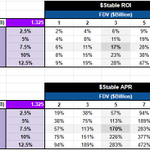
So… what’s the ROI looking like?
ROI Estimates
Base Case: 17%
- FDV $3B (same as Plasma)
- Airdrop allocation 7.5%
Bull Case: 38%
- FDV $5B
- Airdrop allocation 10%
Bear Case: 8%
- FDV $2B
- Airdrop allocation 5%
Assuming TGE happens within this year, the APR roughly translates to:
- Base Case: 170% APR
- Bull Case: 380% APR
- Bear Case: 80% APR
Looks like a no-brainer to join this @stable round.


The countdown to Phase 2 of the Pre-Deposit Campaign has begun...
@hourglasshq is set to lead the institutional vault in partnership with a top-tier investment bank.
Mark your calendars and get ready to participate on Thursday, November 6 at 2PM UTC (9AM ET).
14
31
1,628
$Theo YT ROI could actually exceed 100%?
This week’s @Theo_Network point distribution just wrapped up. Based on my rough estimate of ~$0.2 per point, the APY works out to around 20%. It could go even higher if you layer additional yield from other protocols like hyperEVM.
For those who’ve purchased $Theo YT, the cost per 1 point is around $0.1. With an FDV of $100M and a 10% airdrop allocation, that price feels fair — but if you’re expecting a $200M FDV or a higher airdrop share, the YT play could turn into a solid short-term ROI opportunity.

16
24
833
Payment solution for AI
Huge announcement
@GoKiteAI

We're thrilled to announce a new investment from Coinbase Ventures @cbventures. This funding extends our recent Series A round led by @PayPal Ventures and @GeneralCatalyst, and will accelerate development of our infrastructure for autonomous AI agent payments and adoption of the x402 protocol.
Kite @GoKiteAI is now natively integrated with the x402 Agent Payment Standard, positioning ourselves as a primary execution and settlement layer for the protocol. As one of the first L1s to fully implement x402-compatible payment primitives, Kite allows AI agents to seamlessly send, receive, and reconcile payments through standardized intent mandates, unlocking the full potential of the agentic economy.
Coinbase Ventures' investment will support Kite’s continued product and infrastructure development across three converging market shifts shaping the autonomous economy:
✅The Need for a Programmable Trust Layer
✅Scalable Blockchain with the x402 Protocol as the Native Payment Rail for AI
✅The Rise of Agentic Commerce as a Growth Engine
The future of the agentic economy is here, and we're proud to have Coinbase Ventures supporting us on this groundbreaking journey.
Read more: medium.com/@KiteAI/kite-anno…

[Ventuals is backed by the Hyperliquid community]
Among the 4,069 wallets staking on @ventuals, 821 wallets (≈20%) are from the Hyperliquid airdrop wallets, staking a total of 429K $HYPE (~$16M) — enough to meet the HIP-3 threshold alone.
Source:
hyperevmscan.io/address/0x88…
Considering that many farmers operate multiple wallets, the actual number of @HyperliquidX airdrop participants is likely even higher.
Notable KOLs participating in Ventuals staking include:
@krybharat — 50,005 HYPE (~$1.86M) 0x087...
@Bizyugo — 25,000 HYPE (~$930K) 0xbdf...
@mk4_lul — 10,000 HYPE (~$372K) 0x773...
@kirbyongeo — 5,000 HYPE (~$186K) 0x6cd...
The community has already voted with their stakes.
Now it’s up to Ventuals to deliver — and turn the vision of democratizing the private equity market into reality.

KP I Xangle retweeted

Le Comprehensive Crypto x AI Thesis by Cookies 🍪
Here's my thesis on how the maturing crypto x AI infrastructure stack leads to emerging innovative applications
Let's dive in on how to navigate this new age as users and as builders
🧵

KP I Xangle retweeted

When ppl claim this I always wonder how they think it happens, or have unrealistic expectations on how much $1bn actually is.
I joined crypto with $200. If I held my initial bitcoin since then and never traded, I would have ~$300k.
If, instead, from that moment I sold the top and bought the bottom of every crypto cycle on Bitcoin, and never paid any taxes, I would have ~$6m USD.
If I put my entire net worth into the Ethereum ICO and never touched it, today I would have ~$150m pre-tax.
While it was definitely possible to have made >$1bn with the opportunities in the market, these versions of reality would also require me to make no mistakes, and have no need to spend $ in real life, or take excessive risk via leverage.
In reality, I grew up in a working class family. I didn’t have a trust fund and I had to pay off my student loan myself. I had a job at Tescos while at high school. After university, I needed to pay rent and fund cost of living and eventually buy a place to live.
I worked at startups for relatively little $ salary, and while a couple have done okay, they still are illiquid and worth nothing until some exit.
Perhaps if I erase a couple of dumb mistakes and drawdowns, or if I had a lil more grind, then my answer would be different today. But it is easy to say this with perfect hindsight vision. It’s easy to see where you could have optimised better, and decisions you made look dumb when the past makes things so obvious.
The truth is I have always optimised for enjoying my life and not going to 0. I never felt like I had a safety net, so it was never possible for me to do anything in any other way. I would probably have less money if I had tried to add more risk or chased $ harder, because being all-in with your entire livelihood is a mental battle and I feel I only win that battle when the stakes are lower.
In writing this, maybe I do understand why CT folks believe this, because modern CT sees crypto as a late-stage lottery ticket farm, where the optimal strategy is to 5x leverage up your portfolio in a hope of catching a good 20% move and then leaving. Or, literally going all-in on the next coin they heard Ansem is buying. So perhaps to them, looking back at the charts, of course that’s what successful folks did.
In reality, I use leverage close to never (and typically to reduce risk rather than add risk — have used it to add risk maybe 3 times in the last 5 years, and maybe 15 times ever). I never go all-in on anything, have only ever done that on BTC and ETH before in the last decade. When I buy other things, I limit risk to tiny amounts, because I treat it as a 0 until proven otherwise (so, always <1% liquid portfolio). Liquid portfolio is also a smaller % of overall portfolio to future-proof against my own fuckups.
Obviously I made a lot of money, I have been here 12 years! CT doesn’t want to hear about “getting rich in a decade” though. I am happy with where I am and have never really cared or optimised for maximising $ earnings, but instead having a nice life that lets me enjoy the game we play together.