







Pinned Tweet
What Monad has so far:
- High quality open-source C++/rust codebase with many HFT-style optimizations and architectural changes
- Public audits and clear docs that put the technology first. Transparency -- no hand-waving, no unsubstantiated claims
- High-performance system focused on true decentralization, running continuously in testnet with 186 globally distributed validators at 5000-10000 tps
- MonadBFT, a frontier consensus mechanism featuring 400ms block times, 800ms finality, large globally-distributed validator set, and tail-fork resistance
- Async Execution (while supporting EIP-7702 through the Reserve Balance mechanism)
- MonadDb for efficient merkle trie storage
- Native code compiler for frequently used contracts
- Interconnected community of smart, thoughtful crypto-natives who will grow in influence over the next few years
- Ecosystem of promising young startup founders, ready to take their shot
- Over $100m in ecosystem funding pre-mainnet
- Founder support through DeltaV, the Monad Founder Residency, Monad Madness, and more
- Monad Momentum, an incentives program focused on efficient UA and repeatable growth loops to help decentralized apps acquire normie users
- A north star of making open-source, decentralized systems more powerful
But there's still so much more to do. Are you excited?
Monad is now on the Pumpfun app!
You can now find and trade Monad assets on the Pumpfun app
Thanks to the Pumpfun team for the support, and catch you on chain


I am a technology optimist. I believe:
1. decentralization and censorship-resistance (real versions of these properties, not larps) matter to human freedom in the coming age of AI
2. self-sovereign money, implemented by code and maintained through decentralized consensus, is the final form of money. But it needs to be truly decentralized -- cut out every possible weakness, trust assumption, keeper, etc. Of course there will be connectors to the real world - harden those maximally
3. AI will write most smart contract code. Spec-driven development with Formal Verification will be how new contracts are written rigorously. FV will also be crucial to securing all the infra including the blockchain itself
4. AI will harden our surfaces, with some unfortunate hacks in the process, but ultimately the crypto and financial industries will come out stronger
5. properly-constructed and properly-indexed data lakes will enable agents to build software far more productively
6. governments will move to restrict AI usage in the future, causing true decentralization and CR to matter in dramatic fashion
7. quantum security will be a must for any ledger where people trust their assets. And specifically, blockchains will need to deliver quantum-resistance while retaining programmability and performance. Again, no larping
8. ZK will be an important part of the puzzle too, as it'll be increasingly important to prove off-chain computation and utilize the result on chain. But again, performance and effortlessness for users will be the differentiator
9. pragmatic and composable privacy will be the missing piece for real adoption. People will use apps that stack together stablecoins, DeFi, blockchain settlement, passkey or MPC authentication, and friction-free onramps, but the part that gets fintechs over the line is knowing that user balances will remain private while still being able to tap into shared liquidity
10. blockchain will serve as the global, universal marketplace, for anyone anywhere to get the best opportunities. For that we will need guarantees of fair execution, protection from frontrunning, and a convergence of all of the best assets
At @category_xyz and the @monad Foundation, we are assembling all of these missing pieces in parallel with extreme urgency, and I hope this is clear from our actions. See you in the future
Decentralization doesn't matter until it does. Blockchain, and more specifically a blockchain with real decentralization, censorship-resistance, and pre-finalization privacy, will be a defining part of the next era

in a couple years (at most) governments will do everything they can to regulate (limit / restrict) AI inference
- AI will be considered a weapon (already seen)
- commercial rights will be violated (already seen)
- massive job loss (lack of future hiring and layoffs)
- taxation / wealth distribution (see #3)
this will be blockchain's moment - (historically) regulatory arbitrage
AI is a powerful tool for hardening your smart contract codebases. @aviggiano from the Monad Foundation Security Team is sharing some more tips here:


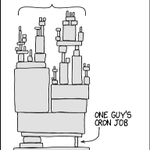
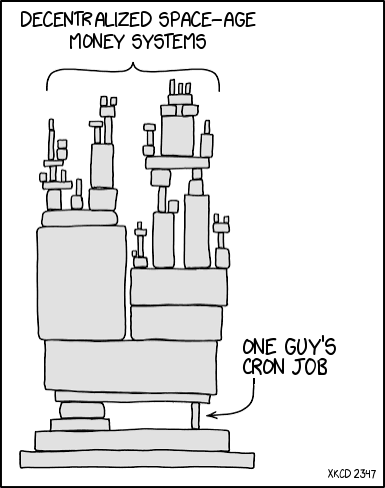
Yesterday's Railway issues, and an increasing stream of cloud provider incidents, highlight a major issue: decentralized apps have no way of scheduling or automating smart contract calls. Someone needs to run that cron on a server, which are becoming increasingly unreliable in the age of AI.
The point of decentralized systems is that we shouldn't need to rely on a single server to maintain an invariant that protects the correctness and solvency of self-sovereign money protocols. Automation needs to move to the blockchain, where a network of distributed nodes brings fault-tolerance and checks-and-balances.
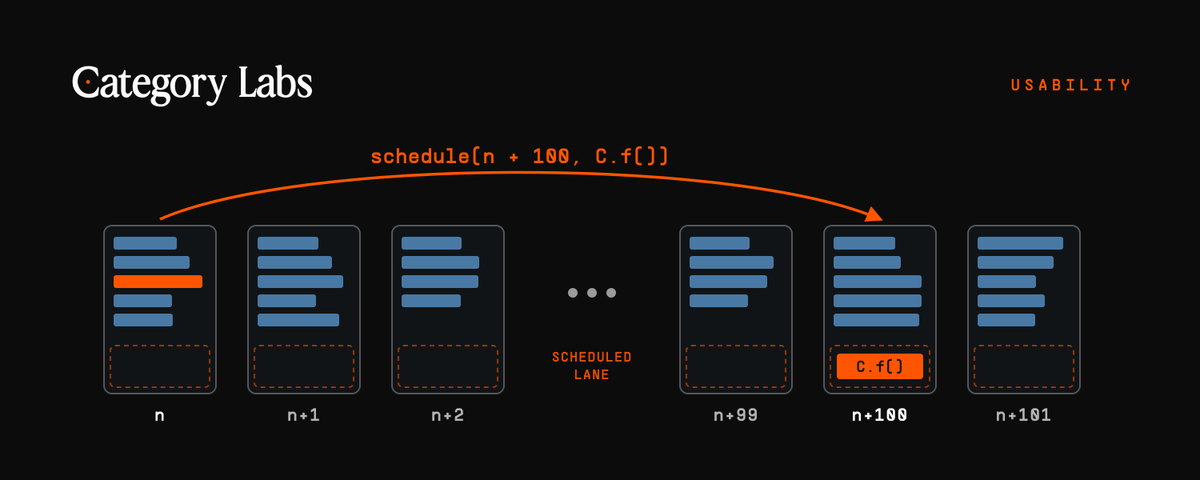
Scheduled Transactions are how we accomplish that.
Scheduled Transactions are far more than a replacement for keepers. They let users and applications alike set up interactions that recur on a cadence, happen once at a chosen moment, or follow from something that happened earlier.
Check out the details below, as well as a few examples of what you can build with Scheduled Transactions, such as on-chain keepers, recurring payments, long-running (asynchronous) computations, automatic refunds in atomic swaps, and order-book cleanup.

Keone Hon retweeted

Blockchain has long been missing a native crontab. Check out this design for scheduled transactions on Monad by Category researchers @CAndrei1998 and @liobaheimbach.
Automatic compounding, recurring payments… What use cases are most interesting to you?
More info about the Formal Verification effort on Monad: category.xyz/blogs/finding-b…

Wow, here is a substantial advancement in theoretical consensus research from @komasito55 (of @category_xyz), @ElodinStorm and Ling Ren!
It resolves a long-standing open question and improves on the previous-best O(n^3) communication complexity of the Dolev-Strong algorithm published in 1983. The new algorithm is near-quadratic while tolerating any number of faulty participants below the total
Category Labs is making fundamental research progress as they continue to improve Monad through exceptional pragmatic algorithm engineering
Dolev–Strong is arguably the best-known consensus protocol, and for roughly 45 years, no deterministic protocol improved on its O(n³) communication.
A new paper by @komasito55, Yuval Efron and Ling Ren improves that bound to O(n² log⁴ n) for Byzantine Broadcast, tolerating t < n faults in O(t) rounds.
After thinking about the problem on and off for years, they started leveraging AI models. The paper is the result of a month of human experts digesting and simplifying the discourse with AI.
The result introduces some interesting new protocol techniques.
Dolev–Strong makes each newly convinced participant send its full evidence to everyone. In the expensive case, many participants send large, redundant sets of signatures.
The new protocol changes who does the work:
- A convinced participant announces acceptance with its own signature
- Unconvinced participants retrieve the missing evidence from multiple sources
- A procedure called Bisect assigns distinct missing signatures to sources, which limits duplicate data
- Ladder increases request sizes gradually. This limits how much communication a malicious source can waste
Commitments to sender lists, combined with graph-based checks, stop a malicious receiver from telling many sources that each must supply all the evidence.
The important difficulty is controlling costs when either side of the retrieval is malicious. The paper supplies a novel method that addresses both sides.
The cryptographic requirements are also relatively modest: signatures, a public-key infrastructure, and vector commitments that can use Merkle trees. The result does not require SNARKs or threshold signatures.
It's a major research result resolving a longstanding question in Byzantine broadcast. Super cool!
Dirol = Esports!

Introducing Dirol Esports, the first matchmaking platform for crypto trading.
Esports has been part of gaming for years, from CS to Dota and Fortnite. We believe traders are the new esports players.
Invite friends to your lobby, play trading matches, earn DRM, climb the leaderboard and prove your skill.
Preparatory work for post-quantum encrypted mempool. Not in the short path but an important building block for a bit later
Category Labs research, best in class
Check out Tree-BTE 🌳, our new tree-based approach to designing batched threshold encryption (BTE), the cryptographic tool for encrypted mempools.
Tree-BTE can be instantiated with different cryptographic hardness assumptions to yield different properties. For example, with a lattice-based hardness assumption, we get a post-quantum secure BTE scheme with >100x faster decryption than prior lattice-based schemes.
Instantiations based on other assumptions (such as DDH, DCR, LWR) are also possible. Check out our paper on eprint.
Ankr’s x402 era starts with Monad
You can pay for RPCs (from any chain) using x402 on Monad

Ankr's x402 era is officially LIVE, starting with @monad!
AI agents can now access Ankr infra and pay for it autonomously. ⚡
→ Pay per RPC request in USDC
→ No accounts, signups, or API keys
→ Autonomous access to blockchain data & agent tools
The agent economy just got a major upgrade.
Learn more 👇
ankr.com/blog/ankr-launches-…

infiniFi Prime is bringing diversified Private Credit to fintech earn accounts
It’s a really exciting collaboration between:
- @infiniFi productization
- @withAUSD stablecoins
- @FasanaraCapital yields
- @MidasRWA vaults
- @monad settlement
♾️

The next generation of Earn accounts is coming onchain.
infiniFi is partnering with @withAUSD & @FasanaraCapital to bring institutional-grade yield to neobanks and fintechs through infiniFi Prime, launching on @monad.
Three pieces of infrastructure.
One massive opportunity🧵
Keone Hon retweeted

farcaster changed hands twice in ten months. merkle to neynar, neynar to balaji's network school yesterday
it is now the Network State Protocol. accept a social smart contract, mint an nft, keep posting. decline and you are read only. ai enforced code of conduct, proof of personhood coming
my timeline is calling this censorship. that take is lazy and i think Balaji is justified
network school is a physical place. residents, families, kids. you cannot run a real community with a real address on an unmoderated feed full of bots and ragebait. the singapore style conduct code is downstream of the product he is actually building, not a growth hack. and an explicit constitution you sign is more honest than a 40 page tos nobody reads plus a moderation policy that changes quietly
if you want to live there, those are the house rules. fine. his house
the problem is the sentence everyone is repeating to make this okay: if you don't like it, take your stuff and leave
you can't
there is no second client with real users. people keep naming hypersnap, which is one niche app, not a market. and only your id and your keys are actually onchain. your posts, your follows, your history and your discovery live in off chain nodes that the new owner runs
so you can take your name and leave your life
that is what sufficiently decentralised means in practice. decentralised enough to say the word, not enough to use
here is the part that bothers me most.
Balaji's product is legitimate and he should never have had to buy the substrate to ship it. a family friendly, moderated, proof of personhood client is a great thing to build. it should be one client among many, sitting on a graph nobody owns, and the people who don't want those rules should keep every follower they have while scrolling somewhere else
>>> he had to acquire the protocol to run a client. that is the indictment
what it should look like
- graph fully onchain. wallet is your identity, no registry, no signup
- posts signed by you, stored outside any single app, anyone can index them
- feed and moderation are modules you choose and swap in one tap
- default client open source, forkable in under an hour
- nobody can sell it because nobody owns it
then you don't need a referendum. you need a market. balaji runs network school rules, someone runs something looser, same graph underneath, and leaving costs you nothing
>> acid test for any social protocol: can it be acquired
if yes it was a company with good branding
building this. thesis and group chat are open
TG t.me/+DnP-JtxPBt8zYTk1
Vision
deltav.monad.xyz/moonshots/o…


State of Onchain Social
- We got the first good attempt by Akhil. Identity to v0.1 of customisable feed
- @bensprks (who worked on Lens before) has joined the community
- TG group is not 56 members: t.me/+DnP-JtxPBt8zYTk1
- Balaji acquired Farcaster
- I could vibe code a graph on monad in one night to experiment. this is not hard anymore
With their Plume Vaults, @plumenetwork is bringing OnRe's ONyc to Monad as nONYC.
RWA distribution is a key pain point and it's been inspiring to see the Plume team tackling this head on. LFG!

ONyc is coming to @Monad through nONYC.
Built by @onrefinance, ONyc gives onchain exposure to reinsurance-backed yield, with returns generated from underwriting premiums and collateral rather than crypto-native incentives.
Until now, ONyc has been available only on Solana. nONYC packages the asset through Plume Vaults, making it deployable across supported EVM networks and opening access to new sources of capital and liquidity.
With more than $225M deployed across Solana DeFi, ONyc has already established itself as a significant RWA onchain.
Now, it’s moving beyond its original ecosystem.
This is what RWA distribution looks like: taking institutional assets that already exist and making them accessible across the networks where capital is already moving.
