

The KiNativ™ platform provides an unrivaled ability to quantitatively profile kinase inhibitors against native kinases in virtually any cell or tissue lysate
ActivX Biosciences, La Jolla, CA
Joined November 2017
- Tweets180
- Following82
- Followers137
- Likes4



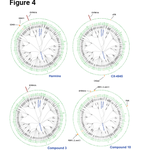
We've been profiling LRRK2 inhibitors for ~15 years. Nice to see Denali's DNL201 gain traction in the clinic science.org/content/article/…

1
Roche wagers $180M in quick cash on a candidate for best-in-class tumor targeting drug - endpts.com/roche-wagers-180m…

1

Might be a path forward for the clinical development of PIK3CD inhibitors

Some great coverage from @BioWorld this week highlighting the potential of IOA-244 for patients with #uvealmelanoma. Look out for our results at ASCO next week!

4
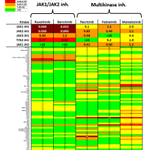
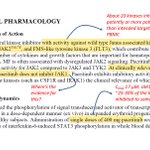
There is currently an unmet medical need for MF. Fedratinib and Pacritinib (likely Momelotinib) show clinical efficacy in patients not responding to Ruxolitinib. Rather than loosely labeling these cmpds JAK2 inhibitors, acknowledge that they are multikinase inhibitors.
1
2

KiNativ retweeted

From the Curator: Dr Domenico Sanfelice talks about recent updates to the Chemical Probes Portal including new 4-star probes and changes to the site.
Read the full article: chemicalprobes.org/news/from…
#Chemicalprobes #DrugDiscovery

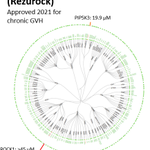
KiNativ used to confirm remarkable selectivity of Belumosudil (Rezurock) for ROCK2 over ROCK1. ROCK2 IC50 2.0 µM, >20X selectivity over ROCK1 (no inhibition of ROCK1 observed at all). Great accomplishment considering that the active sites of ROCK1 and ROCK2 are 91% identical!

1
3
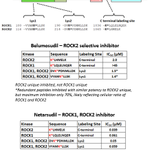
On KiNativ, the probe-labeled peptides mapping to the kinase domain are identical between ROCK1 and ROCK (Lys1 and Lys). However, a probe-labeled peptide 800 aa downstream the kinase domain allows one to distinguish ROCK1 from ROCK2! @Chemical_probes

1
3
Congratulations on your paper! Appreciate the inclusion of the KiNativ selectivity profiles


Our paper "Selective Macrocyclic Inhibitors of DYRK1A/B" is out now in @ACSMedChemLett. Great to work on this med chem story with John Hatcher and team @DFCI_ChemBio. pubs.acs.org/doi/10.1021/acs…

1
2
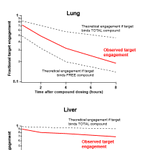
We treated animals with compound, and at various times after dosing, explicitly measured target engagement on KiNativ. In parallel, total and free compound in the tissues were also measured, and this was used to predict theoretical in vivo engagement
1
While TOTAL compound does overestimate engagement, FREE compound clearly underestimates engagement. Significantly, tools (i.e, KiNativ😉) exist to measure in vivo target engagement! @KRHornberger @jsrosenblum @med_chemist @hrosenkrantz5

2
2