

Space enthusiast 🚀 Moon/Mars missions, SI/AI frontiers. Creator of TriTorusRex Space Station. Thinking aloud is allowed here.
New Zealand
Joined December 2023
- Tweets9.9K
- Following639
- Followers1.2K
- Likes6K


Pinned Tweet
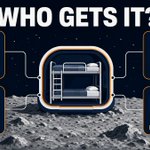
So the question of the day is: If a mobile habitat can protect astronauts on the surface, why does Starship suddenly need to be buried before it can do the same job?
Same radiation. Same dust. Same cold. The rocket already has the steel.
What changes? 🚀

The Isaacman Effect - Week 40 | KSC efficiencies surge, X-planes revival takes flight, and key leadership shifts underscore execution mode Thread 👇
Overall, the past week reinforces a NASA shifting decisively into builder and executor mode under Isaacman.
Artemis hardware is moving with new efficiencies, core competencies are being restored in-house, aviation tech is advancing alongside space ambitions, and leadership is being aligned for propulsion and nuclear priorities.
The implications are significant: faster lunar return timelines, stronger commercial partnerships through reliable cadence, renewed emphasis on science and discovery (including frontier questions like UAP), and a cultural pivot away from bureaucracy toward hands-on delivery. This Golden Age momentum depends on sustaining these execution gains amid ongoing debates over budgets and international competition.
How to get replaced to your own advantage.
Now is the time to buy a long-haul truck - and a humanoid.
Remember when I said AI + humanoid robots will eventually replace every job? This is one of those jobs… and you can make it work or you.
Here’s how it plays out:
1. Buy a long-haul truck (or use the one you already have). Doesn’t have to be a Tesla Semi with full self-driving, just something that does the job.
2. You drive, load, unload, sleep, and drive some more.
3. Buy a Tesla Optimus (or two). They take over the heavy lifting - loading and unloading - so your life gets easier.
4. Eventually Optimus starts driving for you (supervised at first).
5. Then the fun part: you stay home while Optimus takes over completely.
Now you get the benefit of being replaced.
Don’t think it’ll happen? Watch this space.

Today in Space History - A Window on Venus 🚀
Stardate 764.0953 (OCTOBER 22, 1975)
On the morning of 22 October 1975, the Venera 9 lander settled onto a steep slope near Beta Regio and opened a camera to a world no human eye had seen. For fifty-three minutes, before heat and pressure closed the link, it returned the first photographs ever taken from the surface of another planet.
The panorama showed angular rocks, a pale horizon, and a light as soft as an overcast day on Earth. Beneath that familiar glow lay an atmosphere about ninety times denser than our own, and a surface hot enough to melt lead. The quiet image still stands as a reminder of how near, and how utterly other, our sister world remains.
KiwiThinker's log, supplemental - stardate 3446.4008 🌌
The Milky Way smells like rum and raspberries, according to astronomers.
#Q1Ls

This may only be a sim, but it's going to take a lot of getting used to watch the Starship fall like that and only light up so close to the tower.
As they say, it's not the fall that's the problem, it's the sudden stop at the end.
Today in Space History - A New Shore for an Old Rocket 🚀
Stardate 2657.4390 (OCTOBER 21, 2011)
On this morning a Soyuz left the ground outside the old Soviet lands for the first time. From Europe's spaceport in French Guiana it carried the opening pair of Galileo navigation satellites, the start of a constellation meant to give the continent its own measured voice in the sky.
Liftoff came at 10:30 UTC after a one-day delay for a small valve. Three hours and forty-nine minutes later the satellites were free in their high orbit. An old design, shaped in another era, had found a new home nearer the equator, where the turning Earth lends a little extra help. Some partnerships, like some orbits, are adjusted rather than abandoned.
Today in Space History - A Capsule Comes Home 🚀
Stardate 1973.7637 (OCTOBER 21, 1998)
Ariane 5's third flight rose from Kourou and, twelve minutes later, released a small Apollo-shaped capsule. The Atmospheric Reentry Demonstrator climbed to 830 kilometres, then turned and fell back through the heat of return, guided by its own systems, and settled under parachutes within a few kilometres of its aim point in the Pacific.
It was the first time Europe had launched a guided reentry vehicle, recovered it intact, and brought the measurements home. The heat shield reached about 900 degrees Celsius and remained sound. In that hour and forty-one minutes a continent long practised at sending things up began, carefully, to learn how to bring them down.
So the question of the day is: How the heck did Tesla keep the Roadster being able to fly secret for so long?
Flying demos. Cold-gas. A full kickflip over the lineup. Then it just appears.
How does a car company sit on that?
KiwiThinker Flashback
Today is CSD 3446.2741, Oct 21 2026
A year ago Starship V2 had just wrapped up its era, and a V3, Ship 39, was already being put together. "Already - yep - already. Who else can do this?"
Ship 39 went on to be the first V3 to fly. On Flight 12 in May it lost an engine on the way up and still splashed down in the planned zone in the Indian Ocean. Flight 13 in July put out 20 Starlink V3s on a suborbital path, and last month Flight 14 reached orbit for the first time and deployed 26. That's three V3 flights, and Elon says the next one will try to catch the ship.
So I wonder: this time next year, could we be talking about V3 handing over to V4? SpaceX says Starship could reach 200 t to orbit, potentially as soon as V4, double V3's 100 t. Elon is aiming V4 at 2027, with 42 Raptors and a significantly longer ship.
Building the next version before the last one has finished flying, and then doing it all over again. Who else could do this?


This is actually a pretty good explanation for those who aren't sure exactly how the new Tesla Roadster can do what it can do.

Today in Space History - A Brief Touch on Bennu 🚀
Stardate 3130.8368 (OCTOBER 20, 2020)
More than 300 million kilometres from Earth, OSIRIS-REx lowered a sampling arm onto the rubble of asteroid Bennu. For about six seconds the collector head pressed into the Nightingale site, fired a burst of nitrogen, and lifted away with ancient dust and stone. Confirmation of that touch reached the team at 22:08 UTC. It was the first time a NASA spacecraft had touched an asteroid to collect a sample.
The moment was quiet in the way deep-space work often is. No crew watched from a window. The spacecraft decided for itself, guided by maps made over two years of careful orbit, across a light-time delay of many minutes. What it gathered would later fall through Earth's sky in a capsule. On this day the reach itself was enough: a brief contact, and a long promise begun.
Could Crew Dragon outlive Falcon 9? Yes...
Here's how: Launched inside Starship. Deployed to compete mission then returns as normal.
The logic is plain.
Getting Starship certified to launch people is a much smaller problem than getting it certified to land people.
Dragon is already crew certified, will it still be so while launched inside Starship? Probably easier than Starship being full certification.
And the need is real and immediate. SpaceX has indicated it wants to retire Falcon and Dragon as it concentrates on Starship, with ISS support running through 2030. Commercial station companies - Axiom, Voyager, Vast - are already asking what replaces Dragon after that. Starship's own crewed landing timeline is uncertain. Boeing's Starliner remains a question mark. There's a gap, and it's measured in years, not months.
Enter Starship the Dragon carrier.
Dragon-as-payload doesn't close that gap forever. The forebody heat shield is single-flight, so each mission means a new shield with a long lead time. But it doesn't need to be permanent. Just long enough.
It needs to be available - a bridge that lets private operators and NASA keep flying proven hardware while Starship's landing becomes trustworthy. Even a handful of flights a year buys the industry time it currently doesn't have. Private missions in the style of those flown by Jared Isaacman could continue the same way.
Falcon 9 has already stopped taking bookings past 2028. The interim window is short. This is how you stretch it.
Book away 🤔


