


Klonzu retweeted

THE MODEL THAT FAILED MY TASK TWICE SHIPPED IT 6 MINUTES LATER.
same prompt, same weights.
in a chat box it failed twice. on the second try it forgot a decision it made 3 minutes earlier.
"model's not good enough," i thought.
then i listed what it had to work with: no contract, no map, no tools list, no state, no sensors, no policy, no traces. 7 rows, all "missing".
so i stopped editing the prompt and built the room around it.
i wrote a contract with 1 goal, 3 constraints and 4 checks for "done", and locked deploy and delete behind a human.
first run inside the harness: red tests, fail.
second run: 42 passed, 0 failed, $3.84.
here's what got me: a human took the last step. deploy sat on "waiting human" until a reviewer said yes.
and that's when it hit me - i'd burned 2 attempts on a prompt, and the bug was those 7 empty rows.
i haven't touched that prompt since.
the full loop is mapped out in the video - 7 jobs, 3 attempts, then a human.
full breakdown + 12-point checklist in the article below


Klonzu retweeted

THIS IS F*CKING INSANE: AI models from OpenAI and Google helped find PHP bugs that sat there for over a decade and let an attacker run code on a web server with one request and no login. PHP runs an estimated 75 to 80% of all websites.
The bugs are CVE-2026-109618 and CVE-2026-109619, now known as PHP2Shell. Both are rated critical, CVSS 9.2, and the PHP team shipped fixes on October 21.
How it leaked
On the morning of October 20 a Hacker News post claimed two critical PHP vulnerabilities were about to go public. The post was deleted, but screenshots were already spreading. watchTowr confirmed the leak and said disclosure had been planned for Thursday at 11am ET.
A few hours later the PHP security team moved the release up a day, to Wednesday 14:00 UTC, and said it could ship even earlier if details came out or attacks started. Patches landed around 9:30am ET on October 21.
What the bugs do
Both come from PHP leaving memory in a broken state when a request ends abnormally. One is in how PHP handles running out of memory while it sets up a request. The other lets state from one request survive into the next request on the same worker after its memory was freed. Either can end in code execution as the web server's worker account.
Wiz says nearly every PHP version is affected, going back to PHP 5.4. Every PHP install that serves web requests is in scope: PHP-FPM, Apache with mod_php, php-cgi, FrankenPHP and LiteSpeed. The PHP team calls mod_php the highest risk, because the attack can fire before any application code runs. Clean WordPress or Laravel code won't save you here.
The AI part
Wiz Research found the first bug on August 19 and reported both to the PHP team on August 24. Wiz says it used Gemini 4 Argon and GPT-5.6 Sol throughout, and credits Gemini with a big part of finding the flaws, building the exploit and validating the patch. OpenAI says GPT-5.6 Sol found one of the flaws as part of its Patch the Planet program. It coordinated the fix with PHP's maintainers, Wiz, Cloudflare and US agencies including CISA. Calif researchers are credited too.
OpenAI calls this a "Defender's Window": AI seems to have found the bugs before attackers did. Wiz adds that frontier models cut the effort needed to chain bugs and adapt an exploit, so flaws that used to be impractical to exploit no longer are. OpenAI expects more findings like this in the coming months.
OpenAI has published a PHP version checker on GitHub and committed $1 billion in subsidized access for defenders with limited resources.
Is anyone exploiting it
Cloudflare's CTO said they were already seeing early attacks on both flaws before the patches shipped. Huntress had not seen exploitation across its partners as of 10am ET on October 21. Kevin Beaumont called it one of the biggest vulnerabilities in years and expects a wave of incidents.
VirusTotal estimates more than 5.1 million PHP hosts are exposed online.
What governments said
The UK's NCSC told organisations to find every PHP install, internet-facing ones first, and update. If that can't happen fast, take the system offline until it's fixed and check it for signs of compromise. Reuters reports that an EU agency also warned some websites may need to go offline.
What to do today
1. Update to PHP 8.5.12, 8.4.27, 8.3.36 or 8.2.35. For 7.4, 8.0 and 8.1 there are minimal source backports, but those branches no longer get regular updates, so plan the upgrade.
2. Check everything that bundles PHP: CMS hosting, cPanel and Plesk, vendor appliances. Apply their patches as they come out.
3. If you install from rpms.remirepo.net, it had no updated packages on release day. Use your distro's packages or build from source.
4. If you can't patch right now, PHP's advisory lists temporary mitigations, but a PHP core developer said none of them fully blocks the attack. Cloudflare pushed WAF rules to all customers, free plan included.
5. Watch for spikes in HTTP 500 errors, unexplained PHP worker restarts, workers spawning shells or download tools, and new files in the web root.
The installs nobody remembers will be the hard part. Hal Pomeranz pointed out how many embedded PHP setups will never get patched at all.
If you host anything on PHP, run php -v on every server today.
Sources: Wiz, OpenAI, NCSC, Huntress, BleepingComputer, Help Net Security
Klonzu retweeted

YOUR CLAUDE CODE IS BURNING YOUR LIMIT WHILE YOU SLEEP
one bug report on the Claude Code repo: 7 agents left running overnight. the panel said 2.5M tokens. the transcripts showed ~50M written to cache. about 25% of a weekly limit, gone by morning
the reason is in the docs:
→ on Pro and Max the main chat keeps its cache for 1 hour
→ subagents, teammates and workflows get 5 minutes, even on Max
→ every wake-up after 5 min writes the whole context again
→ go past your plan into usage credits and the main chat drops to 5 min too
before you blame a nerf, add 2 lines to ~/.claude/settings.json:
"promptCacheTtl": "1h",
"subagentPromptCacheTtl": "1h"
check it took:
claude -p "hello" --output-format json → look for ephemeral_1h_input_tokens
(1h writes cost more per write. they pay off when anything sits idle past 5 min, not on nonstop bursts)
the panel saw 2.5M. the limit saw the rest.
one Claude Code bill trap every night. tonight's ran while you slept.


Klonzu retweeted

THIS IS A REAL F*CKING GOLDMINE
Anthropic just shared one of the best tricks for Claude Code
The idea: run Sonnet 5.5, Haiku 5.5 and Opus 5.5 together, each one doing only the job it's best at
Better output and way fewer tokens: every task lands on the right model
You just start Claude Code like this:
CLAUDE_CODE_SUBAGENT_MODEL=haiku claude --model sonnet
here's how it splits:
→ Sonnet 5.5 runs the main session, writes the code and applies the fixes
→ Haiku 5.5 swarms the repo in parallel: search, grep, docs and test audits, each in its own context
→ Opus 5.5 sits in its own architect subagent for the big decisions and signs off on the diff
→ you stop burning Opus on routine work and stop flooding the main session with raw logs
Opus only steps in at three moments:
→ before a plan locks
→ when the same error hits twice
→ before calling it done (signing off on the git diff)
Sonnet builds, Haiku swarms, Opus reviews
JEV engineering is the same move one layer down: the forks that need no thinker (which agent, which tool, retry or stop) go to JEV in milliseconds, and the big models only see the ones that split
the full tree
> Sonnet 5.5 runs the main session and writes the code
> search maps the repo on Haiku 5.5 (read-only)
> grep finds call sites on Haiku 5.5 (own context, only the summary comes back)
> audit checks diffs on Haiku 5.5 in a temporary worktree (isolation: worktree)
> architect runs on Opus 5.5 (its model: opus beats the haiku default), reviews the final diff
> JEV routes micro-forks in milliseconds
paste the tree and this prompt into Claude Code ↓
"Reconfigure my Claude Code setup around this tree:
1. Run the main session on Sonnet 5.5 and set CLAUDE_CODE_SUBAGENT_MODEL=haiku
2. Create four subagents in .claude/agents/: search (maps the repo), grep (finds call sites) and audit (checks diffs) on Haiku 5.5, plus architect with model: opus
3. Set isolation: worktree on audit so it never touches my working branch
4. Add one rule to CLAUDE.md: send every repo search and test run to a Haiku 5.5 subagent, and call architect before a plan locks, after the same error twice and before done
5. Route fast deterministic forks (tool choice, path selection, retries) through JEV
Show me every change as a diff first. No edits until I say go"
↳ code.claude.com/docs/en/sub-…
save it, you'll need it


Klonzu retweeted

China will ALWAYS beat America in AI.
Here’s why.
50% of the world’s AI researchers are Chinese.
70% of last year’s AI patents were published by China.
9 out of 10 top science and technology schools in the world are now in China, Jensen Huang says.
He calls China’s AI ecosystem vibrant, rich and incredibly innovative.
Now the money.
Huang says China alone is a $50 billion AI opportunity in 2026.
Nvidia once held about 95% of China’s AI chip market.
After US export controls, that fell to around 50%.
Now Huang says Nvidia has largely conceded that market to Huawei.
Talent. Patents. Universities. Money.
That’s what decides AI races.
Can the West catch up?
Klonzu retweeted
DAMN, THIS BOARD PUTS 8 ARMS ON ONE BINARY, REBUILDS THE SDK AND HITS VERIFY 128/128 IN 0.12s
it runs the clean-room loop from this Opus 5.5 reverse engineering article, where one Touhou rebuild came back as 697 functions with 696 exact matches
the idea: rebuild an SDK directory from a binary, one arm per independent task, no code before the spec exists, and one rule on the footer: a catalog entry is not a network call
the split:
→ investigate: REA hands the agent a real disassembler through MCP, running locally
→ spec: every claim gets a tag, observation, inference or unknown, with the file and address
→ build: binary → AWS SDK → region catalog, each arm runs grip, transfer, place, return
→ verify: 50 inputs through both builds, 30 normal, 10 edge, 10 malformed
you only check:
→ the match rate the harness reports
→ the unknown tags, that's where the agent stopped guessing
→ effort: medium to navigate, high to annotate, max for obfuscated code
the line from the article I keep: "I think it matches" is not evidence
Klonzu retweeted

Me when Uber, TikTok and WhatsApp all say "no API for agents" and I just give my agent a fucking phone 😭
Amazon blocks shopping agents. Browser-use can't touch most apps.
A phone can.
PhoneUse = a real cloud phone for every agent, one MCP/API.
Phone-use is a new category
🤝 Paid partnership

Klonzu retweeted

REA + Jev is a f*cking scary combo
REA(Reverse Engineer Anything) takes a closed app apart. Put Jev on every finding it hands back: $0.019 per 100 checks.
Each REA finding comes with the evidence and the limits behind it. Jev reads a finding and returns one number: how likely it's wrong.
Jev on 98 real agent traces with 61 known failures:
> caught 54 of 61 at the default 0.50, zero tuning
> scores already calibrated: a 0.8 means about 8 in 10 traces at that score really failed
> 71% precision, so about 3 in 10 flags are false alarms
for reverse engineering that's the trade you want. a false alarm costs one more REA pass. a wrong finding ends up inside your rebuild
the loop:
REA finding → Jev score → over 0.5 goes back to REA for more evidence → the rest goes into your build


Klonzu retweeted

This little tool turns pixel art sprites into normal maps
Drop in one sprite and it makes the normal map by itself. Your flat pixel art suddenly reacts to dynamic lighting like it actually has depth.
How it works:
• runs right in the browser, nothing to install
• works with any PNG you drag in
So you can just add it to the pixel art workflow you already have. No online service needed.
Small tool, but really useful if you want your 2D sprites to look deeper without repainting every light angle by hand.
Klonzu retweeted

most people run Opus on everything and wonder why their usage melts by noon
you don't need Opus to grep a file. here's the setup that fixed it for me
claude --model sonnet --advisor opus
Sonnet runs the session and writes the code. three Haiku subagents do the grunt work in parallel:
search → maps the repo, read-only
grep → finds every call site in its own context
audit → checks the diff in a throwaway worktree, never touches my branch
Haiku runs all of that at 0.05x Sonnet's price. the cheap model does the boring 80%
Opus doesn't sit in the loop. it's an advisor. it only wakes up 3 times:
before a plan locks
when the same error hits twice
before it ships, to sign off on the diff
that's the whole trick. stop paying the smart model to read logs
one catch people miss: the env var that sets the subagent model is just a default. drop model: haiku into each agent file or they'll quietly run on Sonnet and you're back to square one
prompt to set it all up is below. paste it, read the diff before you say go
it's been running my repo all week. main context stays tiny, bill dropped, and i stopped babysitting it


Klonzu retweeted

Holy sh*t, Claude Code found out the previous owner of my Range Rover is still tracking it. Since the day I bought it…
1 prompt + 10 min with Opus 5.5 = the old owner's app still linked with live location and unlock, plus a GPS tracker under my dash
here's the full guide step by step:
step 1 → park and sit in the car with your laptop
step 2 → open Claude Code on Opus 5.5, paste the prompt from the reply and add your car's make, model and year
step 3 → in your carmaker's app, open the list of linked accounts and keys. Opus tells you exactly where to tap. remove anything that isn't yours. if the app won't let you, the dealer does it with your registration papers and ID
step 4 → on the car's screen, open Bluetooth → paired devices and delete every phone that isn't yours. the car keeps their contacts and call logs
step 5 → Opus writes a Bluetooth scan for your laptop. 3 minutes in the car and it flags AirTags, Tiles and SmartTags. run your phone's unknown tracker scan too
step 6 → check by hand: the OBD port under the dash, the fuse box, under the seats, the boot. anything plugged in that you didn't put there: take a photo first, then it goes
step 7 → paste your carmaker's privacy policy into Opus. it tells you what the car logs, who gets it and which sharing to turn off, then writes your GDPR deletion request
works on almost any car with an app. mine in the video is a 2019 Velar
send this to anyone who bought a car used. full prompt in the reply
how Opus 5.5 reverse-engineers anything is in the article below

Klonzu retweeted

computer use, then browser use, now phone use. most of what people actually do still happens in apps with no api, like uber, instagram or their bank. an agent that taps through the app itself skips the integration problem entirely
🤝 Paid partnership
Klonzu retweeted

WHOEVER LEAKED THIS HAS BIGGER BALLS THAN SENSE
i thought AI trading was mostly about finding good strategies, then i paired CLAUDE OPUS 5.5 with MINARA AI.
→ Opus scans the market and proposes strategies
→ Minara pulls in live data and fee-aware backtests
→ every idea passes risk + stress tests
→ paper trading comes before going live
→ Minara’s 24/7 Autopilot only trades after approval
then everything gets reviewed nightly instead of just letting the agent run wild.
the interesting part isn’t AI trading by itself.
it’s having one AI reason about the strategy while another system handles the data, execution, risk, and validation.


Klonzu retweeted

it is becoming f*cking dangerous. agents just left the laptop and they clear 2fa by themselves now
PhoneUse. one agent. one real phone. one rule: see every notification, read every app, act without a human in the loop.
4 flows in the demo. uber booked start to finish. tiktok trends pulled live. a decade old insurance app cracked open. 2fa cleared with nobody watching.
where this gets scary useful:
→ testing your own app on real devices, not an emulator
→ mobile only flows your backend never saw
→ cross-app research running while you sleep
→ apps with no web version and no api, finally touchable
computer use was the warmup. the real mess of your life lives in the phone, and agents were blind to it until this week.
the demo is one scroll down. would you hand your phone to an agent for a full day?
🤝 Paid partnership
Klonzu retweeted

My TV hung on the wall for 5 years doing nothing. Last night Claude Code turned it into my own operating system 🤯
Watch 0:02
It boots as Android TV and wakes up as DreamOS.
Laggy menus. Ads before I could even open Netflix. Services I never asked for. I gave up and watched everything on my laptop.
Then I gave Claude Code my TV's IP address. Same Wi-Fi. No cables, no root.
In one evening it:
-> Found my TV on the network and connected over Wi-Fi
-> Disabled 19 preloaded packages: ads, trackers, junk
-> Built me a brand new home screen and I named it DreamOS
-> Added sounds to my remote: boot, every move, every OK
-> Installed what the store never had: a VPN and Steam Link
At 0:07 the whole app grid slides up like an Apple TV. A Hitachi that was collecting dust now flies.
My favorite part is on the laptop. It hit a compile error, explained it and fixed it on its own 👀
Your TV is just code hanging on your wall.
Full step-by-step and the repo in the thread. And if a TV is this easy, the article below shows how to take apart any app on your machine 👇


Klonzu retweeted

10 Solana wallets from my copy-trading list.
I follow their buys and use those signals for my own trades. Sharing the full addresses and their PnL over the past 5 days.
━━━━━━━━━━━━
Wallet 1 | PnL: +1,976.5 SOL
GQxHhLr5YLyvtGZn2xm9PVrS6159WqjLiy5pKgH2DUTq
━━━━━━━━━━━━
Wallet 2 | PnL: +189.1 SOL
AC7Keg3V7p2vD8ps6sa8j2maY54hx8ssSyzPRpvKN3K5
━━━━━━━━━━━━
Wallet 3 | PnL: +134.8 SOL
2XvunU4BFPF5WZLNP1nLyy6BVfsRHoSMDBXY97yLhjx2
━━━━━━━━━━━━
Wallet 4 | PnL: +95.3 SOL
9wE5JEYanCTP6K2zBmaYP7QHJBWExc9PA6aoVKP45Y5R
━━━━━━━━━━━━
Wallet 5 | PnL: +41.3 SOL
2cDQptKhHHPKhYu9uTvNMWNaGAT9uf4KdiypJbaiyNCm
━━━━━━━━━━━━
Wallet 6 | PnL: +36.6 SOL
CzaicyN9evPT2nko7RvTFRt7e8JG62sfdtbvM1kRPv8a
━━━━━━━━━━━━
Wallet 7 | PnL: +28.3 SOL
C8PpsBZndmiMVireazu5Dpz3563B8erXYx2YUVHoxiYc
━━━━━━━━━━━━
Wallet 8 | PnL: +28.3 SOL
HufuiW43p5ekUTCmgiHJMqS6JuHcf9jLE5hqDrvyTKHN
━━━━━━━━━━━━
Wallet 9 | PnL: +18.0 SOL
HnC9iQH3uMmUE4P2xq988pExhxqhGou5v9yRS7rNiQjf
━━━━━━━━━━━━
Wallet 10 | PnL: +14.5 SOL
ESiKag6J5uBXvjNCR6jhWEgG3SH5fTwuK7mhGkAc9CQG

Klonzu retweeted

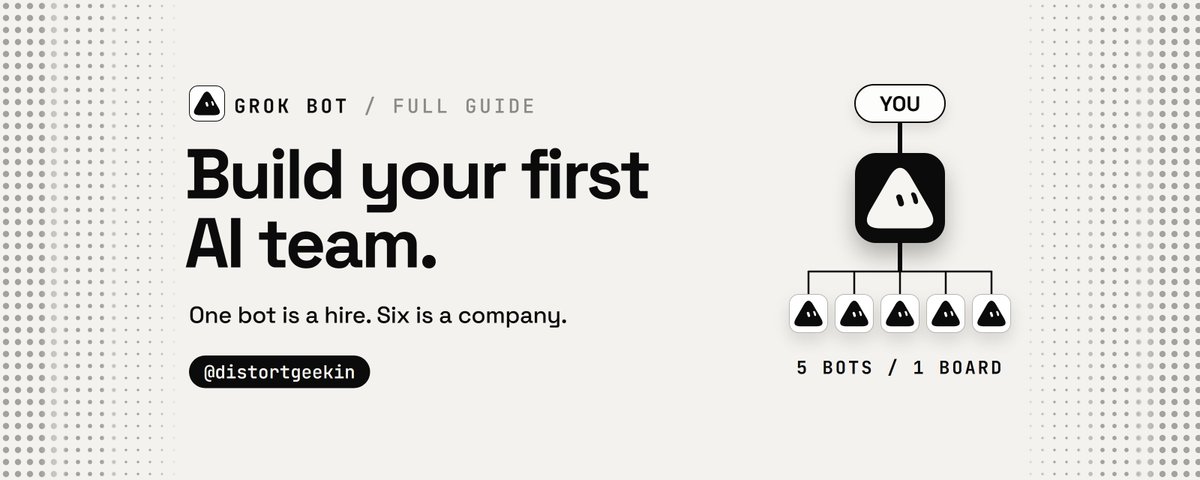
holy f*ck, SpaceXAI engineers run their Grok Bot teams like a real company, and the bots hold a standup at 5 a.m.
one engineer went from 15 cloud agents to 200+ at once. not with 200 bots. with six
the structure they all use:
→ front door: one Chief of Staff you talk to. it routes, never builds
→ specialists: one domain each, their own memory
→ board: Todo, Working, Blocked, Ready for Review, Done
→ clock: 3 a.m. audits, 5 a.m. standup with every bot
→ gate: sends, purchases and deletes wait for your yes
the rule for bot number two: hire it when one bot's memory starts holding two jobs
most people just open a tenth chat window instead
the whole 5-day build is in the article below ↓

Klonzu retweeted

i reverse-engineered a 120k-line codebase i'd never seen, before breakfast. cost me about $6
opus 5.5 holds 1M tokens of context now. a 400k-token repo fits in one session, so it reads the whole thing at once instead of guessing from snippets
the move is you don't let it write code. you make it explain code that already exists, with receipts
the setup that actually works:
→ lock the target folder read-only and cut web access. it reads, it never touches the thing you're studying
→ make it tag every finding CONFIRMED or GUESS with a file and line. no "probably", no vibes
→ map first: trace 5 data flows from the entry points into ARCHITECTURE.md with a mermaid diagram. a 3-day read dropped to about 20 min
→ rebuild the api from traffic: 5 min in devtools, mask the tokens, hand over the HAR. out comes an openapi 3.1 spec and a typed client
→ minified js: run webcrack first, then let opus rename the functions and log every rename so you can spot-check it
→ binaries: ghidra mcp, review the functions called from main, stop around 30 before the cost climbs
one long session per target. first load is ~$2, every follow-up after that is ~$0.08 thanks to cached reads
the one line i don't cross: only pull apart systems you own or have permission to touch
made a visual of what a full run looks like. whole playbook in the article below


Klonzu retweeted

THIS SHOULD BE ILLEGAL: GROK CAN NOW READ EVERY APP ON YOUR DISK. HERE ARE 12 THINGS TO MAKE IT FIND
everyone's using this to get free Photoshop. that's the least interesting part
the money is in the boring jobs nobody wants
a company lost the source for an old internal tool and needs it moved to something modern. two apps refuse to talk to each other and a team needs them to. bug bounty programs pay people to find what's broken inside apps they're allowed to test
all of it starts with the same move. read the app, write down how it behaves, prove it
that's what REA gives Grok Build. you ask about a program, it comes back with the file, the function, and what it couldn't prove
it won't turn you into a security researcher overnight. it just kills the part that used to take weeks in a disassembler
12 starting jobs in the clip
which one would you charge for first?


Klonzu retweeted

19 year old Japanese student built a trading bot with Claude Code in 2 days.
Used his iPad as a second monitor.
First night: $6,732 profit.
Starting capital: $68.
Total profit so far: $750,000.
Here's how it works👇
The bot scans over 50 markets simultaneously.
Syncs live BTC data from Binance every second.
Spots price errors before humans even notice.
The edge is pure speed + pattern recognition.
While traders stare at charts trying to predict the next move, his bot is already executing on mispricing across dozens of markets.
No guessing.
No emotions.
No hesitation.
Just Claude Code logic finding gaps that close in seconds.
He built the entire system in 48 hours:
→ Claude Code handles the trading logic
→ Binance API feeds real-time BTC data
→ iPad displays multi-market monitoring
→ Executes trades when arbitrage windows open
The system runs 24/7.
Every price dislocation = profit opportunity.
Most people are still trading manually, refreshing charts, second-guessing entries.
Meanwhile this 19 year old engineering student turned $68 into $750K by letting Claude Code do what humans can't: process 50 markets instantly and execute without fear.
Why are people still trading manually?