

I want to understand. 💫 Thank you Dr Ray Peat 🥛🍨🍊
Joined July 2022
- Tweets4.2K
- Following535
- Followers4.3K
- Likes27.3K




Ruth retweeted

That's it. Peating has been solved.
WikiPeatia Chat: semantic search over 600h audio and 500+ books, even the wiki itself.
Toggle sources: Ray Peat, Curated, or Everyone.
AI only turns semantic search results into sentences and audits citations to prevent hallucinations.
Claims link to exact words, PDF pages, or transcript seconds. Has memory and should undertand context of the chat. Song by Ty Guy @brainenergy4me
Ruth retweeted

Today I'm posting a new video to my YouTube Channel. Persistent misnaming of 17-OHPC as "progesterone" in medical literature lead to pregnant women receiving the wrong drug through compounding pharmacies: youtu.be/I1C9aDfLH-U

Ruth retweeted

The pamphlet appeared in 1858. The German controversy over materialism still cast a formidable shadow over the Christian nations.
Materialism beckoned to an age enamored by pleasure and profit, yet threatened to annul human freedom and everything held sacred. Neither the theologian’s doctrinal learning nor the philosopher’s rationalism, the author feared, could furnish the weapons needed to overcome the metaphysical materialism of the age. Theology could not annihilate it with “thunderbolts of excommunication and anathemas,” nor even with the “tribunals and pyres of the Inquisition.” Petrified in the stream of time, theology had only its dogmas with which to defend itself.
Philosophy, after the dissolution of the Hegelian system, had sunk into its final deep sleep. The philosophical revolution inaugurated by Kant had once awakened hopes as vast as those stirred by the political revolution in France. It had traversed the same phases and come to an equally tragic end. Had philosophy not become a profession with salaried chairs, a trade sustained by the state, and had the young not been compelled to obtain compulsory qualifications in the subject, no one would have spoken of philosophy at all. Quoting a forgotten journalist: “this branch of literature would probably have become extinct.”
Yet the modern age possessed, the author wrote, one branch of science that might furnish the weapon of the future: physiology. Its adversary was a materialism that philosophized not with the hammer but with physics and chemistry. Physiology’s dynamism would vanquish materialism’s atomism in a duel of empirical evidence against empirical evidence. Victory required the physiologists to restore the conception of the Great Chain of Being, as formulated by Leibniz and, in more recent times, by Matthias Jacob Schleiden and Alexander Braun. To challenge so earthbound a philosophy, they would have to confront the materialists with the full force of a rhetorical question: “In the greatest as in the least, in the telescopic as in the microscopic, what manifests itself everywhere but life and organization, in infinite gradation and progression?"
Ruth retweeted
Cutting salt barely lowers blood pressure in people whose pressure is already normal. A Cochrane meta-analysis of randomized trials found it raises aldosterone, noradrenaline and adrenaline instead.
In a randomized study, one week on a low-salt diet made healthy adults more insulin resistant than one week on a high-salt diet.
In a pooled analysis of four large cohorts, sodium intake below 3 g a day went with more heart events and deaths.
Japan, South Korea and Singapore eat more salt than Americans and live several years longer.
The page also covers why hypothyroid people lose salt in urine and sweat, older studies where extra salt lowered blood pressure in preeclampsia, and salt and sleep.
Link below.

Ruth retweeted

12 things that made Ray Peat different from most people giving health advice:
1. He had a ridiculous understanding of biology, chemistry, physiology, history and nutrition, and managed to connect things most people wouldn’t even think were related.
2. You could ask him a simple question about food and end up getting an explanation involving some obscure experiment from 100 years ago that turned out to be exactly relevant.
3. He seemed to have an endless amount of patience, including with people who were rude to him or obviously didn’t understand what he was saying.
4. I don’t think I’ve ever come across someone who knew so much and felt so little need to remind everyone how smart he was.
5. He had the sort of knowledge that could have made him a fortune if he’d wanted to offer programs, memberships and expensive consultations, but he wasn’t about that.
6. For decades he made himself available to people who had questions about their health, and spent lots of time helping complete strangers without charging them.
7. He didn’t seem remotely embarrassed about discovering he was wrong about something. He was more interested in getting things right than being right.
8. He understood that what helped one person might make another person worse, which is apparently still a rather difficult concept for much of the health industry.
9. There are people all over the world who credit him with helping them recover from health problems they’d been struggling with for years.
10. If someone wasn’t getting better, he didn’t just accuse them of not following his advice properly and tell them to Peat harder.
11. He wasn’t interested in convincing everyone to eat exactly the same food, avoid the same food or follow some perfect diet, but he was interested in understanding what was happening inside the body and what might help it function better.
12. And perhaps the biggest difference of all was that he didn't want people to believe something just because Ray Peat said it. Which makes it rather funny that some of his followers do exactly that…while his critics assume they all do.


Underrated post alert 🚨

The Ethics of Energy: Bioenergetic Idealism.
All philosophy is idealism. Given how many people look up to Ray Peat and want to emulate him I want to answer this: What are Ray’s ethics? What is his ethical ideal?
Introduction: Ray Peat, the philosopher.
I consider Ray to be a philosopher first and a nutritionally inclined biologist second. Before you can understand his nutritional “how” you have to understand his ethical “why.”
Ray has an entire epistemological and metaphysical element to his philosophy. Composed primarily of Blakean mysticism and Aristotelian scientism (according to my analysis). I may or may not dive into these aspects of his thinking in another post because this requires reading his theses and those aren’t the easiest things for the laity to read.
With that being said let’s begin.
Advancing through cooperation: Kropotkin’s Influence
Ray was a fan of Kropotkin. Not because Kropotkin was an anarcho-communist, but because of his theory of mutual-aid being a factor in evolution as opposed to the brutality of Darwin’s proposed evolutionary theory.
Kropotkin’s theory of mutual-aid, extremely simplified, states evolution was much more complex than “dog eat dog” and “survival of the fittest” in the sense of rugged individual violence as we’re commonly taught, but an overlooked, and more important aspect, of evolution is an animal’s ability to cooperate with its species AND other species. Kropotkin then talks about how this applies to humanity. The greatest periods of human evolution and human achievement have been a collective effort.
This has massive implications. Instead of trying to “one-up” your fellow man, you cooperate with them and try to bring them up because that’s what’ll truly drive humanity forward.
So ask yourself: Are you willing to help people in hopes of progressing us forward? Or, are you merely trying to use Ray’s work as a facade in order to climb the social ladder?
Keep in mind, Ray was a prolific email responder (for free) and his nutritional advice was designed for people in poverty.
Tolstoy: The Christian Pacifist.
Along with Kropotkin, Ray said Tolstoy was one of his first political influences.
“But wait, I thought you were talking about ethics, what’s up with all the political stuff?”
Your ethical view inevitably shapes your political view. Very few philosophical writers wrote about ethics and didn’t touch on politics.
Tolstoy was a Christian anarchist and pacifist. His anarchism was more than just political. When Tolstoy was teaching writing, he encouraged his students to merely write. He figured the grammar and spelling errors would correct themselves, so the most effective way to teach is to encourage creativity. While Ray didn’t know this about Tolstoy, a connection can be drawn here:
When you give people the space to breathe in a peaceful manner, they’re much more likely to thrive and find their own way in ways most could not conceive.
So how does this tie into Ray’s ethics? Despite what most people believe, Ray wasn’t a pure Stalinist, although he did believe most of the history of the soviet union was falsified, Ray wasn’t a fan of authoritarianism in general and that includes dealing with people.
Ray didn’t try to control anyone, or say “my way or the highway.” Where do you think the saying “Think. Perceive. Act.” came from?
It was in response to someone asking him for a dietary “protocol” and all he did was shine a mirror back in their face.
Furthermore, he welcomed criticism and debate as long as it was valid and he did so politely.
Ray was quite anti-war and anti-violence especially when the war was propagated by the elites and funded by the unwilling masses.
So far we have two aspects of a Peaty ethics “system.” Cooperation for the advancement of humanity, and a pacifist “live and let live” attitude so people can become who they are.
What about Ray’s heavy influence: William Blake?
William Blake: The Cup that Runneth Over.
Blakean ethics are moderately difficult to define. Blake wrote about everything and anything in a mystical, wonderland manner adorned with artwork.
However, there’s one element everyone who studies Blake admires about him and his work: His unparalleled zest for existence, boundless energy, and emphasis on intuition rather than logical positivism.
An existence akin to a cup bursting at the brim with energy and thus infecting everything around it with the “virus” called “joy.” The essence of Blakean philosophy is an eternal “yes” saying to life and all of its splendor rather than a self-imposed limiting existence.
Blake exalted creativity and art. He praised imagination. He praised amor fati.
Have you ever wondered why Ray focuses on metabolism and energy so much? This is why.
When your metabolism and energy are at their highest, life becomes joyous and your energy is infectious. You can do more. Eat more. Live more. Play more. Everything about you embodies the Blakean cup waterfalling out of the brim.
This is more than reckless hedonism: This is God’s energies at work. Blake was extremely close to God, but rather skeptical of religion. He emphasized a life filled with a personal relationship with God that results in a zest for everything He has created.
Ray’s views on God were complex and multifaceted, but that’s not the take-home point here: The point is Blake’s zest for existence was combined and actualized in Ray’s dietary advice which then makes it possible to live an aspect of Ray’s ethics that’s vastly misunderstood… his absolute love for life.
In a word, Blake is a reflection of Ray's biophilia. A love of life and the living.
Conclusion: A Picture of Ray.
Cooperation, Anti-authoritarianism, Biophilia.
Everything Ray did is a reflection of these traits. Peat’s “ideal man” is someone who…
Cooperates with the world towards the betterment of humanity.
Doesn’t trust authority blindly, but trusts his own intuition and reasoning processes.
And most importantly: Loves life and the living so much he maximizes his energy in order to love and live even more!
Perhaps one day the bioenergetic community will get this…


Ruth retweeted
Dr. Broda Barnes on thyroid therapy for irregular periods. This method was likely so successful because thyroid hormones are necessary for healthy progesterone production.


"In relating progesterone's effects to those estrogen, we should avoid being misled by the opinions expressed in many textbooks, describing symptoms of the luteal phase of the menstrual cycle as symptoms "caused by progesterone". For example, many medical books promote the erroneous idea that progesterone causes edema, because edema often occurs during the luteal phase of the cycle, which is too often conceptualized as "the progesterone dominance phase". Actually, this is the time when the estrogen progesterone ratio frequently reaches its pathological height, for four common reasons:

Ruth retweeted

If you learned about Ray Peat on this app, you might think he was a failed looksmaxxing coach who didn’t understand the first thing about hormones, quantum biology, and peptide dropshipping.
It’s true that none of Coach Peat’s clients were ever invited to a Peter Thiel dinner party.
However, if you read his articles, you can see that he had a deep and nuanced understanding of the topics he wrote about, and especially the narratives he criticized.
You regularly see claims on this app that Ray didn’t understand the essential regulatory roles of things like cortisol, histamine, and serotonin.
“The hypoglycemia and related events resulting from accelerated glycolysis provide a stimulus for increased activity of the adaptive hormones, including cortisol. Cortisol helps to maintain blood sugar by increasing the conversion of protein to amino acids, and mobilizing free fatty acids from fat stores. “
“Serotonin, like histamine, has its proper physiological functions, but it is a mediator of stress that has to be systematically balanced by the systems that support high energy respiratory metabolism.”
“In the brain, serotonin regulates circulation and mitochondrial function, temperature, respiration and appetite, alertness and learning, secretion of prolactin, growth hormones and stress hormones, and participates in the most complex biochemical webs. But the pharmaceutical industry’s myth has led people to believe that serotonin is the chemical of happiness, and that tryptophan is its benign nutritional precursor, and that they are going to harmlessly influence the receptors on nerve membranes.”
There are passages like this in many of his articles.
What’s interesting about Ray is his criticism of the marketing/framing of these substances. Serotonin as "The Happy Hormone" is the most egregious example. His criticisms get dumbed down and passed around; those who don’t read can assume he didn’t understand the basics.
Ray’s ideas circulate as snippets, dumbed down and memefied, iteratively losing meaning. People take these memes and Peat-coded marketing posts as representations of Ray’s work and criticize them.
Short replies in emails and quotes from interviews, spoken in the moment, are not as precise as intentionally written pieces. They miss the surrounding context of the discussion, but they are most useful for social media. The point should be to stimulate interest in the topic, not memetically implant a conclusion. Don’t get me started on chatbot summaries.
Some of these snippet-quoted discussions are high-level; they assume a basic understanding of the “essential” and “adaptive” functions of “PTH, nitric oxide, serotonin, cortisol, aldosterone, estrogen, TSH, and prolactin,” etc., when discussing the harms of their excess.
[I don’t know where you can get a copy of that book; it’s long out of print.]

"It is important to emphasize that progesterone is not just the hormone of pregnancy. To use it only "to protect the uterus" would be like telling a man he doesn't need testosterone if he doesn't plan to father children, except that progesterone is of far greater and more basic significance than testosterone." From PMS to Menopause
26 years ago Bill Clinton said after the completion of the Human Genome sequencing: "In fact, it is now conceivable that our children’s children will know the term cancer only as a constellation of stars”.
2
21
912
“The mathematical habit of mind inclines biologists to see organisms as disembodied information, ultimately as the information contained in the genetic code. Change (they are likely to say) is random, "chaotic," ultimately unknowable. There is no place in this system for a radical critic of the purpose and direction of the system.” Dr Peat raypeat.com/art/
3
289
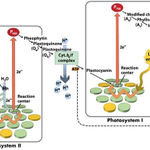
Humans have mitochondria and plants have chloroplasts. Both make energy using an electron transport chain. When researchers blocked progesterone in wheat the plants were less drought-resistant and they had less chlorophyll. In other words they couldn't tolerate as much stress and couldn't produce as much energy. doi.org/10.1016/j.steroids.2…

1
23
764
Also giving progesterone to wheat "improved photochemical efficiency of PSII in wheat leaves subjected to heat stress" (increased energy production). link.springer.com/article/10…

3
282
