

@KobeissiLetter
Account based inUnited States
About this account
- Account based in
- United States
- Connected via
- Web
Account-level information from X, not a live location or the device used for a specific post.
Official X account for The Kobeissi Letter, an industry leading commentary on the global capital markets. Email us: [email protected]
United States
Joined June 2015
- Tweets33.8K
- Following603
- Followers2.7M
- Likes28.9K







Pinned Tweet
ANNOUNCEMENT:
We are excited to present The Kobeissi Letter’s 2025 performance report.
Our analysis provided a net return of +30.7% in 2025, outperforming the S&P 500's 2025 return of +16.4%.
Since 2020, our investment strategy has now returned +516.3%, significantly outperforming the S&P 500’s +111.9% return over the same period.
Our 2025 return builds on +8.1% in 2024, +15.5% in 2023, +92.8% in 2022, +35.3% in 2021, and +44.8% in 2020.
Since 2020, our analysis has delivered a Compound Annual Growth Rate (CAGR) of +35.4%, outperforming the S&P 500’s +13.3% CAGR.
Read the full annual report here:
thekobeissiletter.com/perfor…


BREAKING: The NAHB Housing Market Index fell -3 points in October, to 29, its lowest level since June 2012.
This marks the 2nd consecutive monthly decline in homebuilder sentiment, totaling -6 points, marking the largest 2-month decrease since June 2025.
All 3 components deteriorated, with current sales falling -2 points, to 33, the lowest since June 2012.
Sales expectations dropped -5 points, to 32, the lowest since November 2022, while buyer traffic plunged -5 points, to 18, the lowest since April 2012, excluding the 2020 pandemic.
Furthermore, 43% of builders cut prices this month, the highest proportion of any month from 2020 to 2026.
The affordability crisis is putting further pressure on homebuilder sentiment.

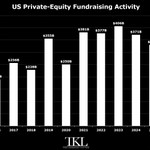
US private equity firms are struggling to attract new capital:
Private equity funds raised just $222 billion from investors in the first 9 months of 2026, on track for the weakest year since 2020.
This would also mark the 3rd consecutive annual decline.
By comparison, the industry attracted $406 billion in full year 2023 and $330 billion last year.
Higher rates have made it harder for private equity firms to sell businesses at attractive prices, weakening investment returns and prompting investors to become more reluctant to commit capital to new funds.
Smaller firms managing less than $15 billion are facing the most pressure.
Private equity has lost its shine in the rapidly evolving macroeconomic backdrop.

BREAKING: IBM stock, $IBM, surges over +6% after reporting stronger than expected earnings due to AI.

BREAKING: Meta stock, $META, surges +5% after reporting stronger than expected Q3 2026 earnings.

BREAKING: Foreign holdings of US Treasuries jumped +$83 billion in August, to $9.33 trillion, their 6th-highest total on record.
The surge was driven by Canada, which raised its holdings by +$38 billion, to $465 billion, its 4th-highest on record.
This was followed by Belgium, which increased its holdings by +$20 billion, to a record $491 billion.
The UK, the 2nd-largest holder, raised its holdings by +$11 billion, to a record $1.01 trillion.
Meanwhile, Japan, the largest foreign holder, cut its holdings by -$36 billion, to $1.07 trillion, its lowest since November 2024.
China, the 3rd-largest holder, reduced its holdings by -$27 billion, to $591 billion, its lowest level since August 2008.
Foreign holdings of US Treasuries are rising despite continued selling in Japan and China.

BREAKING: Meta, $META, has been ordered to pay $25 billion in penalties by a New Mexico court as part of a data privacy case stemming from the company’s Cambridge Analytica scandal.
The penalty comes after a jury found Meta liable for misleading people about how it safeguards and collects user data.
BREAKING: US housing starts fell -5.2% MoM in September, to an annualized rate of 1.22 million, the 2nd-lowest reading since May 2020.
This follows MoM declines of -4.9% and -5.9% in July and August.
Single-family housing starts dropped -4.6% MoM last month, to 859,000, the 2nd-lowest since April 2023.
At the same time, multifamily housing starts fell -7.2%, to 349,000, the 2nd-lowest since May 2025.
Higher mortgage rates and worsening affordability are heavily weighing on housing demand.
Furthermore, elevated housing inventories and falling homebuilder confidence are discouraging new construction.
The US housing market is frozen.

AI-related borrowing is skyrocketing.
US Dollar-denominated AI-related corporate bond issuance is up to $419 billion so far in 2026, the highest annual figure on record.
This represents a +90% YoY increase from full-year 2025 and a +437% increase from full-year 2024.
Year-to-date, Alphabet, $GOOGL, Amazon, $AMZN, Meta, $META, Microsoft, $MSFT, and Oracle, $ORCL, have issued a combined $157 billion in corporate bonds, accounting for 37% of the total.
This is followed by investment-grade and high-yield data center and computing companies, which have raised $66 billion and $37 billion, respectively, and together account for ~25% of AI-related issuance.
Other AI-linked corporate bonds have represented $159 billion, or 38%.
The AI revolution is driving an unprecedented wave of corporate borrowing.

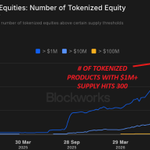
Tokenization is accelerating.
There are now over 360 onchain tokenized equity products, up +200% YTD.
10 of these products have exceeded $100 million in tokenized supply.
As we saw this weekend, demand for 24/7 access to equities is rapidly expanding.
In fact, the majority of volume in these tokenized products, at ~60%, is currently taking place outside of regular market hours.
Today, onchain giant Jupiter, a leader in this space, reported a +215% quarter-over-quarter jump in tokenized equity trade count.
We expect more record highs ahead in this space.

This is unprecedented.
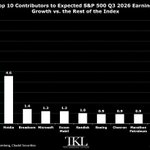
Micron, $MU, and Nvidia, $NVDA are expected to account for 36% of the S&P 500’s earnings growth in Q3 2026 earnings season.
This comes as $MU and $NVDA are expected to contribute +5.2 and +4.6 percentage points to the index’s +27% YoY earnings growth, respectively.
Meanwhile, the next 8 top contributors are projected to add +8.2 percentage points, accounting for ~30% of the estimated S&P 500’s net income growth.
Then, the remaining 490 stocks are set to contribute just +9.2 percentage points, representing 34% of the index’s projected earnings growth.
Excluding those top 10 contributors, earnings growth is estimated to decline -11% YoY in Q3.
Never in history have we witnessed market concentration like this.

BREAKING: The 15 largest S&P 500 stocks now account for a record 46.7% of the index’s market value.
By comparison, during the 2000 Dot-Com Bubble, the 15 largest stocks accounted for 27.2% of the S&P 500.
The remaining 485 stocks represent just 53.3% of the S&P 500’s market cap.
This comes as Nvidia, $NVDA, Apple, $AAPL, Alphabet, $GOOGL, and Microsoft, $MSFT, account for 7.5%, 7.1%, 5.9%, and 5.6%, respectively, or 26.1% combined.
This means just 4 stocks account for more than the next 11 combined.
Furthermore, the combined market cap of the 5 largest stocks now equals that of the bottom 434 stocks in the index, the largest gap on record.
Market concentration is at historic extremes.

BREAKING: Citadel founder Ken Griffin says AI is "almost certainly" a bubble, noting that companies are struggling to turn AI spending into productivity gains.
However, Griffin says he is bullish on AI's long-term potential.

The global debt crisis has never been worse.
Japan now has a gross government Debt-to-GDP ratio of 204.4%, the highest among any major world economy.
Italy follows at 138.4%, while the United States stands at 125.8%, which is only below the ~132.0% record set during the 2020 pandemic.
At the same time, France’s gross government Debt-to-GDP ratio is 118.4%, while Canada’s, China’s, and the UK’s are 110.7%, 106.9%, and 103.6%, respectively.
By comparison, Germany is the only major economy below 100.0%, at 64.6%.
The current average among advanced economies is 108.2%.
The world economy is drowning in debt.

BREAKING: Elon Musk says SpaceX, $SPCX, and Tesla, $TSLA, have formed special committees to discuss a potential merger between the two companies.
"I do think there’s a lot of merit to combining the companies as we are pretty much in the superintelligence singularity, and there’s a lot to be gained from cooperating," Musk said.
"Do I think it would be a good idea? Yes, but at the end of the day, the shareholders have to be supportive of this," Musk said.
BREAKING: Netflix stock, $NFLX, extends losses to over -6% after reporting weaker than expected guidance.
This puts the stock down -52% from its all time high and at its lowest level since August 2024.
Netflix has now lost -$290 billion in market cap since its high.

The US affordability crisis is worsening:
Food prices have surged +34.5% since December 2019, now at their highest level on record.
Rent and grocery prices have risen +33.3% and +30.0%, respectively.
Furthermore, motor vehicle maintenance and repair prices have soared +55.2% over the same period.
Meanwhile, prices for services excluding rent, including medical care, transportation, education, communication, and recreation, have increased +29.2% since December 2019.
As a result, the Consumer Price Index (CPI) has risen +30.4%.
Basic necessities are becoming increasingly unaffordable in the US.

BREAKING: SpaceX stock, $SPCX, rises after reporting stronger than expected Q3 2026 revenue.
The company posted $14.6 billion in quarterly revenue.

BREAKING: Hedge funds sold more global technology stocks in the 5 trading sessions ending October 15th than in any other 5-session period since 2016.
5-day sales were 2.6 standard deviations above the average over the last 12 months.
Over this period, the largest sales were recorded in the US technology sector, with semiconductor stocks accounting for 57% of US tech sales.
Meanwhile, in just 1 week, hedge funds reversed all cumulative purchases of AI stocks since the start of 2025, erasing nearly 2 years of accumulation in this group.
Despite the sales, hedge fund net exposure to global tech stocks remains higher than it has been 90% of the time over the last 5 years.
Hedge funds are reducing their exposure to tech at a record pace.

