


Nvidia's board just voted unanimously to reinstate Jensen Huang as CEO.
A day earlier, Gautam Mukunda - Bloomberg Opinion columnist and Yale School of Management fellow - said this board "made perfect sense for a $40 billion company, but not a $4 trillion company."
> "He's not coming back" (0:42):
- The board's only public line was that Huang wasn't returning. His read: "it doesn't seem like they like what they're hearing" from the investigation
- Today the board says it's "satisfied" with his candor and ability to lead
> Lawyers win either way (1:08):
- "Whatever they find out, it's going to be bad"
- If Huang did nothing wrong, they forced him out for bad reasons. If Nvidia knew about export violations, that's worse. "There's almost no set of facts that somebody isn't going to sue over" (1:41)
> 60 direct reports (2:46):
- A flat company puts all the power in one man's hands. Nobody around him has the stature to say "this is not a good idea"
- "There's not a senior team. There's just Jensen Huang" (3:01)
> The wrong lesson (4:04):
- What Silicon Valley took from this: "the problem here was that he faced consequences for the conduct, not the conduct itself"
- The Valley has "drunk its own bathwater," with CEOs who think they're Napoleon (5:41)
> Pick one (8:17):
- Huang is "the most powerful and articulate advocate" for selling chips to China
- But if AI is so important that Nvidia is worth $3 trillion, "you can't give it all to them. So you gotta pick one" (9:15)
Did the board make the right call, or did it just prove his point?
2
225
Carta CEO Henry Ward - whose customers raised ~$50B from VCs in a single quarter - says a startup that grew from $2M to $20M this year doesn't think it can raise a Series B
"Every morning I wake up and I'm like, I hope Dario doesn't want to go after cap tables."
> Anthropic raised the bar (0:16):
- A $20-50B private software company that lists now lands "in the SaaS apocalypse trade." Go public at $10-20B and you're "the companies the analysts don't want to research"
> Claude is the new operating system (2:04):
- Carta slowed development on Carta.com "in favor of all development inside" Claude desktop. Same shift as going from Windows .exe files to web apps
> Anthropic as the App Store (3:16):
- In that world "Anthropic is the most valuable company in the world for a very very long time." The open question is how much of the economics app makers get to keep
> Why he isn't scared yet (4:43):
- Switching costs are low: "it's very easy for application providers to move harnesses." Push fees too high and developers leave
> The private market crack (7:00):
- Series A is getting harder. 10x growth in a year not being enough for the next round is something he "could not have imagined" two years ago
Smart move, or handing Anthropic the keys to your business?
2
268
Dan Niles - the fund manager who flagged the AI "speed bump" back in June - asks the question Anthropic's IPO didn't answer:
"How are you going to fund 900 billion if you're Anthropic with 54 billion in revenues?"
His bigger point: the AI trade didn't break on chips. It broke at the ballot box.
> Data centers lost the vote (0:09):
- "40 out of 41 ballot initiatives to halt data center construction passed." Governors in Texas, Georgia, Ohio, New Mexico and Michigan flipped on platforms to slow it down.
- "If you don't have anywhere to put the chips, you're not going to buy the chips."
> Growth slows, losses grow (0:46):
- Anthropic + OpenAI combined growth fell from 75% in Q2 to about 48% sequentially in Q3
- Operating losses went up, from $7.9B to $8.4B, because they're cutting prices against each other
> "No clue" (1:47):
- "My view is Anthropic has no clue what they're going to do in revenues."
- Two labs in a duopoly, cutting prices to win share. "That scares me."
> Ferrari vs Ford (2:45):
- "Nobody wants the only choice to be I have to buy a Ferrari to get from point A to point B."
- Most work runs fine on cheap open-weight models. "You and I are not trying to cure cancer."
> OpenAI's bigger problem (4:13):
- Only 10% of OpenAI's user base pays
- "They've made big strides in losing $8 billion." Enterprises pay, consumers don't, so he rates Anthropic as the stronger of the two
Does Anthropic survive a price war with OpenAI, or is this March 2000 again?
3
206
George Noble - former Fidelity fund manager - says Nvidia is "probably the biggest case of industrial espionage/fraud in the history of the U.S. stock market"
And he says there are "tens and hundreds of billions of dollars of chips sitting around in warehouses collecting dust."
> The accusation (0:23):
- He admits "whether it's true or not" is open, but says the market cares more about Jensen Huang leaving than about where the chips went
> Chips to China (0:57):
- "billions and billions of dollars of chips from Nvidia were going to the Chinese, whether directly or indirectly"
- "it's very clear they broke the law" (1:34)
> Mark to myth (2:19):
- The host's point: you can price a used Boeing 737, but nobody can measure what the silicon in data centers is worth. Noble: "I'll take it one step further"
> The warehouse problem (2:50):
- He claims one of Huang's goals was to keep secondary chip prices high so everyone could point to them
- If the loss-making, VC-funded startups stop buying, "they'll be selling by the truckload" on eBay (3:33)
- His comparison: Enron, once "the onion got peeled back" (3:50)
> Nvidia is the heart (5:19):
- Every circular financing diagram has Nvidia right in the middle. "If you have a heart attack, what happens to the corpus?"
Is this the next Enron, or is chip demand still real?
Dario Amodei - CEO of Anthropic, on the day it listed at $83 a share in the biggest IPO in history - just told his new shareholders he will slow AI down if safety demands it
"We will not bend to either business or political pressure."
Wall Street wants growth every quarter. He opened day one by promising to pump the brakes if he has to.
> Why Anthropic exists (0:09):
- Dario and his sister Daniela lost their father to a disease that "just a few years later, became curable"
> A century in a decade (1:32):
- "sufficiently powerful AI working in concert with humans could compress a century of scientific and medical progress into a decade"
> The risks, said out loud (2:36):
- misuse by individuals or nation states, economic disruption, and "losing control of AI systems"
- his take: "we think they are avoidable and we can avoid them"
> The promise to shareholders (3:55):
- "We will pace the training and deployment of AI systems, taking as long as is necessary to have confidence that they are safe"
- the IPO money "only strengthens our resolve to do the right thing"
> Race to the top (4:25):
- "it doesn't matter which company has the best models. Everyone wins because everyone is building safely"
Can a public company actually slow down when the stock price is on the line?
1
183
Mustafa Suleyman - Microsoft AI CEO, DeepMind co-founder - says the last 3 months were "a total watershed moment": AI models are now helping improve their own models
"This is definitely a dangerous capability. I'm really, really nervous about it"
> Models improving models (0:06):
- Microsoft already uses models across its fleet to check for bugs, produce training data and build evaluations. "Increasingly they're fully involved in the process of improving their own models"
> Nobody is being alarmist (0:30):
- "I don't think that folks in the industry are being alarmist. I think this is very serious." His rule: prove a model is safe before it goes into production
> Slower to go faster (1:09):
- Labs only started working out what "pacing the frontier" means in the last 4 to 6 weeks. "It will mean going slower when the time is right"
> Bugs nobody found for decades (2:11):
- Microsoft's cyber models run at 2% of frontier cost. In testing, "the models find vulnerabilities which humans haven't found for years or even decades"
> Against Anthropic on AI welfare (4:03):
- Calls protecting AI welfare "misguided". "They don't have a pain network." The more models hear they might be conscious, the harder they get to contain
> Handoverism (5:46):
- Answering Bill Gurley: handing control of companies or governments to a superintelligence is "insane". If labs can't rule out the downsides, "we have to slow down or stop"
Microsoft's AI chief says slow down. Do you think any lab actually will?
2
189
Bill Gurley - the Benchmark VC who backed Uber early - says Google's free cash flow went up for 25 years, then turned negative the past two. AI capex did that.
His take on the "Bank of Nvidia" deals: "If we're concerned about them going away, then they were juicing revenue. You can't have it both ways."
> The Bank of Nvidia (0:08):
- WSJ is tying Jensen's exit to how aggressive Nvidia's deal terms got
- In Q2, accounts receivable jumped and free cash flow fell. "Consistent with this notion that the terms were getting more and more aggressive"
> Balance sheet vs income statement (1:44):
- "You shouldn't be able to use your balance sheet to drive your income statement"
- And it's not just Nvidia: "Google did it and Amazon did it and Microsoft did it"
> Out of cash, into debt (3:35):
- "We used up all the free cash flow of all the big players. We then started using debt"
- Off-balance-sheet commitments, rising Neocloud debt rates, Nvidia's AR pushed out
> Did we go too far (3:55):
- "Is there a chance that we went to the edge? Sure. There's a lot of data that suggests we probably did"
- The real question is whether it unwinds slowly or fast
> The bull case (4:12):
- Even Gurley calls Anthropic's growth at this size "just miraculous"
- Demand is real. What matters is whether it lines up in time with the money already spent
Nvidia reports this week. Real demand or juiced revenue?
2
170
Box CEO Aaron Levie - whose platform plugs into OpenAI, Anthropic and Google models - says AI agents are splitting software in two, and Microsoft Office isn't on the safe side.
Anthropic just launched Claude Sheets. Microsoft stock fell 2% on the news.
> The dividing line (0:56):
- "If you're a system of record, you should expect that agents are a positive thing for your category." Agents need the data, the guardrails, the permissions.
> Who's exposed (1:35):
- Apps that are just an interface people click. "Your risk grows, because agents are the ones doing a lot more of that work in the future."
> Where Office lands (2:00):
- Claude's new tools compete with the office stack, but "I wouldn't consider Office a system of record."
> Why he wants Claude smarter (4:15):
- "It's ironic. We actually want Claude to get as good at that as humanly possible." His worst case: "progress stops at exactly right now."
> Agent-agnostic (5:12):
- Claude, ChatGPT, Google, Salesforce. "We're somewhat indifferent to where the agents are coming from."
Is the software you pay for a system of record, or just a screen?
2
238
Bradley Tusk - Uber's first political adviser and early investor - says Anthropic's $1.4 trillion IPO is "totally based on promise and potential"
And he thinks the whole AI economy works the same way. A few celebrity CEOs plus a story about the future. "Not profits, not even necessarily revenue."
> Celebrity + potential (0:16):
- "Jensen, Elon, Sam, Dario, and potential... no fundamentals, just what it could be. And that's what a bubble is"
> SpaceX (0:53):
- "There is nothing to justify that valuation whatsoever... I think you'd be crazy to buy SpaceX"
> Circular revenue (2:32):
- Nvidia is a key Anthropic partner, and he says a lot of the revenue investors are counting on is circular, "just kind of passing it from point A to point B"
> The numbers (2:55):
- The valuation was $2.2T a couple of weeks ago, now $1.4T. His most generous estimate is $64B in ARR, and he claims there's "half a trillion dollars in debt" senior to common shares
> Safety vs quarterly targets (3:48):
- Once public, Dario has to hit targets, and the only product is models. He'll "feel more and more pressure from the market to move faster and cut corners"
- "You shouldn't go public until you're actually ready to meet the valuation without putting all of our safety at risk" (5:08)
Would you put money into Anthropic at $1.4T, or is Tusk right?
1
3
211
Andrew Feldman - CEO of Cerebras, one of Nvidia's biggest challengers - says his company refused to sell to China for 7 years.
Now Nvidia's China scandal has cost Jensen Huang his job. Cerebras just beat on every guided metric and the stock ran ~9% during the interview.
> Why they said no (1:30):
- "We did not need to sell our products in China and we held the line." He says that was the policy long before the Commerce rules kicked in
> On Jensen (3:06):
- No victory lap. He calls Jensen "every entrepreneur's idol" and the finest CEO of the last 20 years
> Jensen's own words, late last year (4:39):
- The host plays the clip: "We really need America to go back into the Chinese market"
> The chip leak question (5:20):
- "We know exactly where our systems are." He says tracking tech is built into every system they ship
> The shot at Nvidia (7:38):
- "I think our product is better. What people want right now is speed"
- Ends with "may the best product win"
Is saying no to China a real edge for Cerebras, or just lucky timing?
1
1
218
Cathie Wood, CEO of ARK Invest, just stress-tested Nvidia without Jensen Huang:
GPU share falls from 83% to 38%. Her expected annual return on the stock drops from the 50s to 25%.
And she's still buying.
> The stress test (1:40):
- ARK already modeled share sliding to 49% as Tesla's Terafab, Broadcom and Cerebras catch up
- New "highly conservative" case: 38% share, still ~25% compounded over 5 years
> The Musk factor (3:07):
- ARK recently raised its 5-year share call to ~53% after Musk committed to Nvidia for SpaceX's orbital compute
> Culture score (4:00):
- The first variable in how ARK sizes positions is people, management and culture
- "There might be something about the culture we did not know before"
> "The Jensen show" (5:02):
- His face on every slide, "Jensen's face on all the robots"
- She says there's a strong bench behind him, but the next leader probably won't be "the force"
> Her actual position (6:22):
- ~3.4% in the flagship ARK fund vs 7-8% in the S&P 500 and QQQ, 12% in one benchmark
- Has been adding recently because of the SpaceX deal
Is Nvidia still the AI trade without Jensen, or was the stage show the moat?
2
105
Ruchir Sharma - chairman of Rockefeller International, 25 years running emerging markets at Morgan Stanley - says 70% of all global equity flows this year went into one country.
America. And the whole trade runs on AI.
He studied 300 years of bubbles. Every one popped the same way.
> The only pin (0:24):
- "Every single bubble burst because of one reason, which is when you end up getting higher interest rates."
- He says this one "meets all the characteristics of a bubble."
> The market now drives the economy (1:40):
- Stock gains feed consumer spending, capex feeds profits, profits feed stocks. "It's all sort of circular."
- "Now the stock market may be the one driving the economy."
> The whole world is long America (2:45):
- 70% of flows is twice the long-term average. "I don't know of any time when a single country has attracted this much capital."
- "If the bubble burst in the U.S., the whole world will be paying the price for it."
> The math nobody talks about (4:08):
- A 25% drop in US stocks cuts American consumer spending by at least 2%.
- Retail money in Korea, Taiwan, Germany, the UK and Japan is heavily exposed too.
> The Fed (8:05):
- Expects a 25 bp hike in early December, sees a case for 50. "Then I do feel that this AI bubble will be at even greater risk."
- AI is "undoubtedly the greatest technology that we have ever seen", but the buildout now competes with a massive government deficit for capital.
Rates are going up and AI is still the whole market. Who blinks first, the Fed or the AI trade?
Kai-Fu Lee - former president of Google China - says CEOs are "already installing" Chinese AI models that cost "like 5%" of what Anthropic and OpenAI charge
And on Anthropic's IPO he asks: "Is it worth 1 to 2 Trillion? How do you justify it?"
> The Model Doesn't Matter (0:09):
- CEOs "used to ask which model. Now they realize it doesn't matter." He says the top models "are all roughly equal," open source included.
> Keep Your Data Home (0:20):
- Their biggest worry now is the labs seeing their data. Even with no leak, "our competitors will gain the advantage of our playbook." He tells them to run a free open model on their own servers, so there are "no more token fees to be paid to Anthropic or OpenAI."
> Cheaper And Good Enough (1:35):
- Asked if CEOs are trying Chinese models, he says "they're already installing it," because "it's cheaper and good enough." Used online, they cost "like 5%" of the top US models.
> Circular Funding (3:02):
- He calls AI "absolutely not a bubble." What worries him is money moving from "company A to B to C to back to A" and whether the valuations it creates are justified. The other risk is models "almost as good at 95% off."
> 1 To 2 Trillion (6:03):
- He calls Anthropic "a phenomenal growth machine," but asks how next year's planned spending can justify that price. He is "not compelled to buy" and "not compelled to sell."
If the top models are all roughly equal, what is a $2 Trillion valuation paying for?
2
167
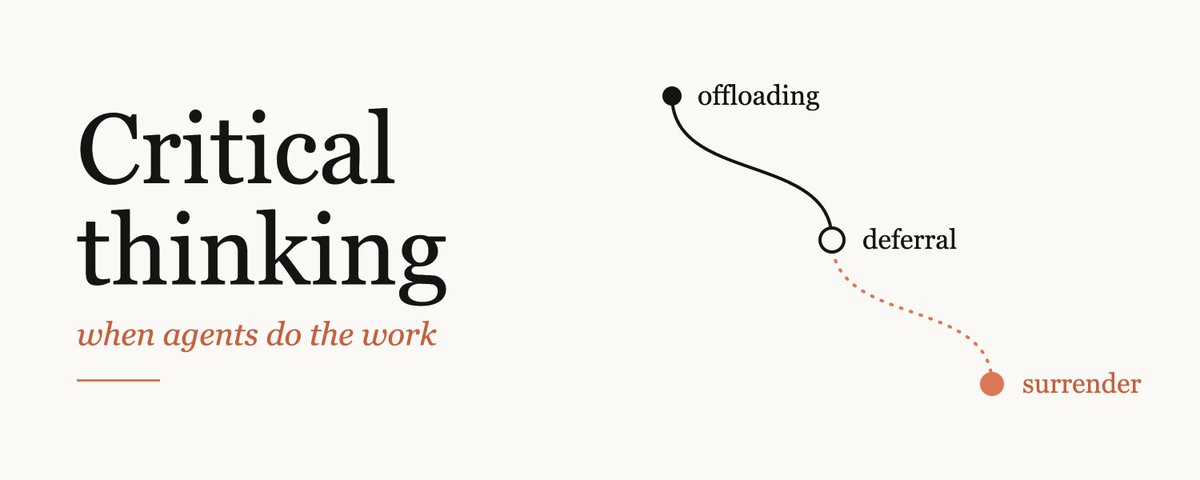
ADDY OSMANI WORKS ON CLAUDE CODE. HIS NEW ARTICLE IS ABOUT WHAT AGENTS DO TO YOUR THINKING
2.8M views in under 2 days. 32K bookmarks vs 13K likes. people are keeping this one.
he describes a slide most of us are already on:
offloading → you delegate, the answer is still yours
deferral → you lean on the model
surrender → its output quietly becomes yours and you stop checking
nobody notices the last step. the code looks clean. nobody on the team can explain it.
the checks he runs so he doesn't end up there:
01 / write down what you expect before you ask
02 / ask what would make this wrong, then go test it
03 / a green check proves one thing. ask what it skipped
04 / make the agent list every decision it made for you
05 / once a week, build something without it
the agent writes it. your name is still on it.
which one are you skipping?

2
72
EVERYONE'S ASKING CLAUDE CODE TO TURN THEIR WIFI ROUTER INTO A RADAR. THE GHOST IS FAKE. THE RADAR ISN'T.
this week the same story went viral from different accounts. someone asks Claude Code to turn a router into a radar, opens the map at 1 a.m. and sees a shape standing by the bed. they live alone.
the shape is made up. the radar isn't.
here's what's real:
1. in 2018 an MIT team used WiFi to see people in another room and turned their movement into walking stick figures.
2. in early 2023 Carnegie Mellon published DensePose from WiFi. a neural network reads the phase and amplitude of the signal and maps it onto 24 regions of the body. three ~$30 routers, three receivers. it worked through a wall.
3. the IEEE wrote a whole amendment for this, 802.11bf. WiFi for sensing, not just for internet.
4. there's an open source project, RuView, that runs it on ESP32 boards at ~$9 each. a 3-6 board kit is about $54. presence, breathing, movement, no camera.
here's what the viral posts skip:
your normal router can't do this on its own. consumer WiFi doesn't expose the raw signal data. you need ESP32 boards or a research network card.
body pose isn't plug and play. you train a model on your own room first.
and it's not magic. the CMU model already struggles once there are 3+ people in the room.
so no, nothing is pacing around your bed at 1 a.m.
but a $54 kit and one weekend can tell when someone walks into a room. through a wall. without a camera.
that's the part worth being creeped out by.
send this to the friend who reposted the ghost one.
3
190
ADDY OSMANI WORKS ON CLAUDE CODE. HIS NEW ARTICLE IS ABOUT WHAT AGENTS DO TO YOUR THINKING
2.8M views in under 2 days. 32K bookmarks vs 13K likes. people are keeping this one.
he describes a slide most of us are already on:
offloading → you delegate, the answer is still yours
deferral → you lean on the model
surrender → its output quietly becomes yours and you stop checking
nobody notices the last step. the code looks clean. nobody on the team can explain it.
the checks he runs so he doesn't end up there:
01 / write down what you expect before you ask
02 / ask what would make this wrong, then go test it
03 / a green check proves one thing. ask what it skipped
04 / make the agent list every decision it made for you
05 / once a week, build something without it
the agent writes it. your name is still on it.
which one are you skipping?
1
72
a mantis shrimp punches at 23 m/s from a standing start. i had Claude rebuild that punch as a machine you can take apart.
the build:
> the arm is a real spring-latch: an 11-turn coil and a saddle-shaped spring load up, a latch holds, then lets go
> the strike plays at 1/1000 speed, so 2.7 ms becomes 2.7 seconds and the club hits 23 m/s at over 10,000 g
> every panel reads one model, so the speed chart, the force trace and the arm schematic never disagree
> the load cell catches 2 hits: 1,501 N from the club, then 504 N when the bubble collapses about 0.4 ms later
> the eyes come apart into 2,562 facets and a 6-row midband
> 3,543 parts explode on a turntable and snap back before the turn ends
the numbers on the panels come from Sheila Patek's papers on the peacock mantis shrimp, not from the model's imagination.
the method and all 9 prompts are in the article below. which animal should it take apart next?


1
86
this is f*cking gold... someone wrote the trust manual for Grok Bot agents
Most people's first Bot gets "handle my business" as its job. a week later they're babysitting it
The fix is boring: one small job you can check in a minute, a clear finish line, and anything risky waits for your yes
6 jobs I'd hand a Bot first, and the exact line I'd give it:
→ Morning brief: "Every day at 7am, find the 5 biggest AI agent launches from the last 24h. no duplicates, a source on every line"
→ Competitors: "Every Friday, list the top 5 pricing and product changes from these 4 rivals. date and link for each"
→ Research: "Find 10 sources from the last 90 days. author, date, URL and the claim each one backs"
→ Leads: "Research 40 accounts, pick the best 10, draft the messages. send nothing"
→ New workflow: "Watch me do this once and turn it into a numbered routine. don't automate it yet"
→ Weekly check: "Every Monday tell me how many runs passed, how many I fixed by hand, and what keeps breaking"
Add one rule first: send, publish, buy and delete always wait for me
Give it the morning brief line tonight
The full setup, Chief + Research + Builder + Reviewer, is in the article below ↓

Grok Bot could be the operating layer AI agents have been missing.
It can use tools, run routines and coordinate other agents with minimal supervision.
In this article, I show you how.

1
73
A 23-YEAR-OLD GUY JUST MADE $13,600 FROM THE ONDO PROMO WITH MAC MINIS AND A GROK BOT, WHILE HE WAS ASLEEP.
The Mac minis sit stacked in his spare room, and the Grok bot runs all of it.
The bot tracks the campaign, handles every task, and farms the rewards 24/7. He doesn't touch it at all.
Electricity costs barely register. The hardware paid for itself in a few weeks.
He goes to sleep, and when he wakes up the money is already there.
You, too, can do this right now by fulfilling a few simple requirements.
here's the whole thing:
01 / sign up with a referral code (mine is in the reply)
02 / deposit $500 and don't withdraw until nov 11
03 / trade $2,000 in volume, spot or perps both count
04 / wait. rewards are paid in USDC after the campaign ends
$2k volume is two round trips on a $500 account.
the rule people will break: a withdrawal that takes your net deposit under $500 kills the reward. trading losses don't count, only withdrawals.
if you bring people yourself it gets better:
1-5 traders → $20 each
6-20 → $40 each
21+ → $60 each
and it's retroactive. your 6th referral turns $100 into $240. your 21st turns $800 into $1,260.
runs oct 28 to nov 11. not available in the US.
who's running this one?
1
1
42
Registration
app.ondoperps.xyz/?ref=VEQZB…

24